Key takeaways
- Counter stool: roughly 24–27 inches from floor to seat.
- Bar stool: roughly 28–31 inches from floor to seat.
- Extra-tall stool: often 33–36 inches, intended for specialized counters rather than ordinary patio bars.
The best outdoor bar stools for most patios are powder-coated aluminum models with quick-drying sling or synthetic-wicker seats, while teak is the better choice when natural appearance and long-term repairability matter more than low weight or easy stacking.
Our top picks


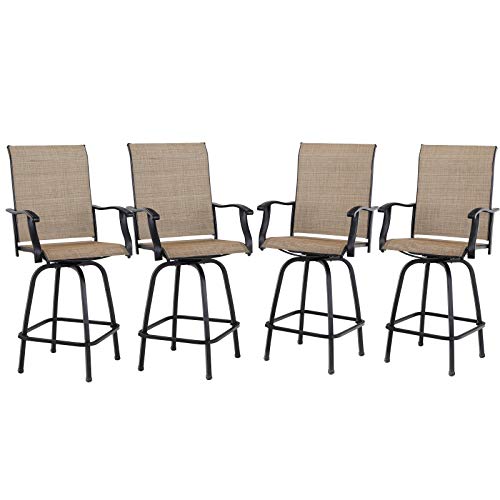
As an Amazon Associate we earn from qualifying purchases at no extra cost to you. Ratings are shown as listed on Amazon.
Quick answer: which outdoor stool should you buy?
| Your priority | Best material or design | Why it fits | Main compromise |
|---|---|---|---|
| Lowest maintenance | Powder-coated aluminum with textilene or a quick-dry cushion | Does not rust, is light to move, and dries quickly | Can feel less substantial in wind |
| Natural appearance | Grade A teak | Dense hardwood, stable outdoors, and repairable | Heavy and needs periodic cleaning |
| Soft, woven appearance | HDPE synthetic wicker over aluminum | Comfortable-looking and weather-resistant when properly made | Cheap fibers can fade or split |
| Small patio or frequent storage | Stackable aluminum or resin-composite stool | Several stools occupy one compact footprint | Stacking frames can have firmer seats |
| Exposed, windy location | Heavier teak or weighted aluminum frame | Less likely to shift or tip | More difficult to carry |
Counter height vs. bar height
Height is the first decision because the wrong stool can make an otherwise attractive outdoor kitchen uncomfortable. Counter stools generally suit surfaces about 34–36 inches high, while bar stools suit surfaces about 40–42 inches high.
Measure from the finished floor to the top of the counter or bar, then subtract about 9–12 inches for legroom. That gives the approximate seat height you need:
- Counter stool: roughly 24–27 inches from floor to seat.
- Bar stool: roughly 28–31 inches from floor to seat.
- Extra-tall stool: often 33–36 inches, intended for specialized counters rather than ordinary patio bars.
For example, if an outdoor counter is 36 inches high, a 25–27-inch seat leaves 9–11 inches between the cushion and countertop. A 30-inch bar stool would leave only 6 inches, forcing your knees upward and making meals uncomfortable.
Allow at least 24 inches of horizontal space per person. A 72-inch counter therefore fits three stools comfortably, but only two if the stools have wide arms or a seat broader than about 22 inches. Leave roughly 12 inches behind the stool when possible so people can pull it out without blocking a walkway.
Material head-to-head: aluminum, teak, and wicker
Powder-coated aluminum: best all-rounder
Aluminum is usually the safest recommendation for a patio that needs light, low-maintenance furniture. It does not rust like untreated steel, and a properly applied powder coat protects the surface from moisture and everyday abrasion. It is also easy to carry indoors before storms.
Look for welded joints, stainless-steel or aluminum fasteners, drainage holes, and a finish described as UV-resistant. A hollow frame is convenient but can move in strong wind. For a breezy balcony, choose a wider base, heavier-gauge frame, or a design with a low center of gravity.
Aluminum is often the easiest material to stack. Four armless stools may stack into a column around 4–6 feet high, depending on frame geometry. Armrests, curved backs, and thick cushions can prevent close stacking, so “stackable” should mean that the actual number you need can be stacked safely—not merely that two units nest together.
Teak: best for warmth and longevity
Outdoor-grade teak contains naturally durable oils and performs well in rain, humidity, and sunlight. New teak starts golden-brown and gradually turns silver-gray if left unfinished. That color change is normal and does not mean the wood has failed.
Teak is more stable and weather-tolerant than many less-durable woods, but it still benefits from airflow. Do not wrap damp teak tightly in plastic, and avoid leaving the legs standing in pooled water. Clean with mild soap and a soft brush; aggressive pressure washing can damage the grain.
Teak stools are typically heavier than aluminum and are less likely to blow over, but they are rarely the best option for frequent stacking. Look for mortise-and-tenon or robust outdoor joinery, stainless-steel hardware, and feet that can be replaced. Teak can be sanded and repaired, giving it an advantage over woven surfaces that have begun to unravel.
HDPE synthetic wicker: best for a woven look
Outdoor wicker is not a single material. Traditional natural wicker is vulnerable to persistent moisture and is generally unsuitable for fully exposed patios. The weather-resistant option is usually synthetic wicker made from high-density polyethylene, wrapped around an aluminum frame.
HDPE fibers can resist rain and ultraviolet exposure better than inexpensive PVC-look alternatives, but quality still varies. Inspect the weave for consistent tension, a fully covered frame, and smooth edges where the fibers meet. A broken strand can gradually loosen nearby strands, so avoid dragging the stool across rough concrete.
Wicker stools are comfortable and visually softer than bare metal, but the weave can make stacking awkward. They also take longer to dry after rain, especially when the seat includes a thick cushion. Choose removable, zippered cushions with solution-dyed outdoor fabric and quick-dry foam if the stools will remain outside.
Weather resistance beyond the frame
A rustproof frame does not automatically make a stool weatherproof. The vulnerable parts are often the hardware, foot glides, seat webbing, cushion filling, and joints where water collects.
- Fasteners: stainless steel or corrosion-resistant coated hardware is preferable, especially near salt air.
- Seat material: solution-dyed acrylic, polyester sling, or HDPE woven fiber generally handles outdoor use better than ordinary indoor fabric.
- Foam: quick-dry foam drains faster than standard upholstery foam, which can remain damp and develop odors.
- Feet: replaceable nylon or rubber glides protect both the frame and the patio surface.
- Drainage: slatted seats, mesh, and perforated surfaces dry faster than solid upholstered seats.
Near the coast, rinse salt deposits with fresh water every few weeks and dry the hardware. In a snowy climate, store cushions indoors and avoid trapping moisture under a cover. A breathable furniture cover is useful for dust and pollen, but it should not be sealed around wet furniture.
Stackability and storage: calculate the real footprint
Stackability matters most when the stools must share a shed, narrow balcony, or garage corner. Compare the stored height rather than relying on the label.
Suppose each stool is 30 inches tall and the first stool contributes 30 inches while each additional stool adds 5 inches. Four stools occupy approximately 45 inches vertically: 30 + (3 × 5) = 45 inches. If the frame adds 8 inches per stool instead, the same set needs 54 inches. That difference can determine whether the stack fits beneath a 48-inch shelf.
| Typical design | Approximate seat height | Typical seat width | Storage behavior | Best use |
|---|---|---|---|---|
| Armless aluminum counter stool | 24–27 in | 16–20 in | Often stacks 4–8 high | Compact counters and frequent storage |
| Aluminum bar stool with back | 28–31 in | 18–22 in | Often stacks 3–6 high | Outdoor bars and kitchens |
| Teak stool with back | 24–31 in | 18–23 in | Usually limited stacking | Permanent, design-focused seating |
| Wicker stool with cushion | 24–31 in | 18–24 in | Often 2–4 high | Covered patios and comfort |
A practical buying checklist
- Measure the counter. Confirm whether it needs counter or bar height, then check the actual seat-height range.
- Measure the user space. Divide the available counter length by 24 inches, then reduce the result if the stools have arms or unusually wide backs.
- Check the exposed conditions. Choose heavier construction for wind, corrosion-resistant hardware for salt air, and quick-drying upholstery for frequent rain.
- Confirm the storage plan. Verify the number of stools that stack and calculate the final stack height.
- Inspect the replacement parts. Replaceable glides, cushions, and woven sections can extend useful life more than a slightly thicker finish.
- Match the maintenance you will actually do. Aluminum is forgiving; teak needs cleaning and occasional care; wicker needs prompt attention when strands loosen.
Final verdict
For the broadest range of patios, choose stackable powder-coated aluminum at the correct counter or bar height, preferably with a ventilated seat and corrosion-resistant hardware. Choose teak when weight, natural grain, and long-term repairability matter most. Choose HDPE wicker over an aluminum frame when appearance and cushioning are priorities, but keep it under cover or use quick-drying components in wet climates.
The best outdoor bar stools are not necessarily the most expensive ones. They are the stools whose seat height matches the counter, whose materials match the weather, and whose storage footprint fits the space you actually have.