Key takeaways
- Players: 2 to 4
- Age guidance: 8 and up
- Format: Board game with dice, cards, currency and tokens
- Ruleset: Classic property-trading structure, Pokémon theming
- Typical session: commonly 60 to 120 minutes; shorter if the table agrees to a round limit or a time cap before starting
- Table space: the board sits in the 19-inch square class, so plan roughly 30 x 30 inches once you add card stacks, currency trays and dice
If you want the single best answer for 2026: Pokémon Battle Academy is the best overall pick for most readers, because it is the only item in this roundup that teaches an actual competitive rule system, plays cleanly with two people of different experience levels, and keeps working after the novelty of the artwork wears off. It suits families with one Pokémon-obsessed player and one patient adult, and it suits adults who bounced off the full trading card game because nobody ever explained the turn structure. If you specifically want a fan-made digital project rather than a licensed product, the best route is a community ROM hack patched onto a base game you legally own and run through a well-maintained emulator — the digital half of this guide covers that in detail. Best budget pick: the Buffalo Games Pokémon Fan Favorites 300-piece puzzle. Best premium pick: Ravensburger’s Pokémon Labyrinth, the most genuinely replayable strategy game here.
This guide compares ten currently available Pokémon tabletop, puzzle and collectible products by format, session length, standout mechanics, setup and safety, and how each one holds up across repeat plays — plus a full breakdown of the fan-game scene, its legal status, and how to install a patch without picking up something unpleasant.
Top 3 Picks
Best overall: Pokémon Battle Academy
Battle Academy is the pick that converts curiosity into actual play. It ships as a self-contained, learn-as-you-go card game package rather than a board game, which means the rules scale from “first ever game” to “real deck construction” without you buying anything else. It is the strongest choice for a household where one person already understands the Pokémon TCG and everyone else does not.
Best budget: Buffalo Games Pokémon Fan Favorites 300-Piece Puzzle
At the lowest price tier in this list, the 300-piece Fan Favorites puzzle delivers the best ratio of hours-entertained to money-spent for adults and teens. It is small enough to finish across two or three relaxed evenings, big enough to feel like a project, and it stores flat in a box roughly the size of a hardback book.
Best premium: Ravensburger Labyrinth Pokémon
Labyrinth’s shifting-maze mechanic has been in print for decades for a reason: it is simple to teach, genuinely tactical, and different every single game. The Pokémon edition wraps that proven engine in franchise art, making it the premium pick for families who want a game that survives the twentieth play, not just the first.
Quick Comparison
| Product | Best for | Key specs | Price tier |
|---|---|---|---|
| Monopoly Pokémon Edition | Family game night with a ruleset everyone already knows | 2–4 players; ages 8+; classic property-trading rules with Pokémon theming; long sessions | Mid-range |
| Buffalo Games Pokémon Fan Favorites, 100-Piece Puzzle | Young children’s first real puzzle | 100 pieces; ages 6+; large-format pieces; single-sitting build | Budget |
| Buffalo Games Pokémon Fan Favorites, 300-Piece Puzzle | Adults and teens wanting a short solo project | 300 pieces; standard adult piece size; 2–4 evening build | Budget |
| Ravensburger Labyrinth Pokémon | Replayable family strategy nights | Family strategy game; shifting-maze mechanic; 2–4 players; 20–40 minute rounds typical of the line | Premium |
| Ravensburger Pokémon Mini Memory | Players aged 3+ and mixed-age groups | 2–6 players; ages 3+; matching pairs; rounds of a few minutes | Budget |
| Funko POP! Games: Pokémon — Gengar | Display, gifting, desk shelf presence | Vinyl figure; standard POP footprint of roughly 3.75 in tall; window-box packaging | Budget |
| Buffalo Games Pokémon Legendary Pokémon, 1000-Piece Puzzle | Long solo builds and rainy-weekend projects | 1000 pieces; adult difficulty; multi-week build; large table footprint | Mid-range |
| Pokémon Battle Academy | Learning the real Pokémon TCG from zero | Two-player head-to-head card game; guided first-game walkthrough; expands into standard TCG play | Premium |
| Guess Who? Pokémon Edition | Fast two-player rounds and travel | 2 players; 48 Pokémon; roughly 15-minute rounds; portable format | Mid-range |
| Jazwares Pokémon Characters 8 Pack | Imaginative play and shelf collecting | 8 figures: Garchomp, Pikachu, Eevee, Lucario, Riolu, Munchlax, Glaceon, Leafeon; display-scale sculpts | Premium |
Two things stand out in that table. First, the price tiers do not track with how long a product stays in rotation — the cheapest puzzle here can outlast the most expensive board game if your group prefers quiet solo time to table talk. Second, “premium” in this category buys component quality and design depth, not volume; a premium puzzle or figure set is not automatically a better buy than a budget one.
How We Chose
Selection was based on documented product information, published category norms and the design lineage of each game system, not on hands-on use. Four criteria carried the most weight. Format fit: does the product match a real play pattern — solo, two-player, four-player, or display-only — rather than a hypothetical one? Rule depth and replay value: games with a proven engine that has stayed in print across multiple editions were favoured over titles that lean entirely on artwork. Age and complexity floor: we checked the stated age guidance and player counts against what the mechanics actually demand, because a 6+ label on a puzzle and a 6+ label on a competitive card game mean very different things. Upgrade path: does the product lead somewhere, either into the wider Pokémon TCG, into harder puzzles, or into a collection that keeps its appeal? Products that dead-end after one session scored lower. Price tier was treated as a category label, not a ranking — budget items win on value, premium items win on longevity, and both can be the right answer for different households.
1. Monopoly Pokémon Edition – Best for family game night with a familiar ruleset
As an Amazon Associate we earn from qualifying purchases at no extra cost to you.

Monopoly Pokémon Edition is for the household that already knows how Monopoly works and does not want to teach a new rulebook at 8pm on a Friday. The property-trading loop, the rent escalation, the jail mechanic and the bankruptcy endgame are all intact; the theme replaces street names with locations and characters from the Pokémon world, and the tokens and card art carry the franchise styling. If your group has played Monopoly before, the teach takes about ninety seconds.
Who it suits
It fits groups of two to four players aged eight and up who are comfortable with a game that runs long. It is a strong pick for multi-generational tables, because the adults usually know the rules and the kids usually know the Pokémon, so everyone has a lane. It is a poor fit for anyone hoping for a 20-minute filler, and a poor fit for a two-player-only household that dislikes negotiation, since Monopoly at two players is a very different and much more mechanical experience than it is at four.
Key specs
- Players: 2 to 4
- Age guidance: 8 and up
- Format: Board game with dice, cards, currency and tokens
- Ruleset: Classic property-trading structure, Pokémon theming
- Typical session: commonly 60 to 120 minutes; shorter if the table agrees to a round limit or a time cap before starting
- Table space: the board sits in the 19-inch square class, so plan roughly 30 x 30 inches once you add card stacks, currency trays and dice
Strengths
The biggest strength is social friction, in the good sense. Monopoly’s mechanics force trades, refusals and grudges, and that is exactly the texture that makes a family game night memorable. The Pokémon skin lowers the barrier for younger players who would otherwise tune out a generic property board. Component-wise, the licensed edition uses the same board stock, card weight and moulded tokens as the standard line, so it does not feel like a cheap reskin in the hand.
It is also unusually good at handling uneven player counts. At three players, the negotiation gets sharper because every trade has an obvious third-party consequence. At four, alliances form and break. The game scales by social pressure rather than by rules changes, which means no one has to re-read a rulebook when a fifth person leaves the room.
Pros
- Zero learning curve for anyone who has played Monopoly before
- Strong theming that keeps younger players engaged through a long session
- Scales socially from two to four players without rule changes
- Standard Monopoly component quality rather than thin licensed-board stock
- Enormous house-rule ecosystem if your group wants shorter games
Cons
- Session length is genuinely long; 90 minutes is normal, not worst case
- Player elimination means someone can sit out the last third of the game
- Luck-heavy dice loop frustrates groups that prefer skill expression
- Requires meaningful table space and a place to leave it set up
- Two-player games become a grind rather than a negotiation
How it compares with the nearest alternative
The nearest alternative in this list is Pokémon Battle Academy. Both are premium-feeling licensed products aimed at families, but they solve opposite problems. Monopoly is the right choice when your group wants a long, loud, socially driven evening with rules nobody has to learn. Battle Academy is the right choice when your group wants to learn a real competitive system and improve at it over time. If your table argues about luck versus skill, take Battle Academy. If your table argues about who cheated on the rent, take Monopoly. A household that buys both has one game for parties and one game for practice, and they will not compete for the same evenings.
2. Buffalo Games Pokémon Fan Favorites, 100-Piece Jigsaw Puzzle – Best for young children’s first puzzle

The 100-piece Fan Favorites puzzle is the entry point in this roundup, and it is deliberately designed to be finished in one sitting. Buffalo Games labels it for ages six and up, which is realistic: 100 pieces is enough to feel like a real achievement without the multi-evening commitment that makes younger kids lose interest and wander off. The artwork pulls together a spread of well-known Pokémon, which matters more than it sounds — a child who can name every character in the picture has a reason to keep going when the sky section gets tedious.
Who it suits
It suits children aged six to nine, and it suits the specific situation of a child who has outgrown chunky wooden puzzles but is not ready for a 300-piece adult build. It also works well as a shared activity between a child and a parent, because the piece count is low enough that an adult can guide without taking over. It is not the right pick for a teenager or an adult building alone — they will finish it in under an hour and never open the box again.
Key specs
- Pieces: 100
- Age guidance: 6 and up
- Piece format: larger-than-adult pieces typical of the children’s range, which are easier for smaller hands to grip and rotate
- Typical build time: roughly 1 to 2 hours for a six-year-old, well under an hour for an adult
- Table space: fits comfortably on a coffee table or a cleared dining table corner
- Storage: box footprint comparable to a large hardback book
Strengths
The piece count is the feature, not a limitation. A 100-piece puzzle has a completion horizon short enough that a child can hold the whole goal in their head, which is the single biggest predictor of whether they come back to a second puzzle. The larger piece format reduces the fine-motor frustration that kills interest in the six-to-eight age band, and the illustrated scene gives natural sorting cues — by colour block, by character, by background — so a child can develop an actual strategy rather than just trying random pieces.
Buffalo Games is a long-established puzzle publisher, and its children’s line uses the same die-cut consistency as its adult range. That means edges line up cleanly, which sounds trivial until you have built a cheap puzzle where three pieces fit in the same slot and the picture never quite resolves. The brand’s catalogue also gives you a natural upgrade ladder: the same Fan Favorites artwork exists in higher piece counts, so a child who finishes this one can move up without changing theme.
Pros
- Completable in a single sitting, which suits short attention spans
- Larger pieces are easier for six-to-eight-year-old hands
- Recognisable character artwork provides built-in sorting cues
- Consistent die-cutting from an established puzzle publisher
- Lowest price tier in this roundup
Cons
- Almost no replay value once the child has memorised the picture
- Too easy for anyone over about ten
- Loose pieces are easy to lose without a bag or tray
- Single-player activity unless an adult joins in
- Cardboard pieces can delaminate if they get wet or are forced
How it compares with the nearest alternative
The nearest alternative is the Buffalo Games Pokémon Fan Favorites 300-piece puzzle, from the same publisher and the same artwork family. The difference is purely a step on the difficulty ladder: 100 pieces for a first solo build, 300 for a child who has finished two or three and wants something that takes more than one evening. If you are buying for a six-year-old, buy the 100. If you are buying for a nine-year-old, skip straight to the 300 — a child who finishes a 100-piece puzzle in forty minutes will treat the smaller box as a toy they have outgrown. The 300-piece is also the better buy if two children will share it, because the longer build gives both of them something to do.
3. Buffalo Games Pokémon Fan Favorites, 300-Piece Jigsaw Puzzle – Best budget pick for adults and teens

The 300-piece Fan Favorites puzzle is the value sweet spot of this entire list. It is priced in the budget tier, it uses the standard adult piece size rather than the oversized children’s cut, and it lands in the rare middle ground where the build lasts long enough to be satisfying but short enough that you can finish it across two or three evenings without the box dominating your living room for a fortnight. Buffalo Games markets it as a puzzle for adults, and the piece format supports that claim.
Who it suits
It suits adults and teenagers who want a low-stakes, screen-free activity that fits into a normal weeknight. It suits couples who want something to do side by side without needing to talk continuously. It also suits older children who have already completed several 100-piece puzzles and are ready for a genuine step up. It is not the right pick for a dedicated puzzler who wants a project measured in weeks — that is what the 1000-piece entry further down this list is for.
Key specs
- Pieces: 300
- Audience: adult-oriented cut and difficulty
- Piece format: standard adult piece size, noticeably smaller than the 100-piece children’s range
- Typical build time: roughly 6 to 10 hours solo; faster with two people working the same picture
- Session structure: comfortably split into three 2-to-3-hour sittings
- Table space: needs roughly half a dining table while in progress
Strengths
Here is the arithmetic that makes this the budget pick. A 300-piece puzzle built at a relaxed 40 pieces per hour takes about 7.5 hours of entertainment. Split that across a household of two, and you get roughly 15 person-hours from one box in the lowest price tier. Compare that with a board game that runs 60 minutes and needs three other people to be available, and the puzzle’s cost-per-hour is dramatically better — provided you actually enjoy the activity, which is the only condition that matters.
The 300-piece count also hits a psychological sweet spot. It is large enough that the picture does not resolve immediately, so there is a real middle phase where you are working off shape and colour rather than the box lid. It is small enough that you never hit the despair phase that a 1000-piece build produces when you are staring at 400 near-identical blue pieces. For most casual puzzlers, the 300-to-500 range is where the hobby is most fun, and this sits at the bottom of that band.
Component quality is consistent with the rest of the Buffalo Games line: clean die-cuts, a linen-style surface finish that reduces glare under a lamp, and a box sturdy enough to store the puzzle flat between sessions.
Pros
- Best cost-per-hour ratio in this roundup
- Standard adult piece size, so it does not feel like a children’s product
- Completable across two or three evenings without monopolising a table for weeks
- Works solo or with a partner
- Low-glare surface finish helps under direct lamp light
Cons
- Limited replay value; most people build it once
- Too easy for experienced puzzlers who want a real challenge
- No box insert or sorting trays included in the budget tier
- Needs a flat surface you can leave undisturbed mid-build
- Piece count is too high for children under about eight
How it compares with the nearest alternative
The nearest alternative is the Buffalo Games Pokémon Legendary Pokémon 1000-piece puzzle. Same publisher, same category, roughly three times the piece count and a step up in price tier. The 300-piece wins on accessibility: it fits a normal weeknight, it fits a smaller table, and it is the better gift for someone whose interest in puzzles is casual. The 1000-piece wins on depth — the Legendary Pokémon artwork has more distinct regions and the sheer piece count creates a build that genuinely occupies a fortnight of evenings. A useful rule: if the recipient has finished a puzzle in the last year, buy the 300. If they have a dedicated puzzle table and a roll-up mat, buy the 1000.
4. Ravensburger Labyrinth Pokémon – Best premium pick for replayable strategy nights

Ravensburger Labyrinth is the one product in this roundup with a genuinely deep mechanical spine, and the Pokémon edition applies that spine to franchise artwork. The core idea is that the board is a grid of tiles, one tile is always loose, and on your turn you slide that loose tile into the board from one of the edges — which shifts every row or column behind it and changes the routes for everyone. You then move your piece along the newly formed paths to reach your current objective. Because the maze changes on every single turn, no two games play the same way, and no one can memorise a winning route.
Who it suits
It suits families with children aged around seven and up who can handle a rule set with two moving parts — slide a tile, then move. It suits adult groups who want a light strategy game that still rewards planning, and it is one of the better options here for a two-player evening because the shifting board creates direct interference: you can deliberately slide a tile to cut off your opponent’s route. It is not a party game, and it is not a good fit for a player who dislikes spatial reasoning.
Key specs
- Players: 2 to 4, in the standard format of the Labyrinth line
- Mechanic: shifting-tile maze; insert a loose tile each turn, then move
- Objective: collect a sequence of themed targets and return to the start
- Typical session: roughly 20 to 40 minutes per game in the line’s usual range, depending on player count and how much the table negotiates
- Replay value: very high; board layout is randomised by play, not by a fixed setup
- Components: thick board tiles, moulded playing pieces, illustrated card stock
Strengths
The reason Labyrinth has stayed in print for decades is that it solves the two problems that kill family board games: teachability and repetition. The teach is short because there is only one unusual rule, and once a player has slid a tile once, they understand it. The repetition problem is solved structurally, because the board state is never the same twice. That combination is rare, and it is why this is the premium pick rather than a licensed reskin of something thinner.
There is also real tactical depth hiding under the simple rules. Because the loose tile is visible to everyone, experienced players plan two turns ahead: they position so that whichever tile gets inserted, they still have a route. Skilled play involves deliberately blocking opponents by inserting a tile that seals the only path to their target. In a four-player game, that creates shifting alliances and short-term cooperation, which is exactly what keeps a family game on the shelf instead of in the donation pile.
Component quality is what you would expect at the premium tier. Ravensburger’s board tiles are thick and hold up to repeated insertion and removal, which matters because the central mechanic is literally sliding cardboard in and out of a channel hundreds of times. Cheap versions of this design wear out at the seams. The Pokémon edition uses the same construction standard as the classic line.
Pros
- Proven mechanic with decades of published history behind it
- Board state changes every turn, so games never repeat
- Two-minute teach for anyone who has played a board game before
- Directly interactive at two players; you can block and counter-block
- Premium tile construction built for repeated tile insertion
Cons
- Highest price tier of the board games here
- Luck of the draw on target order can decide close games
- Players who struggle with spatial reasoning will find it frustrating
- Four-player games can slow down as everyone plans
- Needs a flat table; tiles do not survive play on a soft surface
How it compares with the nearest alternative
The nearest alternative is Monopoly Pokémon Edition. Both are licensed family board games in a mid-to-premium price band, but they occupy opposite ends of the design spectrum. Monopoly is long, social, luck-driven and rules-familiar; Labyrinth is short, tactical, spatial and needs a genuine teach. If your group’s complaint about game night is “we never finish anything,” Labyrinth fixes it. If your group’s complaint is “we want something everyone already knows how to play,” Monopoly is the safer purchase. For a household buying one premium game, Labyrinth is the better long-term investment purely because it will still surprise you on the twentieth play, whereas Monopoly’s outcome space is largely exhausted after five.
5. Ravensburger Pokémon Mini Memory Game – Best for players aged 3 and up

The Pokémon Mini Memory Game is the youngest-player entry in this roundup, and it earns its place by being honest about what it is: a matching-pairs game with a small footprint, a low price tier, and a player range of two to six. The mechanic is the oldest one in the hobby — turn two tiles face up, keep them if they match, turn them back if they do not — and that is exactly why it works with three-year-olds. There is no reading, no arithmetic, and no turn-order complexity to explain.
Who it suits
It suits households with toddlers and preschoolers, and it suits mixed-age groups where an older child or adult plays alongside a much younger one without the game collapsing. It is also one of the few products here that works at a party or a playdate, because the two-to-six player count means you can rotate children in and out without restarting. It is not a game for adults playing alone, and it is not a substitute for a real strategy game once the children are past about six.
Key specs
- Players: 2 to 6
- Age guidance: 3 and up
- Mechanic: memory matching; turn two tiles, keep matching pairs
- Round length: a few minutes for a full game with a small tile set, which makes it ideal for short attention spans
- Components: thick card stock tiles in the style of Ravensburger’s long-running memory line
- Table space: fits on a tray; genuinely portable
Strengths
Memory games get dismissed as trivial, but they are doing real developmental work. A three-year-old playing matching pairs is practising working memory, turn-taking and the specific social skill of not grabbing the tile someone else just revealed. The Pokémon artwork gives the tiles enough visual distinction that a pre-reader can tell them apart without needing to read a label, which is the single most important design requirement for this age band.
Ravensburger’s memory line has been a staple for decades, and the construction reflects that. The tiles are thick enough that a three-year-old can pick them up without bending them, and the printed faces are durable enough to survive repeated handling. That durability is not a minor point — the most common failure mode for toddler games is a tile that delaminates after a month, at which point you can identify it from the back and the entire game breaks.
The two-to-six player range is unusually generous for this category. Most preschool games cap at four. Six means you can run it at a family gathering with cousins of different ages and nobody has to sit out, which is worth more than any mechanical sophistication at this age.
Pros
- Playable from age three with no reading required
- Very short rounds suit short attention spans
- Two-to-six player range handles playdates and family gatherings
- Durable thick card stock from a long-established publisher
- Lowest price tier and genuinely portable
Cons
- No strategic depth; adults will play along rather than compete
- Children outgrow it quickly once they can reliably remember tile positions
- Small tile sets are easy to scatter and lose
- No solo play mode
- Not a meaningful challenge for anyone over about seven
How it compares with the nearest alternative
The nearest alternative is the Buffalo Games Pokémon Fan Favorites 100-piece puzzle, the other entry aimed at the youngest players. Both target roughly the same age band, but they demand different things. Memory is a social, turn-based game that needs at least two people and rewards attention. The 100-piece puzzle is a solo or shared build that rewards patience and spatial reasoning. For a three-year-old, buy Memory — the puzzle’s age guidance starts at six for good reason. For a five- or six-year-old, buy both: the puzzle for quiet time and Memory for when a sibling or friend is over. If you can only buy one for a mixed-age household, Memory scales better, because adults and older children can play it as a genuine game rather than as a supervisory activity.
6. Funko POP! Games: Pokémon – Gengar – Best display and gift pick

The Gengar POP! is not a game, and this roundup includes it because a large share of Pokémon fans are collectors first and players second. Funko’s POP! line is the best-known vinyl figure format in the hobby, and the standard figure footprint is roughly 3.75 inches tall — small enough to sit on a desk, a shelf or a monitor stand without dominating the space. Gengar is one of the franchise’s most recognisable designs, which makes it a safe gift for a fan whose collection you do not know well.
Who it suits
It suits collectors who already own POP! figures from other lines and want the Pokémon range represented. It suits desk-display buyers who want one small piece of franchise personality at work or on a gaming setup. It suits gift-buyers who need something recognisable, low-cost and low-risk. It does not suit anyone looking for an activity — there is nothing to play here — and it does not suit buyers who want a large centrepiece statue, which is a different product class entirely.
Key specs
- Format: vinyl figure in the standard POP! size class, roughly 3.75 inches tall
- Packaging: window-box display packaging, which allows shelf display without unboxing
- Material: moulded vinyl with painted detail
- Display footprint: a few square inches of shelf or desk space
- Care: keep out of direct sunlight to avoid paint fade over time
Strengths
The case for this figure is consistency. Funko has produced POP! figures at a stable scale for years, so a Gengar bought in 2026 sits at the same height as one bought a decade ago, and the boxes stack predictably. For a collector building a themed shelf, that uniformity is the whole appeal — the figures read as a set rather than as a random assortment of merchandise.
Gengar specifically is a strong choice because of its silhouette. The design is chunky, high-contrast and readable from across a room, which is more than you can say for every Pokémon. Figures with thin limbs or complex appendages tend to look fragile or cluttered at this scale; Gengar’s rounded, spiky form translates cleanly into the vinyl format. It photographs well, which matters if you post collection photos, and it survives being knocked off a shelf better than a figure with a thin tail or a delicate accessory.
The window box is a genuine feature rather than packaging waste. Displaying in-box keeps the paint protected from dust and UV, and it keeps resale or trade value intact if the recipient ever wants to move it on. Out of box, the figure is still the right size for a desk.
Pros
- Standard POP! scale, so it displays consistently with the rest of a collection
- Bold, high-contrast character design that reads well at small size
- Window-box packaging allows display without unboxing
- Low price tier makes it a low-risk gift
- Sturdy moulded form survives shelf knocks
Cons
- Not a game; provides no interactive value
- Paint quality on mass-produced vinyl figures varies between units
- Collectors often want the full set, which multiplies the spend
- Direct sunlight will fade the paint over time
- Small enough to be a choking hazard for very young children
How it compares with the nearest alternative
The nearest alternative is the Jazwares Pokémon Characters 8 Pack, the other collectible-adjacent product here. The comparison is display versus play. The Funko Gengar is a single, larger, display-oriented figure with a consistent scale that fits a POP! shelf. The Jazwares set is eight smaller figures including Garchomp, Pikachu, Eevee, Lucario, Riolu, Munchlax, Glaceon and Leafeon — a broader roster aimed at imaginative play and at building a scene rather than a shelf row. If the recipient is an adult collector with a POP! shelf, buy Gengar. If the recipient is a child who wants to act out battles, buy the eight-pack. Buying both is defensible if the child also collects, but the eight-pack alone covers more play scenarios.
7. Buffalo Games Pokémon Legendary Pokémon, 1000-Piece Jigsaw Puzzle – Best long solo project

The Legendary Pokémon 1000-piece puzzle is the biggest time commitment in this roundup and, for a certain kind of puzzler, the best value on the list. Where the 300-piece entry fits a weeknight, this one is a fortnight. The artwork is built around legendary Pokémon, which gives the picture large, distinctive forms with strong colour separation — a meaningful advantage at this piece count, because puzzles fail when the image is a uniform wash of similar tones.
Who it suits
It suits dedicated puzzlers who want a project rather than an evening’s activity. It suits people who work from home and want a screen-free break they can return to in twenty-minute increments. It suits households with a dedicated puzzle table, a roll-up mat, or a spare room where a half-finished build can sit undisturbed. It does not suit anyone whose only available surface is a dining table that gets cleared for meals, and it does not suit casual puzzlers who found the 300-piece entry about right.
Key specs
- Pieces: 1000
- Audience: adult difficulty
- Typical build time: roughly 25 to 35 hours solo at a steady 30 to 40 pieces per hour; considerably less with two people working the same picture
- Assembled footprint: the 1000-piece format typically assembles into roughly the 20 x 27 inch class
- Working space needed: add a 10 to 12 inch sorting margin on each side, which puts the real requirement near 44 x 51 inches
- Storage: full-size puzzle box; consider a roll-up mat or a puzzle board for work in progress
Strengths
The table-space arithmetic is the thing most buyers get wrong, so here it is worked out. A 1000-piece puzzle assembling to roughly 20 x 27 inches needs that footprint plus room to lay out unsorted pieces. If you reserve 12 inches on each side for sorting trays, the working area becomes about 44 x 51 inches. A standard dining table is in the region of 36 x 60 inches. That means the puzzle fits lengthwise with room to spare but is tight across the width — you would have roughly 8 inches of margin on the long edges and effectively none on the short ones. The practical fix is a puzzle board or roll-up mat, which lets you build on a smaller surface and store the whole thing vertically between sessions. Without one, you need a surface nobody else uses.
The Legendary Pokémon artwork is well chosen for this piece count. Legendary designs tend to be large, high-contrast and visually distinct from one another, which creates natural sorting zones. A 1000-piece puzzle with a busy crowd scene becomes an exercise in matching identical pixels; a puzzle with a handful of big, differently coloured creatures lets you work region by region and feel progress. The linen-style surface finish across the Buffalo Games line also helps here, because at this piece count you will spend many hours under a lamp and glare becomes a real fatigue factor.
Cost-per-hour is where this entry wins outright. At 30 hours of solo build time in the mid-range price tier, it is the cheapest entertainment per hour in this entire roundup — cheaper than a cinema ticket, cheaper than a board game that needs four people to be free on the same evening.
Pros
- Best cost-per-hour of any product in this roundup
- Legendary-focused artwork has strong colour separation for sorting
- Genuinely satisfying multi-week project for dedicated puzzlers
- Low-glare surface finish reduces eye strain under lamplight
- Works equally well solo or as a two-person evening activity
Cons
- Requires a large, undisturbed surface or a puzzle board
- Needs 25 to 35 hours; not a casual purchase
- High piece count can cause genuine fatigue in the middle phase
- Effectively no replay value once completed
- Risk of lost pieces is meaningful without a mat or trays
How it compares with the nearest alternative
The nearest alternative is the Buffalo Games Pokémon Fan Favorites 300-piece puzzle. Same publisher, same category, one third the size and a lower price tier. The 300-piece is the right buy for anyone whose puzzle habit is occasional, whose table gets cleared daily, or who wants a gift that will actually be finished. The 1000-piece is the right buy for someone who already owns a puzzle mat, has finished a large puzzle in the past year, and treats puzzling as a hobby rather than a rainy-day activity. A useful test: if the recipient has ever said “I wish this puzzle were bigger,” buy the 1000. If they have ever said “I should really finish that puzzle from last Christmas,” buy the 300.
8. Pokémon Battle Academy Board Game – Best for learning the real Pokémon TCG
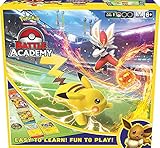
Battle Academy is the best overall pick in this roundup, and the reason is structural rather than cosmetic. It is a two-player card game built specifically to teach the actual Pokémon Trading Card Game — the same rule system used at organised play events — through a guided first game rather than a rulebook. You start playing almost immediately, with the materials walking you through turn structure, energy attachment, evolution and prize-taking as you go. Once you have finished the teaching sequence, the same components function as a normal card game, which means the product does not expire when the training wheels come off.
Who it suits
It suits a household with one experienced player and one beginner, which is the most common Pokémon situation in the world: a child who watches the anime and collects cards, and an adult who has never played. It suits adults who collected cards as children and want to find out what the actual game is like. It suits two children of similar age who want to learn together. It does not suit a solo player, and it does not suit a group of four who all want to play in the same session without buying additional product.
Key specs
- Players: 2, head to head
- Format: trading card game with pre-constructed decks and a guided learn-to-play sequence
- Ruleset: the standard Pokémon TCG rule system, which means skills transfer directly to organised play
- Upgrade path: components remain usable with standard TCG cards, so the product leads into the wider hobby rather than dead-ending
- Typical session: a first guided game runs longer than a normal game because of the teaching pauses; experienced games are substantially quicker
- Components: cards, damage counters, playmat-style reference material and a rules walkthrough
Strengths
The single best design decision here is that Battle Academy teaches the real game, not a simplified variant. Plenty of licensed card games invent a dumbed-down ruleset for children, which means the child has to relearn everything the moment they meet a real player. Battle Academy does the opposite: the turn structure, the energy economy, the evolution timing and the prize condition are all the genuine article. That means the first game you play at a local event will feel familiar rather than alien.
The second strength is the guided walkthrough. Card games fail at the teach, not at the play. A new player who has to read forty pages of rules before touching a card will usually quit before the first turn. Battle Academy sequences the learning so that each rule arrives when it is needed, which is how almost every successful modern board game handles onboarding and how almost no traditional card game does.
The third strength is the upgrade path, and