Key takeaways
- Length: 62 inches (AMO), takedown
- Riser: laminated hardwood with sight, plunger, stabilizer and quiver bushings
- Limbs: laminated wood core with black glass facing; replacement limbs sold separately
- Draw weights: approximately 25–50 lb in 5 lb steps, with heavier options in some configurations
- Hand: right or left, sold as separate models
- Typical brace height: around 7.5–8.5 inches
- Best draw-length range: up to roughly 29–30 inches before stacking becomes noticeable
The best recurve bow for most target and field archers in 2026 is the Samick Sage 62-inch takedown recurve. It wins on the things that actually matter over a five-year ownership cycle: a 62-inch platform long enough to be forgiving at a 29-inch draw, a takedown joint that lets you pack it in a case or a backpack, a wooden riser already drilled for a sight, plunger and stabilizer, and a limb ladder that runs from beginner-light weights up past 50 lb in five-pound steps. You can buy it once at 25 lb, learn form for a season, then buy a second set of limbs for the price of a mid-range accessory instead of a whole new bow.
If you want the cheapest honest way in, the SOPOGER takedown kit covers 20, 30 and 40 lb in one package and is the least painful way to find out whether archery sticks. If you already know it will, the Sanlida Hermit X8 is the pick: an ILF wooden hunting recurve that takes standard International Limb Fitting limbs, so every upgrade after that is a limb swap rather than a new bow. Everything below is judged on draw weight range, riser and limb materials, takedown convenience, adjustability, accuracy potential, durability and who each bow actually suits.
Top 3 Picks
Best overall: Samick Sage 62″ Takedown Recurve. The safest single purchase in the category. A 62-inch takedown with a wooden riser and laminated limbs, available in right or left hand and in draw weights from roughly 25 lb to 50 lb-plus, with replacement limbs sold separately in every weight. It suits a beginner who intends to still be shooting in three years, and it suits a target or field archer who wants one bow that does both.
Best budget: SOPOGER Recurve Bow and Arrow Set. A 20/30/40 lb takedown kit that gives a new archer three weight options and a complete starter package without committing to premium money. It is the right answer when the goal is to learn the shot cycle cheaply and upgrade later, not to own a forever bow.
Best premium: Sanlida Hermit X8 Standard ILF Takedown. A 60-inch wooden ILF hunting recurve that accepts standard ILF limbs and allows tiller and poundage adjustment at the riser. It suits an archer who has outgrown bolt-on limbs and wants a platform that grows with them, or a hunter who wants a quiet wooden bow with real tuning range.
Quick Comparison
| Product | Best for | Key specs | Price tier |
|---|---|---|---|
| Samick Sage 62″ Takedown Recurve | All-around target and field shooting; the one-bow answer | 62 in takedown; wooden riser with accessory bushings; laminated limbs; ~25–50 lb in 5 lb steps; right/left hand; replacement limbs available | Premium |
| CVLIFE 62″ Recurve Bow and Arrow Set | Hunters who want a wooden 62-inch takedown with a kit included | 62 in wooden takedown; 40 lb right hand; hunting-oriented setup; kit accessories | Mid-range |
| DRMVALG Recurve Bow and Arrow Set | Adults and youth buying a first bow on a tight budget | Takedown recurve kit; beginner draw weights; right-hand configuration; complete starter package | Budget |
| Obert Original Black Hunter Takedown Recurve | Smooth-drawing hunting and target practice on a mid-range budget | 60 in takedown; bamboo core limbs; black riser; hunting/target profile; commonly offered in the 30–50 lb class | Mid-range |
| GQT 60″ Recurve Bow and Arrow Set | Archers who want adjustable draw weight in a wooden hunting bow | 60 in wooden takedown; 30–50 lb right hand; outdoor/hunting setup; kit accessories | Mid-range |
| LWANO Recurve Bow and Arrow Set | Teens and adult beginners who want a cheap, complete kit | Takedown recurve kit; adult/youth/teen beginner draw weights; right-hand; starter accessories | Budget |
| Sanlida Hermit X8 Standard ILF Takedown | ILF adjustability, limb upgrades and serious hunting setups | 60 in takedown; ILF limb fitting; wooden riser; hunting recurve geometry; premium build class | Premium |
| SOPOGER Recurve Bow and Arrow Set | Cheapest sensible entry with multiple draw-weight options | Takedown kit in 20/30/40 lb; right and left hand options; complete starter package | Budget |
| Bear Archery Grizzly Recurve | Traditional one-piece hunting, no takedown hardware | One-piece recurve; 60 lb right hand; brown maple riser; classic hunting profile | Premium |
| ZSHJGJR American Hunting Bow 320FPS | Maximum draw-weight adjustability in a single hunting rig | Adjustable 40–55 lb draw weight; right hand; listing claims up to 320 FPS; naming mixes recurve and compound terminology | Premium |
| NorthSpoor 51″ Recurve Bow and Arrow Set | Compact, tight-quarters shooting and smaller archers | 51 in takedown; 40 lb; short-axle hunting profile; kit accessories | Mid-range |
| NorthSpoor 40 lb Takedown (Left and Right Hands) | Ambidextrous beginners and family bows | 40 lb takedown; offered for left and right hand; starter kit format | Budget |
How We Chose
Every bow here was assessed from published manufacturer and retailer specifications, brand documentation, and the established physics of recurve design — not from firing them. Four criteria decided the ranking. Category fit came first: a bow must genuinely do the job its listing claims, so a 51-inch bow is judged as a compact hunting and stumping bow, not as a target-line bow, and a listing that mixes “recurve” and “compound” terminology is flagged rather than smoothed over. Specification quality came second: bow length, draw-weight range and steps, riser material, limb construction, hand orientation and whether limbs are replaceable all matter more than accessory counts in a box. Use-case match came third, judged against realistic numbers — a 25 lb bow teaches form, a 40 lb bow is a legal hunting weight in many jurisdictions, and a 60 lb bow is a specialist tool. Upgrade path came last: a bow that accepts standard replacement limbs, or ILF limbs, holds value for a growing archer in a way that a sealed one-piece bow or a fixed-limb kit does not.
1. Samick Sage 62″ Takedown Recurve – Best for All-Around Target and Field Shooting
As an Amazon Associate we earn from qualifying purchases at no extra cost to you.

The Samick Sage is the bow most often recommended to someone who asks “which recurve should I buy first?” and it earns that position on structure rather than novelty. It is a 62-inch takedown recurve — long enough to be stable and forgiving at a 29-inch draw, short enough to carry through brush, and split in two at the riser for transport. The riser is a laminated wood block with bushings already installed for a sight, a plunger button, a stabilizer and a quiver, which matters more than it sounds: on cheaper bows you either drill your own holes or shoot barebow forever.
Draw weights span roughly 25 lb to 50 lb and beyond in five-pound increments, with right- and left-hand versions sold as separate models. Limbs are laminated, black-faced, and — critically — sold separately in every weight. That single fact is what makes the Sage a long-term purchase rather than a starter bow: an archer who starts at 25 lb can move to 35 lb for the cost of a limb set instead of a new bow.
Key specifications
- Length: 62 inches (AMO), takedown
- Riser: laminated hardwood with sight, plunger, stabilizer and quiver bushings
- Limbs: laminated wood core with black glass facing; replacement limbs sold separately
- Draw weights: approximately 25–50 lb in 5 lb steps, with heavier options in some configurations
- Hand: right or left, sold as separate models
- Typical brace height: around 7.5–8.5 inches
- Best draw-length range: up to roughly 29–30 inches before stacking becomes noticeable
Strengths
The 62-inch length is the reason this bow appears in so many recommendations. A longer bow bends the string through a shallower angle at full draw, which reduces finger pinch, makes the arrow leave the string more cleanly, and hides small form errors that a 48-inch bow would punish. At the same time, 62 inches still fits a normal bow case and still threads through a treeline. The riser weight sits in the hand and soaks up vibration, so the shot feels quieter and deader than the price of the platform suggests.
Accessory mounting is the second strength. Because the riser is pre-drilled, an archer can add a simple sight and a plunger and shoot barebow-plus, or go full Olympic-style with a long rod and a clicker, without modifying anything. And because the bow has been in production for years, the ecosystem around it — strings, rests, limb sets, tuning information — is unusually deep. If something breaks, it is replaceable.
Pros
- 62-inch platform is forgiving at long draw lengths and stable in wind
- Replaceable limbs make weight progression cheap
- Pre-drilled riser supports sights, plungers, stabilizers and quivers
- Quiet, low-vibration shot for a bow in this class
- Right- and left-hand models both available
Cons
- Ships as a bare bow — string, rest, arrows and accessories are usually extra
- Bolt-on limb fitting limits you to the same limb pattern
- Wooden riser is not adjustable for tiller or poundage the way an ILF riser is
- Heavier than an aluminium-riser target bow of the same length
How it compares with the nearest alternative
The closest alternative in this list is the CVLIFE 62-inch wooden takedown, which matches the Sage on length and hand orientation and adds a kit, but fixes the draw weight at 40 lb right hand. The Sage wins on flexibility: five-pound steps and separately sold limbs mean a beginner is not stuck at one weight, and a target archer is not stuck at a hunting weight. The CVLIFE wins on completeness out of the box and on cost of entry. Against the Sanlida Hermit X8, the Sage is the simpler, cheaper, bolt-on platform; the Hermit X8 is the ILF platform you buy when you want tiller adjustment and unlimited limb choice.
2. CVLIFE 62″ Recurve Bow and Arrow Set – Best for a Complete Wooden Hunting Setup

The CVLIFE 62-inch set is aimed at a specific buyer: an adult right-handed archer who wants a wooden takedown hunting recurve at a sensible weight and wants the accessories included rather than sourced separately. The listing describes a 40 lb right-hand wooden takedown in a 62-inch format, which is a conventional and well-proven hunting configuration — long enough to be stable, light enough to carry, and heavy enough at 40 lb to be a legal hunting draw weight in a large number of jurisdictions that set a 35–45 lb floor for deer-sized game.
Because the bow is a takedown, it breaks into two pieces at the riser and stores in a fraction of the space a one-piece bow needs. That is the practical difference between taking a bow on a trip and leaving it at home. The wooden riser keeps the bow quiet in the hand, and 40 lb is a weight that a reasonably strong adult can reach with good form in a few months of regular practice — heavy enough to hunt with, not so heavy that it teaches bad habits.
Key specifications
- Length: 62 inches (AMO), takedown
- Draw weight: 40 lb, right hand
- Riser: wood, takedown configuration
- Intended use: hunting and hunting practice
- Package: sold as a bow-and-arrow set rather than a bare bow
- Best draw-length range: comfortable for most adult archers up to roughly 29 inches
Strengths
The single biggest advantage is that the kit removes the most common beginner failure mode: buying a bow and then discovering that nothing else needed — rest, string, arrows, quiver, arm guard — came with it. Everything arrives together, so the first session happens the day the box opens. The 62-inch length also means the bow is not fighting the archer. Short hunting recurves are popular for portability, but a 62-inch bow is measurably more forgiving on release, which is exactly what someone moving from practice into their first season needs.
The fixed 40 lb weight is a genuine strength for the right person. It sits at the sweet spot where a bow is light enough to shoot fifty arrows in a session without collapse, and heavy enough that arrows fly with real authority. Paired with a properly spined arrow in the 500 class, a 40 lb recurve typically launches a 400–500 grain arrow in the approximate 160–185 FPS range, a figure that varies with draw length, arrow mass and the archer’s release.
Pros
- 62-inch hunting-length platform is stable and forgiving
- 40 lb is a practical hunting weight in many jurisdictions
- Kit format means shooting starts immediately
- Wooden takedown riser keeps the shot quiet
- Right-hand 40 lb configuration suits the largest share of adult buyers
Cons
- No weight choice — 40 lb is fixed in this configuration
- Right hand only; left-handed archers must look elsewhere
- Kit accessories are starter grade and usually get replaced first
- Not adjustable for tiller or poundage at the riser
How it compares with the nearest alternative
Against the Samick Sage, the CVLIFE trades flexibility for completeness. The Sage lets you start at 25 lb and buy up; the CVLIFE hands you 40 lb and everything you need to shoot it today. For an adult who is confident they want to hunt and does not want to assemble a kit, that is a fair trade. Against the GQT 60-inch set, the CVLIFE has the advantage of two extra inches of bow length, while the GQT counters with an adjustable 30–50 lb range in a shorter, more brush-friendly package. If you shoot in open country, take the 62; if you shoot from a blind, the 60-inch GQT is the more manoeuvrable bow.
3. DRMVALG Recurve Bow and Arrow Set – Best for Beginners on a Tight Budget

The DRMVALG set is a budget-tier takedown recurve kit aimed squarely at adults and youth who are buying their first bow and do not yet know whether archery will hold their interest. That is a legitimate and useful category. The single most common mistake a new archer makes is spending heavily on a first bow, discovering that a 40 lb draw weight is too much for unpractised muscles, and quitting because every session hurts. A low-cost kit at a beginner-appropriate weight solves that problem by making the commitment small.
The bow is a takedown, which means it separates at the riser for storage and transport — important when the bow will live in a closet or a car boot between sessions. It ships as a set with the accessories a first session requires, so there is no separate shopping list to work through before the first arrow flies. The configuration is right-hand, which covers the majority of buyers; left-handed archers should look at the SOPOGER or NorthSpoor options that explicitly offer both hands.
Key specifications
- Type: takedown recurve bow and arrow set
- Intended archers: adults and youth beginners
- Draw weights: beginner-appropriate light-to-moderate weights, typically in the 20–40 lb class depending on the variant offered
- Hand: right hand
- Package: bow plus starter accessories and arrows
- Assembly: takedown, tool-light limb attachment
Strengths
The value proposition is simple: the lowest sensible cost of finding out whether you enjoy archery. Everything needed for a first month of practice arrives together, and the light draw weights that beginner kits are built around are genuinely the right place to start. Form is learned at 15–25 lb, not at 40. A new archer who spends three months at 20 lb building a repeatable release will progress faster than one who starts at 40 lb and develops a flinch.
The takedown design also matters more than beginners expect. A one-piece bow is awkward to store, awkward to transport and awkward to move through a doorway. A two-piece bow lives in a bag. That small convenience is the difference between practising twice a week and practising twice a season. Because the bow is inexpensive, the owner can also afford the things that actually improve accuracy — a decent tab or glove, properly spined arrows, a target — rather than spending the entire budget on the bow itself.
Pros
- Lowest-risk way to start archery
- Beginner-appropriate draw weights build form instead of bad habits
- Complete kit means no separate accessory shopping
- Takedown format stores and travels easily
- Leaves budget for arrows, tab and target, which matter more than the bow
Cons
- Starter accessories are basic and will be the first upgrades
- Fixed draw weight in each variant; no easy step up without a new bow
- Right hand only in this configuration
- Build materials are entry-level and less durable than a premium wooden takedown
How it compares with the nearest alternative
The LWANO set is the closest competitor and sits in the same budget tier with a similar adult/youth/teen beginner focus. The distinction is largely one of configuration and package contents rather than architecture — both are entry-level takedowns aimed at the same buyer. The SOPOGER set is the more interesting alternative because it spans 20, 30 and 40 lb and offers both right- and left-hand options, which makes it the better choice for a left-handed beginner or for a family where two archers of different strengths will share the bow. If you are right-handed and simply want the cheapest complete start, the DRMVALG is competitive; if you need weight or hand options, the SOPOGER wins.
4. Obert Original Black Hunter Takedown Recurve – Best for Smooth Bamboo-Core Draw

The Obert Black Hunter is a 60-inch takedown recurve built around bamboo core limbs, and that single material choice is the reason it stands out in the mid-range band. Bamboo cores are lighter and more elastic than the maple cores used in most budget limbs, which produces a draw that builds more smoothly and releases with less hand shock. On a 60-inch hunting-length bow, that translates into a shot that feels calmer than the price suggests.
At 60 inches, the Black Hunter sits between the 62-inch all-rounders and the sub-55-inch compact bows. It is a hunting and target-practice platform — light enough to carry, long enough to be stable, and short enough to shoot from a seated position or through cover. The takedown joint allows the bow to be split for transport, and the dark riser gives it the unassuming look that field archers tend to prefer over bright target furniture.
Key specifications
- Length: 60 inches (AMO), takedown
- Limbs: bamboo core construction
- Riser: dark-finished riser in the Black Hunter pattern
- Draw weights: commonly offered across the 30–50 lb hunting range depending on variant
- Intended use: hunting and target practice
- Best draw-length range: comfortable for most adults up to roughly 29 inches
Strengths
Bamboo cores are the headline. The practical effect is a limb that stores and returns energy with a more progressive feel: the first inch of draw is soft, the last inch is firm without being abrupt, and the bow does not jump in the hand at release. Archers who have only shot fibreglass-over-maple limbs usually notice the difference immediately, and it is the kind of difference that improves accuracy because it makes the release easier to repeat.
The 60-inch length is a deliberate compromise that works. It is two inches shorter than a 62-inch all-rounder, which makes it noticeably handier in a blind, a treestand or thick cover, but it retains enough length to avoid the finger pinch and string angle problems that plague very short recurves. The takedown design means the whole thing fits into a compact case, and the dark riser does not spook game the way a glossy target riser can. For an archer who splits their time between practice butts and actual hunting, this is close to an ideal single bow.
Pros
- Bamboo core limbs draw smoothly with low hand shock
- 60-inch length balances portability and stability
- Takedown format for easy transport and storage
- Subdued hunting finish suits field use
- Hunting-capable draw weights in the 30–50 lb band
Cons
- Two inches shorter than a 62-inch bow, so slightly less forgiving at very long draws
- Bamboo-cored limbs are more sensitive to dry-fire damage than heavy glass laminates
- Bolt-on limb fitting limits aftermarket limb choice
- Not a dedicated target-line bow; no long-rod geometry
How it compares with the nearest alternative
The GQT 60-inch set is the closest match on length and intent, and the two bows solve the same problem differently. The GQT offers an adjustable 30–50 lb range in a wooden right-hand hunting bow, which suits someone who wants to move up in weight without buying new limbs. The Obert counters with bamboo core limbs and a smoother draw character at a fixed weight. If you value tuning range, take the GQT; if you value how the bow feels at full draw and you already know your weight, the Black Hunter is the more refined shooting experience. Against the 62-inch Samick Sage, the Obert is the handier hunting bow and the Sage is the more versatile all-rounder.
5. GQT 60″ Recurve Bow and Arrow Set – Best for Adjustable Draw Weight in a Wooden Hunting Bow

The GQT 60-inch set is a wooden right-hand takedown hunting recurve offered with a 30–50 lb draw-weight range, which makes it one of the more flexible mid-range options here. Flexibility matters because draw weight is the one specification a new archer almost always gets wrong — usually by starting too heavy. A bow that spans 30 to 50 lb lets an archer begin in the low end of the range, build strength over a season, and step up without replacing the whole bow.
The 60-inch format is a deliberate hunting length: shorter than a target bow, longer than a compact brush bow. It is designed for outdoor use, and the wooden riser keeps the shot quiet, which is what a hunter wants when a second shot is unlikely. The set format means the bow arrives with the starter accessories needed to shoot it, so the first session is not delayed by a missing rest or string.
Key specifications
- Length: 60 inches (AMO), takedown
- Draw weight: adjustable across the 30–50 lb range
- Hand: right hand
- Riser: wood
- Intended use: outdoor shooting and hunting
- Package: bow and arrow set with starter accessories
Strengths
The adjustable draw weight is the reason to buy this bow. Most budget and mid-range recurves lock you into one weight, which means a beginner who starts at 30 lb and outgrows it faces buying new limbs or a new bow. A 30–50 lb range covers the entire arc of a developing archer: 30 lb for form work and indoor practice, 40 lb for the point where hunting becomes realistic in jurisdictions with a 35–45 lb minimum, and the top of the range for an archer who has built the strength to use it. That is three bows in one platform.
The 60-inch length is well judged for field use. It is short enough to shoot from a ground blind without the lower limb catching the roof, and long enough that the string angle at a 28–29 inch draw does not pinch the fingers. The wooden riser adds mass where it helps — in the hand — which reduces vibration and makes the bow quieter and steadier than a light metal riser of the same size. Because it ships as a set, the practical cost of getting started is lower than the bow’s tier suggests.
Pros
- 30–50 lb adjustable range covers beginner through hunting weight
- 60-inch length suits blind, treestand and field shooting
- Wooden riser is quiet and vibration-damping
- Set includes starter accessories
- Right-hand configuration matches most buyers
Cons
- Right hand only
- 60 inches is slightly less forgiving than 62 inches at very long draws
- Adjustment mechanism is not the same as full ILF tiller tuning
- Starter accessories are basic
How it compares with the nearest alternative
The Obert Black Hunter is the direct rival: same 60-inch length, same hunting intent, different philosophy. The GQT gives you a weight range and a kit; the Obert gives you bamboo core limbs and a fixed weight. If you are still deciding what weight you can handle, the GQT’s 30–50 lb span removes that decision from the critical path. Against the CVLIFE 62-inch set, the GQT is shorter and adjustable, while the CVLIFE is longer and fixed at 40 lb. Archers who shoot from stands and blinds should take the GQT; archers who shoot in open country and want maximum stability should take the 62-inch CVLIFE.
6. LWANO Recurve Bow and Arrow Set – Best for a First Bow for Teens and Adults

The LWANO set is a budget-tier takedown recurve kit built for adult, youth and teen beginners — a broad target that reflects what entry-level archery actually looks like in most households. It is a family bow in spirit: light enough for a teenager to draw, straightforward enough for an adult to assemble, and inexpensive enough that buying one to test the water is not a financial decision.
Like the other budget kits here, the LWANO is a takedown, so it splits at the riser for storage. That matters for a bow that will spend most of its life in a cupboard. It ships with the accessories needed for a first session, which removes the usual beginner trap of buying a bow and then discovering the rest of the required kit is a separate purchase. The configuration is right-hand and the draw weights are beginner-appropriate.
Key specifications
- Type: takedown recurve bow and arrow set
- Intended archers: adults, youth and teens
- Draw weights: beginner-appropriate light-to-moderate weights, typically in the 20–40 lb class depending on variant
- Hand: right hand
- Package: bow, arrows and starter accessories
- Assembly: takedown, limb bolts
Strengths
The strongest argument for the LWANO is the same one that applies to every good budget kit: it puts the money where it matters. A beginner’s accuracy is limited by form and by arrow spine, not by limb materials. Spending less on the bow leaves more for correctly spined arrows, a proper tab or glove, an arm guard and a target — the four things that actually determine whether early practice is productive. The LWANO’s price point makes that allocation possible.
The light draw weights are also correct for the intended archer. Youth and teen beginners should be starting well under 30 lb, and adults who have never drawn a bow should not start at 40. A light bow lets a new archer complete the full shot cycle — stance, hook, draw, anchor, release, follow-through — without the collapse that comes from over-bowing. That cycle, repeated a few thousand times, is what produces accuracy later. The takedown design adds a practical benefit: the bow can be broken down and packed, which suits the way families actually transport equipment.
Pros
- Very low cost of entry for a complete setup
- Beginner-appropriate draw weights for teens and adults
- Complete kit — bow, arrows and basic accessories together
- Takedown format for easy storage and transport
- Leaves budget for arrows and a target, which drive early accuracy
Cons
- Entry-level materials and finish
- Fixed draw weight per variant, with no cheap upgrade path
- Right hand only
- Starter accessories will need replacing as the archer improves
How it compares with the nearest alternative
The DRMVALG set targets exactly the same buyer at the same tier, so the decision between them comes down to package contents, available draw weights and current availability rather than to any architectural difference. The more meaningful comparison is with the SOPOGER set, which offers 20, 30 and 40 lb options and both hand orientations. For a single right-handed archer who wants the cheapest complete start, the LWANO is a reasonable pick. For a household with a left-hander, or for anyone who wants the option to move up in weight without buying a new bow, the SOPOGER is the better-structured purchase.
7. Sanlida Hermit X8 Standard ILF Takedown – Best for ILF Adjustability and Long-Term Upgrades

The Sanlida Hermit X8 is the bow in this list for an archer who has moved past the beginner stage and wants a platform rather than a product. It is a 60-inch takedown hunting recurve with a wooden riser built to the ILF standard — International Limb Fitting — which means the limbs attach with the dovetail-and-socket system used across modern recurve archery rather than with the bolt-through system used by budget takedowns.
ILF is the single most consequential upgrade path in recurve archery. An ILF riser accepts limbs from many manufacturers, in many draw weights, in wood, bamboo, foam and carbon constructions. It also allows the archer to adjust limb alignment and tiller, and to shift poundage within a range by turning the limb bolts — typically a swing of several pounds either way. On a bolt-on bow, none of that exists: you shoot the limbs you were given until you buy a different bow.
Key specifications
- Length: 60 inches (AMO), takedown
- Limb fitting: ILF (International Limb Fitting) standard
- Riser: wooden, hunting recurve geometry
- Intended archers: adults and hunters
- Adjustability: limb alignment and tiller adjustment at the riser; poundage tuning within the limb’s range
- Best draw-length range: suited to typical adult draws up to roughly 29 inches
Strengths
Tuning range is the whole point. Tiller — the relative stiffness of the upper and lower limb — can be adjusted to match an archer’s grip and release, and on a hunting bow a slightly positive tiller usually produces a quieter, more forgiving shot. Poundage can be moved up or down a few pounds at the bolts, which is enough to soften a bow for winter practice and stiffen it before a season. Limb alignment can be corrected with shims rather than accepted as it comes.
The upgrade path is the second strength. Because the riser takes standard ILF limbs, an archer who buys the Hermit X8 at one weight can later fit a set of foam-core or carbon limbs for a faster, flatter cast without replacing the riser. That is a fundamentally different ownership model from a bolt-on kit bow, and it is why ILF risers hold their value. The wooden riser keeps the bow quiet and hand-friendly for hunting, while the 60-inch length keeps it manoeuvrable in cover. For a hunter who also shoots paper and 3D targets through the off-season, this is one bow doing both jobs competently.
Pros
- ILF fitting accepts limbs from a wide range of makers and materials
- Tiller, alignment and poundage adjustment at the riser
- 60-inch length is hunting-friendly and still stable
- Wooden riser is quiet and damps vibration
- Genuine long-term upgrade path — limbs, not bows, get replaced
Cons
- Premium tier pricing compared with bolt-on takedowns
- ILF limbs are more expensive than bolt-on replacements
- Adjustment rewards an archer who will actually learn to tune
- Overkill for a beginner who is still learning basic form
How it compares with the nearest alternative
The Samick Sage is the obvious comparison and the honest one: the Sage is a 62-inch bolt-on takedown with excellent limb availability inside its own pattern, and the Hermit X8 is a 60-inch ILF takedown with excellent limb availability across the entire market. If you will keep the same limbs for years, the Sage is cheaper and slightly longer. If you intend to experiment with limb weights and materials, tune tiller, and treat the riser as a permanent purchase, the Hermit X8 is the more rational buy. Against the Bear Grizzly, the Hermit X8 is the modular, adjustable option; the Grizzly is the fixed, traditional one.
8. SOPOGER Recurve Bow and Arrow Set – Best Budget Multi-Draw-Weight Kit
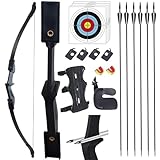
The SOPOGER set is the most useful budget bow in this list because it solves the two problems that most often derail a first purchase: the wrong draw weight and the wrong hand. It is offered in 20, 30 and 40 lb and in both right- and left-hand configurations, which makes it the natural choice for a left-handed beginner and for a household where two archers of different strength will share equipment.
Twenty, thirty and forty pounds map neatly onto the actual stages of learning. Twenty pounds is a form-building weight that a teenager or a lightly built adult can shoot for an hour without fatigue. Thirty pounds is where an archer starts shooting at longer distances with a flatter trajectory. Forty pounds is a hunting-capable weight in jurisdictions that require 35–45 lb for deer-sized game. Being able to choose among those three at the point of purchase, rather than guessing, is worth more than any material upgrade at this tier.
Key specifications
- Type: takedown recurve bow and arrow set
- Draw weights: 20 lb, 30 lb and 40 lb variants
- Hand: right-hand and left-hand options
- Intended archers: adults and youth
- Package: bow, arrows and starter accessories
- Assembly: takedown, limb bolts
Strengths
Hand and weight options are the differentiator. Almost every budget recurve kit is right-hand only and fixed at one weight, which quietly excludes left-handed archers — a meaningful share of the population, and a group that also includes many cross-dominant shooters who should be shooting left-handed because of eye dominance rather than hand dominance. The SOPOGER set gives that archer a legitimate entry point without forcing them to shoot from the wrong side or jump to a premium bow.
The three weight choices also make the set a genuine multi-stage purchase. A family can buy a 20 lb bow for a teenager and a 30 lb bow for an adult and share arrows, targets and accessories. An adult can start at 20 lb, spend a season on form, and then buy the 30 lb version — or simply buy the 30 lb limbs if they are offered — rather than changing platform entirely. And because it is a takedown, it stores small and travels easily, which is the difference between a bow that gets used and one that lives behind a door.
Pros
- Three draw weights (20/30/40 lb) cover beginner through hunting-capable
- Right- and left-hand options — rare at this tier
- Complete kit gets an archer shooting the same day
- Takedown format for easy storage and transport
- Low cost makes the initial commitment low-risk
Cons
- Entry-level materials and finish
- Starter accessories are basic and get replaced
- No ILF or cross-brand limb compatibility
- Adjustability is limited to choosing the right variant up front
How it compares with the nearest alternative
Against the LWANO and DRMVALG sets, the SOPOGER wins on options rather than on build: same tier, same basic takedown architecture, but three weights and two hand orientations instead of one of each. That makes it the better first bow for a left-hander and the better first bow for a family. Against the NorthSpoor 40 lb left-and-right-hand takedown, the SOPOGER offers more weight choice, while the NorthSpoor focuses on a single 40 lb configuration for both hands. For a beginner, the SOPOGER’s lower weights are the more useful starting point; for an adult who already knows they want 40 lb, the NorthSpoor is the more direct purchase.
9. Bear Archery Grizzly Recurve – Best for Traditional One-Piece Hunting

The Bear Grizzly is a different kind of bow from everything else in this list: a traditional one-piece recurve with a brown maple riser, listed in a 60 lb right-hand configuration. It has no takedown joint, no limb bolts and no adjustment. What it has is the simplicity and the shooting character that traditional archers specifically want — a single continuous piece of bow that behaves identically every time it is picked up.
The 60 lb draw weight makes this a specialist’s bow rather than a beginner’s. Sixty pounds at a 28-inch draw is a serious weight: it demands established back tension, a clean release and a level of conditioning that takes most archers a year or more to build. A hunter who has shot 45–50 lb for several seasons may find 60 lb appropriate for larger game or for flatter trajectory at distance. A new archer should not start here, and no one should buy a 60 lb bow as a first recurve.
Key specifications
- Type: one-piece traditional recurve
- Riser: brown maple
- Draw weight: 60 lb as listed
- Hand: right hand
- Adjustability: none — no limb bolts, no tiller adjustment, no poundage range
- Intended use: traditional target shooting and hunting
Strengths
Simplicity is the feature, not a limitation. A one-piece bow has no joint to work loose, no limb bolts to check, no alignment to verify. It either shoots or it does not, and it shoots the same way in year five as it did in week one. Traditional archers value that consistency because it removes variables: the only things that change are the archer and the arrow. For hunting, a one-piece bow also has an inherent advantage in that there is nothing to fail in the field.
The 60 lb draw weight, for the right archer, delivers real performance. Heavier draw weights launch heavier arrows at useful speeds, which matters for penetration and for trajectory at distance. A 60 lb recurve with a properly spined arrow in the 340–400 class will shoot flatter than a 40 lb bow with the same arrow mass, which reduces range estimation error — a significant practical advantage in field and hunting situations. The brown maple riser is also a classically handsome and durable choice, warm in the hand and quiet on release.
Pros
- One-piece construction — nothing to adjust, nothing to loosen
- 60 lb draw delivers flat trajectory and strong arrow energy
- Brown maple riser is durable, quiet and traditional in appearance
- No takedown joint means no alignment or fit issues
- Consistent shot behaviour over the life of the bow
Cons
- 60 lb is far too heavy for a beginner or an unfit archer
- No takedown — full-length transport and storage
- No poundage or tiller adjustment; the weight is the weight
- Right hand only in this
Affiliate disclosure. As an Amazon Associate we earn from qualifying purchases at no extra cost to you. Prices accurate as of the date shown.Best Recurve Bows for Target and Field UseCheck price on Amazon