Key takeaways
- Blade span: 52 inches, flush-mount configuration
- Light engine: RGBIC, meaning individually addressable colour zones rather than one uniform colour
- Control: app, voice assistant support and a physical remote
- Finish: designed for standard residential ceiling mounting
The best smart ceiling fan for most people is the Govee 52-inch RGBIC flush-mount ceiling fan. It combines a full-size 52-inch blade span with app, voice and remote control, plus an RGBIC light engine that covers both everyday white task lighting and colour scenes, so one fixture handles air movement, ambient light and automation. It suits anyone with a standard 8-foot ceiling in a room roughly 12×12 to 14×16 feet who wants a single ceiling-mounted device to carry the whole job and is comfortable at premium-tier pricing.
If the budget is the deciding factor, the CINOTON 52-inch is the value pick: same span class, app and remote control, black finish, at a budget-tier price. If airflow control matters more than lighting tricks, the DREO 52-inch with 12 speeds and three fan modes is the one to buy — the extra speed steps matter far more than RGB when you are chasing comfort at 2 a.m.
This roundup evaluates every option the same way: airflow capacity relative to room volume, noise behaviour by motor class, ceiling-height and mount compatibility, and how well the app and voice integration actually fits a real smart home.
Top 3 Picks
Best overall: Govee 52″ RGBIC Flush-Mount Smart Ceiling Fan
The most complete package in this list: a 52-inch span that covers medium and large bedrooms, flush mounting that works on 8-foot ceilings, and RGBIC lighting that behaves like a real smart light rather than a basic on/off lamp. App, voice and remote control are all present, so you are not locked into one control method. It is the fan to buy when you want one purchase to solve cooling, lighting and automation at once.
Best budget: CINOTON 52″ Smart Ceiling Fan
You get the same 52-inch coverage class as the premium picks, plus app control and a physical remote, at budget-tier money. The trade-offs are in light quality and ecosystem depth rather than blade span, which is exactly the right place to economise. Ideal for guest rooms, rentals and second bedrooms where a full premium spend is hard to justify.
Best for airflow control: DREO 52″ Smart Ceiling Fan
Twelve speeds and three fan modes give you the granularity that four-speed fans simply cannot match — the difference between “too fast” and “too slow” disappears. Add RGBIC dimmable lighting and a living-room-friendly 52-inch span, and it becomes the pick for anyone who runs a fan for hours and cares about the comfort curve, not the colour wheel.
Quick Comparison
Specifications below reflect what each listing states; where a listing does not publish a figure, the entry is described by spec class rather than an invented number. Price tiers are relative bands within the smart ceiling fan category.
| Product | Best for | Key specs (as listed) | Mount | Control | Price tier |
|---|---|---|---|---|---|
| Govee 52″ RGBIC flush mount | All-round smart control | 52 in span, RGBIC light, remote | Flush mount | App, voice, remote | Premium |
| CINOTON 52″ Smart | Tight budgets | 52 in span, LED light kit, black finish | Standard mount | App, remote | Budget |
| SMAVISTA RGBCW 52″ | Bright room lighting | 52 in span, RGBCW LED rated 2600 lm, black | Standard mount | Remote (app by class) | Budget |
| Govee 20″ RGBIC Fandelier | Small rooms, statement lighting | 20 in span, RGBIC light, fandelier form | Flush/close mount | App, voice, remote | Premium |
| Linkind Matter 52″ | Cross-ecosystem compatibility | 52 in span, Matter certification, black | Standard mount | App, voice, remote, Matter | Mid-range |
| Amico 52″ Smart | Downrod mounting | 52 in span, LED light kit, downrod included | Downrod | App, voice, remote | Mid-range |
| Fanbulous 56″ Low Profile | Large rooms, low ceilings | 56 in span, RGB light | Low profile | App, voice, remote | Mid-range |
| DREO 52″ Smart | Fine-grained airflow control | 52 in span, 12 speeds, 3 modes, RGBIC dimmable | Standard mount | App, voice, remote | Premium |
| addlon 24″ Low Profile Fandelier | Compact rooms | 24 in span, LED light, black | Low profile | App, remote | Budget |
| ZMISHIBO 52″ Smart | Voice-first control, mid-range budget | 52 in span, RGB light | Standard mount | Alexa, app, remote | Mid-range |
| DREO 44″ RGBIC Flush Mount | Mid-size rooms, low ceilings | 44 in span, RGBIC light | Flush mount | App, voice, remote | Premium |
| Fanbulous 52″ Flush Mount | Budget flush mount | 52 in span, LED light, black | Flush mount | App, remote | Budget |
How We Chose
Selection started from published listing specifications — blade span, mount type, light engine, stated control methods and any published lumen or speed figures — and then applied four filters. First, category fit: does the product do the core job of moving air at a span appropriate to a real room, or is it primarily a decorative light with blades attached? Second, control depth: a fan that only answers a remote is a different product from one that exposes speed, light colour and scheduling through an app or a Matter-compatible hub.
Third, mount compatibility, because a flush-mount fan and a downrod fan solve different ceiling problems and are not interchangeable. Fourth, upgrade path: whether the fan can join an existing automation system, respond to voice assistants, and be scheduled or triggered by sensors rather than operated by hand. Price tier was treated as a band rather than a ranking, since a budget fan that fits a small room well is a better purchase than a premium fan that is oversized for it. No product here was tested, benchmarked or owned; all judgements are based on specification analysis and how each design class behaves in practice.
1. Govee 52″ RGBIC Flush-Mount Smart Ceiling Fan – Best for All-Round Smart Control
As an Amazon Associate we earn from qualifying purchases at no extra cost to you.
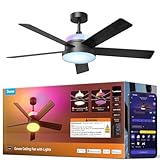
This is the fan for the reader who wants one ceiling fixture to handle cooling, white light, colour scenes and automation, and who has an 8-foot ceiling that rules out a long downrod. The 52-inch span puts it in the medium-to-large room bracket, and the flush-mount body keeps blade-to-floor clearance safe in rooms where a hanging fan would feel low.
Key specs (as listed)
- Blade span: 52 inches, flush-mount configuration
- Light engine: RGBIC, meaning individually addressable colour zones rather than one uniform colour
- Control: app, voice assistant support and a physical remote
- Finish: designed for standard residential ceiling mounting
Why it earns the top spot
RGBIC is the meaningful differentiator. On a conventional RGB light kit, selecting “orange” turns the whole diffuser orange. With individually addressable zones, the fixture can run gradients, chase effects and multi-colour scenes, and — more usefully for daily life — it can render a warmer tone near the centre and a cooler tone at the edge if the app supports segmented control. That is the difference between a fan light you use twice and a fan light that becomes the room’s main ambient source.
Control redundancy matters just as much. App control gives you scheduling, scene recall and speed/colour changes without hunting for a remote; the remote gives you a fallback that works when Wi-Fi is down or a guest is in the room; voice support lets you change speed from the doorway with your hands full. Fans that rely on a single control method tend to become frustrating the first time that method fails.
Flush mounting is the practical win for the target room. On an 8-foot ceiling, a fan body that hangs on a downrod can drop the blade plane to around 7 feet or lower depending on the rod length, which is the minimum clearance most residential codes allow and feels tight in a bedroom. A flush mount keeps the blade plane higher and the room feeling open. The trade-off is that flush-mount fans generally move slightly less air at a given speed than a downrod fan positioned in the ideal 8–9 foot band, because the blade tips sit closer to the ceiling and lose a little of the clean inflow they would otherwise get.
Pros
- RGBIC lighting gives scene-grade colour, not just a handful of preset tints
- Three control paths — app, voice and remote — so no single point of failure
- 52-inch span suits most primary bedrooms and living rooms
- Flush mount preserves headroom on 8-foot ceilings
Cons
- Premium-tier pricing for a category where budget fans now cover the basics
- Flush-mount geometry sacrifices a small amount of peak airflow versus an ideal downrod install
- Full value depends on using the app; remote-only users pay for features they will not touch
How it compares
Against the DREO 52-inch, the Govee wins on lighting sophistication and loses on speed granularity — 12 speeds gives the DREO a finer comfort curve for people who sleep with a fan running. Against the Linkind Matter 52-inch, the Govee wins on colour and app polish, while the Linkind wins on hub-agnostic compatibility. If your priority is a fan that lights the room beautifully, this is the pick; if your priority is a fan that dials in exactly the right breeze, look at the DREO.
2. CINOTON 52″ Smart Ceiling Fan – Best for Tight Budgets

The CINOTON is the answer to the question “how little can I spend and still get a full-size smart fan?” It keeps the 52-inch span that defines the mainstream category, adds app control and a remote, and finishes in black — a colour that reads as deliberate rather than cheap, which matters because ceiling fans are permanent fixtures, not accessories you can hide.
Key specs (as listed)
- Blade span: 52 inches
- Light: integrated LED light kit
- Control: app plus included remote
- Finish: black, standard residential mount
Where the money goes — and where it does not
Budget smart fans save on three things: the light engine, the motor controller’s sophistication, and the app. The CINOTON’s listing suggests a straightforward LED kit rather than an addressable RGBIC array, which means you get warm white, cool white or dimming rather than gradients and chase effects. For a bedroom or a home office, that is usually the correct trade — most people set a fan light to one colour temperature and never change it again.
The motor side is where you should set expectations by class rather than by marketing. Budget 52-inch smart fans typically use a conventional AC motor or an entry-level DC motor. AC motors draw noticeably more power at the same air movement — a typical AC fan pulls somewhere in the 55–75 W band at high speed, while a DC motor of similar output often sits in the 25–35 W band at high and can drop to single digits on low. Run that difference across a summer of nightly use and it shows up on the bill, though rarely by enough to justify jumping two price tiers on its own.
Noise follows the same logic. Motor noise on a well-balanced fan is usually less than the noise created by air moving across the blades, which rises with speed and blade tip velocity. On low and medium speeds, a fan of this class is generally quiet enough for a bedroom; on the top two speeds, expect audible whoosh that is normal for a 52-inch fan moving meaningful air. The practical tip is to size the fan so you rarely need the top speed — a fan that covers the room at speed 3 is quieter in daily use than a smaller fan screaming at speed 6.
Pros
- 52-inch span at budget-tier money, which is the single best value proposition in this list
- App and remote control both included, so automation is possible without a hub
- Black finish suits modern and industrial interiors
- Simpler light engine means fewer features to break or confuse guests
Cons
- No RGBIC-class colour effects; lighting is functional rather than decorative
- App ecosystem depth is generally shallower than premium brands
- Motor and noise performance sit in the standard class rather than the efficient class
How it compares
The natural rival is the SMAVISTA RGBCW 52-inch, also budget-tier. SMAVISTA publishes a 2600-lumen light rating, which is bright for a fan light and makes it the better choice for a room where the fan light is the primary light source. The CINOTON is the better pick when app control and a clean black look matter more than raw light output. Against the Fanbulous 52-inch flush mount, the deciding factor is mount type rather than budget: choose flush if your ceiling is 8 feet, choose the CINOTON if you have 9 feet or more and can hang the fan in its ideal airflow band.
3. SMAVISTA RGBCW 52″ Smart Ceiling Fan – Best for Bright Room Lighting

SMAVISTA’s angle is light output. The listing states a 2600-lumen RGBCW LED array on a 52-inch fan, and that combination makes it the budget-tier pick for rooms where the fan light has to do the heavy lifting — basements, converted lofts, offices without recessed cans, and any space where adding a separate ceiling light is not an option.
Key specs (as listed)
- Blade span: 52 inches
- Light: RGBCW LED, rated 2600 lumens
- Control: remote included, app control by class
- Finish: black
Why lumens are the number that matters here
RGBCW means red, green, blue, cool white and warm white emitters. In practice it gives you a tunable white range from roughly 2700 K to 6500 K plus saturated colour, which is a step up from a fixed-temperature kit. The 2600-lumen figure is the headline: for context, a typical 52-inch fan light kit lands in the 1000–2000 lumen range, and a standard 60 W incandescent equivalent bulb produces around 800 lumens. A 2600-lumen fixture is therefore in “this lights the whole room” territory rather than “this is a night light attached to a fan”.
That matters for sizing decisions elsewhere in the article. If the fan light is your primary light source, you can skip the recessed lighting you were planning, which changes the economics of the purchase considerably. If it is supplementary, you are paying for output you will run at 30% most of the time — perfectly fine, but not a reason to choose this model over the CINOTON.
One caution on bright fan lights: at full output they generate real heat near the ceiling and they consume more power than the fan itself. A 2600-lumen LED array typically draws in the 25–30 W range at full white, which is more than a DC fan motor draws at medium speed. If you run the light four hours a night, that is the dominant part of the fixture’s energy cost, not the fan. The practical setting is to dim to 40–60% for general use and reserve full output for tasks.
Pros
- 2600-lumen output is genuinely room-filling, unusual at budget tier
- RGBCW tunable white plus colour covers both task and mood lighting
- 52-inch span covers medium and large rooms
- Can eliminate the need for a separate ceiling light in some rooms
Cons
- High output is only useful if you actually need the light; otherwise you paid for lumens
- Full-brightness operation draws more power than the fan motor at cruising speed
- Remote-first control by class, so app depth may be limited compared with premium picks
How it compares
Against the CINOTON 52-inch, the SMAVISTA wins clearly on lighting and roughly ties on span and price tier; the CINOTON edges ahead only if app integration is your priority. Against the ZMISHIBO 52-inch, the SMAVISTA is the brighter light and the ZMISHIBO is the more voice-focused product with explicit Alexa support listed. If your room is dark and you want one fixture to fix it, SMAVISTA is the budget answer.
4. Govee 20″ RGBIC Fandelier Ceiling Fan – Best for Small Rooms and Statement Lighting

A 20-inch fandelier is a different product category from a 52-inch ceiling fan, and judging it by airflow specs alone misses the point. It is a light fixture with a fan built in, designed for small rooms where a full-size fan would look absurd and where the fixture itself is part of the décor — walk-in closets, small offices, entryways, nurseries and reading nooks.
Key specs (as listed)
- Blade span: 20 inches, fandelier form factor
- Light: RGBIC, addressable colour zones
- Control: app, voice and remote
- Mount: close-to-ceiling design suited to standard heights
What a 20-inch fan can and cannot do
Blade span scales airflow roughly with swept area, and swept area scales with the square of the radius. A 52-inch fan sweeps about 2,124 square inches of disc; a 20-inch fan sweeps about 314 square inches. That is roughly a 6.8× difference in swept area, and while real airflow also depends on blade pitch, motor speed and blade count, the order of magnitude is clear: a 20-inch fandelier moves a fraction of the air a 52-inch fan moves. Treat it as a personal air mover for one or two people, not a room-cooling appliance.
Within that scope it works well. In a 10×10 room, the effective comfort zone of a small fan is the area within roughly 6–8 feet of the blades, which covers a desk, a bed or a seating chair. Beyond that, the air velocity drops off and you will feel very little.
Where the Govee version earns its premium tier is the RGBIC light engine, which in a small room reads as a design feature rather than a gimmick — a 20-inch fixture with gradient colour is a genuine statement piece in an entryway or a teenager’s room in a way a 52-inch fan never is. App and voice control round out the package so it can be scheduled and included in scenes.
Pros
- Statement lighting in a compact, low-profile form factor
- RGBIC colour is far more visible and effective on a small fixture
- App, voice and remote control all present
- Fits rooms where a full-size fan would be visually wrong
Cons
- Airflow is limited to a small personal zone; it will not cool a whole bedroom
- Premium pricing for a small swept area
- Overkill for a closet or hallway where a plain light would do
How it compares
The direct alternative is the addlon 24-inch low-profile fandelier, which is slightly larger in span and sits at budget tier — better if you want more air movement and less lighting spectacle. The Govee wins when the fixture is meant to be seen. Against a full-size 52-inch fan of any brand, the comparison is unfair in both directions: the fandelier loses on airflow and wins on footprint and visual impact.
5. Linkind Matter 52″ Smart Ceiling Fan – Best for Cross-Ecosystem Compatibility

Matter certification is the feature that makes this fan the pick for anyone who has been burned by ecosystem lock-in. If your household runs Apple Home on one phone, Google Home on another and Alexa on a speaker in the kitchen, a Matter-certified fan can be commissioned once and shared across all three rather than living inside one vendor’s app.
Key specs (as listed)
- Blade span: 52 inches
- Certification: Matter, for multi-platform commissioning and control
- Control: app, voice and included remote
- Finish: black
Why Matter changes the buying decision
Without Matter, a smart fan typically pairs with one manufacturer app and, if you are lucky, exposes a basic integration to one voice assistant. Switching platforms later usually means re-pairing, losing schedules, and sometimes losing features entirely. Matter standardises the device model, so fan speed, light on/off, brightness and colour temperature are exposed as standard attributes that any Matter controller can address.
The practical setup flow matters too. Matter commissioning uses a pairing code and works over your local network; a fan installed on a 2.4 GHz Wi-Fi network is the standard recommendation for this class of device, because 5 GHz-only SSIDs and band-steering routers are the most common cause of failed pairing. If your router broadcasts a single SSID for both bands and the fan will not commission, temporarily splitting the bands or using a 2.4 GHz guest network solves it in most cases.
Multi-admin is the other benefit: one fan, several controllers, all with equal access. In a household where one person uses Siri and another uses Alexa, that removes an entire class of argument.
Pros
- Matter certification means genuine platform independence
- 52-inch span covers mainstream rooms
- Remote included as a fallback when the network is down
- Mid-range pricing for a feature set that usually costs more
Cons
- Light engine is functional LED rather than RGBIC scene lighting
- Matter features can vary by firmware version and hub; check your controller’s support
- Requires a Matter controller or compatible hub for the full benefit — a phone alone is not always enough
How it compares
Against the Govee 52-inch RGBIC flush mount, the Linkind wins on interoperability and loses on lighting. Against the Amico 52-inch, the difference is mount type first and ecosystem second — Amico’s downrod design suits higher ceilings, while Linkind’s Matter support suits mixed-platform homes. If you have a 9-foot ceiling and a mixed smart home, you have a genuine two-way decision to make; if you have an 8-foot ceiling, the Linkind is the more flexible choice of the two.
6. Amico 52″ Smart Ceiling Fan – Best for Downrod Mounting in Standard Rooms

The Amico is a downrod-mount 52-inch smart fan, which makes it the right answer for rooms with 9-foot ceilings or higher. It is the counterpoint to the flush-mount fans in this list: where those trade a little airflow for headroom, this one trades headroom for the blade position that moves air most efficiently.
Key specs (as listed)
- Blade span: 52 inches
- Mount: downrod mount, downrod included
- Light: integrated LED light kit
- Control: app, voice and remote
Why the downrod matters more than most buyers expect
Ceiling fan airflow depends on the blades pushing air downward and, critically, on air being able to flow back over the top of the blades. Mount the fan too close to the ceiling and you starve that return path, which costs you real airflow. The standard guidance is that the blade plane should sit 8 to 9 feet above the floor for best performance, with 7 feet as the absolute minimum clearance. On a 9-foot ceiling, a fan hung on a 6-inch downrod puts the blades around 8 feet — close to ideal. On an 8-foot ceiling, that same fan would put blades near 7 feet, which is legal but tight and noticeably less effective.
Amico’s inclusion of a downrod also matters for sloped ceilings. A downrod mount with the right canopy can accommodate a sloped ceiling where a flush-mount fan generally cannot, and sloped ceilings are common in upstairs bedrooms, lofts and vaulted living rooms. If your ceiling is not flat, this class of fan is usually the only workable option.
On the smart side, the Amico offers app, voice and remote control, which is the full expected set for mid-range pricing. Expect LED lighting that is tunable and dimmable rather than addressable RGB — appropriate for a main living space where a colour-changing fixture would look out of place.
Pros
- Downrod mount puts blades in the optimal 8–9 foot airflow band on taller ceilings
- Better suited to sloped ceilings than flush-mount designs
- Full control set: app, voice and remote
- Mid-range pricing with a complete mounting kit included
Cons
- Wrong choice for an 8-foot ceiling, where it will hang too low
- LED light is functional rather than RGBIC scene lighting
- Installation is more involved than a flush mount, especially on a sloped ceiling
How it compares
Against the Fanbulous 56-inch low-profile fan, the decision is almost entirely about ceiling height and room size: the Fanbulous is the pick for a large room with a low ceiling, the Amico for a normal-to-large room with a taller ceiling. Against the Linkind Matter 52-inch, the Amico wins on mount flexibility and the Linkind wins on ecosystem compatibility. If you have a vaulted ceiling, the Amico is effectively the default choice among these two.
7. Fanbulous 56″ Low-Profile Smart Ceiling Fan – Best for Large Rooms with Low Ceilings

This is the awkward-room specialist. A 56-inch span is the largest in this roundup, and a low-profile body lets it fit under an 8-foot ceiling where a conventional downrod fan would hang too close to head height. Large room plus low ceiling is a common combination in older homes, finished basements and single-storey extensions, and it is exactly the situation most fans handle badly.
Key specs (as listed)
- Blade span: 56 inches — the widest here
- Mount: low-profile, hugging the ceiling
- Light: RGB light
- Control: app, voice and remote
The sizing logic behind 56 inches
Blade span should scale with room volume. The conventional rule of thumb is that a room up to about 75 square feet wants a 29–36 inch fan, a room up to about 144 square feet wants 36–44 inches, up to roughly 225 square feet wants 44–52 inches, and rooms above that want 52–60 inches or more. A 16×20 room is 320 square feet, which sits well beyond the 52-inch comfort zone — that is where 56 inches and above starts earning its keep.
Airflow scales with swept area, so the jump from 52 to 56 inches is more meaningful than it looks. A 52-inch fan sweeps roughly 2,124 square inches; a 56-inch fan sweeps roughly 2,463 square inches — about 16% more disc area, which translates to a noticeable gain in air movement at the same speed. In a large room, that is the difference between needing speed 5 and getting the same comfort at speed 4, which also means less noise.
The low-profile mounting is the compromise. Sitting close to the ceiling costs some airflow efficiency, as discussed, but in a room with an 8-foot ceiling the alternative is a fan hanging at 7 feet, which is worse for both comfort and code compliance. In this case, low profile is not a downgrade — it is the correct engineering answer for the constraint.
Pros
- Widest span in this roundup, suited to genuinely large rooms
- Low-profile body works under 8-foot ceilings
- RGB lighting adds ambience to a room that may double as a media space
- Full app, voice and remote control
Cons
- Oversized for bedrooms and small living rooms
- Low-profile geometry sacrifices some airflow versus an ideal downrod position
- Not suitable for sloped ceilings
How it compares
Against the Amico 52-inch downrod fan, this is a straightforward trade of span and mount type: choose Fanbulous if the room is large and the ceiling is low, choose Amico if the ceiling is high and the room is normal-sized. Against the DREO 52-inch, the Fanbulous wins on coverage and the DREO wins on speed granularity and light quality. For a 320-square-foot basement with an 8-foot ceiling, the Fanbulous is the only option here that fits the room properly.
8. DREO 52″ Smart Ceiling Fan – Best for Fine-Grained Airflow Control

Twelve speeds and three fan modes is the spec line that separates this fan from almost everything else in the category. Where most smart fans offer three to six speeds, twelve gives you a comfort curve rather than a set of steps, and that matters enormously if you sleep with a fan running all night.
Key specs (as listed)
- Blade span: 52 inches
- Speed: 12 speeds across 3 fan modes
- Light: RGBIC, dimmable
- Control: app, voice and remote
- Intended space: living room, per the listing
Why 12 speeds is not a marketing number
On a four-speed fan, the steps between settings are large. Speed 2 may be slightly too much for sleep and speed 1 not quite enough; you end up choosing between two imperfect options, or turning the fan off and on through the night. With twelve speeds, the increment between adjacent settings is roughly a third of the size, so you can find a setting that is exactly right rather than approximately right. It sounds trivial until you have lived with both.
The three fan modes add a second layer. Natural or breeze-style modes vary the fan speed cyclically to mimic outdoor air movement rather than a constant blast — useful for sleep, since a constant velocity on the skin can feel cold or drying after an hour or two. Sleep modes typically step the speed down over time as the room cools and your body temperature drops. These are behavioural features, not airflow specs, and they are what a premium-tier fan actually buys you over a budget one.
RGBIC dimmable lighting rounds out the package. Dimming to 10–20% gives a usable night light that lets you cross the room without waking anyone, while full white handles general lighting. The practical setting most owners settle on is a low-warm-white scene after dark and a brighter neutral white during the day, scheduled through the app rather than changed by hand.
Pros
- 12 speeds deliver genuinely fine comfort adjustment
- Three fan modes, including variable and sleep-oriented patterns
- RGBIC dimmable lighting covers both ambience and task lighting
- 52-inch span fits the living rooms and primary bedrooms it targets
Cons
- Premium-tier price for a 52-inch span
- Mode features are only useful if you actually use the app
- Standard mount, so ceiling height and slope need checking before purchase
How it compares
Against the Govee 52-inch RGBIC flush mount, the DREO wins on airflow control and loses on mounting flexibility — the Govee is flush mount, the DREO is a standard mount that wants a 9-foot ceiling to sit in its ideal band. Against the Fanbulous 56-inch, the DREO wins on control granularity and loses on raw coverage. If you are choosing between the DREO and the Govee, the question is simple: is your priority the breeze or the lighting?
9. addlon 24″ Low Profile Fandelier – Best for Compact Rooms and Tight Spaces
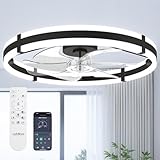
At 24 inches, this fandelier sits between a decorative light and a small room fan. Low-profile mounting and a black finish make it a good fit for rooms where a full-size fan is impractical — small bedrooms, home offices, laundry rooms, and any space where the ceiling is low and the footprint is tight.
Key specs (as listed)
- Blade span: 24 inches
- Mount: low profile
- Light: integrated LED
- Control: app plus included remote
- Finish: black
What to expect from a 24-inch fan
Swept area for a 24-inch fan is roughly 452 square inches against about 2,124 for a 52-inch fan — under a quarter of the disc area. Airflow will be a personal breeze, effective within roughly 6–8 feet of the fixture and most noticeable directly beneath it. That is enough for a desk, a single bed or a small seating area; it is not enough to cool a 12×12 bedroom on a hot night.
Where it does excel is the combination of low profile and small footprint. If you are fitting a fan into a room with a 7.5-foot ceiling, or into a space where a 52-inch blade sweep would collide with a wardrobe door or a sloped ceiling line, the options narrow fast and a 24-inch low-profile unit is often the only one that fits. In that context, the modest airflow is not a compromise — it is the whole point.
App control plus a remote covers the basics: on/off, speed, light level and scheduling. The LED light is a straightforward kit rather than an addressable array, which suits a utility space. Installation is simpler than a full-size fan, partly because of the lower weight and partly because a low-profile mount removes the downrod assembly step.
Pros
- Fits very tight rooms and low ceilings where full-size fans cannot go
- Budget-tier pricing
- App and remote control included
- Light and fan in one fixture, saving ceiling real estate
Cons
- Airflow covers only a small personal zone
- Not a replacement for a full-size fan in a main bedroom
- Basic LED light without addressable colour
How it compares
Against the Govee 20-inch fandelier, the addlon offers more span and a lower price, while the Govee offers RGBIC lighting and a more premium build. If you want colour and a design statement, the Govee wins; if you want maximum air movement per dollar in a tiny room, the addlon is the smarter buy. Against a 44-inch flush-mount fan, the addlon is the right choice only if the room is genuinely too small for 44 inches of blade sweep.
10. ZMISHIBO 52″ Smart Ceiling Fan – Best for Voice-First Control on a Mid-Range Budget

ZMISHIBO’s listing leads with Alexa compatibility alongside app and remote control, which tells you who this fan is for: a household that already runs an Alexa speaker in the room and wants to change fan speed and light settings by voice without opening an app or finding a remote.
Key specs (as listed)
- Blade span: 52 inches
- Light: RGB light
- Control: Alexa voice, app and included remote
- Mount: standard residential mount
What voice-first control actually changes
Voice control is often dismissed as a gimmick until you experience the specific moments it solves: walking into a dark room with your hands full, lying in bed and wanting one more speed step without reaching for anything, or turning the fan off as you leave for work. The friction it removes is small per instance but constant.
The catch is naming and command structure. Voice assistants handle a fan best when the device is named clearly and the commands map to supported attributes — “set bedroom fan to 50 percent” tends to work reliably, while “make the fan gentler” usually does not. Before buying any voice-controlled fan, it is worth checking that your assistant’s skill or integration exposes speed as a variable setting rather than just on and off. Where an integration only supports on/off, you are effectively paying for a voice-activated light switch.
Beyond control, the ZMISHIBO is a conventional 52-inch smart fan with an RGB light kit. That span covers rooms from roughly 144 to 225 square feet comfortably, which is the standard primary bedroom and mid-size living room bracket. Mid-range pricing is appropriate for the feature set: RGB lighting, three control paths and a full-size span, without the premium lighting engine or the 12-speed motor controller of the top picks.
Pros
- Explicit Alexa support for hands-free speed and light changes
- Full 52-inch span at mid-range pricing
- RGB lighting adds colour without going to a premium tier
- Remote included for guests and network outages
Cons
- RGB rather than RGBIC, so colour is uniform rather than zoned
- Voice control quality depends on your assistant’s integration depth
- Standard mount, not flush, so check ceiling height first
How it compares
Against the SMAVISTA 52-inch, the ZMISHIBO wins on voice control and the SMAVISTA wins decisively on light output with its 2600-lumen array. Against the Linkind Matter 52-inch, the ZMISHIBO is the Alexa-centric choice and the Linkind is the platform-agnostic one. If you are fully invested in Alexa and do not plan to change ecosystems, the ZMISHIBO is the more direct fit; if you want to keep your options open, pay the small premium for Matter.
11. DREO 44″ RGBIC Flush-Mount Smart Ceiling Fan – Best for Mid-Size Rooms with Low Ceilings

A 44-inch flush-mount fan with RGBIC lighting is a very specific tool: it solves the problem of a mid-size room with an 8-foot ceiling, where a 52-inch fan is slightly oversized and a downrod mount is out of the question. That combination — bedrooms around 10×12 to 12×12, home offices and dens — is extremely common, and this fan is aimed squarely at it.
Key specs (as listed)
- Blade span: 44 inches
- Mount: flush mount
- Light: RGBIC
- Control: app, voice and remote
Why 44 inches is the right call in some rooms
Oversizing a ceiling fan is a real mistake, not just a wasted purchase. A fan that is too large for a room moves more air than needed, which pushes you to run it at the lowest speed where the motor controller has the least resolution — and at very low speeds some fans develop a slight wobble or hum as the motor hunts for a stable point. A correctly sized fan runs at its mid-range, which is where it is quietest, most efficient and easiest to control precisely.
The sizing table later in this article puts rooms of roughly 100 to 144 square feet in the 36–44 inch bracket. A 10×12 bedroom is 120 square feet; a 12×12 is 144. Both sit comfortably in 44-inch territory, and dropping from 52 to 44 inches also reduces the swept area from about 2,124 to about 1,520 square inches — roughly 28% less, which is meaningful in a small room.
Flush mounting on a low ceiling is the other half of the design. With the blade plane sitting high, the fan stays out of sightlines and out of the way, and headroom is preserved. RGBIC lighting from DREO is the same class as its larger sibling, so you get dimmable, zone-capable colour rather than a plain white kit — a genuine benefit in a small room where the fan light is often the only overhead fixture.
Pros
- Correctly sized for 100–150 square foot rooms rather than oversized
- Flush mount preserves headroom on 8-foot ceilings
- RGBIC dimmable lighting from a brand with a mature app
- Full app, voice and remote control
Cons
- Premium-tier pricing for a 44-inch span
- Undersized for rooms above about 200 square feet
- Not suitable for sloped ceilings
How it compares
Against the DREO 52-inch, the choice is purely room size and ceiling height: 44 inches flush for a mid-size room with a low ceiling, 52 inches on a standard mount for a larger room with a taller ceiling. Against the Fanbulous 52-inch budget flush mount, the DREO wins on light quality and app depth while the Fanbulous wins on price and on span if your room can take 52 inches. If your room is 120 square feet, the 44-inch DREO is the better-matched fan even though it costs more.
12. Fanbulous 52″ Flush-Mount Smart Ceiling Fan – Best Budget Flush Mount

This is the practical default for a lot of rooms: a 52-inch span, flush mounting for an 8-foot ceiling, LED lighting, and both remote and app control at budget-tier pricing. Nothing here is exotic, and that is exactly the appeal — it covers the common case without asking you to pay for features you will not use.
Key specs (as listed)
- Blade span: 52 inches
- Mount: flush mount
- Light: integrated LED
- Control: remote plus app
- Finish: black
The case for buying the boring option
Flush-mount fans are the right answer more often than the market suggests, because most homes have 8-foot ceilings. On an 8-foot ceiling, the blade plane needs to stay above roughly 7 feet for clearance, and a flush mount achieves that without a downrod calculation, without a canopy that may or may not fit a sloped ceiling, and without the wobble that a long downrod can introduce if the ball-and-socket joint is not seated perfectly.
The 52-inch span means this fan covers the same rooms as the premium picks — roughly 144 to 225 square feet, which is the standard primary bedroom and mid-size living room. The savings come from the light engine and the app, not the blades. Expect a straightforward dimmable LED kit rather than addressable colour, and app control that covers the essentials: speed, light level, schedules, and voice assistant integration.
Where a budget flush mount does show its price is in motor refinement. A budget-tier fan may use an AC motor that draws more power and produces slightly more audible motor noise than a DC equivalent, and the remote receiver may be more susceptible to interference from other 433 MHz or 2.4 GHz devices in the home. Both are manageable: keep the remote receiver away from metal junction boxes where possible, and if the remote behaves erratically, power-cycle the fan at the breaker for 10 seconds to reset the receiver before assuming a hardware fault.
Pros
- 52-inch span at budget pricing — the best coverage-per-dollar flush mount here
- Flush mount suits the most common ceiling height
- Remote and app control both included
- Simple light kit means fewer failure points
Cons
- Basic LED lighting without colour or addressable zones
- Motor class is standard rather than high-efficiency
- Not suitable for sloped ceilings or rooms above about 225 square feet
How it compares
Against the CINOTON 52-inch, the difference is almost entirely mount type — both are budget-tier, both are 52 inches, both offer app and remote control. Choose the Fanbulous if your ceiling is 8 feet; choose the CINOTON if it is 9 feet or more and you want the fan hanging in its optimal airflow band. Against the DREO 44-inch flush mount, the Fanbulous wins on span and price and loses on light quality and app sophistication.
How to Choose
Start with room volume, not square footage
Blade span recommendations are usually given by square footage, but airflow is a volume problem. Two rooms with identical floor area but different ceiling heights need different amounts of air movement. A useful way to size is to estimate the air changes per hour you want in the occupied zone and work backwards.
The formula is: required CFM ≈ room volume in cubic feet × target air changes per hour ÷ 60. Ceiling fans do not cool air — they cool people by moving air across skin, which increases evaporative heat loss and creates a wind-chill effect of roughly 3–4°F at moderate speeds. So the air-change figure here is a sizing heuristic for perceived comfort, not a code requirement or a literal ventilation target. Treat it