Key takeaways
- Washer: 4.7 cu ft top-load, high efficiency; typically handles 16–20 lb of laundry per load
- Dryer: 7.4 cu ft electric, moisture-sensing dry with automatic overdry protection
- Format: side-by-side pair, vented dryer
- Hookups: 120 V outlet for the washer; 240 V/30 A outlet plus a 4-inch vent run for the dryer
- Smart features: app-based cycle control, remote start, cycle status and end-of-cycle notifications
- Price tier: budget
The best smart washer and dryer for most homes in 2026 is the LG WT8400CWPRK1 Matte Black Mega Capacity Top Load pair with TurboWash and SmartThinQ Wi-Fi. It pairs a mega-capacity top-load washer with a 7.4 cu ft vented electric dryer at a mid-range price tier, runs on the hookups nearly every US laundry room already has — a 120 V outlet for the washer, a 240 V/30 A outlet and a 4-inch vent for the dryer — and puts the genuinely useful smart features (remote start, downloadable cycles, end-of-cycle alerts, diagnostic troubleshooting) in the app instead of behind a flagship paywall. It suits households of three to five people running 8–12 loads a week who can spare roughly 54–60 inches of side-by-side floor space and can vent a dryer. If you cannot vent at all, the Samsung Bespoke AI Laundry Ventless Heat Pump Dryer Combo is the better answer because it dries without a duct. If budget is the hard constraint, the Samsung 4.7 cu ft top-load washer with matching 7.4 cu ft electric dryer is the value pick that still gives you sensor drying and app control.
Top 3 Picks
Best overall: LG WT8400CWPRK1 Mega Capacity Top Load Washer and Dryer Pair
This mid-range matte black pair covers the widest range of real homes: mega-capacity top-load washing, TurboWash cycle technology, and SmartThinQ Wi-Fi control, matched to a vented 7.4 cu ft dryer that handles a king comforter without a second pass. It is the pick for a three-to-five-person household with a standard vented hookup and no interest in paying premium money for a heat pump.
Best budget: Samsung 4.7 Cu Ft Top Load Washer & 7.4 Cu Ft Electric Dryer
Sensor drying that stops when the load is actually dry, a low-vibration design that behaves on a second floor, and app-based cycle control for a budget-tier price. For a household of three or four, this is the most useful laundry money you can spend without moving up a tier.
Best premium: Samsung Bespoke AI Laundry Ventless Heat Pump Dryer Combo
A 5.3 cu ft all-in-one washer and ventless heat pump dryer in one unit, aimed at homes with no duct run at all — condos, converted basements, closets on interior walls, and anywhere an exterior vent is impossible or forbidden by the building. It is the premium answer to a problem that vented pairs cannot solve.
Quick Comparison
| Product | Best for | Key specs | Price tier |
|---|---|---|---|
| Samsung Smart 4.7 Cu Ft Top Load Washer & 7.4 Cu Ft Electric Dryer | Budget family laundry with a vented hookup | 4.7 cu ft top-load HE washer; 7.4 cu ft electric dryer; sensor dry stops overdrying; low-vibration design; app control | Budget |
| Samsung WA44A320KIT1 Top Load Smart Washer and Dryer Pair | First apartments, rentals and starter homes | 4.5 cu ft top-load HE washer; 7.4 cu ft electric dryer; white finish; smart connectivity; side-by-side pair | Budget |
| LG Matte Black Mega Capacity Top Load Washer and Dryer Pair | Large households that want a matched premium pair | Mega-capacity top-load washer; matching vented dryer; TurboWash technology; SmartThinQ Wi-Fi; matte black finish | Premium |
| Samsung 5.3 cu ft Bespoke AI Laundry Ventless Heat Pump Dryer Combo | Homes with no dryer vent | 5.3 cu ft all-in-one washer and ventless heat pump dryer; AI cycle selection; ultra-capacity drum; no duct required | Premium |
| Samsung WA52DG5530K1 5.2 Cu Ft Washer and 7.4 Cu Ft Electric Dryer | Big top-load loads on a mid-range budget | 5.2 cu ft top-load HE washer; 7.4 cu ft electric dryer; white finish; smart app features; side-by-side pair | Mid-range |
| GE Profile PFQ97HSPVDS 28 Inch Smart Front Load Washer/Dryer Combo | A true all-in-one in a 28-inch footprint | 4.8 cu ft front-load washer/dryer combo; 12 wash cycles; 28-inch width; ventless operation; smart app control | Premium |
| LG WashTower Stacked Smart Laundry Center | Gas homes that want a stacked center | 4.5 cu ft front-load washer over a 7.4 cu ft gas dryer; single-unit stacked design; center control panel; smart connectivity | Premium |
| Samsung White Top Load Washer and Electric Dryer Pair | Tight budgets and small laundry closets | 4.4 cu ft top-load HE washer; 7.2 cu ft electric dryer; white finish; high-efficiency cycles; smart features | Budget |
| Midea 2.7 Cu Ft 24″ All-in-One Front Load Washer Dryer Combo | Apartments, condos and RVs | 2.7 cu ft combo; 24-inch width; 1400 RPM spin; all-in-one wash and dry; white finish | Budget |
| LG WT8400CWPRK1 Matte Black Mega Capacity Top Load Pair | Most households with a vented electric hookup | Mega-capacity top-load washer; matching vented dryer; TurboWash technology; SmartThinQ Wi-Fi; matte black finish | Mid-range |
| Samsung Bespoke AI Laundry Hub Washer and Dryer | A single-unit stacked hub at mid-range money | 4.6 cu ft washer with Steam Wash; 7.6 cu ft dryer in one stacked unit; AI features; shared control panel | Mid-range |
| LG 5.0 cu ft Mega Capacity Smart Front Load All-in-One Washer Dryer Combo | A mid-range ventless all-in-one | 5.0 cu ft front-load combo; TurboWash360; Wi-Fi with ThinQ app; ventless drying; white finish | Mid-range |
How We Chose
Every pick here was selected from manufacturer-published specifications, installation requirements, and well-established category behaviour rather than from any kind of physical trial — no unit was handled, benchmarked, or owned for this article. The shortlist was built on four filters. First, category fit: does the machine’s format (side-by-side pair, stacked hub, or all-in-one combo) actually solve a real installation problem, or is it a format in search of a buyer? Second, capacity and cycle class: drum volume in cubic feet, top-load versus front-load wash action, and whether the dryer uses a sensor or a timer, because those three variables decide how a set behaves week to week. Third, smart-feature depth: whether the app offers remote start, cycle downloads, energy reporting and diagnostic alerts, or just a status screen. Fourth, upgrade path and serviceability: whether the unit sits on a standard 120 V/240 V hookup or locks you into a proprietary install, and whether consumables such as lint filters, condenser assemblies and drain pumps are user-accessible. Price tiers reflect the general market band each set occupies — budget, mid-range, or premium — not a live price, since listings move daily.
1. Samsung 4.7 Cu Ft Top Load Washer & 7.4 Cu Ft Electric Dryer — Best for Budget Family Laundry With a Vented Hookup
As an Amazon Associate we earn from qualifying purchases at no extra cost to you.
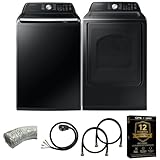
This is the pair to buy when the laundry budget is real but the household is not small. A 4.7 cu ft top-load high-efficiency washer sits at the useful top of the mainstream class — big enough for a queen comforter, a week of towels, or two days of a family of four’s clothes in one cycle — and it is matched to a 7.4 cu ft electric dryer that is genuinely full-size rather than a scaled-down companion unit. The budget tier here costs you finish materials and cycle count, not capacity.
The dryer’s sensor cycle is the headline feature and it is worth understanding why. A timed dry cycle keeps heating until the clock runs out, which means a light load of synthetics gets ten to fifteen minutes of unnecessary heat every time. A moisture-sensing cycle reads the exhaust and stops when the load reaches its target, which cuts both energy use and fabric wear. The listing calls out overdry protection specifically, and that is the right thing to advertise: overdrying is the single biggest cause of shrinking, pilling, and static in a vented electric dryer.
The low-vibration design matters more than it sounds. Top-load washers spin at high RPM with an unbalanced load, and on a second-floor laundry room over a bedroom the difference between a well-damped machine and a badly damped one is the difference between a usable appliance and a nightly argument. If your laundry is upstairs, on a wood subfloor, or on a raised platform, this belongs on the shortlist for that reason alone.
Key specs
- Washer: 4.7 cu ft top-load, high efficiency; typically handles 16–20 lb of laundry per load
- Dryer: 7.4 cu ft electric, moisture-sensing dry with automatic overdry protection
- Format: side-by-side pair, vented dryer
- Hookups: 120 V outlet for the washer; 240 V/30 A outlet plus a 4-inch vent run for the dryer
- Smart features: app-based cycle control, remote start, cycle status and end-of-cycle notifications
- Price tier: budget
Pros
- Full-size 7.4 cu ft dryer at a budget-tier price, which is where most budget sets cut corners
- Sensor drying stops the cycle on moisture, not on a timer
- Low-vibration spec makes upstairs and wood-floor installs practical
- Standard hookups — no proprietary electrical or plumbing requirement
- App control and alerts without a premium-tier premium
Cons
- Top-load wash action is less gentle on delicate fabrics than a front-load drum
- Uses more water per cycle than a comparable front loader
- No steam refresh or ventless option at this tier
- Finish and cycle count are basic compared with mid-range and premium pairs
How it compares
Against the Samsung WA44A320KIT1 pair (4.5 cu ft washer, 7.4 cu ft dryer), this set is the better buy if you can stretch slightly: you gain 0.2 cu ft of wash capacity, which is roughly one extra set of queen bedding per cycle, and you gain the low-vibration design. Against the mid-range Samsung 5.2 cu ft pair, you give up half a cubic foot of wash volume and some cycle variety, but you keep the sensor dry and the app. If your household is three or four people and your dryer vents, this is the value ceiling of the budget tier.
2. Samsung WA44A320KIT1 Top Load Smart Washer and Dryer Pair — Best for First Apartments and Rentals

This white pair is aimed at the first-laundry-room buyer: a 4.5 cu ft top-load high-efficiency washer with a 7.4 cu ft electric dryer, sold as a matched set in the budget tier. The 4.5 cu ft drum is the standard mainstream size for a household of two to four, and it is the size most rental properties, starter homes and mid-size condos were actually built around — meaning the set will fit the space and the existing hookups without a redesign of the room.
What you are buying here is predictability. Top-load high-efficiency washers in this class use an impeller or a low-profile agitator rather than the old full-stroke agitator, which cuts water use to roughly the 14–20 gallon range per cycle instead of the 35–45 gallons a 2010-era top loader would pull. Over 300 cycles a year that difference shows up on a water bill, and in a rental where you are not changing the water heater, it also shows up on the gas or electric side.
The dryer side is the familiar 7.4 cu ft vented electric format with sensor drying, which is the capacity that lets you dry a comforter without splitting it into two passes. Smart connectivity covers the practical app features: cycle selection, remote start, and notifications when the load is done. There is nothing exotic here, and for a first laundry room that is the point — the fewer proprietary requirements, the easier the install and the easier the eventual replacement.
One thing worth planning for: the washer needs a level floor and a drain standpipe or laundry tub that can accept a high-efficiency machine’s drain rate. If your existing drain is a shallow utility sink, check that it can handle a fast pump-out before you commit, because a slow drain will trigger a washer error on the spin cycle.
Key specs
- Washer: 4.5 cu ft top-load, high efficiency; typically 14–20 gallons of water per cycle
- Dryer: 7.4 cu ft electric, vented, with moisture-sensing dry
- Format: side-by-side pair in white
- Hookups: 120 V washer outlet; 240 V/30 A dryer outlet and a 4-inch vent
- Smart features: app cycle control, remote start, status notifications
- Price tier: budget
Pros
- Mainstream 4.5 cu ft size fits the majority of existing laundry spaces
- Full-size 7.4 cu ft dryer rather than a compact companion
- High-efficiency water use keeps utility costs down in rentals
- Standard white finish matches almost any room and resale expectation
- Simple hookup requirements mean a fast, low-risk install
Cons
- Slightly smaller wash drum than the 4.7 cu ft Samsung budget pair for similar money
- No low-vibration spec called out, so upstairs installs need a solid subfloor
- Basic cycle list — no steam sanitise or allergen cycle at this tier
- Top-load action is harder on fine fabrics than a front-load drum
How it compares
Compared with the Samsung 4.7 cu ft budget pair, this set trades 0.2 cu ft of wash capacity and the low-vibration design for a lower entry point — a fair trade if the machine is going on a concrete slab in a rental and will be replaced in a few years anyway. Compared with the Samsung 4.4 cu ft / 7.2 cu ft budget pair, this is the larger and better-specified option: you get 0.1 cu ft more wash volume and 0.2 cu ft more dryer volume, which matters more on the dryer side because that is where bulky items get split into two loads.
3. LG Matte Black Mega Capacity Top Load Washer and Dryer Pair — Best for Large Households That Want a Matched Premium Pair
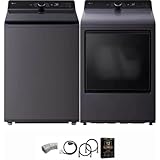
This is the pair for a household that runs laundry constantly and wants the room to look deliberate. A mega-capacity top-load washer in matte black is matched to a vented dryer of the same family, with LG’s TurboWash technology and SmartThinQ Wi-Fi control. Mega-capacity in the top-load class generally means a drum in the 5.0 cu ft and up range, which translates to roughly 20–25 lb of laundry per load — enough that a family of five can consolidate two old loads into one.
The practical benefit of that capacity is not just fewer cycles; it is fewer dryer loads. Laundry bottlenecks almost always sit on the drying side, and a washer that holds more than the dryer can dry simply moves the queue. What a mega-capacity top-load pair buys you is the ability to wash a full king-size bedding set plus towels in one washer cycle and then split only the drying, which is a real scheduling improvement in a busy house.
TurboWash, as LG uses the term, is about cutting cycle time by using stronger, more directed water motion rather than longer agitation — the direction most manufacturers have gone, because the biggest complaint about high-efficiency top loaders has always been cycle length. Combined with a matching vented dryer, this set targets households that want speed and volume rather than the longest possible cycle list.
SmartThinQ connectivity covers remote start, cycle download, energy monitoring, and diagnostic alerts that can report a fault code to the app rather than requiring a service call to interpret. That last feature is genuinely useful in a premium machine, because it turns “the washer is beeping and I do not know why” into a specific part number.
The trade-offs are the familiar premium top-load ones: matte black finishes show detergent residue and lint more than white, and a high-capacity top loader with a fast spin needs a solid floor. If your laundry is on a suspended wood floor over a living space, budget for an anti-vibration mat or a reinforcing pad, because capacity and spin speed both scale the vibration energy.
Key specs
- Washer: mega-capacity top-load (generally 5.0 cu ft and above in this class); TurboWash cycle technology
- Dryer: matching vented dryer in the same finish family
- Format: side-by-side pair, vented
- Finish: matte black
- Smart features: SmartThinQ Wi-Fi — remote start, cycle download, energy monitoring, diagnostic alerts
- Price tier: premium
Pros
- Mega capacity reduces total cycle count for large households
- Matched premium finish gives a laundry room a designed look
- TurboWash targets shorter cycles rather than longer ones
- Full diagnostic and energy reporting through the app
- Standard vented hookup — no proprietary plumbing or venting
Cons
- Premium tier pricing for a vented pair, where the money is in capacity and finish rather than a heat pump
- Matte black shows water spots and detergent splash
- High-capacity spin needs a very solid floor to stay quiet
- Large drum encourages overloading, which unbalances fast spins
How it compares
Against the mid-range LG WT8400CWPRK1 pair, this is the same basic proposition one tier up: you are paying for the premium finish, the larger drum class, and a deeper app feature set. If you wash eight loads a week or fewer, the mid-range version is the better value and you will not feel the capacity difference. Against the Samsung Bespoke AI Laundry Hub, the choice comes down to format: this pair is side-by-side and needs the floor width, while the Hub is a single stacked unit that trades width for height.
4. Samsung 5.3 cu ft Bespoke AI Laundry Ventless Heat Pump Dryer Combo — Best for Homes With No Dryer Vent

This is the answer to a specific problem that no vented pair can solve: you have no duct, and running one is impossible, forbidden, or absurdly expensive. It is a single all-in-one unit with a 5.3 cu ft ultra-capacity drum that washes and then dries the same load using a ventless heat pump system, with AI cycle selection handling the fabric and load sensing. Condos, converted basements, interior closets, historic buildings with façade restrictions, and rentals where the landlord will not cut a hole in the wall are all squarely in this machine’s territory.
Heat pump drying works differently from a vented dryer, and the difference changes how you use it. Instead of heating air to a high temperature and blowing it outside, a heat pump moves heat between two coils, condensing moisture out of the air and draining or collecting it. That means no duct, much lower drying temperatures, and roughly 40–50% less energy per load than a vented electric dryer — but also longer cycle times. A full load that a vented dryer finishes in 50–60 minutes can take considerably longer in a heat pump, so the practical habit is to start a load earlier and let it run.
Because there is no vent, there is also no duct to clean, which removes the single biggest fire-risk maintenance item in a laundry room. What replaces it is a condenser or heat exchanger that needs periodic rinsing and a lint filter that needs emptying every single load — the trade is real, and it is worth being honest about it, because a neglected heat pump dryer loses drying performance faster than a neglected vented dryer does.
AI cycle selection in this class reads load weight and, in some implementations, soil level, then picks water and cycle parameters rather than making you choose. That is more valuable on an all-in-one than on a separate washer, because the wash and dry phases have to be balanced against each other — an oversized wash load becomes an endless dry cycle, and the machine’s sensing is what keeps you from making that mistake.
The 5.3 cu ft drum is the largest class in this roundup. Be aware that in an all-in-one, the drying phase handles meaningfully less than the washing phase can hold — a common rule of thumb is that you can wash a full drum but should dry roughly half of it. Practically, that means loading an all-in-one to about half to two-thirds for combined wash-and-dry cycles.
Key specs
- Format: single all-in-one washer and ventless heat pump dryer
- Capacity: 5.3 cu ft ultra-capacity drum
- Drying method: heat pump, no duct required
- Energy: typically 40–50% less per dry load than a vented electric dryer
- Smart features: AI cycle selection, app control and monitoring
- Price tier: premium
Pros
- Solves a hard installation problem — no vent, no exterior wall, no compromise
- Substantially lower energy use per dry load than a vented electric dryer
- No duct means no duct cleaning and no lint build-up fire risk
- Large 5.3 cu ft drum for an all-in-one
- Lower drying temperatures are gentler on fabrics
Cons
- Longer dry times than a vented dryer — plan around it, not against it
- Condenser and lint filter need regular, disciplined cleaning
- You cannot wash a second load while the first is drying
- Needs ambient temperatures above roughly 45–50°F, so an unheated garage is out
- Premium pricing for a single unit rather than a pair
How it compares
Against the GE Profile 28-inch combo, this unit wins on capacity: 5.3 cu ft versus 4.8 cu ft in the wash drum. Against the LG 5.0 cu ft all-in-one combo, it is the larger and more premium machine, with AI cycle selection as the differentiator. If you have any vent at all and room for two units, a vented pair remains faster and cheaper to run per load — but if you do not, this is the class of machine you want.
5. Samsung WA52DG5530K1 5.2 Cu Ft Washer and 7.4 Cu Ft Electric Dryer — Best for Big Top-Load Loads at Mid-Range Money

This pair is the volume play in the middle of the market: a 5.2 cu ft high-efficiency top-load washer matched to a 7.4 cu ft vented electric dryer, in white, at a mid-range price tier. A 5.2 cu ft top-load drum sits in the large-capacity class — roughly 20–24 lb of laundry per cycle — which is enough to wash a king comforter, a set of bath towels, and a day of family clothes in one go if you load it sensibly.
The value proposition is capacity per dollar. You are not paying for a heat pump, a matte finish, or a stacked single-unit design; you are paying for a big drum and a full-size dryer. For a household of four or five that runs laundry on a schedule, that is often the most rational allocation of money in the whole category, because cycle count is the thing you actually feel.
The dryer’s 7.4 cu ft drum is the mainstream full-size class, which is the size that makes a difference on bulky items. Bedding, comforters, and sleeping bags need room to tumble; crammed into a smaller drum they ball up, dry unevenly on the outside, and stay damp in the middle. A full-size dryer with sensor drying handles those loads in one pass instead of two.
Smart features in this tier cover the app essentials — cycle control, remote start, notifications, and basic energy reporting. What you do not get at mid-range money is the deepest diagnostic suite, and that is a reasonable place to economise: the features that save real money are sensor drying and high-efficiency water use, both of which are present here.
Two installation notes for a drum this size. First, a 5.2 cu ft top load filled to the top will not clean properly — high-efficiency washers need the load to move, so fill to about three-quarters and let the drum do its job. Second, the drain hose and standpipe need to handle the pump-out rate; if you are replacing an older machine, check the standpipe height and that it is not shared with a dishwasher discharge.
Key specs
- Washer: 5.2 cu ft top-load, high efficiency; typically 20–24 lb per load
- Dryer: 7.4 cu ft electric, vented, with moisture-sensing dry
- Format: side-by-side pair in white
- Hookups: 120 V washer outlet; 240 V/30 A dryer outlet and a 4-inch vent
- Smart features: app cycle control, remote start, notifications, energy reporting
- Price tier: mid-range
Pros
- 5.2 cu ft top-load drum in the large-capacity class at mid-range money
- Full-size 7.4 cu ft vented dryer handles comforters in one pass
- High-efficiency water use keeps running costs down despite the big drum
- Standard hookups and a white finish that fits any laundry room
- Sensor drying avoids the overdry problem common to timed cycles
Cons
- Top-load wash action is less gentle than a front-load drum
- No steam or sanitise cycle at this tier in most configurations
- Large drum encourages overloading, which hurts cleaning and balance
- Mid-range app features rather than the deepest diagnostic suite
How it compares
Against the Samsung 4.7 cu ft budget pair, this is a straight capacity upgrade — you gain about half a cubic foot of wash volume and move up a price tier, but you keep the same vented dryer format and the same sensor dry logic. Against the LG WT8400CWPRK1 mid-range pair, the choice comes down to brand ecosystem and finish: LG’s pair adds TurboWash and a matte black option, while this Samsung set competes on raw drum size. If capacity is your priority and you have no strong app preference, this is the more volume-per-dollar pick.
6. GE Profile PFQ97HSPVDS 28 Inch Smart Front Load Washer/Dryer Combo — Best All-in-One in a 28-Inch Footprint

This is a genuine all-in-one: a 4.8 cu ft front-load washer and ventless dryer in a single 28-inch-wide cabinet, with 12 wash cycles and smart app control, at a premium price tier. The 28-inch width is the detail that matters most, because it slots into the space a standard washer occupies without requiring a second machine’s worth of floor. If you have a laundry closet with a single 30-inch opening and no vent, this is the format the space was effectively designed for.
Front-load wash action is the other structural advantage. A front-loading drum lifts and drops laundry through a shallow water bath rather than dragging it through a deep one, which is gentler on fabric and uses less water — typically in the 10–16 gallon range per cycle for a full-size front loader, against 14–20 for a comparable high-efficiency top loader and 35–45 for an old agitator machine. Over a year of laundry, that is a measurable difference on a water bill and on the energy used to heat water.
Twelve wash cycles is a deliberately mid-sized list. It covers the practical set — normal, heavy duty, delicates, quick wash, bulky, whites, rinse and spin, and so on — without the twenty-plus cycle menus that most households never fully explore. If you want a machine that defaults sensibly and lets you override occasionally, that is the right shape of cycle list.
Ventless drying means no duct, which opens up interior closets, converted pantries, and any wall position in a condo or apartment. The cost is dry time: expect longer cycles than a vented electric dryer, especially on towels and denim. The maintenance pattern is also different — a condenser or heat exchanger that needs periodic cleaning and a lint filter that needs emptying every load.
At 4.8 cu ft, the wash drum is large for a combo but the combined wash-and-dry load should still be kept to roughly half to two-thirds of the drum. A 4.8 cu ft front loader washing a full load is fine; a full load that also has to dry in the same drum is not, because airflow through a packed drum is poor.
Key specs
- Format: front-load washer and ventless dryer in one unit
- Capacity: 4.8 cu ft wash drum
- Width: 28 inches
- Cycles: 12 wash cycles
- Smart features: app control, cycle monitoring, remote start
- Price tier: premium
Pros
- True all-in-one in a single 28-inch footprint
- Ventless — installs where no duct is possible
- Front-load wash action is gentler and uses less water
- 12 cycles cover the practical range without menu bloat
- Fits a standard single-machine laundry closet
Cons
- Smaller drum than the 5.0 and 5.3 cu ft all-in-one competitors
- Longer dry times than any vented pair
- One load at a time — no wash-while-drying overlap
- Premium price for a combo that still needs condenser maintenance
How it compares
Against the Samsung 5.3 cu ft Bespoke ventless combo, this unit gives up about half a cubic foot of wash volume and adds nothing in return except the GE Profile cycle programming. Against the LG 5.0 cu ft all-in-one combo, it is slightly smaller again. Where it holds its ground is footprint discipline: at 28 inches wide with a full front-load drum, it fits spaces where a wider machine simply will not go, and that alone justifies it for a lot of closets.
7. LG WashTower Stacked Smart Laundry Center — Best for Gas Homes That Want a Stacked Center

The WashTower format solves two problems at once: it stacks a 4.5 cu ft front-load washer over a 7.4 cu ft dryer in a single integrated unit, and it puts the controls at chest height in the middle rather than at the top of a stack or the back of a top loader. This particular configuration uses a gas dryer, which is the detail that decides whether it is right for you — if your laundry has a gas line and a 120 V outlet rather than a 240 V dryer circuit, this is one of the few premium stacked centers built for exactly that setup.
Gas drying has a real cost argument. A gas dryer typically costs less per load to run than an electric resistance dryer in most markets, because gas is usually cheaper per unit of heat than electricity. If you already have a gas stub in the laundry, choosing gas is usually the lower-running-cost decision, and the WashTower lets you keep that advantage in a stacked footprint.
The integrated single-unit design is the other half of the appeal. A conventional stack is two machines and a stacking kit, with a gap between them and separate controls. A tower is one cabinet with one control panel, which looks cleaner and removes the stacking kit as a failure point. It also typically needs less vertical clearance than a stacked pair plus kit, though you should still verify the exact height against your closet opening, since towers run tall.
The 4.5 cu ft front-load washer is the mainstream full-size drum, and the 7.4 cu ft dryer is full-size for a vented machine. Front-load wash action brings the usual advantages: lower water use, gentler fabric handling, and better spin extraction, which means clothes go into the dryer with less residual moisture and the dryer finishes faster.
Smart connectivity covers remote start, cycle download, and status alerts through the app. The centre control panel is the feature you will appreciate every single day, though — no reaching over a top-load lid and no bending to a floor-level panel.