Key takeaways
- A home security system with cameras is a bigger commitment than a single doorbell or one indoor camera.
A home security system with cameras is a bigger commitment than a single doorbell or one indoor camera. You are choosing how power reaches each camera, where video is stored, how many views you can cover, and whether you will pay a monthly fee to keep clips. Those four choices shape your daily experience far more than the resolution printed on the box, and they are hard to change after you have drilled holes and run cable.
This guide is for homeowners and renters who want multi-camera coverage for a yard, driveway, or entry points and would like to avoid surprises. The six systems below fall into three families: solar wire-free kits, a plug-in wireless camera, and a wired DVR kit with a hard drive. One alarm kit from the same search results was left out because its listing describes sensors and a base station rather than cameras. Everything is judged from the listing text, so verify details on the maker page before buying.
Quick Picks
Our top picks




As an Amazon Associate we earn from qualifying purchases at no extra cost to you.
| Product | Best for | Key spec from the title |
|---|---|---|
| GMK 4-Pack System | Wire-free outdoor coverage | 2K video, IP65, 2-way talk |
| 2K Solar Wireless System | Easy install with AI alerts | 2K, 5GHz and 2.4GHz Wi-Fi, solar |
| ELYSOO 2K/4MP System | Local storage included | 2K/4MP, solar, IP65 |
| AIWIXEN 4CH Wired System | 24/7 reliable recording | 4x 1080P, 512GB HDD, IP68 |
| 4MP Solar PTZ Kit | No subscription | 128GB local storage, PTZ tracking |
| CAMCAMP Wireless System | Plug-in power | 355-degree view, auto human tracking |
How to Choose
Wired, solar, or plug-in power
A wired kit with a DVR gives the most dependable recording because power and data run through cable, so there are no batteries to charge and little Wi-Fi interference. Solar wire-free cameras are far easier to mount but depend on sunlight and a battery, so shaded spots can leave them weak in winter, and short winter days make that worse in northern states. Plug-in wireless cameras avoid battery worries but need an outlet nearby.
Storage and subscriptions
Look for a clear answer to where video lives. A DVR with a hard drive, such as the 512GB unit listed here, records continuously with no fee. A kit with a 128GB local storage option can avoid monthly plans, while cloud-only systems do not. Calculate how many days of footage the drive holds at your resolution and camera count, and find out whether older footage is overwritten automatically. Without that loop, a full drive stops saving at the worst moment.
Resolution, night vision, and detection
For a yard, 2K or 4MP gives enough detail to read a face or a license plate at close range, while 1080P suits doorways. Color night vision helps identify clothing, and human or vehicle detection cuts false alerts from branches and cats. Ignore marketing about “AI” unless the listing says what it detects. A system that tells people, vehicles, and animals apart saves you from checking notifications every time a squirrel crosses the lawn, which is the biggest reason owners mute their apps within a week.
Weather protection and network
Outdoor cameras should carry an IP65 protection class or higher. IP68 handles heavier exposure. Wi-Fi cameras need a solid signal at the mounting spot, so check a phone signal on site, and prefer dual-band models if your router supports 5GHz. Budget kits often cut corners on app quality and cloud features, so read the app descriptions as well.
Before installing any camera, check local recording and privacy laws, keep the lenses aimed at your own property, and never point them at neighbors or private spaces. Post a notice if guests or workers will be recorded, and consider turning off audio recording in areas where it could capture private conversations, since audio rules are often stricter than rules for video.
The 6 Best Options
GMK 4-Pack System
The GMK kit includes four wireless outdoor cameras with 2K video, VicoHome app support, motion detection, color night vision, 2-way talk, and IP65 waterproofing. It is a full-property starter set for owners who prefer to avoid running cable through walls.
- Strength: four cameras in one box cover the front, back, and sides.
- Strength: 2-way talk and color night vision add everyday usefulness.
- Trade-off: the title does not state local storage size, so confirm storage and power details.
Skip it if you want a wired setup with continuous recording. It suits homeowners who want a quick weekend install and an app-first experience. Check how the cameras are powered, since the title leaves that detail out. A four-camera pack also tends to be the best value per view, because buying single cameras usually works out higher per view than a bundle. Think about whether you would use the fourth camera before paying for it, and place the first pair at the front door and driveway, where most incidents begin.
2K Solar Wireless System
This system lists 2K video, dual-band Wi-Fi on 5GHz and 2.4GHz, solar power, wire-free installation, AI detection, two-way audio, and mobile alerts. The solar design means no outlet is required at the mounting spot.
- Strength: dual-band Wi-Fi improves flexibility with modern routers.
- Strength: AI detection and mobile alerts reduce wasted notifications.
- Trade-off: solar charging depends on daily sun exposure.
Skip it if your cameras will sit under deep eaves or trees. It fits sunny yards and rental properties where drilling is limited. Since the camera is wire-free, you can try a few mounting positions before making holes, and shifting a unit a few feet can fix a weak Wi-Fi spot or a glare problem. Pair it with a small ladder and a level, and the whole installation is a short project.
ELYSOO 2K/4MP System
ELYSOO advertises 2K/4MP video, dual-band Wi-Fi, included local storage, solar power, and IP65 protection. The included storage is the standout, since it removes a separate memory card purchase.
- Strength: local storage is included, so subscription fees are optional.
- Strength: IP65 protection handles rain and dust.
- Trade-off: the title truncates features, so confirm night vision and detection options.
Skip it if you want a hardwired DVR. It suits budget-conscious homeowners wanting solar power and no mandatory plan. Even with local storage, ask how clips are retrieved: some systems require you to pull the card, while others let you stream stored footage in the app. The right answer depends on whether you plan to review video often or only after an incident.
AIWIXEN 4CH Wired System
This wired kit includes four 1080P cameras, a DVR with a 512GB hard drive, human and vehicle detection, IP68 waterproofing, and 24/7 recording. Because it uses cable, it is the traditional choice for reliable coverage.
- Strength: continuous recording to an internal drive with no monthly fee.
- Strength: IP68 protection and human or vehicle detection suit harsh weather.
- Trade-off: running cable means more work than wireless kits.
Skip it if you cannot run wires or prefer 2K resolution. It suits owners of a house with accessible attic or conduit routes who want maximum reliability. A DVR also keeps video inside your house, which some owners prefer for privacy reasons, and the listed 512GB drive stores footage from four 1080P cameras for as long as its size and your recording settings allow. Buyers should plan for an uninterruptible power supply if outages are common.
4MP Solar PTZ Kit
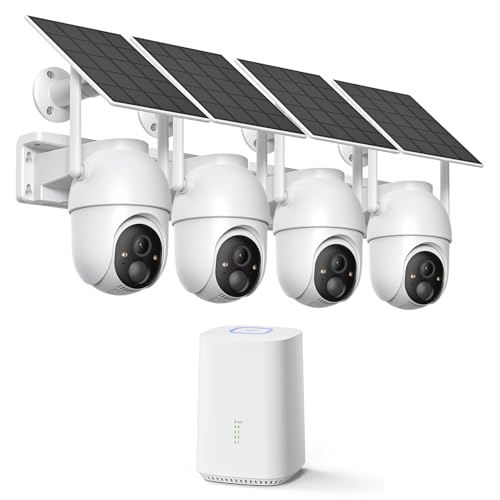
This four-camera kit lists 4MP video, 128GB of local storage with no subscription, solar power, PTZ auto tracking, and color night vision. The pan-tilt-zoom feature follows movement across a wider area.
- Strength: no subscription is required, thanks to local storage.
- Strength: PTZ auto tracking follows subjects across the yard.
- Trade-off: moving parts and solar charging add maintenance points.
Skip it if you want a fixed lens with continuous recording. It suits owners of a larger property who want fewer blind spots. Because PTZ cameras move, they can miss the start of an event while panning elsewhere, so set patrol or tracking behavior in the app and make sure the solar panels face the sun. Owners of acreage or long driveways will appreciate the reach.
CAMCAMP Wireless System
CAMCAMP offers WiFi 5G cameras with 24/7 recording, auto human tracking, a 355-degree view, two-way audio, color night vision, and plug-in power. Plug-in power removes battery concerns.
- Strength: 24/7 recording on a plug-in design is steady.
- Strength: 355-degree movement covers a large area per camera.
- Trade-off: each camera needs an outlet or power run nearby.
Skip it if your best mounting spots have no power. It suits covered porches and garages with convenient outlets. A cable run along a soffit or under eaves can hide the cord, and a weatherproof outlet cover protects the connection. It is also the more flexible option for a garage or workshop, where mounting indoors avoids weather altogether.
Which One Fits Your Situation
You rent and cannot drill much
The 2K Solar Wireless System or the GMK 4-Pack avoids cable runs and installs in an afternoon. Both rely on wireless connections, so mount them within reliable range of your router.
You want continuous recording with no fees
The AIWIXEN 4CH Wired System records 24/7 to a hard drive, an old-school but dependable setup.
You own a large yard
The 4MP Solar PTZ Kit uses auto tracking to cover more ground per camera, which is useful when a fence line or a long driveway would otherwise need extra fixed units.
You have outlets at every spot
The CAMCAMP Wireless System keeps recording around the clock without charging, as long as you can reach an outlet or run a protected cable.
Common Mistakes
- Mounting solar cameras in shade and wondering why batteries drain.
- Ignoring storage and discovering later that clips require a fee.
- Placing cameras too high, so faces are captured from above.
- Skipping a Wi-Fi check at the mounting location.
- Aiming cameras at neighbors or public spaces rather than your own property.
Related guides
- Gaming Headsets For Competitive Fps Directional Audio
- Threadripper Vs Xeon Vs Core I9 For Workstations
- Compact Mini Itx Gaming Pcs For Small Desks
Frequently Asked Questions
Are wireless cameras as reliable as wired ones?
Wired kits are usually steadier, since they avoid Wi-Fi drops and dead batteries. Wireless cameras trade some reliability for easy installation. If you choose wireless, keep a spare battery or confirm the solar panel placement, and check the app periodically for offline warnings so you notice a dead camera before you need it.
Do I need a subscription?
Not if the kit offers local storage or a DVR. Cloud-only systems usually charge for saved clips, so check before you buy, and read what the free tier includes, such as clip length, retention days, and how many cameras it supports.
How many cameras do I need?
Most homes start with four, covering the front door, driveway, back door, and side yard. In 2026 four-camera kits remain the common starting point.
Where should cameras be mounted?
Mount them about nine feet up, angled slightly downward, with a clear view of entry points and no obstruction from trees or lights. Avoid pointing the lens at bright lamps or the sun, which can wash out the image, and keep the camera out of easy reach so it cannot be tampered with.