Key takeaways
- Astrophotography flips the usual lens priorities. Sharp center resolution at f/8 matters little when your subject is a faint arc of stars that needs.
Astrophotography flips the usual lens priorities. Sharp center resolution at f/8 matters little when your subject is a faint arc of stars that needs the aperture wide open for as much light as possible. What counts is how a lens behaves at its widest setting: do stars at the corners stay round, or smear into little wings? Is there heavy darkening toward the edges? Can you reach focus on a point of light in total darkness? A lens that shines on daytime landscapes can disappoint under a dark sky, and the reverse is also true.
This guide is for photographers with a mirrorless or DSLR body who want to shoot the Milky Way, constellations, or wide-field deep-sky targets. The five lenses below cover Nikon Z, Sony E, and Canon EF mounts, plus one telescope-style Petzval design for deep-sky work. They were chosen from a larger search list; a telephoto zoom, a lens heater, and a duplicate listing of the same Sony lens were left out. Everything is judged from the listing text, so check mount, sensor coverage, and filter details on the maker page.
Quick Picks
Our top picks


As an Amazon Associate we earn from qualifying purchases at no extra cost to you.
| Product | Best for | Key spec from the title |
|---|---|---|
| Viltrox AF 16mm F1.8 Z | Nikon Z Milky Way shooters | 16mm f/1.8, full frame, built-in LCD |
| Sigma 16mm f/1.4 DC DN | Sony E wide-field work | f/1.4 aperture, stepping motor |
| Sony FE 14mm f/1.8 GM | Premium ultra-wide skies | 14mm f/1.8, XD linear motors |
| SVBONY SV545 Petzval | Deep-sky on a tracker | 203mm focal length, F4.5, field flattener |
| Rokinon 135mm F2.0 | Canon DSLR close-up star fields | 135mm f/2.0 telephoto |
How to Choose
Aperture and focal length
For Milky Way shots on a fixed tripod, look for an aperture of f/2 or faster and a focal length between about 14mm and 24mm. A wider lens allows longer exposures before stars trail, and a faster aperture gathers more light per second. Focal lengths near 135mm are for tracked, framed deep-sky subjects, and they punish any tracking error. As a rule of thumb, divide 500 by the focal length to estimate how many seconds you can expose before stars visibly trail on a fixed tripod, and shorten that figure on high-resolution sensors. A 14mm lens therefore allows exposures many times longer than a 135mm lens on the same camera.
Corner performance
Coma, the comet-like smear on stars near the edges, is the defect astrophotographers hate most. Premium lenses control it better, while budget designs often show it at f/1.4 or f/1.8 and need to be stopped down slightly. Expect some vignetting wide open too, which software can correct. Ignore daytime sharpness charts and look for night sky samples from other photographers before buying.
Mount and sensor compatibility
A lens must match your camera mount, such as Nikon Z, Sony E, or Canon EF, and the listing should say whether it covers full frame. Using a lens on the wrong sensor size can add heavy vignetting or crop. Adapters can work but may reduce performance, so match mount and sensor if you can.
Focus, weather, and extras
Autofocus is of limited use in the dark, so a smooth manual focus ring that holds at infinity matters more. Check whether the lens needs a dew control strap in humid nights and whether front filters are supported. Budget lenses may cut corners on build, so inspect the focus action and keep a headlamp with a red light to avoid ruining night vision. Also ignore claims about “astro” on the box unless the maker shows night sky samples, and remember that the best lens is the one that fits your mount and budget.
The 5 Best Options
Viltrox AF 16mm F1.8 Z
The Viltrox is a full-frame 16mm f/1.8 wide-angle lens for Nikon Z mount with a built-in LCD screen. It is listed for bodies such as the Z7, Z7 II, and Z8, which gives Nikon shooters a wide, fast option for the Milky Way without the cost of first-party glass.
- Strength: f/1.8 and 16mm cover a wide patch of sky.
- Strength: the built-in LCD displays settings in the dark.
- Trade-off: stars at the corners may need stopping down slightly.
Skip it if you shoot with Sony or Canon bodies, since the mount is Nikon Z only. It suits Nikon owners who want wide framing and autofocus for daytime use, plus a fast aperture at night. Confirm full coverage on your camera before buying. The built-in screen is a thoughtful touch for night work, since it can show aperture or focus distance without turning on a phone or headlamp. Focus breathing and autofocus speed matter less in the dark, so judge this lens mainly on how well the corner stars hold their shape at f/1.8 and at one stop narrower.
Sigma 16mm f/1.4 DC DN
The Sigma 16mm is a Contemporary-line lens for Sony E mount with an f/1.4 aperture and stepping motor, described as suited to vlogging and landscapes. The f/1.4 aperture is the fastest of the wide options in this group, which gathers extra light for dark skies.
- Strength: f/1.4 collects the most light of any wide lens listed.
- Strength: a stepping motor supports smooth autofocus for general use.
- Trade-off: the title mentions vlogging and landscapes, not astro performance specifically.
Skip it if you want ultra-wide 14mm framing or a full-frame guarantee. It suits Sony E-mount owners with a crop-sensor body who also want one lens for vlogging and travel. The DC marking in the name typically points to a crop-sensor design, so check coverage before using it on a full-frame body. For night sky work, try shooting at f/1.4 and f/2 and compare the corners, because a slight stop-down often cleans up stars noticeably while still gathering plenty of light.
Sony FE 14mm f/1.8 GM
This Sony G Master lens lists a 14mm focal length, f/1.8 aperture, XD linear motors, and XA elements, with the title naming astrophotography, landscapes, and architecture. It is the premium wide pick for Sony full-frame shooters.
- Strength: 14mm frames a huge expanse of sky in one shot.
- Strength: XA elements and G Master design target edge-to-edge image quality.
- Trade-off: it sits at the premium tier, so budget options exist.
Skip it if you shoot on a tight budget or do not need 14mm. It suits serious night sky photographers who want to push exposure times and capture a full Milky Way arch. The 14mm focal length also fits foreground-heavy compositions such as a barn, a mountain, or a campsite beneath the stars, and it doubles as a lens for architecture and interiors. Because the lens is a G Master, it is built to a high standard for use outdoors, though a lens hood and a dew strap are still sensible on cold, damp nights.
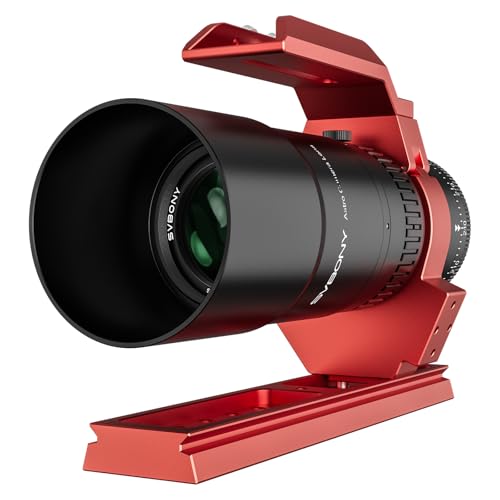
SVBONY SV545 Petzval
The SV545 is a telescope-style Petzval APO lens at F4.5 and 203mm focal length for full-frame astrophotography, with a built-in field flattener. It targets deep-sky imaging rather than casual wide shots.
- Strength: a field flattener keeps stars sharp across the frame.
- Strength: 203mm focal length frames nebulae and galaxies.
- Trade-off: you need a tracking mount for the long exposures this focal length requires.
Skip it if you only own a fixed tripod, or if you want a lens for daytime use too. It suits imagers already using an equatorial tracker who want a compact refractor-style optic. Think of it as a small astrograph rather than a camera lens: it gives high magnification of framed objects, so it pairs best with a guided tracker, accurate polar alignment, and a sturdy tripod. Buyers should confirm the mounting thread and adapter needed for their camera before ordering, because the title lists the focal length but not the connection to your body.
Rokinon 135mm F2.0
The Rokinon is a 135mm f/2.0 ED UMC telephoto for Canon digital SLRs, with an optical design said to deliver sharp images. The fast f/2.0 aperture is unusual at this focal length and suits tracked star fields.
- Strength: f/2.0 is fast for a 135mm lens.
- Strength: ED glass helps control color fringing around bright stars.
- Trade-off: at 135mm, any tracking error will show as streaks.
Skip it if you plan to shoot wide Milky Way scenes from a static tripod. It suits Canon DSLR owners with a tracker who want nebulae and constellations framed tightly. The 135mm focal length is a favorite among deep-sky shooters for fitting large nebulae such as those in Orion into a single frame. A sturdy tracker and careful polar alignment are the entry requirements, as are short trial exposures to check star shape before committing to a long sequence of frames.
Which One Fits Your Situation
You shoot Nikon Z mirrorless
The Viltrox AF 16mm F1.8 Z is the clear fit, with a wide view and a quick aperture. It also works for daytime landscapes and street scenes, which makes it a practical single lens for a Nikon Z owner.
You use a Sony body and want the best
The Sony FE 14mm f/1.8 GM is the premium route to broad Milky Way images. Pair it with a sturdy tripod and a remote release, and expect the lens to reward careful focusing on a bright star.
You want a flexible lens for travel and night
The Sigma 16mm f/1.4 pairs a fast aperture with lighter weight for Sony E-mount owners.
You own a tracking mount and chase nebulae
The SVBONY SV545 Petzval or the Rokinon 135mm F2.0 suit longer focal lengths, depending on whether you want a telescope-style lens or a Canon-mount lens.
Common Mistakes
- Choosing a slow telephoto zoom and wondering why stars look dim.
- Ignoring the mount and buying a lens that needs an adapter.
- Shooting wide open at f/1.4 without checking corner stars first.
- Skipping a sturdy tripod and a remote shutter release.
- Forgetting dew control on humid nights, which fogs the front element.
Related guides
- Gaming Headsets For Competitive Fps Directional Audio
- Threadripper Vs Xeon Vs Core I9 For Workstations
- Compact Mini Itx Gaming Pcs For Small Desks
Frequently Asked Questions
What focal length is best for the Milky Way?
Between 14mm and 24mm works for most scenes, since wider lenses allow longer exposures before stars trail. In 2026 many photographers choose a fast 14mm to 20mm prime.
Do I need a tracker?
For wide lenses on a tripod, no. For 135mm and longer focal lengths, a tracking mount is practically required to avoid trailing.
Is autofocus useful at night?
Usually not. Manual focus with a magnified live view on a bright star is more reliable. Zoom the live view to the maximum on a bright star, turn the focus ring until the star is the smallest point, and then lock it with a strip of tape so it does not shift while you shoot.
Can I use a crop-sensor lens on full frame?
You can, but you may see heavy vignetting or a cropped image. Match the lens coverage to your sensor, and check the maker page for the image circle, because the listing for a full-frame lens will say so clearly, while crop-sensor lenses often use a DC label.