Key takeaways
- Wildlife cameras answer a simple curiosity: what walks through your woods when you are not there?
Wildlife cameras answer a simple curiosity: what walks through your woods when you are not there? A fox on the garden path at midnight, a deer family at the creek, a bobcat on the fence line, or just the neighbor’s cat. Getting those pictures takes a camera that waits for hours without draining its battery, snaps fast enough to catch a passing animal before it leaves the frame, and survives rain, frost, and curious paws. Those needs are different from a home security camera, and they shape the whole shopping list. Understanding trigger speed, flash type, and power source before you buy will do more for your photo collection than any megapixel number.
This guide is for backyard naturalists, hunters scouting game trails, farmers watching for predators, and families who simply love watching animals. The seven cameras below are all trail-style models: some use a solar panel, some pack multiples so you can watch several spots, and one uses cellular service to send pictures to a phone. Everything is judged from the listing text, so check trigger speed, battery details, and card limits on the maker page before buying.
Quick Picks
Our top picks




As an Amazon Associate we earn from qualifying purchases at no extra cost to you.
| Product | Best for | Key spec from the title |
|---|---|---|
| WOSPORTS 4K Trail Camera | Fast-moving animals | 64MP, 0.2S trigger, no-glow night vision |
| MAXDONE Solar Trail Camera | Long, unattended stays | Solar, 6000mAh, 32GB included |
| WOSODA Trail Cameras (2-Pack) | Two spots on a budget | 48MP, 1080P, waterproof |
| Moultrie Edge 3 (2-Pack) | Alerts to your phone | Cellular, 40MP, 0.5s trigger |
| WOSODA Mini 4-Pack | Covering many spots | 4 tiny cameras, 30MP, 1080P |
| Misstech Solar Trail Camera | Fastest solar trigger | 4K/64MP, 0.1s motion trigger |
| CEYOMUR Trail Camera | Weather resistance | 36MP, 850nm IR LEDs, IP66 |
How to Choose
Trigger speed and recovery
The time between motion and the first photo decides whether you get an animal or an empty trail. A trigger time near 0.1 to 0.2 seconds catches fast walkers, while 0.5 seconds suits slower subjects at the edge of a clearing. Also check recovery time, the pause between shots, because a slow camera misses the second and third deer in a group.
Night vision and flash type
No-glow or low-glow infrared flashes spook animals less, but they limit night range and image brightness. Standard infrared reaches farther and gives brighter images, though it can show a faint red glow. A listed 850nm infrared wavelength is a common compromise. Nocturnal animals are the main target for many buyers, so night quality matters as much as megapixels.
Power, storage, and signal
Solar panels and large built-in batteries reduce trips to the camera, which also reduces disturbance. A card slot with 32GB or more holds weeks of images. Cellular models send pictures to your phone but need coverage and a data plan. Check the camera for a waterproof or IP66 label before leaving it out through a season.
Mounting, scent, and rules
Mount the camera at animal chest height on a sturdy tree, angled slightly downward, and facing north or south to avoid sun glare. Walk in gently and limit visits to avoid leaving scent, and check cards on a fixed schedule rather than every few days. Clear tall grass and low branches from the field of view with pruning shears, because moving vegetation can trigger hundreds of empty photos. Ignore megapixel inflation, because a sharp, well-placed 1080p image beats a blurry 64MP frame. Budget models often cut corners on night range and trigger speed.
Check local hunting and wildlife rules before placing a camera, since some areas restrict cameras on public land, baited sites, or during certain seasons. Keep cameras on your own property or on land where you have permission, and never aim them at neighbors or private spaces.
The 7 Best Options
WOSPORTS 4K Trail Camera
This non-cellular, non-Wi-Fi camera lists 64MP photos, 4K video, a 0.2 second trigger, no-glow night vision, a 2.0-inch LCD, and a 120-degree wide angle. It suits owners who want quick shots without a data plan.
- Strength: the 0.2 second trigger catches fast animals.
- Strength: no-glow night vision is less likely to startle wildlife.
- Trade-off: no wireless alerts, so you must visit to collect images.
Skip it if you want to see pictures from your couch. It suits backyard watchers who check the card weekly and want a fast shutter without any subscription. The built-in screen lets you review photos at the camera without a laptop, which saves time in the field. Because the lens covers 120 degrees, it works well along a wide trail or at the edge of a field, and the card slot makes it easy to swap in a fresh card and carry the old one home. Strap it to a tree trunk and clear any branches in front of the sensor to avoid false triggers.
MAXDONE Solar Trail Camera
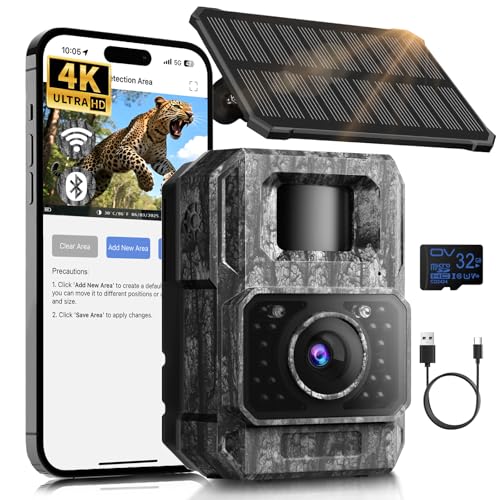
MAXDONE lists 4K video, 64MP photos, Wi-Fi, Bluetooth, night vision, motion activation, a 6000mAh power source with a solar panel, and a 32GB card included. Wi-Fi and Bluetooth make it easier to preview images from a phone nearby.
- Strength: the solar panel and 6000mAh power extend deployment time.
- Strength: a 32GB card is included.
- Trade-off: Wi-Fi and Bluetooth work only at short range.
Skip it if you want remote alerts from far away. It suits patient observers who leave the camera for long periods and view images when they visit. Look closely at how the solar panel attaches, since a panel that sits in full shade will not help, and consider angling the camera so the panel faces south in the northern hemisphere. Bluetooth and Wi-Fi previews save a trip home when you only want to check a single clip.
WOSODA Trail Cameras (2-Pack)
WOSODA sells two cameras with night vision, motion activation, waterproofing, 48MP photos, 1080P video, and SD card support, described for wildlife monitoring. It is the budget way to cover two spots.
- Strength: two cameras let you watch two trails.
- Strength: waterproof bodies suit outdoor use.
- Trade-off: 1080P is lower than the 4K options.
Skip it if you need 4K detail. It suits beginners trying the hobby, or anyone who wants to compare two locations side by side, such as a creek crossing and a field edge, before committing to a larger purchase. Having two identical cameras also simplifies card management, since both use the same format and the same accessories.
Moultrie Edge 3 (2-Pack)
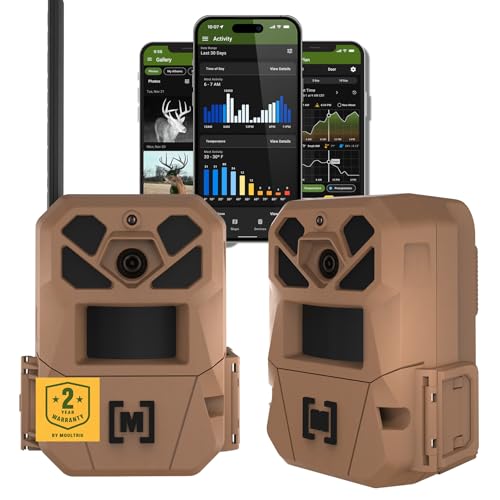
This pair lists cellular service, 40MP photos, a 0.5 second trigger, HD photos through the mobile app, 1080p video, multi-carrier support, and low-glow infrared. It lets you scout from anywhere.
- Strength: cellular delivery sends pictures to your phone.
- Strength: low-glow infrared is discreet.
- Trade-off: it needs coverage and likely a data plan.
Skip it if your site has no mobile signal. It suits hunters and landowners who want updates without hiking in. Fewer visits mean less human scent on the trail, which many scouts consider as important as the camera itself. Review the data plan terms and the app features before relying on alerts, and confirm the camera can run on batteries you can easily replace in the field.
WOSODA Mini 4-Pack
This four-camera pack lists 30MP photos, 1080P video, a waterproof tiny body, SD card use, night vision, motion activation, and a fast trigger time, described for deer. Its small size hides easily.
- Strength: four cameras cover many angles.
- Strength: tiny bodies are hard to spot.
- Trade-off: small cameras may have shorter battery life.
Skip it if you want a bigger screen or higher resolution. It suits those wanting to cover a large area. Small, camouflaged units suit scouting several trails or fence lines at once, and the pack means a spare is on hand if one gets damaged. Cameras this small usually run on a handful of batteries, so plan to carry replacements and check each unit on a regular schedule.
Misstech Solar Trail Camera
Misstech lists 4K and 64MP photos, clear night vision, a 0.1 second motion trigger, and solar power for recording wild animals. The 0.1 second trigger is the fastest in this guide.
- Strength: 0.1 second trigger catches quick animals.
- Strength: solar power reduces battery swaps.
- Trade-off: the title leaves out storage and battery details.
Skip it if you need verified card limits. It suits patient observers in sunny clearings, meadows, and field edges where a solar panel can recharge the battery. A fast trigger is only useful when the camera is aimed well, so place it where animals funnel through a narrow path and confirm the card and battery details on the maker page before purchase.
CEYOMUR Trail Camera
CEYOMUR lists 36MP photos, night vision, motion activation, 850nm infrared LEDs, video, a 2.0-inch color screen, and IP66 waterproofing. It is a durable general choice.
- Strength: IP66 protection handles heavy rain.
- Strength: a color screen lets you review shots.
- Trade-off: 36MP is modest compared with the 64MP models.
Skip it if you want solar power. It suits wet climates, coastal woods, and anyone leaving a camera out through a rainy season. The 850nm infrared wavelength listed in the title is a common choice that balances range and discretion, and the color screen lets you aim the lens and check the first photos before walking away.
Which One Fits Your Situation
You want to catch fast animals
The Misstech Solar Trail Camera and WOSPORTS 4K Trail Camera have the fastest triggers.
You want pictures sent to your phone
The Moultrie Edge 3 uses cellular service to deliver images.
You want to watch many locations
The WOSODA Mini 4-Pack or WOSODA 2-Pack spreads cameras across trails.
You live in a wet climate
The CEYOMUR Trail Camera carries IP66 protection for heavy weather.
Common Mistakes
- Pointing the camera at the sunrise or sunset, causing glare and false triggers.
- Mounting too high, so small animals walk under the view.
- Leaving vegetation in front of the lens, which triggers repeated empty photos.
- Forgetting to format a fresh card before deployment.
- Ignoring local rules on cameras and bait.
Related guides
- Gaming Headsets For Competitive Fps Directional Audio
- Threadripper Vs Xeon Vs Core I9 For Workstations
- Compact Mini Itx Gaming Pcs For Small Desks
Frequently Asked Questions
How high should I mount a wildlife camera?
Mount it near the chest height of the animal you want to photograph, angled slightly downward, on a stable tree.
Will the flash scare animals?
Infrared flashes are less likely to, but no-glow types are quietest. Even so, animals can notice a new object, so give them time to get used to it and avoid handling the camera more than you need to. Wearing gloves and avoiding strong scents when you set it up also helps.
How many megapixels do I need?
Fewer than the listings suggest. A well-placed 1080p camera often beats a poorly placed 64MP one, and 2026 listings inflate numbers freely.
Do I need a cellular camera?
Only if you want remote alerts and have signal. Card-based cameras work fine if you can visit, and they avoid monthly fees. Cellular models make the most sense for distant sites where every trip is expensive or disturbs the area you are watching.