Key takeaways
- 42 inches: Best for residential lawns with gates, landscaping, trees, and passages below about 48 inches. It is also easier to position on a trailer.
- 48–52 inches: A useful middle ground for open suburban properties where a 42-inch mower feels slow but a 60-inch machine would be awkward.
- 60 inches: Best for broad, open areas. The extra width reduces mowing time, but the machine may leave uncut strips around trees and require more battery energy in thick grass.
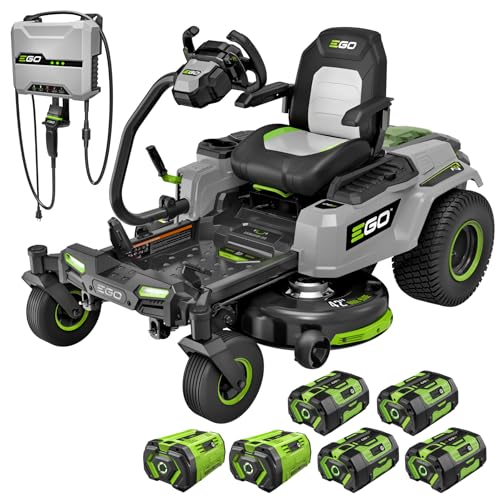
The best battery powered zero turn riding mowers are the EGO POWER+ Z6 for the widest range of deck sizes, the Greenworks CrossoverZ for a practical 60V alternative, and higher-capacity 80V or commercial machines when you regularly mow several acres or tackle slopes.
Our top picks



As an Amazon Associate we earn from qualifying purchases at no extra cost to you. Ratings are shown as listed on Amazon.
Quick comparison
The figures below are manufacturer-stated specifications or advertised maximums. Runtime changes substantially with grass height, moisture, blade speed, slope, operator weight, and how often the mower stops to reposition.
| Mower or spec class | Cutting width | Battery capacity | Stated runtime | Charging time | Best terrain and lawn size |
|---|---|---|---|---|---|
| EGO POWER+ Z6 ZT4201L | 42 inches | Four 10Ah batteries; approximately 2,240Wh nominal at 56V | Up to 2 acres | About 2 hours with the included charger system | Flat or gently rolling lawns up to roughly 1–2 acres |
| EGO POWER+ Z6 ZT5201L | 52 inches | Six 10Ah batteries; approximately 3,360Wh nominal | Up to 2 acres | About 2 hours with the included charger system | Large, mostly open lawns where maneuverability and deck width both matter |
| EGO POWER+ Z6 ZT6123L | 60 inches | Six 12Ah batteries; approximately 4,032Wh nominal | Up to 4 acres | About 3 hours with the included charger system | Large open properties with relatively firm, maintained ground |
| Greenworks CrossoverZ 60V | 42 inches | Four 8Ah batteries; approximately 1,920Wh nominal at 60V | Up to 2 acres | Roughly 90 minutes, depending on charger configuration | Small to medium lawns, especially for owners already using Greenworks 60V tools |
| High-capacity 72–80V battery zero-turn | 48–60 inches | Usually 3,000–5,000Wh nominal | Often advertised at 2–4 acres | Approximately 2–5 hours | Large lawns and light commercial work; choose models with suspension and traction control for uneven ground |
How to choose the right mower for your lawn
1. Match deck width to obstacles, not just acreage
A 60-inch deck covers more ground per pass, but it is not automatically the best choice. Measure gates, narrow side yards, tree spacing, and the tightest route to your storage area before buying.
- 42 inches: Best for residential lawns with gates, landscaping, trees, and passages below about 48 inches. It is also easier to position on a trailer.
- 48–52 inches: A useful middle ground for open suburban properties where a 42-inch mower feels slow but a 60-inch machine would be awkward.
- 60 inches: Best for broad, open areas. The extra width reduces mowing time, but the machine may leave uncut strips around trees and require more battery energy in thick grass.
Zero-turn steering saves time around obstacles, but it does not eliminate trimming. A wider deck can increase the amount of hand-trimming around beds, fences, and posts.
2. Treat advertised runtime as an upper bound
Manufacturers generally state runtime under favorable conditions. A realistic shopping estimate is often 60–80% of the advertised figure when mowing dense grass at a normal height. Slopes, wet turf, a low cutting height, and frequent blade-deck loading can reduce it further.
For example, suppose a mower carries four 10Ah batteries rated at 56V. Its nominal energy is:
4 × 10Ah × 56V = 2,240Wh
If the mower consumes an average of 2,000W while cutting, the theoretical runtime is:
2,240Wh ÷ 2,000W = 1.12 hours
Allowing for reserve capacity, drivetrain losses, acceleration, and uneven grass may reduce usable mowing time to around 45–55 minutes. That does not mean the manufacturer’s acreage claim is false: acreage depends on mowing speed, overlap, grass conditions, and whether the blades run continuously.
Use the mower’s stated acreage as a comparison point, then leave a reserve of at least 20% so you are not forced to finish on critically low batteries.
3. Calculate your lawn’s mowing time
A simple estimate helps compare deck sizes. Use:
Acres per hour = deck width in feet × mowing speed in miles per hour × efficiency factor ÷ 8.25
The efficiency factor accounts for turning, overlap, obstacles, and stopping. Use 0.60 for a complicated lawn, 0.70 for an average lawn, and 0.80 for a broad open field.
For a 42-inch mower at 5mph on an average lawn:
3.5 × 5 × 0.70 ÷ 8.25 = approximately 1.48 acres per hour
In practice, an acre may take about 40–50 minutes once turning and obstacles are included. A 60-inch mower at the same speed and efficiency calculates to about 2.1 acres per hour, but only if the ground is open enough to use the wider deck effectively.
Head-to-head: the leading residential choices
EGO POWER+ Z6: best overall flexibility
The EGO Z6 range stands out because it is available with 42-, 52-, and 60-inch decks and uses the company’s 56V battery platform. The smaller ZT4201L is the more sensible fit for a typical residential lawn: it can pass through tighter spaces and uses fewer batteries. The six-battery ZT5201L and ZT6123L offer a larger energy reserve for bigger properties.
The Z6 is particularly attractive if you already own EGO outdoor tools, since compatible batteries can be shared in principle, although using mower batteries in handheld tools may be impractical because of their size and weight. Its dashboard, selectable blade speeds, LED lighting, and adjustable driving modes add convenience, but the key buying decision remains battery capacity and deck width.
Choose the 42-inch model for obstacle-heavy properties, the 52-inch model for a broad residential lawn, and the 60-inch model only when your gates and storage route can accommodate it.
Greenworks CrossoverZ 60V: best for a smaller battery ecosystem
The Greenworks CrossoverZ 60V is a strong match for homeowners already invested in Greenworks 60V equipment. Its 42-inch deck is easier to maneuver than a large commercial-style deck, while the four-battery system gives it enough energy for many lawns up to roughly two acres under favorable conditions.
Its main limitation is not cutting performance but charging logistics. If your property is close to the mower’s maximum advertised acreage, plan to charge immediately after mowing and confirm how many batteries the specific package includes. Product bundles can differ, and battery capacity matters more than the mower’s voltage label alone.
72–80V and commercial-class machines: best for demanding ground
Higher-voltage machines are not automatically faster, but they can support larger motors, larger battery packs, and stronger drivetrain components. They make more sense on several-acre properties, frequently overgrown grass, or light commercial routes where a residential mower would spend too long at maximum load.
For hills and uneven ground, prioritize a low center of gravity, wide rear tires, a stable seat, good forward traction, and a manufacturer-approved slope limit. A zero-turn mower can pivot efficiently on flat ground but may be less forgiving than a conventional tractor on a steep side slope. Avoid judging hill suitability from battery voltage alone.
Decision matrix
| Your situation | Recommended class | Why | What to avoid |
|---|---|---|---|
| Under 1 acre with gates and many trees | 42-inch, 2,000–2,500Wh system | Enough reserve without excessive width or weight | 60-inch decks that cannot reach all areas |
| 1–2 acres, mostly open, flat lawn | 42–52 inches, at least 2,200Wh | Balances maneuverability, coverage, and charging time | Small packs that require a mid-job recharge |
| 2–4 acres of open grass | 52–60 inches, approximately 3,300Wh or more | Wider coverage and a larger energy reserve reduce downtime | Residential packs rated only for 1–2 acres |
| Frequent hills or rough ground | High-capacity model with strong traction hardware | Stability and usable power matter more than deck width | Light machines chosen solely by advertised acreage |
| Limited overnight charging access | Model with removable batteries or fast multi-battery charging | Lets you charge indoors or prepare a spare set | Integrated packs with no practical backup plan |
Features worth paying for
- Battery readout in watt-hours or percentage: More useful than a simple “fuel gauge” because you can plan around remaining energy.
- Adjustable blade speed: Lower settings can reduce consumption in short, dry grass; use higher power for dense or damp growth.
- Wash-port or accessible deck: Battery motors reduce engine maintenance, but grass buildup still affects cutting quality and energy use.
- Replaceable battery packs: Important if you want to extend the mower’s service life after the original pack eventually loses capacity.
- Suspension seat and wide tires: More valuable on uneven ground than cosmetic dashboard features.
Bottom line
For most homeowners, the EGO POWER+ Z6 ZT4201L is the safest starting point: its 42-inch deck suits ordinary residential access, and its battery capacity is appropriate for many lawns up to about two acres. Choose the Greenworks CrossoverZ 60V when its 60V battery ecosystem fits your existing tools and your lawn is similarly sized. Move to a six-battery 52- or 60-inch EGO Z6, or a high-capacity 72–80V machine, when your property is genuinely large and open.
The decisive specifications are not voltage or top speed in isolation. Compare usable battery capacity, deck width, charging time, access restrictions, and terrain together—and size the battery reserve for real grass conditions rather than the most optimistic acreage claim.