Key takeaways
- Best advantage: stable cooking temperature with minimal fire management.
- Weakness: requires power and usually costs more than a basic gas-and-charcoal combo.
- Choose pellet when: you smoke often but do not want to adjust vents every 20 minutes.
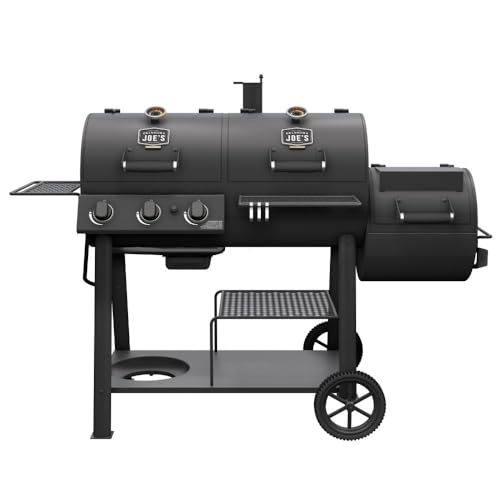
The best grill smoker combos for most backyards are the Char-Griller Dual Function 2-Burner for low-cost charcoal-and-gas flexibility, the Oklahoma Joe’s Longhorn Reverse Flow for traditional smoking, and a pellet model such as the Traeger Pro 575 when temperature automation matters more than having separate fuel chambers.
There is no single best design because “combo” can mean two fuel systems in one cabinet, an offset smoker with a grill chamber, or a pellet cooker that smokes and grills from the same firepot. The right choice depends on whether you value fast weeknight cooking, wood-fired flavor, high-heat searing, or large-batch smoking.
Our top picks


As an Amazon Associate we earn from qualifying purchases at no extra cost to you. Ratings are shown as listed on Amazon.
Best grill smoker combos at a glance
| Best for | Model or spec class | Fuel | Approx. cooking area | Temperature range or capability | Typical assembly time | Typical market range |
|---|---|---|---|---|---|---|
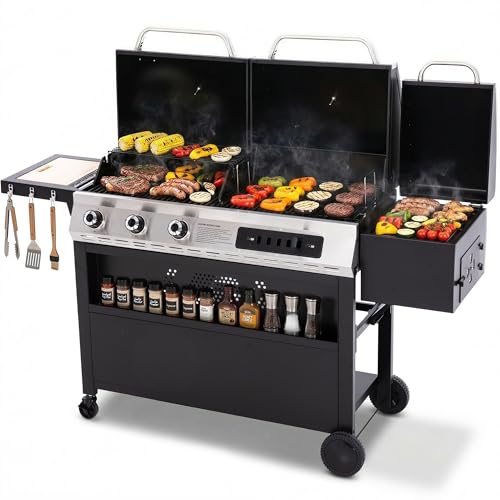
| Separate gas and charcoal cooking | Char-Griller Dual Function 2-Burner | Propane and charcoal | About 1,200 sq in total, depending on configuration | High-heat grilling plus indirect smoking | 2–4 hours | Usually $300–$500 |
| Traditional offset barbecue | Oklahoma Joe’s Longhorn Reverse Flow | Charcoal and wood | About 1,000 sq in total | Best around 225–275°F for smoking; higher for grilling | 3–5 hours | Usually $450–$700 |
| Automated smoking and roasting | Traeger Pro 575 | Wood pellets | 575 sq in | About 180–500°F, depending on operating mode | 1–2 hours | Usually $700–$900 |
| Gravity-fed charcoal convenience | Char-Griller Gravity 980 | Charcoal and wood chunks | About 980 sq in | Low-and-slow smoking through high-heat grilling | 2–4 hours | Usually $700–$1,000 |
| Portable charcoal-and-gas flexibility | Gas-and-charcoal dual-fuel specification class | Propane and charcoal | Usually 500–800 sq in | Fast gas cooking and charcoal searing | 1.5–3 hours | Usually $250–$500 |
Cooking-area figures are manufacturer-rated totals, not always the amount that can comfortably hold food at once. Grates, warming racks, fireboxes, and separate chambers may all be included, so leave space for airflow and turning food.
Head-to-head: pellet, charcoal, and gas combinations
Pellet: easiest temperature control
Pellet cookers use an electric auger and fan to feed compressed hardwood pellets into a firepot. You select a temperature, and the controller adjusts fuel delivery. Models such as the Traeger Pro 575 are therefore the least demanding option for brisket, pork shoulder, ribs, and roasting.
The trade-off is electrical dependence. A pellet cooker needs a weather-protected outlet, and its flavor is usually subtler than a well-managed charcoal or offset fire. Pellet grills can grill burgers and chicken effectively, but many do not match a dedicated gas burner or charcoal bed for rapid, extremely hot searing. Look for a model with a direct-flame or high-heat mode if steaks are a priority.
- Best advantage: stable cooking temperature with minimal fire management.
- Weakness: requires power and usually costs more than a basic gas-and-charcoal combo.
- Choose pellet when: you smoke often but do not want to adjust vents every 20 minutes.
Charcoal and offset: strongest smoke character
Traditional charcoal-and-wood combinations, including the Oklahoma Joe’s Longhorn Reverse Flow, reward active cooking. The fire needs airflow control, fuel additions, and occasional food rotation. Reverse-flow plates help distribute heat more evenly than a simple offset design, but they do not make the cooker fully automatic.
Offset models are excellent for brisket and ribs when you enjoy tending the fire. They also provide a separate grill chamber or firebox for direct cooking. Their biggest drawback is efficiency: thin steel loses heat quickly in cold or windy conditions, while a large chamber can require more charcoal and wood than a pellet grill.
- Best advantage: pronounced wood-smoke flavor and a large cooking environment.
- Weakness: the steepest learning curve and the longest assembly time.
- Choose charcoal or offset when: fire management is part of the appeal and smoke intensity matters most.
Gas-and-charcoal: fastest route to flexibility
A dual-fuel grill such as the Char-Griller Dual Function 2-Burner gives you two different workflows. Propane heats quickly for burgers, sausages, and weeknight meals; charcoal provides stronger browning and smoke. Some designs use separate chambers, while others place both fuel systems in one body.
Gas is convenient but usually produces less smoke than charcoal. If you plan to smoke for six or more hours, verify that the charcoal side has a deep enough bed for indirect cooking and that the lid seals reasonably well. Gas burners are also useful for holding a steady medium temperature while the charcoal section handles a second dish.
- Best advantage: quick startup and genuine fuel choice.
- Weakness: temperature control is less automated than pellet cooking.
- Choose gas-and-charcoal when: you grill frequently but smoke only occasionally.
Decision matrix: match the cooker to your situation
| Your priority | Best fit | Why | What to accept |
|---|---|---|---|
| Cook dinner in 20–30 minutes | Gas-and-charcoal combo, using gas | Fast ignition and predictable preheating | Less smoke flavor |
| Smoke overnight with minimal supervision | Pellet grill | Digital control and automatic fuel feeding | Electricity requirement and higher purchase cost |
| Maximum traditional barbecue flavor | Reverse-flow offset | Burning wood and charcoal gives strong smoke character | Fuel tending and longer learning curve |
| Frequent steaks and occasional ribs | Gas-and-charcoal combo or gravity-fed charcoal grill | Both can reach grilling temperatures while supporting indirect cooking | More cleanup than gas alone |
| Limited patio space | Single-body pellet grill or compact dual-fuel model | One footprint replaces two cookers | Less separation between cooking zones |
| Cooking for 10–15 people | Large offset or 900-plus-square-inch combo | More room for multiple racks and zones | Longer warm-up and higher fuel use |
Temperature control: what the numbers mean in practice
For smoking, a cooker that can hold 225–275°F is more useful than one that advertises an impressive maximum temperature. At 250°F, a pork shoulder may take roughly 1.5–2 hours per pound before resting, although thickness, wrapping, weather, and the desired internal temperature change the result.
For direct grilling, 450–550°F at the grate is generally enough for burgers, chicken thighs, and steaks. A gas-and-charcoal combo should have at least one burner or charcoal zone that can be isolated from the food for two-zone cooking. On an offset, use the main chamber for indirect heat and reserve the firebox grate for smaller, high-heat items.
Do not rely only on the lid thermometer. Lid gauges can read substantially differently from grate level, especially near the firebox. Place a separate probe beside the food, then adjust vents or burner settings based on that reading.
A worked fuel and capacity calculation
Suppose you want to cook three racks of ribs, two 8-pound pork shoulders, and a tray of chicken. A practical planning estimate is:
- Three rib racks: about 180–240 sq in of grate space.
- Two pork shoulders: about 220–300 sq in, depending on shape.
- Chicken tray and airflow clearance: about 180–250 sq in.
- Turning and spacing allowance: roughly 20 percent.
Using the middle of those ranges gives 210 + 260 + 215 = 685 sq in. Adding 20 percent produces about 822 sq in. That means a cooker advertised at 575 sq in may be tight for this menu, while a 900–1,000 sq in model gives useful breathing room. The calculation also explains why a smaller cooker can outperform a larger one for a single family meal: it heats faster and wastes less fuel.
Assembly time and ownership details
Assembly is part of the buying decision. Basic gas-and-charcoal grills usually require attaching legs, shelves, handles, burners, and grates. Pellet grills add a hopper, auger, controller, and electrical connections. Offset smokers are often the slowest because the firebox, chimney, baffles, doors, and heavy body must be aligned carefully.
Plan for a second person when lifting an offset or large pellet grill. After assembly, perform a burn-in: remove packaging, run the cooker at a high setting for the manufacturer’s recommended period, and let it cool before adding food. This clears manufacturing oils and confirms that the controller, burners, vents, and thermometer work correctly.
Buying checklist
- Measure the complete footprint, including lid clearance and side shelves.
- Confirm whether the advertised cooking area includes warming racks.
- For pellet models, check outlet placement, controller features, and resistance to rain.
- For charcoal models, inspect the depth of the firebox and the quality of the ash removal system.
- For gas models, verify the number of burners and whether replacement regulators and grates are available.
- Prefer a separate grate-level thermometer or plan to add one.
- Budget for a cover, heat-resistant gloves, fuel storage, and a reliable instant-read thermometer.
For most households, choose gas-and-charcoal if fast grilling is the priority, pellet if consistent smoking is the priority, and a reverse-flow offset if traditional smoke flavor and hands-on fire management are the reason you want a combo cooker in the first place.