Key takeaways
- Compare the best mouse wrist rests for gaming, from gliding palm rests that move with your hand to cooling gel and memory foam pads for long sessions.
Most wrist rest roundups are really about keyboards. The long foam bar in front of a board is well covered, but the mouse hand has a different problem: it travels. A support that works while you type can turn into an anchor when you need to sweep, flick, and re-center a mouse for hours. That is why standalone mouse wrist rests split into two camps — padded rests that stay planted in one spot, and gliding palm rests that ride along under your hand as it moves.
This guide covers only standalone mouse rests, not keyboard bars and not mouse pads with a rest built in. We compare the two gliding designs that define the category, a budget glider, and two padded options for players who aim mostly from the wrist and want a fixed cushion. Every pick below is a current listing with a confirmed model, size, and material, so you can match the rest to your grip style and hand size before you buy.
Disclosure: As an Amazon Associate, we earn from qualifying purchases made through links in this article, at no extra cost to you.
Quick Picks
| Product | Best for | ASIN |
|---|---|---|
| DeltaHub Carpio 2.0 | Best gliding palm rest overall | B098P8C3BT |
| DeltaHub Carpio G 2.0 | Fast flicks and FPS play | B0CDH1T73C |
| Virtusx Ergonomic Mouse Wrist Rest | Gliding support on a budget | B08Y853CR3 |
| HyperX Wrist Rest – Mouse | Cooling gel comfort in a fixed pad | B09SGTWKWV |
| BRILA Ergonomic Memory Foam Mouse Wrist Rest | Compact desks and small hands | B07DF83HK7 |
How to Choose a Mouse Wrist Rest
Gliding vs. stationary
The first decision is whether the rest should move. Gliding rests sit under the heel of your palm and slide across the pad or desk on low-friction feet, so support stays under your hand through a full sweep. They suit arm and hybrid aimers who cover a lot of pad. Stationary rests are soft pads that sit in one place; they suit wrist aimers who pivot from a fixed point and lift the mouse to re-center. Neither style is better in the abstract — the right one follows how your hand actually travels during a match.
Height and alignment
A mouse rest should lift the wrist just enough to keep the hand level with the mouse, not tilt it upward. Gliding models raise the palm by roughly half an inch to a centimeter. Padded models run thicker — around 22 mm for the HyperX below — which pairs well with tall mice and can feel like too much under a low, flat mouse.
Sizing and handedness
Gliding rests are handed and sized. The Carpio line comes in right- and left-handed shells, each in small and large, and the maker suggests sizing by comparing your hand to a credit card. Padded rests are ambidextrous and simpler: check the length against the space in front of your mouse area, and the thickness against your mouse height.
Materials and upkeep
Silicone pads on a hard shell wipe clean and glide on PTFE feet, but feel firmer than foam. Gel and memory foam feel softer at first touch and hold the wrist in a shallow cradle, though foam compresses over months of daily use. Cloth covers breathe better in warm rooms; smooth covers wipe clean after a spill.
Grip style fit
Palm grip players put the most weight on a rest and gain the most from one. Claw grip players rest lighter and often prefer a slim glider that stays out of the way during fingertip corrections. Fingertip grip players may find any rest slows them down, though a low glider still helps during menu and strategy time between matches.
The Best Mouse Wrist Rests for Gaming
DeltaHub Carpio 2.0

Specs
- Gliding palm rest with PTFE feet and an ABS base
- Silicone contact pads, contoured to the palm
- Right- and left-handed versions, small and large sizes
- Raises the wrist by about 1 cm
- Weight: 0.08 kg (large)
- Model: DELTAHUB-Carpio-Ergo-RH-WR-LS-BL-LG-BK (right, large, black)
The Carpio 2.0 is the design that made gliding rests a category. Instead of a cushion you rest on, it is a shaped shell that cradles the heel of the palm and slides with it on PTFE runners, lifting the wrist about a centimeter so the hand sits level with the mouse. The contoured shape shifts pressure toward the lower palm and away from the center of the wrist, and the hollow base keeps it light.
Because it moves with you, it fits arm and hybrid aimers who found fixed pads kept catching their wrist mid-sweep. Expect an adjustment period of a week or two while your hand learns to trust the glide. Sizing matters more here than with any foam pad: pick the shell that matches your hand and your mouse hand, since a left-handed version exists for southpaw players.
Best for: players who want gliding support that follows full mouse sweeps.
DeltaHub Carpio G 2.0

Specs
- Gaming version of the Carpio gliding rest
- Removable, adjustable silicone strap with N52 magnetic attachment
- Perforated silicone pads for airflow
- PTFE gliders on the base
- Small and large sizes, right-handed and left-handed versions
- Weight: about 3.2 oz
The G 2.0 takes the Carpio idea and fixes its one weakness in fast games: during a hard flick, a loose rest can lag behind the hand. The magnetic strap loops over the wrist and keeps the rest attached through lifts, flicks, and quick re-centers, then pops off when you want it gone. The pads are perforated, which helps on warm days when the solid pads of the standard model can feel sticky against skin.
In play, the strap changes the feel from “a rest you balance on” to “a rest that comes with you,” which is exactly what FPS and battle royale players need when the mouse leaves the pad’s center every few seconds. If your games are slower paced, the standard Carpio 2.0 gives you the same glide for less complexity; if your aim style is violent, this is the one to get.
Best for: FPS players whose fast flicks leave a loose rest behind.
Virtusx Ergonomic Mouse Wrist Rest

Specs
- Gliding palm rest with a curved, palm-shaped shell
- Raises the palm by about half an inch
- Silicone fill with a smooth plastic cover
- Slides on hard desks and mouse pads
- Model: ENHMR (Enoch)
- Single size, black finish
The Virtusx takes the gliding concept and strips it down to the basics: a curved shell that cups the palm, a silicone core, and a smooth underside that slides as your hand moves. It lifts the palm roughly half an inch, a touch lower than the Carpio’s lift, and the one-size shell keeps the decision simple.
The trade-offs are fit and finish. There are no size options, no handed versions, and no strap for aggressive flicks. As a first gliding rest, though, it answers the only question that matters — whether a moving rest suits your aim — at the lowest commitment in this guide.
Best for: trying the gliding style without paying for the premium designs.
HyperX Wrist Rest – Mouse

Specs
- Stationary padded rest sized for mouse use
- Cooling gel layered with memory foam
- Dimensions: 228 × 88 mm, 22 mm thick
- Anti-slip rubber base with anti-fray stitching
- Weight: 6.7 oz
- Model: 4Z7X2AA
HyperX shrinks its well-known keyboard rest down to mouse size, and the result is the best fixed pad here for wrist aimers. The cooling gel layer gives it a cool first touch that foam-only pads lack, and the memory foam underneath holds a shallow cradle without bottoming out during long sessions. At 228 mm long it spans the width of a typical mouse area, so your wrist stays supported through small corrections without the pad wandering.
The 22 mm height is the spec to check: it lines up neatly with mid-height and tall gaming mice, and it can feel like a speed bump under very low mice. The rubber base grips hard and soft pads alike, and the stitched edges hold up better than glued seams when the pad gets shoved around a desk. If your aim lives in a small area and your wrist aches at the desk edge, this is the straightforward fix.
Best for: wrist aimers who want a cool, fixed cushion that stays put.
BRILA Ergonomic Memory Foam Mouse Wrist Rest
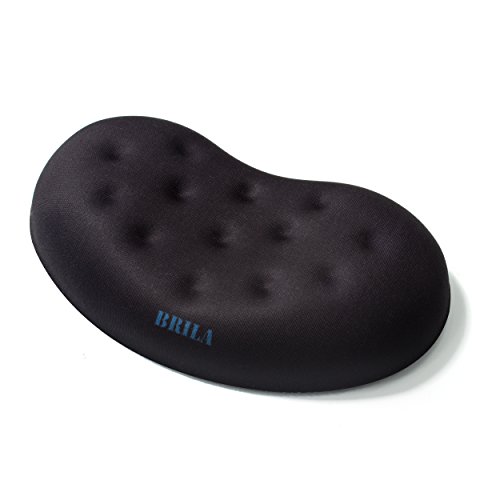
Specs
- Compact standalone memory foam rest
- Dimensions: 5.1 × 3.1 × 0.8 inches
- Molded wrist groove with massage holes
- Lycra cover over slow-rebound memory foam
- Non-slip PU base
- Listed 2-year replacement coverage
The BRILA is the smallest rest in this guide, a palm-sized cushion with a molded groove that your wrist settles into. The groove does the positioning work for you, which makes it a friendly option if you are new to mouse rests and unsure where the support should sit. The massage holes break up the contact surface, and the Lycra cover feels smooth when you slide on and off the pad between rounds.
At 0.8 inches thick it adds less height than the HyperX, so it pairs better with low and medium mice, and the small footprint fits cramped desks and laptop setups where a 228 mm pad would crowd the mouse area. The compromise is travel: the groove holds your wrist in one spot, so wide arm sweeps will run off the edge of the cushion. For compact setups and shorter sessions, that is a fair trade.
Best for: small desks, laptop gaming, and anyone who wants a low, guided cushion.
FAQ
Do gliding wrist rests actually help in fast-paced games?
They help players who move the mouse with the arm or a mix of arm and wrist, because support stays under the palm through the whole sweep instead of ending at the edge of a fixed pad. The strapped Carpio G 2.0 exists for the fastest styles, since it stays attached during flicks. Pure fingertip players may still prefer no rest at all during matches and use one only for desktop time.
Will a mouse wrist rest slow down my aim?
A rest that is too tall can, because it bends the wrist back and adds drag against the pad. Match the height to your mouse: slim gliders for low mice, thicker gel pads for tall mice. Most players adapt within a week or two, and the comfort gain during long sessions is the reason to persist through the adjustment.
How do I choose between the Carpio 2.0 and the Carpio G 2.0?
Choose the G 2.0 if you play shooters with frequent flicks and lifts, since the magnetic strap keeps the rest on your hand. Choose the standard 2.0 for mixed gaming, strategy titles, and desktop work, where the strap is unnecessary. Both come in small and large, in right- and left-handed shells, so size by hand first and pick the version by game pace second.
Can I use a keyboard wrist rest for my mouse instead?
You can, but the fit is poor. Keyboard rests are long bars built to span a board, so they crowd the mouse area and force the wrist to pivot over a corner. A mouse rest is sized for the space your mouse hand actually uses, and a gliding model moves in a way a keyboard bar never will. The HyperX mouse size exists precisely because the keyboard version is the wrong shape for mousing.
Conclusion
For most players, the DeltaHub Carpio 2.0 is the pick: it is the gliding rest the category is measured against, sized and handed to fit properly. Step up to the Carpio G 2.0 if flick-heavy shooters keep leaving a loose rest behind, or try the Virtusx first if you want to test the gliding idea on a budget. If your aim stays in one place and you simply want the ache gone, the HyperX mouse rest brings cooling gel comfort in a fixed pad, and the compact BRILA covers small desks and low mice. Match the style to how your hand moves, and your wrist will feel the difference within a week.
FAQ
Do gliding wrist rests actually help in fast-paced games?
Will a mouse wrist rest slow down my aim?
How do I choose between the Carpio 2.0 and the Carpio G 2.0?
Can I use a keyboard wrist rest for my mouse instead?
More from Amazon
Programs that pair well with the guide above. Offers and eligibility are set by Amazon and may change.
Free shipping on eligible items, Prime Video and more. Eligible new members can start with a free trial.
Start a Prime free trialAd-free music streaming. Eligible new subscribers can start with a free trial.
Try Music Unlimited freeA Prime membership for ages 18-24 with a trial period. Eligibility is set by Amazon.
See Prime for Young AdultsAudiobooks and podcasts to listen to on the go. Eligible new members can start with a free trial.
Try Audible freeAs an Amazon Associate we earn from qualifying purchases.