Key takeaways
- Tales of Berseria PC requirements and the best GPU, CPU, RAM and SSD to run it — recommended hardware by resolution plus complete 1080p, 1440p and 4K build guides.
Thinking about playing Tales of Berseria on PC and wondering what hardware you actually need? The good news is that this action JRPG from Bandai Namco is one of the lightest games you can install today. Released on January 26, 2017 and built around a DirectX 9.0c renderer, it was designed for hardware from the late 2000s, so almost any desktop or laptop built in the last decade will run it. This guide covers the official Tales of Berseria PC system requirements, what each resolution realistically needs, CPU, RAM and storage advice, and complete build recommendations for 1080p, 1440p and 4K.
Our top picks
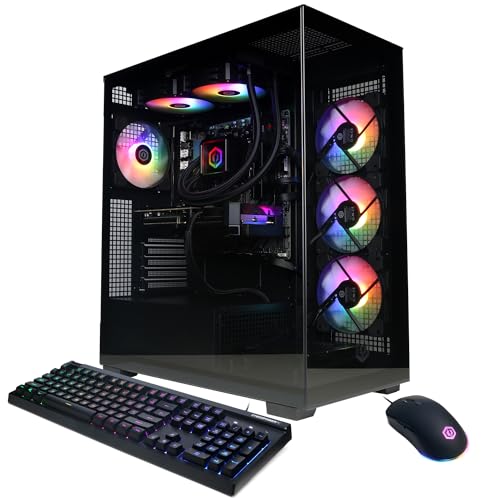
 CyberPowerPC Gaming PC
- System: AMD Ryzen 5 5500 3.6GHz 6 Cores…
- Graphics: AMD Radeon RX 6500 XT 4GB Graphics…
- Connectivity: 1 x USB-C 3.2 | 5 x…
| Product | Key specs | |
|---|---|---|
 CyberPowerPC Gaming PC | Check price | |
 CyberPowerPC Gaming PC | Check price | |
| CyberPowerPC Gaming PC | System: AMD Ryzen 5 5500 3.6GHz 6 Cores… Graphics: AMD Radeon RX 6500 XT 4GB Graphics… Connectivity: 1 x USB-C 3.2 | 5 x… | Check price |
 CyberPowerPC Gamer Master Gaming PC | System: AMD Ryzen 7 8700F 4.1GHz 8 Cores… Graphics: NVIDIA GeForce RTX 5060 Ti 8GB Graphics… Connectivity: 2 x USB-C 3.2 | 4 x… | Check price |
As an Amazon Associate we earn from qualifying purchases at no extra cost to you.
How Demanding Is Tales of Berseria?
Tales of Berseria is a light game, and it is an old one — it launched on January 26, 2017 and runs on DirectX 9.0c. Its cel-shaded art style has aged well without ever asking much of a graphics card. The official minimum spec asks for a GeForce 9800 GTX or Radeon HD 4850, cards from 2008, alongside 2 GB of system RAM. The official recommended spec only steps up to a GeForce GTX 560 or Radeon HD 7870 and 4 GB of RAM.
In practical terms, that means budget cards and even modern integrated graphics can handle 1080p comfortably, and 1440p and 4K are within reach of modest current-generation GPUs rather than high-end ones. Tales of Berseria is also not a CPU-heavy title: it is a single-player action JRPG with no large-scale simulation, no dense open world and no big multiplayer matches, so processor load stays low throughout. The only figure worth planning around is the 15 GB of free storage space the game requests.
Tales of Berseria Official PC System Requirements
| Component | Minimum (official) | Recommended (official) |
|---|---|---|
| OS | Windows 7, 8, 10 (64-bit) | Windows 7, 8, 10 (64-bit) |
| Processor | Intel Core 2 Duo E8400 3.0GHz or AMD Phenom II X2 550, 3.1GHz | Intel Core i5-750, 2.66GHz or AMD Phenom II X4 965, 3.2GHz |
| Memory | 2 GB RAM | 4 GB RAM |
| Graphics | GeForce 9800 GTX or AMD Radeon HD 4850 | GeForce GTX 560 or Radeon HD 7870 |
| DirectX | Version 9.0c | Version 9.0c |
| Storage | 15 GB available space | 15 GB available space |
Source: the official Tales of Berseria™ Steam store listing (app 429660), checked October 2026. Publishers can update these specs after patches.
Best GPU for Tales of Berseria by Resolution
1080p
At 1080p the official recommended hardware — a GeForce GTX 560 or Radeon HD 7870 — is already enough, so nobody needs to buy a modern card specifically for this game. If you are shopping anyway, an entry-level GPU from the last few generations such as a GeForce GTX 1650 or Radeon RX 6400 handles Tales of Berseria without strain, and a current-generation card like the AMD Radeon RX 7600 sits far above anything the game can use. Many modern desktop processors with integrated graphics can also run it at 1080p.
1440p
1440p is still easy territory for Tales of Berseria, because the engine predates the effects that make modern games expensive to render. Cards from the recommended tier upward cope fine, and older mid-range options such as a GeForce GTX 1060 or Radeon RX 580 are already sufficient. A current card like the AMD Radeon RX 7600 or GeForce RTX 5060 gives you plenty of headroom, and an RX 9060 XT is more than this resolution needs.
4K
4K is genuinely achievable here with a modest modern GPU, which is unusual for a game article and reflects how light the renderer is. An NVIDIA GeForce RTX 5060 or AMD Radeon RX 9060 XT is enough to drive Tales of Berseria at 4K, and stepping up to an RTX 5070 or RX 9070 simply adds headroom rather than unlocking playability. Even the previous-generation NVIDIA GeForce RTX 4060 handles 4K in this title. Tales of Berseria at 4K is not a heavy load, so there is no need to chase a flagship card for it.
CPU, RAM and Storage for Tales of Berseria
The official processor requirement tops out at an Intel Core i5-750, 2.66GHz or AMD Phenom II X4 965, 3.2GHz, with a Core 2 Duo E8400 or Phenom II X2 550 as the minimum — all of them 2008–2009 parts. Any CPU sold in the last decade clears that bar with room to spare, and because Tales of Berseria is not a CPU-heavy game you will not see meaningful gains from a faster chip. If you are building a general-purpose gaming PC anyway, the AMD Ryzen 5 7600 is a strong value choice, while the AMD Ryzen 7 7800X3D and Intel’s Intel Core i5-14600K are far more processor than this game can use.
Memory is just as modest: the official minimum is 2 GB and the recommended figure is 4 GB. In practice 8 GB is a comfortable baseline for a modern system and 16 GB covers everything else you are likely to run alongside it. A 32 GB DDR5 kit such as the Corsair Vengeance DDR5 32GB is a sensible long-term purchase for a new build, though Tales of Berseria itself will never come close to using that much. Storage is a modest 15 GB, so the game fits on almost any drive. An SSD is not required, but installing Tales of Berseria on one — an NVMe drive like the Samsung 990 Pro 2TB NVMe SSD, for example — shortens load times and area transitions noticeably.
Recommended PC Builds for Tales of Berseria
1080p budget build: AMD Radeon RX 7600 + AMD Ryzen 5 7600 + 16 GB DDR5 — enormously more than Tales of Berseria needs at 1080p, and a solid base for newer games too.
1440p sweet-spot build: AMD Radeon RX 7600 + AMD Ryzen 7 7800X3D + 32 GB DDR5 + 2TB NVMe SSD — for Tales of Berseria alone you could spend far less, but this is the setup most players should aim for if they also play demanding modern titles.
4K high-end build: NVIDIA GeForce RTX 4060 + AMD Ryzen 7 7800X3D + 32 GB DDR5 + fast NVMe SSD — comfortably above what Tales of Berseria requires at 4K, and a well-rounded high-end system overall.
Is It Worth Upgrading Your PC for Tales of Berseria?
Usually, no — and it is worth being honest about that. Tales of Berseria runs on hardware from around 2008, so it is rarely a good reason to spend money on new components. If your current PC is genuinely ancient (a pre-2010 graphics card, 2 GB of RAM, a mechanical drive and a dual-core CPU), then it is a fine excuse to modernise, but you should treat the upgrade as an investment in everything else you want to play. If you do upgrade, the graphics card delivers by far the biggest jump in gaming performance, so start there. A modern quad-core processor will not bottleneck a current GPU in this game, so you can usually keep your CPU, and adding RAM or moving the game to an SSD is a cheap way to smooth out loading and general responsiveness. Rather than replacing everything at once, target the weakest link in your build for the best value.
Can You Play Tales of Berseria on a Laptop or Handheld?
Very easily. The official minimum is a GeForce 9800 GTX-class GPU, so almost any gaming laptop from the last decade — even one with an older mobile GPU — can run Tales of Berseria at 1080p, and modern integrated graphics in thin-and-light laptops can often manage it too. Expect shorter battery life and more heat than a desktop, as always. On handhelds like the Steam Deck and ROG Ally, this light, older title runs comfortably at reasonable settings, making it a great portable pick for a long RPG. If portability matters, prioritise a device with a decent GPU and pair it with a fast microSD card or SSD for storage — the game only needs 15 GB.
How to Boost FPS in Tales of Berseria
Tales of Berseria predates DLSS, FSR and XeSS, so you cannot rely on in-game upscaling to lift performance the way you would in a modern release. Instead, if you do run into trouble, lower the render resolution first — that is the single biggest lever — and use any driver-level scaling option your GPU control panel offers. After that, reduce the more expensive visual effects such as shadows and post-processing before turning down everything else, and keep your GPU drivers up to date. Closing background applications frees up resources, and installing the game on an SSD cuts load times even though it will not change frame rates. On a light, older game like this, the smoothest experience usually comes from a modest resolution and a stable, consistent frame rate rather than pushing the highest settings.
Frequently Asked Questions
Can my PC run Tales of Berseria?
Almost certainly. If your PC meets the official minimum — a GeForce 9800 GTX or Radeon HD 4850-class GPU, a Core 2 Duo E8400-class CPU and 2 GB of RAM — it will run Tales of Berseria. In practice any PC built in the last decade, including many laptops using integrated graphics, exceeds those figures. For a comfortable 1080p or 1440p experience, the official recommended tier of a GeForce GTX 560 or Radeon HD 7870 with 4 GB of RAM is more than enough.
Is Tales of Berseria demanding on PC?
No. Tales of Berseria is a light, older game. Its official requirements date back to 2008-era hardware, and even budget or integrated graphics handle it at 1080p.
What GPU do I need for Tales of Berseria at 1440p 60fps?
Very little by modern standards. The official recommended card, a GeForce GTX 560 or Radeon HD 7870, is already sufficient for 1440p, and older mid-range cards like the GTX 1060 or RX 580 will do the job too. A AMD Radeon RX 7600-class graphics card is far more than this game requires, but it gives you comfortable headroom for newer titles as well.
How much RAM does Tales of Berseria need?
The official minimum is 2 GB and the official recommended figure is 4 GB. In practice 8 GB is a comfortable baseline for a modern system and 16 GB is the standard for a general-purpose gaming PC; faster memory makes little difference here because the game is not CPU-limited.
Do I need an SSD for Tales of Berseria?
No — an SSD is optional, and the game only asks for 15 GB of available space. An SSD does reduce load times and area transitions noticeably, so it is a nice quality-of-life upgrade. An NVMe drive like the Samsung 990 Pro is ideal if you are buying storage for a wider game library.