Our Short List of 3
All 5 Picks at a Glance
| Product | Specs | Action |
|---|---|---|
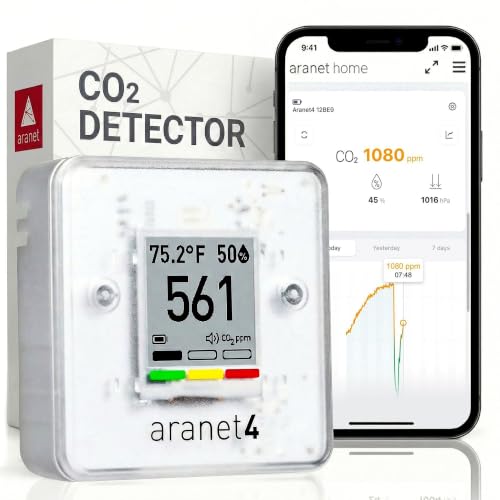 Aranet4 HOME CO2 Monitor | Check price on Amazon | |
 Temtop M2000C 2nd Generation Handheld CO2 Monitor | Check price on Amazon | |
 SwitchBot Meter Pro CO2 Monitor | Check price on Amazon | |
 Qingping Air Monitor Lite | Check price on Amazon | |
 Airthings View Plus Air Quality Monitor | Check price on Amazon |
Key takeaways
- Find the best portable co2 monitors for home, office, and travel. Compare NDIR sensors, battery life, displays, and app features for cleaner indoor air.
The best portable co2 monitors make invisible indoor air visible. Carbon dioxide builds up fast in a closed room: a bedroom overnight, a crowded office, a classroom, or a car with the windows shut. Levels that climb well above outdoor air leave people drowsy and unfocused, and the only way to know is to measure. A portable CO2 monitor shows the number on a display or in an app, so the response is simple and immediate: open a window, turn on ventilation, or step outside for fresh air.
Portability is what separates these monitors from a fixed wall sensor. A portable monitor runs on batteries or a rechargeable cell, fits in a hand or a bag, and moves from room to room. That matters because CO2 varies sharply between spaces: the bedroom may be stuffy while the living room is fine. A single portable monitor can check every room in turn, which is more useful than a fixed sensor that only watches one spot.
This guide covers five portable CO2 monitors that suit different needs. One is the accuracy benchmark with a sensor trusted by schools and offices. One is a handheld multi-gas meter for spot checks and data logging. One is a compact value pick with a large, clear display. One is a small touchscreen monitor that also tracks particles and works with a smart home. And one is a battery-powered multi-sensor monitor for a home where CO2 is one of several things worth watching. All five measure real CO2 with a dedicated sensor rather than estimating it from other gases, which is the single most important thing to check before buying any CO2 monitor.
How to Choose
1. Insist on a real NDIR CO2 sensor
The sensor is the whole product. NDIR, or non-dispersive infrared, sensors measure CO2 directly and are the standard for accurate portable monitors. Cheaper monitors often use an eCO2 estimate, which guesses CO2 from volatile organic compounds and can be far off. If a listing does not name the sensor type, treat its CO2 numbers with caution. Every pick in this guide uses a dedicated CO2 sensor, and the most accurate ones use NDIR with a published accuracy figure.
2. Check the measurement range and accuracy
A useful portable CO2 monitor should measure from outdoor levels up to at least 5,000 parts per million, and the best ones reach 9,999. Accuracy is usually stated as a figure plus a small percentage of the reading, such as plus or minus 30 parts per million plus 3 percent of the reading. A tighter accuracy figure matters for comparing rooms and tracking small changes, while a looser figure is still fine for the basic question of whether a room needs ventilation.
3. Decide between handheld and room-to-room portable
A handheld monitor is carried in the hand for spot checks: walk into a room, wait for the reading to settle, and move on. A room-to-room portable monitor sits on a desk or shelf for hours or days, runs on batteries, and is moved when needed. Handheld meters are best for checking many spaces quickly. Desk-style portables are best for watching one room over time, such as a bedroom overnight or a home office during the workday.
4. Look at the display and alerts
A clear display matters more than it sounds, because the monitor is only useful if the number is easy to read at a glance. An e-ink display is readable in any light and uses very little power. A colour LCD shows more information at once. A simple green, yellow, and red indicator lets anyone in the room understand the air without reading numbers. Audible alarms and app notifications help when the monitor sits in a room where nobody is looking at it.
5. Check battery life and power
Battery life decides how portable a monitor really is. Some run for years on a pair of AA batteries, some run for hours on a rechargeable cell, and some need a USB cable for continuous use. A monitor with multi-year battery life can be left in a classroom or office and forgotten until the batteries need changing. A rechargeable handheld needs regular charging but is easier to carry. Match the power source to the routine: long battery life for a monitor that stays put, and a rechargeable cell for one that travels.
6. Consider app history and smart home support
An app adds history, graphs, and alerts, which turn a single reading into a pattern: the bedroom peaks overnight, or the meeting room climbs every afternoon. Bluetooth sync is enough for a monitor that stays near a phone. Wi-Fi adds remote access and smart home automation, such as turning on a fan when CO2 climbs.
7. Think about size, weight, and extra sensors
A pocket-sized monitor is easy to carry to the office, the classroom, or on a trip. A larger monitor with a bigger display is easier to read from across a room. Extra sensors for particles, temperature, humidity, and volatile compounds add context: temperature and humidity help explain comfort, and particle readings show whether opening a window will help or bring in outdoor pollution. Decide whether CO2 alone is enough, or whether a broader air quality picture is worth a larger device.
Top Picks
Aranet4 HOME CO2 Monitor
The Aranet4 HOME is a battery-powered portable CO2 monitor and the accuracy benchmark in this guide. It uses an NDIR CO2 sensor with a range of 0 to 9,999 parts per million and published accuracy of plus or minus 30 parts per million plus 3 percent of the reading, which is the tightest accuracy figure among the picks here. That precision makes it the monitor schools, offices, and careful home users reach for when the number itself matters, not just a rough indication.
The device is a small white square with an e-ink display that shows CO2, temperature, humidity, and air pressure at a glance, with a colour indicator for quick reading. Two AA batteries last up to about four years, so it can sit in a classroom or bedroom and keep measuring without charging or a cable. Bluetooth connects it to the Aranet app, which stores up to 90 days of history and shows trends over time. It measures CO2 only, with no particle or volatile compound sensor, which keeps it focused and simple.
Who it is for: anyone who wants the most accurate portable CO2 reading available in a small battery-powered device, including teachers, office workers, and home users who track ventilation carefully.
Caveats: it has no particle or volatile compound sensor, so it cannot show the full air quality picture. It uses Bluetooth rather than Wi-Fi, so remote access needs a phone nearby or an additional hub. Confirm the listing is the Home model, not a different Aranet variant.
Temtop M2000C 2nd Generation Handheld CO2 Monitor
Temtop M2000C 2nd Generation Handheld CO2 Monitor
The Temtop M2000C 2nd Generation is a handheld CO2 monitor for spot checks and detailed air quality work. It measures CO2 up to 5,000 parts per million alongside PM2.5, PM10, temperature, and humidity, with an audio alarm that sounds when readings cross a set threshold. That combination suits someone who wants to walk through a building checking rooms in turn, or who needs data logging and export for a workplace or a study.
The handheld design includes a colour display with readings and a graph view, and it exports recorded data to a computer over USB for analysis. The rechargeable battery and compact body make it easy to carry in a bag, and the rubber sleeve protects it during transport. It is the most instrument-like pick in this guide: more information, more settings, and more to learn, in exchange for a broader picture of the air than a CO2-only monitor gives.
Who it is for: people who check many rooms or buildings, who want data logging and export, and who value particle readings alongside CO2 in one handheld device.
Caveats: several different codes circulate for the M2000C 2nd Generation across regional listings, so confirming the exact listing is the top priority before ordering. The handheld form and rechargeable battery mean it needs regular charging, unlike the multi-year battery life of the Aranet4. Confirm the listing is the standalone M2000C 2nd Generation, not a bundle with a thermometer or a carrying case.
SwitchBot Meter Pro CO2 Monitor
SwitchBot Meter Pro CO2 Monitor
The SwitchBot Meter Pro CO2 is a compact portable CO2 monitor and the best value pick in this guide. It uses an NDIR CO2 sensor with a range of 400 to 9,999 parts per million and accuracy of plus or minus 50 parts per million plus 5 percent of the reading, which is solid for everyday ventilation decisions. Its large 92 millimetre LCD display shows CO2, temperature, and humidity at a glance, which makes it easy to read from across a room.
Power comes from two AA batteries or a USB-C cable, so it can sit on a desk for months or be carried to another room without a charger. Bluetooth connects it to the SwitchBot app, and a SwitchBot Hub 2 adds remote access and smart home integration for buyers who want it. The combination of a clear display, a real NDIR sensor, and a modest size makes it the easiest pick here to recommend for a first portable CO2 monitor.
Who it is for: home and office users who want a clear, affordable CO2 monitor with a large display, and anyone buying a first portable monitor for a bedroom, a home office, or a classroom.
Caveats: its accuracy is looser than the Aranet4, so it is best for ventilation decisions rather than precise measurement. Remote access and smart home features need an additional hub. Confirm the listing is the CO2 version, since SwitchBot sells similar-looking meters without a CO2 sensor.
Qingping Air Monitor Lite
The Qingping Air Monitor Lite is a small touchscreen portable monitor that tracks CO2 alongside particles, temperature, and humidity. Its CO2 range runs from 400 to 9,999 parts per million, and it adds PM2.5 and PM10 readings, which show whether opening a window will improve the air or bring in outdoor particles. That broader picture is useful on days when outdoor air is smoky or dusty.
The colour touchscreen shows the readings clearly, and the 2,000 milliamp-hour battery runs for up to seven hours unplugged, which is enough to carry it between rooms or take it to the office for a day. Wi-Fi and app control are included, along with Apple HomeKit support for smart home users. The manufacturer does not state the CO2 sensor type, so its CO2 numbers should be treated as indicative rather than reference-grade, which is the main trade-off against the NDIR picks above.
Who it is for: smart home users and anyone who wants CO2 plus particle readings in a small portable touchscreen device, especially in an Apple HomeKit household.
Caveats: the CO2 sensor type is not stated by the manufacturer, so accuracy is less certain than the NDIR monitors in this guide. Battery life is measured in hours rather than months, so it needs regular charging. Confirm the listing is the Air Monitor Lite, not a different Qingping model.
Airthings View Plus Air Quality Monitor
Airthings View Plus Air Quality Monitor
The Airthings View Plus is a battery-powered multi-sensor monitor and the most complete pick in this guide. It measures seven factors: radon, PM2.5, CO2, volatile compounds, humidity, temperature, and air pressure. That sensor list covers the main indoor air concerns in one device, which makes it a strong choice for a home where CO2 is one question among several, especially a basement or ground-floor room where radon is a real consideration.
The 2.9-inch e-ink display shows the readings clearly, and six AA batteries power the device, so it can be moved from room to room without a cable. Wi-Fi connects it to the Airthings app, which stores history, shows trends, and sends alerts when readings climb. It works with voice assistants and smart home platforms, and it is the only pick here that measures radon.
Who it is for: homeowners who want one battery-powered monitor that watches CO2 plus radon, particles, and volatile compounds, and who move it between rooms rather than carrying it in a pocket.
Caveats: it is larger than a handheld monitor and is a home device rather than a pocket portable, so it suits room-to-room use rather than travel. It measures more than CO2, which adds complexity for buyers who only want a CO2 number. Confirm the listing is the View Plus model 2960, not a bundle with an outdoor sensor.
Comparison Table
| Monitor | CO2 sensor | CO2 range | Power | Best for |
|---|---|---|---|---|
| Aranet4 HOME | NDIR | 0 to 9,999 ppm | 2 AA, up to 4 years | Most accurate portable CO2 reading |
| Temtop M2000C 2nd | CO2 plus PM2.5 and PM10 | Up to 5,000 ppm | Rechargeable | Handheld spot checks, data export |
| SwitchBot Meter Pro CO2 | NDIR | 400 to 9,999 ppm | 2 AA or USB-C | Best value, large clear display |
| Qingping Air Monitor Lite | Not stated | 400 to 9,999 ppm | Rechargeable, 7 hours | CO2 plus particles, smart home |
| Airthings View Plus | CO2 plus 6 more sensors | CO2 included | 6 AA batteries | Whole-home air quality, radon |
Which One Is Right for You?
Start with how accurate the number needs to be. For the most accurate portable CO2 reading, the Aranet4 HOME is the benchmark, with its NDIR sensor and tight accuracy figure. For everyday ventilation decisions, the SwitchBot Meter Pro CO2 gives a real NDIR reading at a lower cost with a larger display. For handheld checks across many rooms with data export, the Temtop M2000C 2nd Generation is the instrument-like option.
Then consider what else the monitor should measure. If CO2 alone is enough, the Aranet4 or the SwitchBot are the simplest choices. If particle readings matter, the Qingping Air Monitor Lite adds PM2.5 and PM10 in a small portable device, and the Temtop adds them in a handheld meter. If radon, volatile compounds, and particles all matter, the Airthings View Plus covers them in one battery-powered unit that moves from room to room.
Finally, think about power and placement. A monitor that runs for years on AA batteries, such as the Aranet4, can be left in a classroom or bedroom and forgotten. A rechargeable monitor, such as the Qingping or the Temtop, needs a charging routine but is easier to carry. Whichever pick fits, place the monitor at breathing height, away from windows and doors, and give it time to settle before trusting the number: a CO2 sensor needs several minutes in a room to reflect the air there.
Frequently Asked Questions
What is a safe CO2 level indoors?
Outdoor air is about 400 to 420 parts per million of CO2. Indoors, under 800 parts per million is good, 800 to 1,000 is acceptable, and above 1,000 it is time to ventilate by opening a window or turning on ventilation. Levels above 2,000 parts per million commonly cause drowsiness and poor concentration. A portable monitor makes those thresholds visible so the response becomes a habit rather than a guess.
How long does a portable CO2 monitor take to give an accurate reading?
A CO2 sensor needs time to adjust to a new room, usually a few minutes after it is moved. Moving a monitor from outdoors into a stuffy room will show a low number at first that climbs as the sensor settles. For spot checks, wait several minutes before trusting the reading. For continuous monitoring, leave the device in place and let it track changes over hours.
Do I need a CO2 monitor if I already have an air quality monitor?
It depends on what the existing monitor measures. Many home air quality monitors track particles and volatile compounds but have no CO2 sensor at all, and some estimate CO2 rather than measuring it. If the goal is to know when a room needs ventilation, a dedicated CO2 monitor with a real NDIR sensor is the right tool. Check the sensor list on the existing device before assuming it covers CO2.
Where should I place a portable CO2 monitor?
Place it at breathing height, on a desk or shelf, away from windows, doors, and direct sources of CO2 such as a stove or a person breathing directly onto it. Avoid placing it right next to a purifier or an open window, which will show cleaner air than the rest of the room. For a bedroom, a bedside table is a good spot. For an office, the desk where people sit gives the most relevant reading.
Disclosure: As an Amazon Associate, we may earn from qualifying purchases.
FAQ
Which One Is Right for You?
What is a safe CO2 level indoors?
How long does a portable CO2 monitor take to give an accurate reading?
Do I need a CO2 monitor if I already have an air quality monitor?
Where should I place a portable CO2 monitor?
More from Amazon
Programs that pair well with the guide above. Offers and eligibility are set by Amazon and may change.
Free shipping on eligible items, Prime Video and more. Eligible new members can start with a free trial.
Start a Prime free trialAd-free music streaming. Eligible new subscribers can start with a free trial.
Try Music Unlimited freeA Prime membership for ages 18-24 with a trial period. Eligibility is set by Amazon.
See Prime for Young AdultsAudiobooks and podcasts to listen to on the go. Eligible new members can start with a free trial.
Try Audible freeAs an Amazon Associate we earn from qualifying purchases.