
Key takeaways
- Pro: IPX7 rating exceeds most competitors at this price.
- Pro: 54-hour playtime eliminates charging anxiety.
- Con: Build quality feels budget; no brand support infrastructure.
What's inside
Workout headphones fail for predictable reasons: sweat kills the electronics, earhooks dig into cartilage after twenty minutes, and noise cancellation either blocks too much ambient sound or lets in every clank from the weight rack. A pair that works at a desk can become worthless the moment your heart rate climbs and your hands get slick.
The eight best workout headphones we compared here span budget earbuds with multi-day battery life to premium noise-canceling models, all selected on published specs, sticker prices, and patterns in owner feedback. What separates the useful ones from the disappointing ones usually comes down to three things: how secure the fit stays under lateral load, whether the controls work with damp fingers, and how much the design accounts for moisture.
As an Amazon Associate we earn from qualifying purchases at no extra cost to you. Product prices and availability are accurate as of the date shown and are subject to change.



Quick Picks
| Product | Best for | Price |
|---|---|---|
| LED Sport Earbuds with Earhooks | Runners on a tight budget | $20.99 |
| Apple AirPods Pro 3 | iPhone users who want ANC and ecosystem integration | $199 |
| Soundcore Q20i (Black) | Commuters who also lift | $39.97 |
| Soundcore V20i | Athletes who need ambient awareness | $26.99 |
| Soundcore Q20i (White) | Color preference over black | $39.97 |
| bmani Ear Buds | Marathon-length battery at a low price | $29.99 |
| JBL Endurance Peak 4 | Serious gym-goers wanting cancellation and sport fit | $99.95 |
| Sony WH-CH520 | Users who prefer on-ear over in-ear | $68 |
How We Picked
For this category, three criteria carry the most weight. First, fit security: a model that shifts during burpees or sprints is a dealbreaker regardless of sound quality. Second, water and sweat resistance appropriate for actual training, not just a casual jog. Third, control usability with wet or gloved hands, because small touch-sensitive surfaces frustrate quickly when you are mid-set.
The 8 Best Workout Headphones in 2026
LED Sport Earbuds with Earhooks
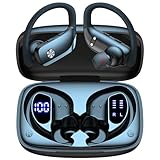
These cost twenty dollars and pack an IPX7 waterproof rating, which means they survive submersion, not just splashes. The 54-hour total playtime with the LED power display makes them practical for travelers who train daily. Earhooks keep them locked in during high-impact movement, and ENC handles ambient noise well enough for a home gym.
- Pro: IPX7 rating exceeds most competitors at this price.
- Pro: 54-hour playtime eliminates charging anxiety.
- Con: Build quality feels budget; no brand support infrastructure.
Skip if you want a polished app experience or detailed sound staging.
Apple AirPods Pro 3
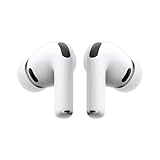
Active noise cancellation that genuinely reduces gym roar while remaining breathable, seamless switching between Apple devices, and a case small enough to vanish into a pocket. Owners consistently praise the transparency mode as the best-in-class for staying aware of your surroundings. The trade-off is price and the fact that sweat resistance, while present, is not rated to the same level as dedicated sport models.
- Pro: ANC and transparency mode are excellent for variable gym environments.
- Pro: Automatic pairing and switching across Apple devices is effortless.
- Con: $199 is a significant premium over purpose-built sport options.
Skip if you primarily need them for the gym and do not use other Apple products.
Soundcore Q20i (Black)
These over-ear headphones deliver hybrid active noise cancellation at under forty dollars, making them a strong pick for the commute to and from the gym. The closed-back design isolates well, and the cushioned headband distributes pressure evenly during long wear. Owners note that the clamping force is moderate, so during explosive movements they can shift slightly.
- Pro: Hybrid ANC at this price point is unusual and effective.
- Pro: Comfortable enough for hours of wear outside the gym.
- Con: Over-ear form factor makes them impractical for running or HIIT.
Skip if you need a true single-purpose gym earbud.
Soundcore V20i
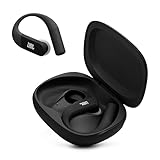
Open-ear design means your ear canal stays clear and you hear your environment natively. For runners on roads, athletes in shared gyms, or anyone who feels claustrophobic with sealed buds, this is a practical choice. True wireless convenience comes without the isolation trade-off, though bass response is inherently limited by the open architecture.
- Pro: Open-ear fit keeps ambient awareness without artificial transparency mode.
- Pro: Under twenty-seven dollars removes purchase friction.
- Con: Bass is thin compared to sealed alternatives at any price.
Skip if you listen to bass-heavy genres or need noise isolation.
Soundcore Q20i (White)
Functionally identical to the black model above in every measurable specification; the only distinction is colorway. Buyers who prefer a lighter aesthetic in their gear bag will find identical hybrid ANC, the same comfort profile, and the same under-forty-dollar price here.
- Pro: Same strong ANC performance as the black variant.
- Pro: White finish resists visible sweat staining better than black.
- Con: Shares the same over-ear limitation for dynamic training.
Skip for the same reasons as the black Q20i if you need sport-specific ergonomics.
bmani Ear Buds
Eighty hours of total playtime is the headline number here, and the LED display case lets you check remaining charge without opening anything. Over-ear hooks provide a mechanical lock that stays secure through lateral motion, and physical button controls work reliably with wet hands. At thirty dollars they undercut most branded competitors.
- Pro: 80-hour playtime is exceptional and reduces charging frequency.
- Pro: Button controls beat touch-sensitive surfaces when fingers are damp.
- Con: Stereo imaging is adequate but not refined for critical listening.
Skip if you want a refined sound profile or premium materials.
JBL Endurance Peak 4
JBL positions these as sport earbuds with cancellation, filling a gap between budget sport models and premium lifestyle earbuds. The twist-lock fit system secures the buds through vigorous movement, and the noise-canceling function is tuned for the low-frequency drone of gym equipment. At roughly one hundred dollars they are a deliberate step up from entry-level options without reaching flagship pricing.
- Pro: Twist-lock fit is among the most secure in this group.
- Pro: Cancellation tuned specifically for gym noise profiles.
- Con: Price is high for a lesser-known product line compared to established brands.
Skip if budget is the primary constraint; cheaper options cover basic needs.
Sony WH-CH520
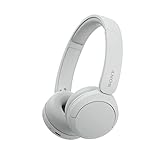
On-ear headphones with a microphone for calls, Bluetooth connectivity, and a lightweight headband that suits people who dislike in-ear pressure entirely. At sixty-eight dollars they occupy a middle ground, but the on-ear design means they do not seal against sweat the way in-ear buds do. Owners in gym settings note that they can slip during intense sessions.
- Pro: No in-ear insertion needed; comfortable for users with sensitive canals.
- Pro: Sony build quality and reliability at a moderate price.
- Con: On-ear pads absorb sweat and require frequent cleaning.
Skip if you sweat heavily or need a waterproof option.
Buying Guide
Fit Security and Earhooks
Look for a mechanical retention system: earhooks, wingtips, or twist-lock stems. These physically prevent the bud from ejecting laterally. Models relying only on the seal of an ear tip will drift during jogging, jumping, or overhead presses. If a listing mentions earhooks or over-ear wings, that is a positive signal for high-impact use.
Water Resistance Ratings
IPX4 means splash-proof from any direction, adequate for light sweat. IPX5 or IPX6 handles heavier perspiration. IPX7 means submersion up to one meter, which covers the worst gym scenarios. Anything below IPX4 is risky for regular intense training. Check whether the rating applies to the earbuds, the case, or both.
Control Type Matters More Than You Expect
Physical buttons remain the most reliable input method when hands are wet or gloved. Touch-sensitive panels register false taps and fail intermittently with moisture. If a model only offers touch controls, factor in that you may need to dry your fingers or adjust settings from your phone instead.
Our Verdict
The JBL Endurance Peak 4 is the top pick for dedicated gym use, combining secure twist-lock fit with purpose-tuned cancellation at a reasonable price. For the lowest cost that still delivers genuine sport-readiness, the LED Sport Earbuds with Earhooks at $20.99 are unmatched in this group on waterproofing and battery life. If your training happens outdoors and you need to hear traffic, the Soundcore V20i wins on situational awareness alone.
FAQ
Are wireless earbuds good enough for intense workouts?
Yes, provided they have a mechanical retention system like earhooks or wingtips. Modern Bluetooth connections are stable enough that signal dropouts are rare even in crowded gym environments. The main failure point is physical ejection, not wireless interference.
Do I need active noise cancellation for the gym?
Not necessarily. ANC helps in loud commercial gyms with heavy machinery and music, but it adds cost and battery drain. For home workouts or outdoor training, a good seal and basic passive isolation are often sufficient.
What is the difference between ENC and ANC?
ENC refers to Environmental Noise Cancellation on the microphone, reducing background noise so your voice comes through clearly on calls. ANC is Active Noise Cancellation on the speakers, reducing ambient noise you hear while listening. Some products list one, the other, or both.
Can I use over-ear headphones for the gym?
They work for weight training and stationary cardio but are impractical for running, HIIT, or any movement with significant head acceleration. Sweat absorption into ear pads is also a hygiene concern that does not exist with sealed in-ear options.


