Key takeaways
- Sensor: APS-C CMOS in the 24-megapixel class
- Mount: Canon RF, accepting RF-S crop lenses and full-frame RF glass
- Screen: side-hinged vari-angle touchscreen that faces forward without covering the hot shoe
- Viewfinder: none — composition is entirely on the rear screen
- Video: 4K at up to 60p, with full-width oversampled 4K at 30p
- Audio: 3.5mm microphone input plus a headphone output for monitoring
- Streaming: plug-and-play USB webcam output without extra capture hardware
The best mirrorless camera with a flip screen for vlogging is the Sony ZV-E10. Its side-hinged vari-angle LCD stays visible when a shotgun mic or a tripod plate is mounted, its Real-time Eye AF keeps a face locked while you move, and its built-in three-capsule directional mic means you can start filming before you buy any audio gear. It suits solo creators who talk to camera. If your ceiling is lower, the Canon EOS M10 is the cheapest genuine interchangeable-lens body in this roundup with a selfie-friendly screen, and the Nikon Z 30 is the most polished premium option for long talking-head sessions.
One warning before you scroll: the twelve listings below are not all the same kind of product. Three are fixed-lens compacts rather than mirrorless bodies, one is a clip-on mirror accessory, and one — the Canon EOS R100 — has a screen that does not flip at all. Each entry states plainly what it is, then compares autofocus behaviour, screen articulation and video specs for vlogging and content creation.
Top 3 Picks
Best overall: Sony ZV-E10
The ZV-E10 gets the fundamentals right for solo shooting: a side-hinged screen that faces you without blocking the hot shoe, Sony’s dependable Real-time Eye AF and subject tracking, a built-in directional mic with a supplied windscreen, and both microphone and headphone jacks. It is not stabilised in-body, so budget for a stabilised lens or accept some walking wobble.
Best budget: Canon EOS M10
It is an older, discontinued-mount body with a 1080p video ceiling and no microphone input, so it is not a long-term platform. But it is the least expensive true interchangeable-lens camera here with a screen that tilts to face you, and for a first vlog where audio is recorded separately it does the one job that matters: letting you see your framing.
Best premium: Nikon Z 30
Nikon’s video-first APS-C body pairs a fully articulating side-flip screen with uncropped 4K up to 30p, long continuous record times, and the same Z mount that scales up to Nikon’s full-frame bodies later. Its autofocus is reliable for a single talking head, though it is a step behind Sony’s subject tracking for fast movement.
Quick Comparison
Every listing in this roundup, sorted by what it actually is. “Articulation” describes how the screen moves — this matters more than screen size, because an up-flipping panel can collide with a mounted microphone and a down-flipping panel can hit a tripod.
| Product | Best for | Sensor / lens class | Screen articulation | Video ceiling | Audio input | Price tier |
|---|---|---|---|---|---|---|
| Canon EOS R50 V + 14-30mm | Vertical video, streaming | APS-C, interchangeable RF | Side-hinged vari-angle | 4K up to 60p, 4K30 full-width | Mic + headphone | Mid-range |
| Sony Alpha a6400 | Hybrid stills-first shooters | APS-C, interchangeable E | 180° up-tilt (blocks hot shoe) | 4K30, 1080p120 | Mic only | Premium |
| Sony ZV-E10 + 16-50mm | All-round solo vlogging | APS-C, interchangeable E | Side-hinged vari-angle | 4K30, 1080p120 | Mic + headphone | Premium |
| IKUCAM 4K 75MP | Lowest spend with a flip screen | Fixed-lens compact | 3″ 180° flip | 4K class (interpolated) | Built-in only | Budget |
| Sony ZV-1F + 20mm | Pocketable run-and-gun | 1-inch, fixed 20mm-equiv | Side-hinged vari-angle | 4K30, 1080p120 | Built-in only, no jack | Mid-range |
| Canon EOS R50 + 18-45mm | Beginners wanting an EVF | APS-C, interchangeable RF | Side-hinged vari-angle | 4K30, 1080p120 | Mic only | Premium |
| Canon EOS M10 + 15-45mm | Cheapest ILC selfie screen | APS-C, interchangeable EF-M | 180° up-tilt | 1080p30 | None | Budget |
| Canon EOS R100 + 18-45mm | Stills-first buyers | APS-C, interchangeable RF | Fixed — no flip | 4K24 (cropped), 1080p60 | Minimal ports | Mid-range |
| Nikon Z 30 + 16-50mm | Long talking-head sessions | APS-C, interchangeable Z | Side-hinged vari-angle | 4K30 full-width, 1080p120 | Mic only | Premium |
| KOQINVIZ Vlog Selfie Mirror | Cameras with no flip screen | Accessory, not a camera | Clip-on mirror | n/a | n/a | Budget |
| PUSOKEI 8K 88MP | Absolute beginners experimenting | Fixed-lens compact | 3″ 180° flip | 8K class (interpolated) | Built-in only | Budget |
| Nikon Z 50 | Hybrid shooters with an EVF | APS-C, interchangeable Z | 180° down-tilt | 4K30, 1080p120 | Mic only | Mid-range |
How We Chose
This roundup is built from manufacturer specifications, published reviews and the way these bodies are actually used on a shoot — not from any physical testing. No camera here was bought, borrowed or measured by us.
Five criteria did the sorting. First, articulation type: whether the screen faces the operator without blocking the hot shoe, the tripod thread or the side ports, because that single detail decides whether a body is usable for solo work. Second, autofocus behaviour: continuous eye and face detection, how quickly a subject is reacquired when they turn away, and whether tracking survives a cluttered background. Third, video specification: the maximum frame rate, whether 4K is oversampled or cropped, and whether the camera imposes a recording time limit. Fourth, audio and monitoring: the presence of a microphone input and a headphone output, which separate a serious vlogging body from a casual one. Fifth, upgrade path: whether the lens mount is alive, how deep the native lens range is, and whether the system scales into full-frame later.
Price tier is used only as a band — budget, mid-range or premium — because listing prices move weekly. Where a product is not what the search term implies, the entry says so.
1. Canon EOS R50 V – Best for vertical video and streaming-first creators
As an Amazon Associate we earn from qualifying purchases at no extra cost to you.

The EOS R50 V is Canon’s video-first APS-C body, sold here with the compact RF-S 14-30mm power-zoom lens. It is aimed at someone who shoots phone-style vertical content but wants interchangeable lenses and cleaner low-light footage than a phone delivers. It suits a creator who records mostly to a computer or a card, publishes to vertical platforms, and rarely needs a viewfinder.
Key specifications
- Sensor: APS-C CMOS in the 24-megapixel class
- Mount: Canon RF, accepting RF-S crop lenses and full-frame RF glass
- Screen: side-hinged vari-angle touchscreen that faces forward without covering the hot shoe
- Viewfinder: none — composition is entirely on the rear screen
- Video: 4K at up to 60p, with full-width oversampled 4K at 30p
- Audio: 3.5mm microphone input plus a headphone output for monitoring
- Streaming: plug-and-play USB webcam output without extra capture hardware
The headline advantage over everything else in this list is that Canon built the body around the screen rather than bolting a hinge onto a stills camera. The vari-angle panel swings out to the side, so a shotgun mic on the hot shoe and a tripod plate underneath both stay clear. Vertical framing is handled in-camera rather than cropped afterwards. The 14-30mm power zoom covers a wide-to-standard range that keeps a talking head in frame at arm’s length and lets you zoom smoothly during a take, which a manual kit zoom cannot do cleanly.
Autofocus is Canon’s Dual Pixel-style phase-detection system with subject detection for people and animals, and it holds a face reliably during normal vlog movement. The lack of a viewfinder is the deliberate trade: it keeps the body small and cheap, and for vlogging the rear screen is what you look at anyway.
Pros
- Side-hinged screen stays clear of microphones and tripod plates
- Microphone and headphone jacks, which is rare at this tier
- Power-zoom kit lens makes smooth in-take zooming possible
- Native vertical-video workflow and direct USB streaming
- RF mount is Canon’s current, actively developed system
Cons
- No electronic viewfinder at all
- No in-body stabilisation, so handheld walking shots rely on lens or digital stabilisation
- APS-C sensor limits low-light performance compared with full-frame bodies
- Overheating and record limits can apply at the highest frame rates in warm conditions
Compared with the Canon EOS R50: the R50 is the stills-and-video hybrid with an EVF, 4K30 and a mechanical shutter feel; the R50 V drops the viewfinder and pushes toward 4K60 and vertical capture. If you photograph as much as you film, take the R50. If you film vertically and stream, the R50 V is the more honest tool.
2. Sony Alpha a6400 – Best for photographers who vlog occasionally

The a6400 is the veteran of this group. It earned its reputation as a hybrid stills body with autofocus that embarrassed far more expensive cameras when it launched, and firmware updates added Real-time Eye AF and Real-time Tracking that keep it competitive in 2026. It suits someone whose primary output is photographs and whose vlogging is occasional — a channel update, a behind-the-scenes clip, a talking-head segment.
Key specifications
- Sensor: 24.2-megapixel APS-C Exmor CMOS
- Mount: Sony E, the widest native lens selection of any system here
- Screen: 180° up-tilting touchscreen
- Viewfinder: 2.36-million-dot electronic viewfinder
- Video: 4K up to 30p, Full HD up to 120p for slow motion
- Audio: 3.5mm microphone input; no headphone output
- Stabilisation: none in-body; relies on optically stabilised lenses
The autofocus is the reason to consider it. Sony’s phase-detection array covers a wide portion of the frame and the eye-detection is fast enough to trust while you are moving, which is the single hardest thing for a vlogging camera to do. The 4K footage is sharp and the 120p Full HD gives you usable slow motion for B-roll.
The catch is the screen. It tilts upward through 180 degrees, which means when it faces you it sits directly above the lens — and directly in front of the hot shoe. Mount a shotgun microphone and you either shoot blind or shoot without the mic. There is also no headphone jack, so you cannot monitor audio while recording; you find out about a hum or a dropout in the edit.
Pros
- Autofocus that still leads much of the category for moving subjects
- Excellent stills image quality with a deep, affordable lens ecosystem
- Electronic viewfinder for bright outdoor conditions
- Mature body with extensive third-party accessory support
Cons
- Up-flip screen blocks the hot shoe when facing forward
- No headphone jack and no in-body stabilisation
- Video tops out at 4K30 with no 4K60 option
- Older battery design means shorter runtime than current bodies
Compared with the Sony ZV-E10: they share a sensor generation and a mount, so the difference is entirely about ergonomics. The ZV-E10 gives you the side-hinged screen, a headphone jack and a built-in directional mic; the a6400 gives you a viewfinder, a better stills grip and a more traditional control layout. If video is the job, the ZV-E10 wins. If photography pays the bills, the a6400 does.
3. Sony ZV-E10 – Best overall for solo vlogging

The ZV-E10 is the camera Sony designed by taking the a6400’s sensor, deleting the viewfinder and rebuilding the body around the screen. It ships here with the 16-50mm power-zoom kit lens. It suits the solo creator who films themselves, records voice on camera and wants the camera to handle focus without a second operator.
Key specifications
- Sensor: 24.2-megapixel APS-C
- Mount: Sony E — the largest native lens range in this roundup
- Screen: side-hinged vari-angle touchscreen, fully forward-facing
- Viewfinder: none
- Video: 4K up to 30p, Full HD up to 120p
- Audio: three-capsule directional built-in mic with supplied windscreen, plus mic and headphone jacks
- Vlogging features: Product Showcase setting that shifts focus from face to object on cue; background-defocus one-touch control
The articulation is the point. The panel swings out sideways, so the hot shoe, the tripod thread and the side ports all remain usable. That combination — forward screen and free hot shoe and a headphone jack — is what makes it the best overall answer to this search rather than merely a good one.
The built-in microphone is genuinely usable for a first channel. It is directional, ships with a wind muff, and records well enough that viewers will not click away; the microphone jack lets you upgrade to a shotgun or lavalier later, and the headphone jack lets you confirm the upgrade actually worked. Autofocus is Sony’s Real-time Eye AF with tracking, and the Product Showcase mode is a small feature that saves an enormous amount of re-takes when you hold something up to the lens.
The honest weaknesses are stabilisation and battery life. There is no in-body stabilisation, so handheld walking footage needs the stabilised kit lens, Active SteadyShot digital cropping, or a gimbal. The battery is the older, smaller Sony cell, and heavy 4K shooting will exhaust it in well under two hours.
Pros
- Best screen articulation in this roundup for solo shooting
- Microphone and headphone jacks on a compact body
- Class-leading autofocus for a moving, talking subject
- E-mount upgrade path that scales from budget primes to full-frame glass
- Product Showcase mode removes a common vlogging annoyance
Cons
- No in-body image stabilisation
- No viewfinder, which hurts in bright sun
- Battery runtime is modest; buy spares
- No 4K60 option for high-frame-rate footage
Compared with the Canon EOS R50 V: both are screen-first, both have mic and headphone jacks. The Sony offers the larger lens ecosystem and arguably faster subject tracking; the Canon offers uncropped 4K60-class capture, a power-zoom kit lens and a native vertical-video mode. If you own or plan to own Sony glass, the ZV-E10 is the natural anchor.
4. IKUCAM 4K Digital Camera – Best for the lowest possible spend with a 180° screen
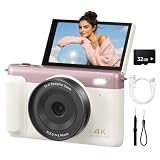
Be clear about what this is: the IKUCAM listing describes a fixed-lens compact camera, not a mirrorless interchangeable-lens body. It has a built-in lens, a 3-inch 180° flip screen, autofocus, a 16x zoom range and a 2500mAh battery. It suits a teenager starting a first channel, a parent filming school events, or anyone who wants a self-facing screen for the smallest possible outlay and has no intention of buying lenses.
Key specifications
- Type: fixed-lens compact with a built-in zoom
- Stills: 75MP claimed — this is an interpolated figure typical of the class, not a native sensor resolution
- Video: 4K class recording, again interpolated in this price bracket
- Screen: 3-inch 180° flip panel for self-framing
- Zoom: 16x, which combines optical and digital magnification
- Battery: 2500mAh rechargeable cell
- Audio: built-in microphone only; no external input
What it does well is remove barriers. The screen flips to face you, the battery is larger than most budget cameras carry, the menu is simple enough to learn in an afternoon, and the whole package costs less than a single mid-range lens. For someone who wants to find out whether they enjoy filming themselves before committing real money, that is a legitimate purpose.
What it does not do is deliver the numbers on the box. Interpolated megapixel counts are a long-standing convention in this class: a small sensor captures a modest native resolution and the camera upscales the file. The same applies to the 4K claim. The 16x zoom is part optical, part digital, and the digital half softens the image as it stretches. Low-light footage will be noisy. There is no microphone input, so audio quality is fixed by the built-in mic.
Pros
- Lowest entry cost in this roundup by a wide margin
- 180° flip screen lets you frame yourself
- Large battery for the class
- Simple menus with no lens decisions to make
Cons
- Not a mirrorless camera and cannot accept lenses
- Interpolated stills and video resolutions
- No external microphone or headphone support
- Small sensor limits low-light performance and background blur
Compared with the PUSOKEI 8K: the two are the same species of product with different marketing numbers. The IKUCAM claims 75MP stills and a 16x zoom; the PUSOKEI claims 88MP and 18x. Neither figure describes a native sensor. Choose on price, on which battery is easier to replace, and on which menu you find less confusing — not on the resolution badge.
5. Sony ZV-1F – Best for pocketable run-and-gun vlogging

The ZV-1F is a compact with a fixed 20mm-equivalent lens and a 1-inch sensor, sold here with a spare battery bundle. It is not mirrorless — the lens does not come off — but it earns its place because its wide prime is purpose-built for holding at arm’s length. It suits a street vlogger, a travel creator or anyone who wants a camera that disappears into a jacket pocket.
Key specifications
- Sensor: 1-inch, 20-megapixel class
- Lens: fixed 20mm-equivalent wide prime with a bright maximum aperture
- Screen: side-hinged vari-angle touchscreen
- Video: 4K up to 30p, Full HD up to 120p
- Audio: built-in directional microphone; no external microphone jack and no hot shoe
- Extras: USB streaming, face and eye detection, background-defocus control
Here is the arithmetic that explains why the wide prime matters. At arm’s length — roughly 60cm from your face — a 20mm-equivalent lens frames about 1.08 metres across. A 16mm kit zoom on an APS-C body, which works out to roughly 24mm equivalent, frames about 90cm at the same distance. That extra 18cm is the difference between your shoulders touching the frame edges and having room to gesture. For a camera you hold out in front of you, that is a real specification.
The side-hinged screen faces forward cleanly, the autofocus tracks faces reliably, and the body is genuinely small. The trade-off is fixed at the factory: no lens mount, no hot shoe and no microphone input. That last omission is the serious one. Your audio is whatever the built-in mic captures, permanently, and there is no path to a lavalier or a shotgun without recording separately and syncing in the edit.
Pros
- Purpose-built wide lens that frames a selfie correctly at arm’s length
- Side-hinged screen that does not obstruct anything
- Small enough to carry constantly, which is what actually gets footage shot
- Reliable face and eye detection for a fixed-lens compact
Cons
- No microphone jack and no hot shoe — a hard ceiling on audio
- Fixed lens means no focal-length flexibility ever
- 1-inch sensor trails APS-C in low
Affiliate disclosure. As an Amazon Associate we earn from qualifying purchases at no extra cost to you. Prices accurate as of the date shown.Best Mirrorless Cameras With Flip Screen for VloggingCheck price on Amazon