Key takeaways
- Compare motherboards built for overclocking, with strong VRM designs, fast DDR5 tuning and PCIe 5.0 for AMD AM5 and Intel LGA 1851 gaming PC builds today.
As an Amazon Associate we earn from qualifying purchases.
Overclocking changes what a motherboard has to do. At stock settings, almost any modern board can run a gaming processor through a long session without drama. Once you raise clock speeds, adjust voltages and push memory well beyond its base specification, the board itself becomes part of the performance equation. Power delivery has to stay stable under sustained load, the firmware has to expose the controls you actually need, and the cooling around the voltage regulation circuitry has to keep temperatures in a range where that stability holds hour after hour.


That is why a dedicated overclocking shortlist looks different from a general gaming motherboard roundup. The boards below were chosen because their Amazon product pages state the features that matter for tuning: multi-stage power designs with named stage counts, memory support described in overclocked terms, and platform tools built around adjusting CPU and memory behaviour. Two of the picks serve AMD Socket AM5 builds with Ryzen 9000, 8000 and 7000 series processors, and one serves Intel builds on the LGA 1851 socket with Core Ultra processors. Between them, they cover the two current desktop platforms that gaming builders are choosing between right now.
Socket choice comes first, because it decides everything else. An AM5 board and an LGA 1851 board are not interchangeable, and neither are their processors or coolers. Read the how-to-choose section first if you are still deciding on a platform; if you already own a processor, skip to the board that matches its socket and check its power design against the tuning you plan to do.
Disclosure: This article contains affiliate links. If you buy through these links, we may earn a commission at no additional cost to you.
How to Choose a Motherboard for Overclocking
Start with the socket and chipset
The processor decides the socket, and the socket decides the board. For AMD, the current gaming platform is Socket AM5, and the X870E chipset sits at the top of that range, pairing strong power designs with PCIe 5.0 for both graphics and storage. For Intel, the LGA 1851 socket hosts Core Ultra processors, and the Z890 chipset is the tier that supports CPU overclocking on that platform. A board from the wrong family will not fit your processor at all, so confirm the pairing before you compare anything else. It is also worth confirming that the board supports your exact processor generation, because both platforms here span more than one processor series.
Read the power design in stages and amps
The voltage regulator module, or VRM, converts power from the supply into the precise voltages the processor needs. When a product page lists a design such as 18+2+2 or 22+2+1+2, those numbers describe how the power stages are arranged, and a higher stage count generally spreads the load across more components. Some pages also state the rating of each stage in amps; a 110A Smart Power Stage, for example, tells you each stage is built to handle substantial current. For overclocking, this matters because raised voltages and clocks increase the current the VRM must deliver continuously, not just in short bursts. Look for the stage arrangement and the stage rating together, and treat either number on its own as an incomplete picture.
Check VRM cooling, not just VRM size
A strong power design still needs to shed heat. Boards in this class use large metal heatsinks over the VRM area, sometimes described as thermal armour, along with heat pipes or extended heatsink surfaces on higher-end models. Memory and storage heatsinks help too, because a tuned system tends to run its memory and its fastest solid-state drives hard at the same time. When you compare boards, note which cooling hardware the page actually names. A board that describes its VRM heatsinks in detail is telling you the maker expected sustained loads, which is exactly the workload an overclocked gaming PC produces.
Match memory support to your tuning plans
Memory overclocking is half of modern tuning. Both platforms here use DDR5, and the pages state maximum memory speeds in overclocked terms that sit far above the base DDR5 specification. AMD boards in this guide support profiles such as EXPO, while Intel boards support XMP profiles; those one-setting profiles are the starting point, and manual timing adjustment is where experienced tuners go next. Check the stated ceiling against the memory kit you plan to buy. There is little value in a board that supports very high memory speeds if your kit is a modest one, and the reverse is also true: a fast kit deserves a board whose page states support for speeds in that range.
Look for tuning tools in firmware and software
Good overclocking boards reduce the friction of tuning. Automated assistance, such as the AI Overclocking named on the ASUS pages in this guide, can produce a starting point based on the processor and cooling it detects, which you can then adjust manually. Features with names such as Core Flex point to finer control over how the processor behaves under different loads. Clear CMOS buttons and debug displays do not raise clock speeds, but they shorten recovery time when a setting does not work, and recovery time is part of the hobby. Beginners benefit most from automation, while experienced tuners may value manual depth and fast recovery more.
Confirm expansion and connectivity for the whole build
An overclocking board is still the foundation of a complete PC. Check that the PCIe layout suits your graphics card and any capture or expansion cards, that there are enough M.2 slots for your storage plans, and that the fastest slots use PCIe 5.0 where you want them. Networking matters for gaming too: Wi-Fi 7 and multi-gigabit wired LAN both appear in this guide. Finally, confirm the form factor fits your case. All three boards here are ATX or extended-width designs in spirit, so a compact case may rule a board out before its power design ever gets a chance to impress you.
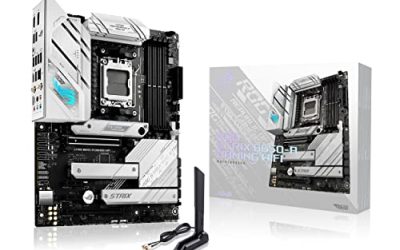
ASUS ROG Crosshair X870E Hero
ASIN: B0DDZSP2BG — View on Amazon
The ROG Crosshair X870E Hero is the AMD flagship in this guide, built for Socket AM5 and the X870E chipset in an ATX form factor. Its product page leads with the specification that matters most for this keyword: an 18+2+2 power stage design. That arrangement is aimed at Ryzen processors from the 9000, 8000 and 7000 series, and it gives the board the power-delivery foundation that sustained CPU tuning requires. If your build starts with a high-core-count Ryzen chip that you intend to run beyond its stock behaviour, this is the specification line to compare against the other boards on your shortlist.
Overclocking support is stated directly in the product name and description. The page names AI Overclocking among its headline features, which gives newer tuners an assisted starting point, and it also names Core Flex, a feature aimed at more granular control of processor behaviour. Between those two, the board addresses both ends of the experience range: a builder who wants the firmware to propose a tune, and a builder who wants to shape the tune personally. The page describes the board as ready for advanced AI PC builds as well, which reflects how much of its feature set is organised around automated adjustment alongside manual control.
The rest of the specification supports the tuned system around the processor. Memory is DDR5, expansion includes PCIe 5.0, and storage runs to five M.2 slots, so a build can combine a fast system drive with several game drives without dropping to slower interfaces. Connectivity is current-generation: Wi-Fi 7 for wireless play and USB4 ports for high-speed external devices. The page also names a PCIe Slot Q-Release Slim mechanism, designed to make removing a large graphics card simpler during upgrades and troubleshooting.
Choose this board if your overclocking build is AMD-based and you want the flagship tier of the AM5 platform, with the strongest stated power design of the two AMD picks here, assisted tuning to start from, and a full set of current connectivity. It is the natural anchor for a Ryzen build where the motherboard is expected to serve through more than one processor upgrade cycle on the same socket.
GIGABYTE X870E AORUS Master
ASIN: B0DGVSW4FD — View on Amazon
The X870E AORUS Master is GIGABYTE’s entry in this guide, also for Socket AM5, and its Amazon page is unusually explicit about overclocking. The manufacturer description states that these boards are built to deliver advanced overclocking performance with X870, and the power design section explains why: a 16+2+2 Twin Digital VRM design with 110A Smart Power Stages, an 8-layer low-loss printed circuit board and doubled copper in the board layers. Each of those details serves stability under load. Digital control helps the board hold voltages precisely, the stage rating describes current capacity, and the board construction supports both power integrity and heat spreading.
Thermal hardware gets its own emphasis on the page. GIGABYTE describes a full-metal thermal design that includes VRM Thermal Armor and M.2 Thermal Guard heatsinks, which addresses the two areas a tuned gaming system heats most: the power circuitry and the fastest storage. Memory performance is the other half of the pitch. The page states DDR5 support up to 8600 MT/s, with AMD EXPO support and a feature named D5 Bionic Corsa aimed at memory performance. For a builder whose tuning plans centre on fast memory as much as on processor clocks, those stated figures give a concrete ceiling to match a memory kit against.
Expansion and connectivity are specified in full. The page lists one PCIe 5.0 x16 slot for graphics and three PCIe 5.0 M.2 slots among its four M.2 positions, Wi-Fi 7, a 5GbE wired connection and ten USB ports in total, including dual USB4 Type-C ports rated at up to 40 Gbps each. Assembly conveniences include the PCIe EZ-Latch Plus and M.2 EZ-Latch systems, which are designed to make installing and removing cards and drives simpler. The board carries a stated 5-year warranty period in its product title, which is worth noting for a component that builders tend to keep through several graphics card changes.
Choose this board if you want the AMD platform with its overclocking case made in the most explicit terms: a named twin digital VRM, a stated stage rating, a stated memory ceiling and thermal hardware described piece by piece. Builders who like to compare hard numbers before buying will find this page the most specification-dense of the three.
ASUS ROG Maximus Z890 Hero
ASIN: B0DGWWRTPV — View on Amazon
The ROG Maximus Z890 Hero carries this guide’s Intel flag. It is an ATX board for the LGA 1851 socket and the Intel Z890 chipset, supporting Core Ultra processors, and its page states the largest power design in this roundup: 22+2+1+2 stages. On a platform where the chipset tier determines whether CPU overclocking is available at all, the Z890 name is the first thing to check, and the stage count is the second. A design of this size is built for sustained delivery to a tuned processor, and it marks the board as ASUS’s flagship overclocking option for this Intel generation.
As with its AMD sibling in this guide, the tuning features are named on the page. The product title lists AI Overclocking alongside AI Cooling and AI Networking, which frames the board’s approach: automated assistance that observes the system and proposes adjustments, with manual control available in the firmware for builders who prefer to set values themselves. For gaming builders moving to this Intel platform for the first time, that combination lowers the cost of a first tune while leaving headroom to learn manual adjustment later.
Platform specifications are current across the board. Memory is DDR5, storage includes three PCIe 5.0 M.2 slots, and networking is Wi-Fi 7. Thunderbolt 4 ports and USB Type-C connectivity cover fast external storage and modern peripherals, and the page describes the board as ready for advanced AI PC builds. The Maximus line has long been the home of ASUS’s most extensive firmware and hardware tuning features on Intel, and this model’s stated specification keeps it in that position for the LGA 1851 generation.
Choose this board if your build is Intel-based on Core Ultra and you want the flagship overclocking tier for that platform: the largest stated stage count here, assisted tuning named on the page, PCIe 5.0 storage and Wi-Fi 7. Builders comparing across platforms should note that this board and the Crosshair above cannot share a processor, so the decision between them is really a decision about which processor family your build starts with.
Comparison Table
| Board | Socket and chipset | Power design stated | Memory | Storage and expansion | Networking |
|---|---|---|---|---|---|
| ASUS ROG Crosshair X870E Hero | AMD AM5, X870E, ATX | 18+2+2 power stages | DDR5 | PCIe 5.0, 5 M.2 slots | Wi-Fi 7, USB4 |
| GIGABYTE X870E AORUS Master | AMD AM5, X870E, ATX | 16+2+2 twin digital VRM, 110A stages | DDR5 up to 8600 MT/s stated | 1 PCIe 5.0 x16, 3 PCIe 5.0 M.2 among 4 M.2 | Wi-Fi 7, 5GbE LAN, dual USB4 |
| ASUS ROG Maximus Z890 Hero | Intel LGA 1851, Z890, ATX | 22+2+1+2 power stages | DDR5 | 3 PCIe 5.0 M.2 slots | Wi-Fi 7, Thunderbolt 4 |
Frequently Asked Questions
Does the chipset decide whether I can overclock?
On the Intel side, yes, the chipset tier matters: the Z890 chipset in this guide is the tier that supports processor overclocking for LGA 1851 builds. On the AMD side, the X870E boards here state overclocking support and features directly on their pages, including power designs and memory tuning support. In both cases, check that the specific board, not just the chipset family, describes the tuning features you want.
How many power stages do I actually need?
There is no single number that fits every build. A mild tune on a mid-range processor asks far less of the VRM than an ambitious tune on a flagship chip. What matters is that the design is sized generously for your processor and that its cooling matches. The boards here state designs from 16+2+2 to 22+2+1+2 stages, all aimed at tuned systems, so the practical step is to match the board tier to the processor tier rather than chase the largest number alone.
Is memory overclocking worth doing on a gaming PC?
It can be, particularly when it is as simple as enabling the EXPO or XMP profile your memory kit was sold with. That single setting runs the memory at its stated speed rather than the platform base speed. The boards here state DDR5 ceilings well beyond base specification, and the GIGABYTE page states up to 8600 MT/s, so pairing a board with a kit whose profile sits within the board’s stated support is the sensible approach.
Can I use one of these boards without overclocking at all?
Yes. A board built for overclocking runs a stock processor perfectly well, and its stronger power delivery and cooling simply operate with more headroom. Many builders buy at this tier for the connectivity, storage and build quality, then tune later. Buying the headroom in advance is reasonable if you expect your tuning interest or your processor to grow during the board’s service life.
What else in my build needs to keep up with an overclocked processor?
Cooling first: a tuned processor produces more heat, so the CPU cooler must be sized for sustained load, and the case needs airflow across the board’s heatsinks. The power supply should have comfortable capacity for the whole system at full draw, and memory should be a kit whose stated profile the board supports.
Conclusion
The best motherboards for overclocking share a pattern: a power design the maker is willing to specify in stages and amps, cooling built for sustained load, memory support stated in overclocked terms, and firmware features that help you tune and recover. The two AM5 boards here take different routes to that pattern. The ROG Crosshair X870E Hero pairs an 18+2+2 design with named assisted and manual tuning features and five M.2 slots, while the X870E AORUS Master makes its case with a twin digital VRM, 110A stages, a stated 8600 MT/s memory ceiling and piece-by-piece thermal hardware. For Intel builders, the ROG Maximus Z890 Hero states the largest power design of the three and brings the same assisted-tuning approach to the LGA 1851 platform.
Decide your processor platform first, then match the board tier to the tuning you genuinely plan to do. Any of these three boards gives an overclocked gaming build a foundation that will not be the limiting factor, and that is precisely what this component is for.
FAQ
Does the chipset decide whether I can overclock?
How many power stages do I actually need?
Is memory overclocking worth doing on a gaming PC?
Can I use one of these boards without overclocking at all?
What else in my build needs to keep up with an overclocked processor?
More from Amazon
Programs that pair well with the guide above. Offers and eligibility are set by Amazon and may change.
Free shipping on eligible items, Prime Video and more. Eligible new members can start with a free trial.
Start a Prime free trialAd-free music streaming. Eligible new subscribers can start with a free trial.
Try Music Unlimited freeA Prime membership for ages 18-24 with a trial period. Eligibility is set by Amazon.
See Prime for Young AdultsAudiobooks and podcasts to listen to on the go. Eligible new members can start with a free trial.
Try Audible freeAs an Amazon Associate we earn from qualifying purchases.