Key takeaways
- Outdoor cameras that can work as national park webcams: a 4K PoE bullet with time-lapse, a solar dual-lens camera with a 180-degree view, and a 4K PTZ model, compared on weatherproofing, power and streaming from their listings.
A national park webcam is not a desk webcam moved outdoors. The job is to sit on a visitor center roof, a ranger station or a lodge balcony for months, survive weather, and keep a live view of a valley, geyser basin or nest available to anyone with a browser. The buying decision is about power, weatherproofing and how the camera publishes its picture: a wired PoE camera that never needs charging, a solar camera that works where no cable reaches, or a PTZ model that can sweep a whole overlook.


This guide is for park associations, lodges, friends groups and hobbyists who run public nature webcams or want a permanent scenic stream from a wild place. A note on the keyword: products below are weatherproof outdoor cameras that can feed a live stream or time-lapse, chosen from their Amazon listings, because no consumer desk webcam is built for this work. Streaming features and power options are taken from each listing.
Quick Picks
As an Amazon Associate we earn from qualifying purchases.
| Product | Best for | Key spec from title |
|---|---|---|
| REOLINK RLC-810A | A wired overlook with power and Ethernet nearby | 4K PoE camera with time-lapse and 100ft night vision |
| REOLINK Argus 4 Pro | Remote viewpoints with no cabling at all | 4K dual-lens 180-degree solar camera |
| REOLINK RLC-823S1 | Wide basins and trailheads one camera must cover | 4K PTZ with 5x optical zoom and auto tracking |
How to Choose
Solve the power problem before the picture problem
Every park webcam fails at power before it fails at resolution. A PoE camera draws power and data from one Ethernet cable, so a building with a network switch can run it indefinitely with no batteries to service. A battery camera with a solar panel trades that certainty for placement freedom, and its listing will state the panel and battery arrangement. In a shaded canyon or a northern winter, solar input falls hard, so match the power type to the site honestly. If a ranger has to visit monthly to swap batteries, the camera is a maintenance job, not a webcam.
Weatherproofing and temperature range are the real specifications
A scenic camera lives outside through freeze, heat and driven rain. Listings for outdoor models state an operating design for outdoor and indoor surveillance, sealed housings and night vision ranges; treat any camera without an explicit outdoor rating as an indoor product regardless of marketing photos. Mounting matters as much as the housing: a bullet camera on a fixed bracket suits a single framed view, while a PTZ unit needs a solid mount because wind moves a loose bracket visibly on stream. Check what the listing says about night performance too, since dawn and dusk are when wildlife appears.
Decide how the public will actually watch
A webcam needs a viewing path, not just a recording path. Cameras in this class typically offer live view through the maker’s app, time-lapse capture, and streams that can be embedded or restreamed to a website or video platform. The RLC-810A below lists time-lapse directly in its title, which is the feature park pages use for sunrise and season-change sequences. If your plan is a permanent public page, confirm the camera supports continuous live viewing and does not depend entirely on motion-triggered clips, because a viewpoint webcam must show an empty, quiet valley as happily as a passing elk.
Match the field of view to the landmark
A narrow lens on a distant feature produces a postage stamp; a very wide lens makes a famous peak look ordinary. Fixed bullet cameras frame one composed view and do it reliably. Dual-lens panoramic models stitch a 180-degree picture that suits wide basins and lakeshores. PTZ cameras solve the problem with movement and optical zoom, letting one unit cover a trailhead, a parking area and a viewpoint in sequence. Read the field of view and zoom figures in the listing and picture the actual overlook before choosing, because no software fixes the wrong lens afterward.
The 3 Best Options
REOLINK RLC-810A
The RLC-810A is the dependable fixed camera of this group: a wired PoE bullet that records in 4K, detects people, vehicles and pets, and lists time-lapse among its headline features, which is exactly what a park page needs for weather and season sequences. One Ethernet cable carries power and data, so a visitor center or lodge with a switch can keep it running for years without touching it. Night vision reaches 100 feet for trailhead and parking views after dark, and a microSD slot up to 512GB keeps local recordings if the network drops.
Specs
- Resolution: 4K (8MP) wired PoE IP camera
- Detection: human, vehicle and pet smart detection
- Night vision: 100ft infrared night vision
- Feature: time-lapse capture listed
- Storage: microSD card up to 512GB, sold separately
- Use: outdoor and indoor surveillance
Best for: A fixed scenic view from a building with Ethernet, such as a lodge overlook.
Watch out for: It needs a PoE switch or injector and a cable run; there is no Wi-Fi fallback.
ASIN: B07K74GWX5
REOLINK Argus 4 Pro
The Argus 4 Pro solves the sites the wired camera cannot reach. It is a battery camera sold with a solar panel, using two lenses to build a single 180-degree 4K picture, which suits wide valleys, lakeshores and meadow viewpoints where one frame must hold the whole scene. ColorX night vision aims for usable color after dark rather than the usual infrared grey, and dual-band Wi-Fi connects it to a lodge or visitor center network. The listing states no subscription is required, an important detail for small park groups publishing a public feed on a small budget.
Specs
- Resolution: 4K (8MP) dual-lens camera
- Field of view: 180-degree panoramic image
- Night vision: ColorX color night vision
- Power: rechargeable battery with solar panel included in this listing
- Connectivity: 5GHz and 2.4GHz Wi-Fi
- Detection: AI person, vehicle and animal detection
- Subscription: none required for core features
Best for: Remote viewpoints with sun exposure and Wi-Fi coverage but no cabling.
Watch out for: Shaded or far-north sites may not give the panel enough light in winter; plan battery checks.
ASIN: B0D8HY411D
REOLINK RLC-823S1
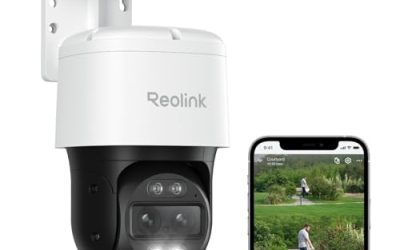
Where one camera must cover a basin, a boardwalk and a parking area, the RLC-823S1 brings movement: it pans 360 degrees and tilts 90, with a 5x optical zoom for pushing in on a nest, a geyser or a distant ridge. It records in 4K over PoE, supports 24/7 recording, and adds color night vision and two-way talk, which suits staffed sites where a ranger may need to address visitors near the mount. Auto tracking follows people and vehicles, more useful at entrances and trailheads than at a static scenic frame.
Specs
- Resolution: 4K UHD PoE PTZ camera
- Movement: 360-degree pan and 90-degree tilt
- Zoom: 5x optical zoom with 3D zoom
- Tracking: auto tracking with AI detection
- Night vision: color night vision
- Recording: 24/7 recording supported
- Audio: two-way talk
Best for: Busy overlooks and entrances where one camera must serve several views.
Watch out for: Moving parts and a larger mount need a very solid installation; wind shake shows on stream.
ASIN: B0CRRSNWTK
Which One Fits Your Situation
A lodge or visitor center wants one famous view, always on
Choose the RLC-810A. The wired PoE connection removes batteries from the story, the fixed frame keeps the composition exactly as you set it, and time-lapse gives the website a second kind of content from the same camera. For a single landmark view that must simply never go down, this is the lowest-maintenance option here.
A friends group funds a webcam at a remote trailhead
Choose the Argus 4 Pro. With solar power in the box and a panoramic dual-lens picture, it can watch a whole meadow or lake shore from a post with no building nearby, as long as Wi-Fi reaches the site or a hotspot is part of the plan. Budget for occasional battery attention in the darkest months.
A staffed site needs to watch several places with one camera
Choose the RLC-823S1. Preset positions can cycle between the overlook, the boardwalk and the entrance, the optical zoom reads detail a fixed wide shot cannot, and two-way talk helps staff manage the area around the camera. It is the right tool when coverage matters more than a single composed postcard frame.
You only need occasional wildlife clips, not a public stream
Reconsider the whole category. A trail camera records motion-triggered clips to a card with no network at all and runs for months on batteries. The cameras in this guide earn their place when the picture must be live, scheduled or published; if nobody will watch in real time, the simpler device is the honest recommendation.
Common Mistakes
- Mounting a battery camera in deep shade and expecting the solar panel to keep up.
- Choosing a camera that only records motion clips for a page that needs a continuous live view.
- Running outdoor cable and connectors without weatherproofing the joins.
- Framing too wide, so the landmark that draws visitors becomes a small detail.
- Ignoring park and land-manager permission rules before installing anything on site.
Frequently Asked Questions
Can these cameras stream to a public website?
That is the use they are suited to. Cameras of this class provide live viewing through their apps and can feed streaming setups, and the RLC-810A adds time-lapse for park pages. Before publishing, check the camera maker’s current guidance on embedding or restreaming its feed, and confirm the site connection has the upload capacity for continuous video.
How do park webcams survive winter?
The wired PoE model has the easiest winter: no battery chemistry to fade in the cold and no panel to keep clear. Solar models work through winter at sunny sites, but short days and snow cover mean the Argus 4 Pro should be mounted where its panel can be reached and brushed off. All three cameras here are built for outdoor use per their listings.
Do I need a subscription for a park webcam?
Not for the cameras in this guide. The Argus 4 Pro listing states no subscription is required, and the PoE models record locally to microSD or a recorder without a cloud plan. Cloud storage subscriptions exist for these brands, but a public viewpoint camera recording locally or streaming live does not depend on one.
What internet connection does a scenic webcam need?
A stable connection with enough upload capacity for the resolution you stream; 4K continuous video is the demanding case, and many park pages stream at a lower resolution than the camera records. Wi-Fi models need a strong signal at the mount, which often means an outdoor access point. Wired PoE avoids that problem entirely where a cable run is possible.
FAQ
Can these cameras stream to a public website?
How do park webcams survive winter?
Do I need a subscription for a park webcam?
What internet connection does a scenic webcam need?
More from Amazon
Programs that pair well with the guide above. Offers and eligibility are set by Amazon and may change.
Free shipping on eligible items, Prime Video and more. Eligible new members can start with a free trial.
Start a Prime free trialAd-free music streaming. Eligible new subscribers can start with a free trial.
Try Music Unlimited freeA Prime membership for ages 18-24 with a trial period. Eligibility is set by Amazon.
See Prime for Young AdultsAudiobooks and podcasts to listen to on the go. Eligible new members can start with a free trial.
Try Audible freeAs an Amazon Associate we earn from qualifying purchases.