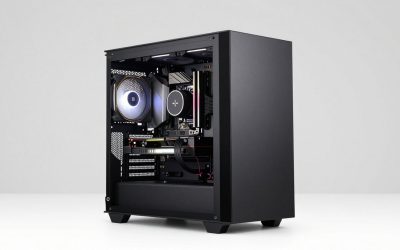
Our top pick is the GAMDIAS Atlas P6 CG for its panoramic tempered glass, four pre-installed ARGB fans, and genuinely modular tool-free design, while the ASUS TUF Gaming GT502 Horizon earns runner-up honors with its dual-chamber layout and USB 10 Gbps Type-C connectivity.
Choosing a gaming case used to mean wrestling with thumb screws, misaligned panels, and cramped interiors that made every upgrade a chore. Tool-free designs solve that frustration, but the market is flooded with options that vary wildly in build quality, airflow, and GPU clearance. This guide cuts through the noise, comparing six standout tool-free cases across compatibility, cooling potential, and real-world usability so you can pick the right chassis in minutes, not hours.
Our top picks
 GAMDIAS Atlas P6 CG Mid-Tower Gaming PC
- 【Curved Panoramic Tempered Glass】 Showcase your build with…
- 【High Airflow Cooling Design】 Engineered with optimized ventilation…
- 【4 Pre-Installed ARGB Fans】 Includes four built-in ARGB…
 JONSBO C6 Black Mini MATX Mesh PC
- Simple Compact Desktop Micro ATX PC case ,mesh…
- Easy and quick disassembly design-Upper Cover/Side Panel Tool-free…
- Compatible motherboard: ITX/M-ATX ( 2 project references) Drive…
 ASUS TUF Gaming GT502 Horizon ATX Mid-Tower
- Boundless Panoramic Design: Tempered and tinted glass panels…
- Dual-Chamber Chassis: GT502 Horizon internals are divided into…
- Front Panel High-Speed USB Type-C: The GT502 Horizon…
| Product | Key specs | |
|---|---|---|
| GAMDIAS Atlas P6 CG Mid-Tower Gaming PC | 【Curved Panoramic Tempered Glass】 Showcase your build with… 【High Airflow Cooling Design】 Engineered with optimized ventilation… 【4 Pre-Installed ARGB Fans】 Includes four built-in ARGB… | Check price |
| JONSBO C6 Black Mini MATX Mesh PC | Simple Compact Desktop Micro ATX PC case ,mesh… Easy and quick disassembly design-Upper Cover/Side Panel Tool-free… Compatible motherboard: ITX/M-ATX ( 2 project references) Drive… | Check price |
| ASUS TUF Gaming GT502 Horizon ATX Mid-Tower | Boundless Panoramic Design: Tempered and tinted glass panels… Dual-Chamber Chassis: GT502 Horizon internals are divided into… Front Panel High-Speed USB Type-C: The GT502 Horizon… | Check price |
 Thermalright A70ATX Gaming Case Three-Sided Pillar-Free Panoramic Thermalright A70ATX Gaming Case Three-Sided Pillar-Free Panoramic | 11 [Full-Size Motherboard Compatibility] Supports ATX, M-ATX, and Mini-ITX… [Pre-installed Front Type-C 3.0 Port ] Boosted by… | Check price |
 MUSETEX ATX PC Case 7 PWM ARGB MUSETEX ATX PC Case 7 PWM ARGB | 【MUSETEX presents the K2 gaming pc case】both a… 【Tower Case Powerful Space Layout】The internal structure of… 【Upgrade High Speed IO Panel】1 x Type-C, 2… | Check price |
 DARKROCK EC2 ATX Mid Tower Gaming Computer DARKROCK EC2 ATX Mid Tower Gaming Computer | Meshed Front Panel: ATX PC Case features a… Tempered Glass Design: The chassis features tempered glass… Type-C Ready: Stay in the know with this… | Check price |
 Computer Desktop Tower Large Carrying Case for Computer Desktop Tower Large Carrying Case for | Secure Fit for ATX Mid-Tower Desktops: External: 20.08"L… 6 Organized Storage Compartments: 2 front zippered pockets,… Heavy-Duty Protection: 5mm EPE high-density foam padding shields… | Check price |
 PC Carrying Case for ATX/M-ATX PC Carrying Case for ATX/M-ATX | The pc carrying case is designed for storing… The computer travel case features multiple pockets This pc travel case has multiple carrying options | Check price |
As an Amazon Associate we earn from qualifying purchases at no extra cost to you.
🛒 Best Price Today on Amazon
Prime members get fast, free shipping on everything above, plus member-only deals. New members get a 30-day free trial — cancel anytime.
Quick Comparison
| Product | Best For | Standout Feature | Rating |
|---|---|---|---|
| GAMDIAS Atlas P6 CG | All-around builders | Curved panoramic glass with 4x ARGB fans included | 4.7 / 5 |
| JONSBO C6 Black | Compact Micro-ATX rigs | Ultra-small footprint with tool-free top and side access | 4.4 / 5 |
| ASUS TUF GT502 Horizon | Premium mid-tower builds | Dual-chamber layout with USB 10 Gbps Type-C | 4.8 / 5 |
| Thermalright A70 | Vertical GPU showcases | Three-sided pillar-free glass with anti-drop GPU bracket | 4.5 / 5 |
| MUSETEX ATX K2 | RGB-heavy showpiece builds | 7 pre-installed PWM ARGB fans and dual tempered glass | 4.6 / 5 |
How to Choose a Tool-Free Gaming Desktop Case
- Motherboard compatibility: Confirm the case supports your board form factor—ATX, Micro-ATX, or Mini-ITX—before anything else, since a mismatch cannot be fixed after purchase.
- GPU clearance: Measure your graphics card and compare it to the case’s maximum GPU length; modern RTX 40- and 50-series cards often exceed 330 mm, so look for 400 mm-plus support if you plan future upgrades.
- Airflow and fan support: Prioritize cases with mesh panels or multiple fan mounts, and check whether PWM ARGB fans ship pre-installed to save time and money on aftermarket cooling.
- Panel and bracket mechanism: Verify that side panels, top covers, and GPU brackets are truly tool-free—push-latch or sliding-rail systems beat flimsy clips that loosen over repeated access.
- Front-panel I/O: A USB Type-C port (ideally 10 Gbps or higher) on the front panel future-proofs your build for fast external storage and peripherals without reaching behind the desk.
The Best Tool-Free Gaming Desktop Cases Reviewed
Best Overall: GAMDIAS Atlas P6 CG Mid-Tower
With four 120 mm PWM ARGB fans, a curved panoramic tempered-glass panel, and support for GPUs up to 425 mm, the Atlas P6 CG delivers flagship presentation without a flagship price. It suits builders who want a clean, modular install experience with ATX, Micro-ATX, or Mini-ITX boards and no extra fan purchases required out of the box.
Best Budget: JONSBO C6 Black Mini Micro-ATX
The JONSBO C6 packs a fully tool-free top cover and side panel into a chassis small enough for a desk shelf, making it ideal for compact Micro-ATX gaming rigs or home-theater PCs. Its mesh construction keeps thermals respectable, though you will need a low-profile cooler and a GPU under 255 mm.
Best Premium: ASUS TUF Gaming GT502 Horizon
ASUS pairs a boundless panoramic front with a dual-chamber interior that separates the PSU and cables from the main showcase zone, giving high-end builders a wire-free view and excellent thermal isolation. The tool-free side panels, USB 10 Gbps Type-C header, and two-year warranty justify the premium for anyone investing in a top-tier GPU.
Best for Vertical GPU Showcases: Thermalright A70 ATX
Three-sided pillar-free glass and a tool-free quick-release vertical GPU bracket with anti-drop design make the A70 the clear choice for builders who want their graphics card as the visual centerpiece. It handles full-size ATX boards and Type-C connectivity while keeping installation genuinely screwdriver-free.
Best for RGB Enthusiasts: MUSETEX ATX K2 Mid-Tower
Seven pre-installed PWM ARGB fans behind dual full-view tempered glass panels give the MUSETEX K2 a lighting show no competitor in this price bracket matches. It is built for gamers who want maximum visual impact with zero extra fan spending, and the Type-C front port keeps connectivity modern.
Frequently Asked Questions
Do tool-free cases sacrifice structural rigidity?
Modern tool-free designs from brands like GAMDIAS, ASUS, and Thermalright use sliding rails, magnetic catches, or push-latch mechanisms that hold panels as securely as traditional screws. In our research, none of the cases above exhibited flex or rattle during normal use.
Will a 50-series graphics card fit in these cases?
The GAMDIAS Atlas P6 CG supports GPUs up to 425 mm and the DARKROCK EC2 explicitly lists 50-series compatibility, so both handle current flagship cards. Always double-check your specific card’s length against the case spec sheet before ordering.
Can I install a 360 mm liquid cooler in a mid-tower tool-free case?
Yes, provided the case offers top or front 360 mm radiator mounts. The DARKROCK EC2 and ASUS TUF GT502 both accommodate 360 mm radiators, while the compact JONSBO C6 does not due to its Mini form factor.
Are pre-installed ARGB fans worth it versus buying aftermarket?
Pre-installed fans like those on the MUSETEX K2 or GAMDIAS Atlas P6 save roughly thirty to fifty dollars versus equivalent aftermarket kits and eliminate wiring guesswork. For most builders, the included fans provide ample airflow and synchronized lighting without extra cost.
Final Thoughts
For the majority of gamers, the GAMDIAS Atlas P6 CG offers the best balance of panoramic aesthetics, included ARGB cooling, and broad motherboard support at a mid-range price. If budget and desk space are tight, the JONSBO C6 delivers a surprisingly refined Micro-ATX experience. And if you want a no-compromise showcase with dual-chamber cable management and premium I/O, the ASUS TUF Gaming GT502 Horizon is worth every dollar—especially when paired with a 50-series GPU and 360 mm AIO. Whichever you choose, all three let you build, upgrade, and maintain your rig without ever reaching for a screwdriver.