Key takeaways
- The best FPS keyboards pair rapid trigger with adjustable actuation and high polling rates. Five picks compared on manufacturer specs, layout and connection.
As an Amazon Associate, we earn from qualifying purchases made through links on this page.
A first-person shooter asks more of a keyboard than almost any other genre. Your movement keys fire hundreds of times a match, counter-strafing depends on how quickly a key resets after you let go, and a wide mouse arc matters more than a number pad you never touch. That is why the best FPS keyboards are no longer ordinary mechanical boards: they are magnetic or optical models whose switches report key position continuously, so actuation and reset points can be tuned in software instead of being fixed by a metal contact.
This guide collects five keyboards built around that idea. Every pick below has adjustable actuation or rapid trigger, every figure quoted is a manufacturer-published specification rather than a latency measurement of our own, and every layout is tenkeyless or smaller except one full-size board included for players who refuse to give up the number pad. If you play tactical shooters where a clean stop decides a duel, or fast arena shooters where repeated hops and strafes chain together, these are the specs that actually change how your inputs register.
What to look for in an FPS keyboard
Switch technology comes first. Hall effect and magnetic switches use a sensor to track how far a key travels, and analog optical switches do the same job with light. Because the board always knows key position, it can fire at a shallow point on the way down and reset the instant the key starts rising. A conventional mechanical switch cannot do either trick: it actuates and resets at fixed points set by its contacts. For FPS play, the magnetic and optical boards in this guide are the relevant category.
Rapid trigger is the headline feature. With rapid trigger enabled, a key resets as soon as it begins moving upward, by a small distance you set, instead of travelling back past a fixed reset point. In practice that means a strafe key can be pressed again sooner, and repeated taps chain faster. Every board here offers it, though the adjustment step and the software behind it differ, and those differences are noted per product.
Adjustable actuation sets the floor. Manufacturers publish an actuation range for each board, for example from a tenth of a millimetre up to several millimetres. A shallow setting makes movement keys feel immediate but raises the chance of accidental presses when you rest your fingers; a deeper setting suits ability keys you never want to fire by mistake. Per-key adjustment, where offered, lets you run WASD shallow and everything else deeper.
Polling rate is the board’s report speed. A standard keyboard reports its state to the PC 1,000 times per second. Boards rated at 8,000 Hz report eight times as often, which is the figure their manufacturers publish for the wired connection. Treat these as manufacturer specifications: the practical gap depends on the rest of your system, and an 8,000 Hz board still needs a wired connection and a game that reads input often enough to use it.
SOCD handling decides counter-strafe behaviour. When you hold A and press D, something has to arbitrate. Features with names like Snap Tap, Speed Tap and FlashTap give priority to the most recent direction, so your character stops and reverses without you fully releasing the first key. Most top boards now include one; the implementation name differs by brand.
Layout is a desk-space decision. A 65 or 75 percent board frees the most room for low-sensitivity mouse sweeps but moves arrows and function keys behind a layer. Tenkeyless keeps a dedicated function row and navigation cluster while dropping the number pad. Full-size keeps everything and costs you mouse room. Pick the smallest layout whose missing keys you will not miss mid-match.
Connection and software matter more than lighting. All five boards here work wired, which is the mode their headline polling figures assume. Two add 2.4 GHz wireless at a lower published polling rate. Software is where actuation, rapid trigger and SOCD settings live, so check whether tuning happens in a desktop app, a web driver or open firmware before you buy.
The five FPS keyboards compared
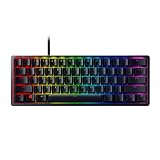
1. Razer Huntsman V3 Pro Tenkeyless 8KHz — analog optical at a true 8,000 Hz

ASIN: B0FRPGVP9G
Razer’s flagship shooter board pairs its second-generation analog optical switches with a wired polling rate the company publishes at a true 8,000 Hz. The switches read key position optically, so actuation adjusts across a manufacturer-stated range of 0.1 to 4.0 mm, and rapid trigger resets a key the moment it starts to rise. Snap Tap handles opposing directions by prioritising the latest input, which is exactly the counter-strafe scenario tactical shooters revolve around.
The tenkeyless frame keeps a full function row and navigation cluster, adds a multi-function digital dial and dedicated media buttons, and uses an aluminium top plate with doubleshot PBT keycaps. A magnetic leatherette wrist rest is included. Basic actuation and rapid trigger settings can be adjusted onboard through the keyboard’s own controls and LED indicators, with Razer Synapse unlocking the deeper per-key tuning.
Who it is for: competitive players who want the highest published polling figure in this guide from a mainstream brand, in a tenkeyless layout that still keeps dedicated media controls.
Limitations, from the specs: it is wired only, so the 8,000 Hz figure assumes the cable; there is no wireless fallback for a second machine. The optical switches are Razer’s own, so the board is not hot-swappable with the magnetic switches used by most rivals here, and replacement keycap and switch options follow Razer’s ecosystem rather than the wider custom market.
2. ASUS ROG Falchion Ace HFX — the compact 65 percent option with 8,000 Hz

ASIN: B0DG7H487F
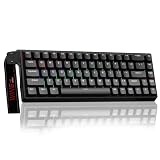
The Falchion Ace HFX is the smallest board in this guide: a 65 percent layout that keeps dedicated arrow keys while dropping the function row and navigation cluster to a layer. Its ROG HFX magnetic switches support a manufacturer-published actuation range of 0.1 to 4.0 mm, rapid trigger through a physical toggle on the board, and Speed Tap, ASUS’s name for last-input-priority SOCD handling. The published polling rate is 8,000 Hz over its wired connection.
Two details separate it from other compact boards. It has two USB-C ports, so it can stay connected to two PCs and switch between them, and an interactive touch panel along the side handles volume and media functions without software. Inside, five layers of dampening foam and a silicone gasket mount soften the typing sound, and a protective cover doubles as a tray and travel case. The keycaps are doubleshot PBT.
Who it is for: low-sensitivity players who angle a small board steeply and want maximum desk clearance, plus anyone who splits time between a gaming PC and a work machine on the same desk.
Limitations, from the specs: the 65 percent layout is a real trade — function keys, Print Screen and the rest of the navigation cluster live behind the Fn layer, which some players use for game binds. It is wired only, and the touch panel’s functions are fixed by ASUS rather than freely remappable.
3. Logitech G515 RAPID TKL — low-profile magnetic switches in a slim frame

ASIN: B0FFM3QSDH
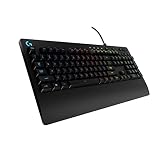
Logitech’s entry takes the opposite approach to height: the G515 RAPID TKL stands about 22 mm tall, the slimmest board here, with low-profile magnetic analog switches. Logitech publishes an actuation range of 0.1 to 2.5 mm, rapid trigger support, and its KEYCONTROL layer for remapping and per-key functions through G HUB. The tenkeyless layout keeps the function row and navigation cluster, and the keycaps are low-profile doubleshot PBT.
The shorter switch travel is the point. A key that bottoms out sooner and resets over a shorter distance suits players who find full-height boards fatiguing over long sessions, and the low frame keeps wrists flatter without a rest. Logitech positions this board for players who want rapid trigger behaviour without moving to a tall, enthusiast-style chassis.
Who it is for: players who prefer a low, flat typing angle, share the desk with work, and still want magnetic switches with rapid trigger from a major brand.
Limitations, from the specs: the published polling rate is 1,000 Hz, the standard figure, rather than the 8,000 Hz two rivals here advertise. The actuation range tops out at 2.5 mm, so there is less room to set deliberately deep actuation for typing, and the low-profile switches and keycaps are not interchangeable with standard-height parts. The switches are also not hot-swappable.
4. Corsair K70 MAX — full-size magnetic board with per-key tuning

ASIN: B0CBHP4SWC
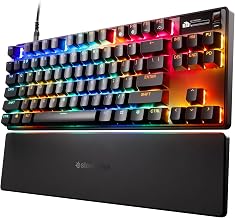
The K70 MAX is the one full-size board in this guide, included for players who use the number pad for binds, streaming controls or work between matches. Its CORSAIR MGX magnetic switches adjust per key across a manufacturer-published 0.4 to 3.6 mm, in fine steps, and support both a rapid trigger mode and dual-point actuation, which binds two actions to one key at different depths. Corsair’s AXON processing publishes an 8,000 Hz hyper-polling rate over the wired connection, and its FlashTap feature covers SOCD priority for strafing.
Around the switches it is a traditional flagship: aluminium frame, doubleshot PBT keycaps, a volume roller and dedicated media keys, a detachable magnetic memory-foam palm rest, and onboard storage Corsair rates for up to 50 profiles. Tuning runs through iCUE, which also handles the per-key actuation and dual-action assignments.
Who it is for: players who want magnetic-switch speed without shrinking the keyboard — streamers, number-pad bind users, and anyone whose desk is wide enough that mouse room is not the constraint.
Limitations, from the specs: full-size is the constraint. The footprint is the widest here and leaves the least room for wide mouse sweeps, which is the main reason most dedicated FPS players choose tenkeyless or smaller. It is wired only, the actuation floor starts at 0.4 mm rather than the shallower settings rivals publish, and the deepest tuning depends on iCUE running on the PC.
5. Keychron Q1 HE — 75 percent aluminium board with open firmware

ASIN: B0D4YKXSPD
The Q1 HE is the custom-keyboard entry: a 75 percent board in a full aluminium case with a gasket-mounted plate, built around Gateron Double-Rail magnetic switches. Keychron publishes adjustable actuation from 0.2 to 3.8 mm with rapid trigger, and the switches are hot-swappable with other compatible magnetic switches. Polling is published at 1,000 Hz in both wired and 2.4 GHz wireless modes, with Bluetooth as a third connection for other devices.
Its distinguishing feature is the firmware. The board runs QMK and is configured through Keychron’s web-based Launcher or VIA-style tools rather than a gaming-brand app, so remaps, layers and analog settings are portable and not tied to a background service. A knob, south-facing lighting and doubleshot PBT keycaps round out a board that types like an enthusiast build while carrying the rapid trigger hardware FPS players are shopping for.
Who it is for: players who split time between shooters and typing-heavy work, want wireless on the desk without giving up rapid trigger, or prefer open firmware and hot-swappable switches over a gaming-brand software suite.
Limitations, from the specs: the published polling rate is 1,000 Hz in every mode, with no 8,000 Hz option. The aluminium case makes it the heaviest board here by a wide margin, which suits a fixed desk but not a LAN bag, and the 75 percent layout still moves some navigation keys to a layer compared with tenkeyless.
Comparison table
| Keyboard | Switch type | Actuation range (manufacturer) | Rapid trigger | Polling rate (manufacturer) | Layout | Connection |
|---|---|---|---|---|---|---|
| Razer Huntsman V3 Pro Tenkeyless 8KHz | Analog optical Gen-2 | 0.1–4.0 mm | Yes, plus Snap Tap | 8,000 Hz | Tenkeyless | Wired |
| ASUS ROG Falchion Ace HFX | ROG HFX magnetic | 0.1–4.0 mm | Yes, plus Speed Tap | 8,000 Hz | 65 percent | Wired, dual USB-C |
| Logitech G515 RAPID TKL | Low-profile magnetic analog | 0.1–2.5 mm | Yes | 1,000 Hz | Tenkeyless | Wired |
| Corsair K70 MAX | CORSAIR MGX magnetic | 0.4–3.6 mm | Yes, plus FlashTap | 8,000 Hz | Full-size | Wired |
| Keychron Q1 HE | Gateron Double-Rail magnetic | 0.2–3.8 mm | Yes | 1,000 Hz | 75 percent | Wired, 2.4 GHz, Bluetooth |
All figures in this table are the manufacturers’ published specifications for each model, not measurements taken for this guide.
Frequently asked questions
Does rapid trigger actually help in FPS games?
It changes how a key resets: instead of travelling back to a fixed reset point, the key can be pressed again as soon as it starts rising. For counter-strafing and repeated movement inputs, that shortens the dead zone between presses. The benefit depends on the reset distance you set and on the game, and every figure involved is a manufacturer specification rather than a promise of a specific in-game result.
Is 8,000 Hz polling noticeably better than 1,000 Hz?
On paper, an 8,000 Hz board reports its state eight times as often. Whether you feel that depends on your monitor’s refresh rate, the game’s input handling and the rest of the system. It is a wired-only figure on the boards here that publish it, and it is one spec among several — switch behaviour and layout usually matter more day to day.
Which layout is best for FPS?
Tenkeyless is the common competitive choice because it keeps the function row and navigation keys while freeing mouse room. A 65 or 75 percent board frees even more room but moves some keys behind a function layer. Full-size works if your desk is wide and you use the number pad, accepting the least mouse space.
What is SOCD handling, and do I need it?
SOCD covers what happens when two opposing inputs are active at once, such as holding A while pressing D. Features like Snap Tap, Speed Tap and FlashTap prioritise the newest direction so your character reverses without you fully releasing the first key. Tactical shooter players value it most; some tournaments and games restrict specific implementations, so check your game’s rules before relying on it.
Can I use one of these boards for typing and work?
Yes. Adjustable actuation cuts both ways: set movement keys shallow for games and a deeper profile for typing, and save each as its own profile. The Keychron Q1 HE suits this split best thanks to its firmware and wireless modes, while the G515 RAPID TKL’s low profile is comfortable for long typing sessions.
Conclusion
For most FPS players, the Razer Huntsman V3 Pro Tenkeyless 8KHz is the straightforward pick: analog optical switches, the joint-widest actuation range here and a manufacturer-published 8,000 Hz polling rate in a tenkeyless frame. If desk space is the priority, the ASUS ROG Falchion Ace HFX delivers the same class of switch technology in a 65 percent body. The Logitech G515 RAPID TKL suits players who want a slim, low board, the Corsair K70 MAX covers anyone who refuses to drop the number pad, and the Keychron Q1 HE is the choice for open firmware, hot-swappable switches and wireless flexibility. Whichever you choose, set your movement keys first, keep a deeper typing profile for everything else, and treat every speed figure as the manufacturer’s published specification for that model.
More from Amazon
Programs that pair well with the guide above. Offers and eligibility are set by Amazon and may change.
Free shipping on eligible items, Prime Video and more. Eligible new members can start with a free trial.
Start a Prime free trialAd-free music streaming. Eligible new subscribers can start with a free trial.
Try Music Unlimited freeA Prime membership for ages 18-24 with a trial period. Eligibility is set by Amazon.
See Prime for Young AdultsAudiobooks and podcasts to listen to on the go. Eligible new members can start with a free trial.
Try Audible freeAs an Amazon Associate we earn from qualifying purchases.