Key takeaways
- Four projectors that can replace a television — three ultra short throw models and one long-throw laser — compared on brightness, image size and listing specs.
Replacing a television with a projector is not mainly a picture-quality decision; it is a room decision. A TV hangs on a wall and works in daylight. A projector that takes its place has to be bright enough for everyday viewing, sit where a TV would sit, carry its own streaming apps and sound, and produce a far bigger image without demanding a darkened cinema room. Buyers who skip those checks end up with a weekend movie projector, not a television replacement.
This guide is for households retiring a large TV for a 100-inch-plus image, renters who cannot wall-mount a big panel, and sports and film viewers who want scale without a panel’s cost at that size. Three of the picks are ultra short throw models that sit on a TV stand inches from the wall; the fourth is a conventional long-throw laser for rooms that can give it distance. All specs come from the Amazon listings.
Quick Picks
As an Amazon Associate we earn from qualifying purchases.
| Product | Best for | Key spec from title |
|---|---|---|
| Epson EpiqVision Ultra LS650 | Bright rooms and the simplest TV-stand setup | 3,600 lumens ultra short throw laser with Android TV |
| Hisense PX3-PRO | Film viewers who want Dolby Vision at up to 150 inches | Triple laser 4K with 3,000 lumens and Dolby Vision |
| Samsung The Premiere LPU7D | A smart-TV experience, including gaming, from a projector | 4K ultra short throw smart laser projector with Gaming Hub |
| BenQ TK710 | Rooms with distance for a traditional ceiling or shelf mount | 4K HDR laser with 3,200 lumens and 1.3x zoom |
How to Choose
Ultra short throw or long throw is the first fork
Ultra short throw projectors sit on the same stand a TV would, inches from the wall, and throw a 100-inch-plus image upward at a steep angle. They avoid ceiling mounts, long cable runs and shadows from people crossing the room, which is why they dominate the TV-replacement category. Long-throw models need metres of distance or a ceiling mount but reward it with flexible placement and often better value. Decide by your room: if the projector must live on TV furniture, the choice is already made.
Brightness decides whether it works as a television
A projector used for evening films can thrive at modest brightness; one replacing a TV must survive daytime news, sport and kids’ viewing with curtains open. The listings here state 3,000 to 3,600 lumens, the range where a large image stays watchable in a lit room, though a light-rejecting screen still helps any of them. Read the lumen figure in the listing rather than the marketing name, and be sceptical of any model that hides it, because brightness is the spec that separates a television substitute from a novelty.
The smart platform and sound are part of the product
A television includes its apps and speakers; its replacement must too. These models carry Android TV or Google TV, or Samsung’s smart platform with its Gaming Hub, so streaming does not depend on an external stick. Built-in sound varies from adequate to genuinely designed, such as the Yamaha system in the Epson. Check the listing for the platform and audio arrangement, and plan on a soundbar only if the listing’s own audio is clearly basic, because a TV replacement that needs three extra boxes has failed its brief.
Image size range and throw distance must fit your wall
Each projector states the image sizes it can produce and, implicitly, the distance those sizes require. Ultra short throw models need the unit placed at a precise small distance from the wall, and a few centimetres changes the image size, so the stand depth matters. Long-throw models state a zoom range that forgives placement. Measure your wall’s usable width, confirm the model covers it within its stated range, and remember that a fixed-focus UST setup rewards a flat wall more than a long-throw model does.
The 4 Best Options
Epson EpiqVision Ultra LS650

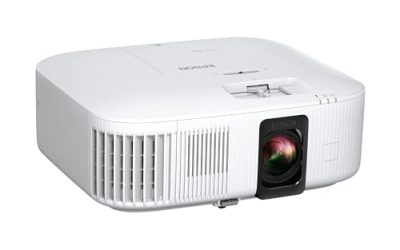
The LS650 is the most television-like projector here. Its 3-chip 3LCD laser engine produces 3,600 lumens, the highest figure in this group, and 3LCD design avoids the rainbow artefacts some viewers see on single-chip rivals. It projects up to 120 inches from a TV stand, runs Android TV for streaming, and its sound is a designed Yamaha system rather than an afterthought. Epson’s setting assistant simplifies the fiddly UST alignment. For a bright family room, it is the pick that asks the fewest compromises of everyday viewing.
Specs
- Ultra short throw laser projector
- 4K PRO-UHD resolution with HDR
- 3,600 lumens brightness
- Image size up to 120 inches
- 3-chip 3LCD design
- Android TV built in
- Sound by Yamaha
Best for: Bright living rooms replacing a TV on the same stand, with family viewing all day.
Watch out for: 4K PRO-UHD is Epson’s pixel-shifting system rather than native 4K, which the listing states in its own wording; the picture is sharp, but know what the term means.
ASIN: B0CKS72W9H
Hisense PX3-PRO

The PX3-PRO is the cinema-leaning ultra short throw: a triple laser engine with 3,000 lumens, Dolby Vision and IMAX Enhanced support, and an image range stretching to 150 inches for rooms with a genuinely big wall. Google TV handles streaming, and the listing’s high refresh support and Designed for Xbox billing make it the gamer-friendliest UST here. Sound is built in with Dolby Atmos support. Choose it when films and big-match sports are the priority and the wall can take the largest image in this roundup.
Specs
- Ultra short throw triple laser projector
- 4K UHD resolution
- 3,000 lumens brightness
- Image size from 80 to 150 inches
- Dolby Vision and Dolby Atmos
- IMAX Enhanced
- Google TV built in
Best for: Film-first households with a large wall and a dimmable room for evening viewing.
Watch out for: Reaching the 150-inch end of its range needs both the wall space and the exact placement distance, so measure before counting on the biggest image.
ASIN: B0DGHZ1C8V
Samsung The Premiere LPU7D

Samsung’s current Premiere is the pick for buyers who want the projector to behave like one of its televisions. It is an ultra short throw 4K laser model for images up to 120 inches, running Samsung’s smart TV platform with the Gaming Hub for cloud gaming, plus voice control through Alexa. Vision Boost adjusts the picture for room light. If your household already lives in Samsung’s interface, this is the least relearning a TV replacement can ask for, and its sound is designed to work without an immediate soundbar purchase.
Specs
- Ultra short throw laser projector
- 4K UHD with AI upscaling
- Image size up to 120 inches
- Samsung smart TV platform with Gaming Hub
- Vision Boost picture adjustment
- Alexa built in
Best for: Samsung households wanting a familiar smart-TV interface and built-in cloud gaming.
Watch out for: This 2024 LPU7D is a different model from the older LSP7T that still circulates under the same Premiere name, so confirm the model code on the listing.
ASIN: B0DC1P67WG
BenQ TK710

The TK710 is the long-throw alternative for rooms that can give a projector distance, whether on a rear shelf or a ceiling mount. Its laser engine is rated at 3,200 lumens with 4K HDR output, a 1.3x zoom and vertical lens shift that make placement far more forgiving than a UST’s fixed geometry, and HDR10 and HLG support. The listing’s low input lag figures target gamers, and eARC lets a soundbar carry the audio properly. It lacks the built-in smart platform depth of the UST models, so budget attention for a streaming source.
Specs
- Long-throw laser projector
- 4K HDR resolution with HDR10 and HLG
- 3,200 lumens brightness
- 1.3x zoom and vertical lens shift
- HDMI with eARC support
- Low input lag gaming modes per the listing
Best for: Dedicated rooms with a ceiling mount or rear shelf and a separate soundbar setup.
Watch out for: It needs real throw distance to reach television-replacing sizes, so it cannot sit on a TV stand like the three UST models.
ASIN: B0D485KG39
Which One Fits Your Situation
Your room is bright and the projector replaces the family TV
Choose the Epson LS650. The highest brightness here, the 3LCD engine’s behaviour in ambient light, Android TV and the Yamaha sound system make it the closest thing to unplugging a television and putting a projector in its place. Place it on the existing stand, run the setup assistant, and everyday viewing — news, sport, streaming — is covered without darkening the room.
Films and big matches are the point of the purchase
Choose the Hisense PX3-PRO. Dolby Vision, the triple laser engine and the 150-inch ceiling on image size serve exactly the content that benefits from scale. Pair it with a wall you can dedicate and light you can control in the evening, and it behaves like a private cinema that also happens to run Google TV for everything else the household watches.
You can mount a projector and already own a soundbar
Choose the BenQ TK710. Lens shift and zoom make a ceiling or shelf installation forgiving, the laser brightness handles a lit room, and eARC hands audio to your existing system properly. It asks more installation effort than any UST model, so it only makes sense where that effort is possible — but in a dedicated media room it is the most flexible projector here.
Common Mistakes
- Treating a low-lumen portable projector as a television replacement for daytime viewing.
- Buying ultra short throw without checking stand depth and the exact placement distance for the image size wanted.
- Forgetting that a UST image shows every bump in the wall; a screen or a flat wall matters.
- Assuming every model includes the same smart platform and apps as the TV it replaces.
- Confusing model generations that share a marketing name, such as Samsung’s Premiere lines.
Frequently Asked Questions
Can a projector really replace a television for everyday use?
Yes, if it is bright enough and carries its own streaming platform and sound, as the models here do. The trade is that even a bright projector prefers some light control for films, and the image rewards a flat wall or a proper screen. For news, sport and streaming in a normal living room, a 3,000-lumen-plus ultra short throw model is a practical substitute at far larger sizes.
What is the difference between ultra short throw and long throw?
Throw describes how far the projector sits from the wall. Ultra short throw models stand inches away on TV furniture and suit rooms arranged around a television. Long-throw models sit metres back or on the ceiling, needing installation but offering zoom and lens shift flexibility. The room decides: furniture placement means UST; a dedicated media room can exploit long throw.
Do I need a special screen for an ultra short throw projector?
Not strictly, but it helps more than with other projectors. The steep projection angle exaggerates wall texture, so a flat, smooth wall is the minimum. An ambient light rejecting screen designed for UST improves daytime contrast noticeably and is the single most effective upgrade for a TV-replacement setup. Check that any screen is specified for ultra short throw before buying it.
How big an image should I plan for?
Match the image to the wall and the seating distance rather than chasing the maximum. The models here cover roughly 100 to 120 inches in typical rooms, with the Hisense reaching 150 inches where the wall allows. A bigger image at the same brightness spreads light thinner, so in a bright room a slightly smaller image from the same projector usually looks better for everyday television.
FAQ
Can a projector really replace a television for everyday use?
What is the difference between ultra short throw and long throw?
Do I need a special screen for an ultra short throw projector?
How big an image should I plan for?
More from Amazon
Programs that pair well with the guide above. Offers and eligibility are set by Amazon and may change.
Free shipping on eligible items, Prime Video and more. Eligible new members can start with a free trial.
Start a Prime free trialAd-free music streaming. Eligible new subscribers can start with a free trial.
Try Music Unlimited freeA Prime membership for ages 18-24 with a trial period. Eligibility is set by Amazon.
See Prime for Young AdultsAudiobooks and podcasts to listen to on the go. Eligible new members can start with a free trial.
Try Audible freeAs an Amazon Associate we earn from qualifying purchases.