Our Top Picks

Most laptop cameras still sit at 720p, and in a dim room they turn a face into a soft, grainy blur. A dedicated HD webcam fixes the two things that matter most on a call: a sharper picture and a microphone that picks up a voice instead of room noise. The five cameras in this guide all record at 1080p or higher, all work as plug-and-play USB cameras, and all carry a physical way to cover the lens when the call ends.
This guide does not rank the cameras by cost and names no money figure anywhere. “Affordable” here means the class of camera itself: a simple USB webcam for everyday calls, classes and streams, rather than a cinema camera or a conference-room system. Every specification below comes from the listing or the maker page for that exact model, and where listings disagree, the article says so. Nothing here comes from practical use; the listings and maker pages are the sources.
What to Look For
Resolution comes first. A camera that records at 1080p shows a clear face on a full-screen call, while a 720p camera softens edges and loses detail in hair and clothing. Every camera in this guide records at 1080p or higher. One records at 2K, which is 2560 by 1440 pixels, a step above 1080p but not the same as 4K. For a video call, 1080p at 30 frames per second is the practical floor; 60 frames per second matters more for fast motion on a stream than for a meeting.
Focus is the next thing to check. Autofocus keeps a face sharp when the speaker leans in or leans back, which matters on long calls. A fixed-focus camera keeps one distance range sharp and lets everything outside that range go soft, so it suits a desk where the speaker sits in one place. Two cameras in this guide use fixed focus and three use autofocus, and the comparison table marks which is which.
Field of view shapes how much of the room the camera shows. A narrow view near 58 degrees frames one person tightly and hides clutter at the edges of a desk. A wide view near 110 degrees fits two people side by side or a whiteboard behind the speaker, but it can stretch faces near the edges of the frame. A mid-range view near 78 to 90 degrees suits most single-person calls. One camera in this guide lets the user switch between three views in software.
Microphones matter more than most buyers expect. A camera with two microphones can soften background noise better than a single microphone, and a microphone with noise reduction helps in a room with a fan, a keyboard, or street noise outside. None of the microphones in this guide replaces a headset in a loud room, and the article says so for each camera where it applies.
A privacy shutter is a small thing that earns its place. Four of the five cameras in this guide have a built-in shutter or cover that slides over the lens, so the camera stays dark when it is not in use. The fifth ships with a separate cover. A shutter is a mechanical fact, not a software setting, so it works even when the computer is asleep.
Connection and mount come last. USB-A plugs into almost any desktop or older laptop, while USB-C suits newer laptops and needs an adapter on older machines. A clip mount grips a monitor lid, and one camera in this guide uses a small adhesive pad instead, which needs a clean, flat surface to hold. Check the connector on the exact model before ordering, because look-alike models in the same family can ship with a different cable.
The Picks
Logitech C920S HD Pro Webcam

The C920S is the long-running all-rounder of this guide, and it earns that place with a simple combination: 1080p video at 30 frames per second, autofocus, dual stereo microphones, and a privacy shutter in one familiar package. The listing names model 960-001257, a glass lens, HD autofocus with light correction, and a 5-foot cable. It works with Windows, macOS and ChromeOS, and it connects over USB-A.
The privacy shutter is the feature that sets the C920S apart from its plainer sibling, the original C920. The shutter slides over the lens with a finger, so the camera stays covered between calls without tape or a separate cap. The dual microphones sit on either side of the lens and pick up a voice clearly at normal desk distance, though they still hear a loud keyboard or a fan in the same room.
This camera is an old design, and the article says so plainly. The C920 line dates back to a camera first sold in 2012, and the C920S keeps the same shape and the same 1080p ceiling. It records at 30 frames per second only, with no 60-frame mode, and it has no USB-C connector and no tripod thread. A buyer who wants a faster frame cadence or a modern connector should look at the other cameras in this guide.
What the C920S does well is stay out of the way. Autofocus holds a face sharp through a long call, light correction lifts a dim room a little, and the clip grips a monitor lid firmly. Confirm model 960-001257 and the C920S with the privacy shutter on the live listing rather than the plainer C920, because the two models share a family name and a similar look.
Anker PowerConf C200 2K Webcam
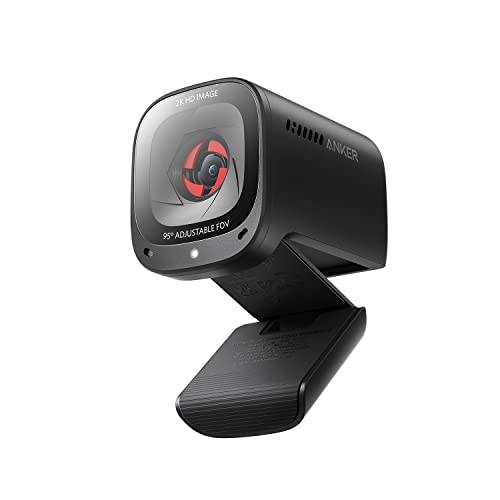
The Anker PowerConf C200 is the only camera in this guide that records above 1080p, at 2K resolution, which is 2560 by 1440 pixels at 30 frames per second. It is also the only pick from a maker other than Logitech. The listing names model A3369, autofocus, dual microphones with AI noise canceling, a built-in privacy cover, and an adjustable field of view of 65, 78 or 95 degrees, chosen through AnkerWork software. It connects over USB-C and carries an f/2.0 lens.
The adjustable field of view is the real reason to choose this camera. A narrow 65-degree view frames one person tightly for a call, the 78-degree view suits a normal desk, and the 95-degree view fits a second person or a wider scene. The privacy cover slides over the lens by hand, so it works without software. The dual microphones use noise canceling to soften background sound, and the autofocus holds a face sharp as the speaker moves.
Two limits deserve plain words. First, 2K is 2560 by 1440 pixels, not 4K, and most conferencing software will send a lower resolution than the camera records anyway, so the extra pixels show up most clearly in recordings. Second, the full field-of-view controls need AnkerWork software, so a computer that cannot run that software keeps the default view. Confirm model A3369 and the black finish on the live listing, and confirm that the box holds the camera and the USB-C cable rather than a bundle with other gear.
Logitech Brio 500 Full HD Webcam

The Logitech Brio 500 is the most feature-rich camera in this guide, built around meetings rather than streaming. It records at 1080p and 30 frames per second, or 720p at 60 frames per second, through a 4MP CMOS sensor. The listing names model 960-001432 in Graphite, RightLight 4 auto-light correction, RightSight auto-framing, Show Mode, dual noise-reducing microphones, a privacy shutter, and a USB-C cable.
RightSight is the feature that defines this camera. It keeps the speaker centered in the frame as they move, which suits a presenter who stands or shifts in a chair. Show Mode tilts the camera down to show a notebook, a sketch, or an object on the desk, which suits a teacher or a designer. RightLight 4 adjusts the picture for dim or uneven light, so a face stays visible when a window sits behind the speaker.
The mount needs a careful word. The Brio 500 fixes to a monitor with a micro-suction pad, which needs a clean, flat surface to hold, and it takes more care to place and remove than a simple clip. RightSight needs Logitech software to run, so a computer without that software keeps a fixed frame. The 60-frame mode works only at 720p, not at 1080p, so a buyer who wants smooth motion at full resolution should know that limit before ordering.
At 160 grams it is the heaviest camera in this guide, and the USB-C cable suits newer laptops while older machines need an adapter. Confirm model 960-001432 in Graphite on the live listing, because the Brio 500 also ships in other finishes under different codes.
Logitech Brio 100 Full HD Webcam

The Logitech Brio 100 is the simplest camera in this guide, and that simplicity is its case. It records at 1080p and 30 frames per second with fixed focus, a single built-in microphone, auto-light balance, and a privacy shutter. The listing names model 960-001616 in Off-White, a 58-degree field of view, a USB-A cable, and certification for Microsoft Teams and Zoom. It weighs 75 grams, the lightest camera in this guide.
Fixed focus is the honest trade here. The lens keeps one distance range sharp, so it suits a desk where the speaker sits in the same place for every call, and it asks nothing of the user. The single microphone hears a voice clearly in a quiet room but has less help against background noise than the dual-microphone cameras in this guide. The 58-degree field of view is the narrowest here, which frames one person tightly and hides the edges of a desk, but it will not fit two people side by side.
The privacy shutter slides over the lens by hand, and the camera works as a plug-and-play USB device with no software to install. The Teams and Zoom certification means the camera meets those platforms’ device checks, which suits a workplace where the IT setup expects certified gear. Confirm model 960-001616 in Off-White on the live listing, because other finishes sell under different codes, and the black version carries its own code.
NexiGo N60 1080p Webcam
The NexiGo N60 is the second non-Logitech camera in this guide and the widest one, with a 110-degree field of view. It records at 1080p and 30 frames per second through a 2MP CMOS sensor and a 3.6mm glass lens, with fixed focus, a noise-reduction microphone, a privacy cover, and 4x digital zoom. The listing names model N60, a USB connection, and plug-and-play use with Windows, Mac, Linux and ChromeOS. The lens stays sharp from about 19.6 inches to 13 feet, which covers a normal desk and a small room.
The wide view is both the strength and the limit of this camera. It fits two people, a whiteboard, or a wide desk in one frame, but a 110-degree lens stretches faces near the edges, so a single speaker sitting close to the camera can look odd at the corners. The fixed focus keeps the setup simple, and the privacy cover slides over the lens by hand. The 4x digital zoom crops into the picture rather than moving a lens, so it softens the image as it zooms in.
Two practical notes belong here. First, NexiGo publishes firmware updates for this camera, so check that the unit runs the latest firmware after it arrives. Second, the microphone uses noise reduction, but a single microphone still hears a loud room, so a headset suits a noisy space better. Confirm model N60 and the exact listing on the live page, because look-alike NexiGo models share a similar name and shape.
Comparison Table
| Camera | Resolution | Focus | Field of view | Microphones | Connection |
|---|---|---|---|---|---|
| Logitech C920S HD Pro | 1080p at 30fps | Autofocus | 78 degrees | Dual stereo | USB-A |
| Anker PowerConf C200 | 2K at 30fps | Autofocus | 65, 78 or 95 degrees | Dual, noise canceling | USB-C |
| Logitech Brio 500 | 1080p at 30fps, 720p at 60fps | Autofocus | Up to 90 degrees | Dual, noise reducing | USB-C |
| Logitech Brio 100 | 1080p at 30fps | Fixed | 58 degrees | Single built-in | USB-A |
| NexiGo N60 | 1080p at 30fps | Fixed | 110 degrees | Single, noise reduction | USB |
Frequently Asked Questions
Do I need a 4K webcam for video calls?
No. A 1080p camera shows a clear face on a full-screen call, and most conferencing software sends a lower resolution than the camera records anyway. A 4K camera helps most in recordings, where the extra pixels survive editing and cropping. For daily calls, classes and meetings, 1080p at 30 frames per second with good light correction and a clear microphone matters more than a higher pixel count.
What makes a webcam good in a dim room?
Three things help: a lens that lets in enough light, software that lifts shadows without washing out the face, and a sensor that stays clean at higher sensitivity. The Brio 500 names RightLight 4 auto-light correction for this, the C920S names HD light correction, and the Brio 100 names auto-light balance. A desk lamp behind the camera helps any webcam more than a brighter sensor alone, because a face lit from the front always looks clearer than a face lit from behind.
Can I use one of these webcams for streaming?
Yes. All five record at 1080p or higher at 30 frames per second, which suits a stream where the camera shows the speaker beside gameplay or a presentation. The Anker C200 records at 2K, which gives a recording more room to crop. The Brio 500 adds Show Mode for showing objects on a desk. For fast motion, note that only the Brio 500 names a 60-frame mode, and it works at 720p rather than 1080p. A headset microphone suits a loud room better than any built-in camera microphone.
How to Choose
Begin with the room and the call. A single speaker at a fixed desk suits the Brio 100 or the NexiGo N60, both fixed-focus cameras that ask nothing of the user. A speaker who moves, leans in, or presents to a room suits the C920S, the C200, or the Brio 500, all three with autofocus. A narrow room suits the Brio 100 at 58 degrees, while a wide desk or a second person suits the NexiGo N60 at 110 degrees, with the C200 in between at 65, 78 or 95 degrees.
Then check the connector. USB-A cameras plug into almost any desktop or older laptop, while USB-C cameras suit newer laptops and need an adapter on older machines. Check the exact model code on the live listing before ordering, because look-alike models in the same family can ship with a different cable, a different finish, or a different mount. Three of the five cameras in this guide come from Logitech, so a buyer who wants a different maker should look at the Anker C200 or the NexiGo N60.
Finally, confirm the listing shows a new unit and a buying option on the live page. Listings change, and a camera that was in stock during research can sell through before the reader opens the page. The features in this guide come from the listings and maker pages for the exact models named, and the limits are stated where they apply, so the reader can check each claim against the live listing.
Disclosure: As an Amazon Associate, we may earn a commission from qualifying purchases made through links in this article, at no additional cost to you.
FAQ
Do I need a 4K webcam for video calls?
What makes a webcam good in a dim room?
Can I use one of these webcams for streaming?
More from Amazon
Programs that pair well with the guide above. Offers and eligibility are set by Amazon and may change.
Free shipping on eligible items, Prime Video and more. Eligible new members can start with a free trial.
Start a Prime free trialAd-free music streaming. Eligible new subscribers can start with a free trial.
Try Music Unlimited freeA Prime membership for ages 18-24 with a trial period. Eligibility is set by Amazon.
See Prime for Young AdultsAudiobooks and podcasts to listen to on the go. Eligible new members can start with a free trial.
Try Audible freeAs an Amazon Associate we earn from qualifying purchases.