Our Short List of 3

All 4 Picks at a Glance
| Product | Specs | Action |
|---|---|---|
| Yamaha CK88 88-Key Stage Keyboard with Built-In Speakers, Black (CK88) | Check price on Amazon | |
| Yamaha DGX-670B, 88-Key Weighted Digital Piano with Sustain Foot Switch and Music Rest, Black | Check price on Amazon | |
 Yamaha PSR-SX720 61-Key Arranger Workstation Keyboard, Black | Check price on Amazon | |
 Yamaha MX88 88-Key Weighted Action Synthesizer | Check price on Amazon |
Key takeaways
- best yamaha keyboards for professionals: compare weighted stage pianos, arrangers and synthesizers for live gigs, studio sessions and rehearsal rooms.
A note before anything else: this guide covers musical keyboards. Every instrument here is a Yamaha digital piano, stage keyboard, arranger workstation or synthesizer built for playing music, not a typing keyboard for a computer. That distinction matters, because the features that make a musical keyboard right for professional use have nothing to do with typing. They have everything to do with how the keys feel under your fingers, how the sounds hold up in a live room, and how quickly you can reach the control you need in the middle of a song.
Professional musicians put keyboards through long days. A piano player may rehearse in the morning, record in the afternoon and play a gig at night. A worship musician may lead a full set on Sunday and practice with a band on Wednesday. A composer may sit at the same instrument for hours building arrangements. The instruments in this guide are built for that kind of working life. They carry weighted or synth-action keybeds, deep sound libraries, and the connections needed to join a stage rig or a studio setup without fuss.
Yamaha has built pianos and keyboards for more than a century, and that history shows in the way these instruments are voiced. The grand piano sounds come from Yamaha concert grands. The electric pianos, organs and synth voices come from decades of Yamaha synthesizer work. What follows is a close look at four instruments that cover the main professional roles: a stage keyboard, a portable grand, an arranger workstation and a music production synthesizer.
What to Look For
Key action and feel
Key action is the first thing to judge, because it shapes every hour you spend at the instrument. Weighted hammer action recreates the resistance of an acoustic piano, with heavier keys in the bass and lighter keys in the treble. Yamaha calls its graded weighted actions GHS and GHC, and its natural wood action NW-GH. Pianists who play classical repertoire, jazz standards or ballads usually want a graded hammer action. Synth action, by contrast, uses light, fast keys with a short travel, which suits organ parts, fast synth lines and players who move between many sounds in one set. Neither action is better in the abstract. The right one is the one that matches the music you play most.
Try to think about the full 88-key range as well. A full-size keyboard gives a pianist the whole compass of the piano, which matters for classical pieces and for two-handed playing. A 61-key instrument trades range for portability, and that trade is often worth it for arrangers and synth players who layer sounds and use octave shift buttons to reach higher or lower notes.
Sound engine and voices
A professional keyboard lives or dies by its core sounds. Listen first to the acoustic piano, because it is the voice you will use most, then to electric piano, organ, strings and synth pads. Yamaha builds its sounds with sampling and modeling technologies such as AWM2, and flagship models carry the CFX concert grand voice sampled from a Yamaha concert grand piano. The number of voices matters less than the quality of the dozen you use every day, but a deep library still helps when a gig calls for an unexpected sound, from a harpsichord to a brass section.
Arranger workstations add a second layer: accompaniment styles. A style is a full backing band that follows your left-hand chords, with drums, bass and rhythmic parts in a chosen genre. For solo performers, wedding musicians and one-person bands, styles turn a single keyboard into a complete ensemble. Look for the number of styles, the quality of the drum kits, and controls such as a chord looper that lets you record a chord progression and then play over it with both hands free.
Polyphony
Polyphony is the number of notes an instrument can sound at once. When you hold a sustain pedal down through a dense passage, or layer piano with strings and a pad, notes add up fast. A 128-note polyphony figure is the professional baseline in this guide, and every instrument here meets it or exceeds it. Higher polyphony is not a luxury for a working pianist. It is what keeps long sustained chords from dropping notes in the middle of a phrase, and it matters even more when you layer two or three voices together.
Connectivity
A professional keyboard must talk to the rest of your rig. USB audio and MIDI let you record straight into a computer and control virtual instruments in a DAW. A standard MIDI pair lets you connect older hardware. Headphone jacks allow silent practice, and many players want two of them so a teacher and a student can listen together. Line outputs feed a PA system or an amplifier, while an auxiliary input lets you play backing tracks through the keyboard speakers. Bluetooth audio, where included, lets you stream reference tracks from a phone or tablet through the instrument for practice.
Weight and portability
Weight decides how often an instrument leaves the house. A stage keyboard near 13 kg can be carried by one person with a gig bag, while a home-oriented portable grand near 30 kg is better left in one room. If you gig weekly, favor the lighter instrument even if it means giving up built-in speakers or a heavier action. If the keyboard lives in a studio or a living room, weight barely matters, and a heavier instrument with bigger speakers may be the better choice. Also think about the stand, the bench, the pedal and the case, since those add to the load you carry.
Built-in speakers and amplification
Built-in speakers change where an instrument can be used. A keyboard with its own speakers works for rehearsal, teaching, small rooms and practice without any extra gear. A stage piano without speakers is built to be heard through a PA or an amplifier, which gives a cleaner result on a loud stage but means you always need external sound. Battery power is a rarer feature, and it frees a stage keyboard from wall power for outdoor sets and venues where power is awkward to reach.
Accompaniment and arranging tools
For solo performers and songwriters, the arranging tools on a keyboard can matter as much as the piano sound. A song recorder captures your ideas. A chord looper frees both hands for melody. One-touch settings recall a matched voice and effect setup for a style with a single press. A joystick controller bends pitch and shapes sounds in real time.
Yamaha CK88 88-Key Stage Keyboard
Yamaha CK88 88-Key Stage Keyboard with Built-In Speakers, Black (CK88)
The CK88 is the stage keyboard in this guide, and it is the one to look at first if you play live. It carries 88 weighted keys with Yamaha GHS action and matte black keytops, so a pianist moving from an acoustic grand will find the touch familiar, with heavier resistance in the bass and a lighter touch in the treble. The sound set blends the piano voices of the Yamaha CP stage piano line with the organ and synth voices of the YC line, giving you three strong sound families in one instrument: acoustic and electric piano, organ with drawbar control, and synth.
What sets the CK88 apart on stage is its front panel. Dedicated knobs and buttons put organ drawbars, filter and envelope controls, and effect settings under your hands without menu diving. Two split points let you divide the keyboard into three zones, so you can play bass with the left hand, piano in the middle and an organ or synth lead with the right hand. The instrument holds 363 voices and 160 Live Set sounds, with 128-note polyphony, so layered and split setups stay full and present even in dense passages.
The CK88 also carries its own speakers, which is unusual for a stage keyboard and genuinely useful. You can rehearse, teach or play a small room with no amplifier at all, then connect to a PA through the line outputs for a larger stage. It can run on batteries as well as wall power, which opens up outdoor sets and venues where power is awkward to reach. At about 13.1 kg it is light enough for one person to carry, and the USB audio and MIDI connection links it to a computer for recording and for controlling virtual instruments.
This is the pick for a gigging pianist or keyboard player who needs one instrument to cover piano, organ and synth in a live set, with controls that can be reached in the dark between songs.
Yamaha DGX-670 88-Key Weighted Digital Piano
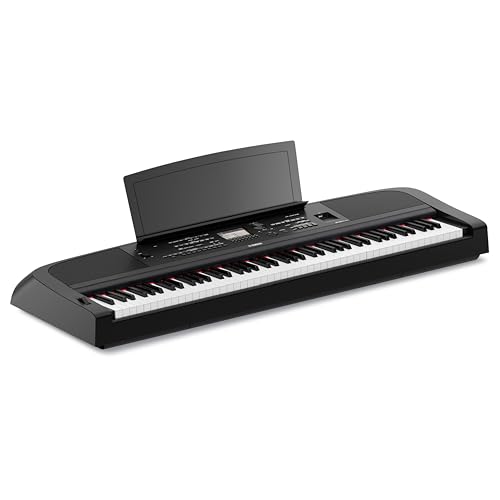
Yamaha DGX-670B, 88-Key Weighted Digital Piano with Sustain Foot Switch and Music Rest, Black
The DGX-670 is the portable grand of this guide, built for a player who wants a full piano experience with a deep library of voices and accompaniment. Its 88 keys use Yamaha GHS weighted action, and its headline piano voice is the CFX concert grand, sampled from a Yamaha flagship grand and shaped with Virtual Resonance Modeling that recreates the way strings and the soundboard interact inside a real piano. The result is a piano voice with presence and warmth that holds up in solo playing and in recordings.
Beyond the piano, the DGX-670 carries 630 voices and 263 accompaniment styles, which makes it a strong tool for a solo performer. Smart Chord lets you play full chord voicings from simple fingerings, and the style engine supplies drums, bass and rhythmic backing that follows your left hand. A microphone input with vocal harmony effects lets a singing pianist add backing vocals, and Bluetooth audio streams reference tracks from a phone or tablet through the built-in speakers for practice.
The DGX-670 is a heavy instrument at about 67.7 pounds, and it is best suited to a fixed spot in a home, studio or teaching room rather than weekly travel. What you gain for that weight is a big, confident speaker system and an instrument that feels complete on its own, with no extra gear needed for a full practice or performance session at home. For a pianist who plays mostly in one place and wants grand piano sound plus a full band in one box, it is a strong match.
Yamaha PSR-SX720 61-Key Arranger Workstation
Yamaha PSR-SX720 61-Key Arranger Workstation Keyboard, Black
The PSR-SX720 is the arranger workstation in this guide, and it is the instrument for a solo performer, songwriter or one-person band. It carries 61 synth-action keys with initial touch, a 7-inch color touch display, and a sound library of 1,377 voices plus 56 drum and sound-effect kits and 480 XG voices, including Super Articulation voices that add realistic phrasing details such as guitar slides, brass falls and vocal-like expression to melodic lines. Polyphony is 128 notes, and the instrument holds about 1 GB of internal memory for songs and data.
The arranging tools are the heart of this instrument. It holds 450 accompaniment styles with one-touch settings, so a single press recalls a matched voice and effect setup for the style in play. A chord looper records a chord progression and plays it back, freeing both hands for melody and improvisation. A joystick controller handles pitch bend and modulation, and assignable live control knobs shape filter, effect and volume settings in real time. A 16-track song recorder captures full arrangements, and the instrument connects to a computer over USB for recording and for expanding the sound set. At about 11.6 kg the PSR-SX720 is easy to carry, and its built-in speaker system lets you rehearse and play small rooms with no extra gear.
Yamaha MX88 88-Key Weighted Action Synthesizer
Yamaha MX88 88-Key Weighted Action Synthesizer
The MX88 is the music production synthesizer in this guide, built for a player who moves between piano parts, synth textures and computer-based production. It carries 88 weighted keys with GHS action and more than 1,000 voices drawn from the Yamaha MOTIF sound engine, covering concert grand piano, electric piano, organ, strings, brass, synth leads, pads and drum kits. Polyphony is 128 notes, and the instrument layers and splits voices across the keyboard for complex performance setups.
The MX88 is designed to sit at the center of a studio as well as on a stage. Its class-compliant USB audio and MIDI connection links it to a computer or a mobile device with no extra interface, so you can record audio straight into a DAW and control virtual instruments from the keyboard. It also works as a deep controller for computer music software, with knobs and buttons mapped to the software you use. At under 14 kg it is light for a full 88-key weighted instrument, which makes it practical for a player who records at home and also takes the same instrument to rehearsals and gigs.
This is the pick for a musician who writes and produces as much as they perform, and who wants one weighted 88-key instrument to cover piano parts, synth work and DAW control in a single setup.
Comparison Table
| Model | Keys | Key Action | Voices | Polyphony | Weight | Best For |
|---|---|---|---|---|---|---|
| Yamaha CK88 | 88 | GHS weighted | 363 | 128 notes | About 13.1 kg | Live stage piano, organ and synth |
| Yamaha DGX-670 | 88 | GHS weighted | 630 | 128 notes | About 67.7 lb | Home piano with full accompaniment |
| Yamaha PSR-SX720 | 61 | FSB synth action | 1,377 | 128 notes | About 11.6 kg | Solo performance and arranging |
| Yamaha MX88 | 88 | GHS weighted | Over 1,000 | 128 notes | Under 14 kg | Studio production and live synth |
Frequently Asked Questions
Which Yamaha keyboard is best for live performance?
The CK88 is the strongest live choice in this guide. Its front-panel controls put organ drawbars, filters and effects within reach during a song, and its two split points let you cover bass, piano and a lead voice at once. Built-in speakers and battery power add flexibility for small rooms and outdoor sets, while the line outputs connect cleanly to a PA for larger stages. A player who performs weekly and carries their own gear will value its light weight as much as its sound set.
Do professional Yamaha keyboards have weighted keys?
Three of the four instruments here have weighted keys. The CK88, the DGX-670 and the MX88 all use Yamaha GHS graded hammer action, which gives heavier resistance in the bass and lighter resistance in the treble, much like an acoustic piano. The PSR-SX720 uses light synth-action keys instead, because it is built for fast arranging work and organ-style playing where a light touch suits the music better. Choose weighted keys for piano repertoire and synth action for arranging and fast synth lines.
Can I connect a Yamaha keyboard to a computer for recording?
Yes. All four instruments here connect to a computer over USB for audio and MIDI. You can record your playing straight into a DAW, control virtual instruments from the keyboard, and use the keyboard as a controller for music software. The MX88 is the most studio-focused of the four, with class-compliant USB audio and MIDI and deep DAW control, while the CK88, DGX-670 and PSR-SX720 all support USB recording and playback as well. A headphone jack on each instrument also allows silent practice and late-night writing sessions.
How to Choose
Begin with the room you play in most. If you gig every week, favor the CK88 or the PSR-SX720 for their light weight, built-in speakers and fast controls. If the keyboard stays in one place, the DGX-670 gives you the fullest home piano experience with the deepest accompaniment. If you write and produce music on a computer, the MX88 ties the piano, the synth and the DAW together in one instrument.
Then match the key action to your hands. Pianists who play classical pieces, jazz standards and ballads will want the graded hammer action of the CK88, the DGX-670 or the MX88. Arrangers and solo performers who layer many sounds and play fast lines will be happier with the light synth action of the PSR-SX720. After that, listen to the piano voice first, because it is the sound you will return to every day, and check the connections you need for your stage or studio setup before you commit. Any of these four instruments can serve a professional musician well. The right one is the one that fits the work you actually do, in the rooms where you actually play.
Disclosure: As an Amazon Associate, we may earn a commission from qualifying purchases made through links in this article, at no additional cost to you.
FAQ
Which Yamaha keyboard is best for live performance?
Do professional Yamaha keyboards have weighted keys?
Can I connect a Yamaha keyboard to a computer for recording?
More from Amazon
Programs that pair well with the guide above. Offers and eligibility are set by Amazon and may change.
Free shipping on eligible items, Prime Video and more. Eligible new members can start with a free trial.
Start a Prime free trialAd-free music streaming. Eligible new subscribers can start with a free trial.
Try Music Unlimited freeA Prime membership for ages 18-24 with a trial period. Eligibility is set by Amazon.
See Prime for Young AdultsAudiobooks and podcasts to listen to on the go. Eligible new members can start with a free trial.
Try Audible freeAs an Amazon Associate we earn from qualifying purchases.