Our Short List of 3
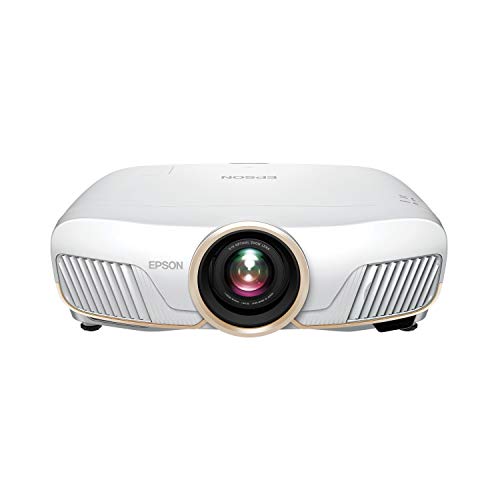
- Best for: Movie-first theater rooms chasing deep blacks on a 120-inch or larger screen.
- 4K PRO-UHD projection with 3-chip 3LCD design
- 2,600 lumens of color brightness and 2,600 lumens of white brightness
- Contrast ratio up to 1,000,000:1 with UltraBlack technology
- HDR10 support with full 10-bit color processing
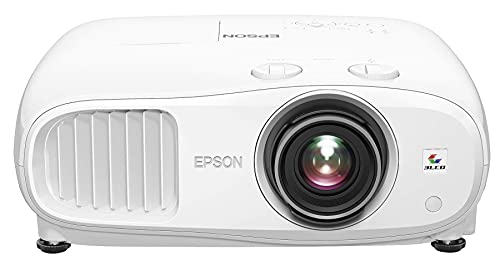
- Best for: Living rooms and media rooms that mix movies, sports, and gaming on one big screen.
- 4K PRO-UHD projection with true 3-chip 3LCD design
- 3,000 lumens of color brightness and 3,000 lumens of white brightness
- Contrast ratio up to 100,000:1
- Full 10-bit HDR support plus HLG

- Best for: Smaller rooms, gaming dens, and simulator setups that need a huge image from a short distance.
- True 4K UHD resolution, 3840 x 2160
- 3,500 lumens from a DuraCore laser light source
- Laser life rated up to 30,000 hours
- Contrast ratio of 500,000:1
All 5 Picks at a Glance
| Product | Specs | Action |
|---|---|---|
| Epson Home Cinema 5050UB |
| Check price on Amazon |
| Epson Home Cinema 3800 |
| Check price on Amazon |
| Optoma UHZ35ST |
| Check price on Amazon |
 BenQ TK710STi |
| Check price on Amazon |
 Epson Home Cinema 2350 |
| Check price on Amazon |
Key takeaways
- Five projectors that can fill screens of 120 inches and up, compared on brightness, throw distance, lens shift, HDR support, and gaming input lag.
Crossing from a television-sized picture to a screen of 120 inches or more changes every part of the projector decision. The same lumens spread across a much larger area, so brightness that looked punchy at 100 inches can turn flat at 150. Throw distance and lens flexibility decide whether the projector can even sit where your room allows, and seating distance starts to expose soft focus and weak contrast.
This guide is for home theater builders, living-room upgraders, and gamers who want that wall-filling picture without guessing. The picks below cover the main routes to a big screen: the Epson Home Cinema 5050UB and Home Cinema 3800 for lens flexibility and color brightness, the Optoma UHZ35ST and BenQ TK710STi for short-throw laser power, and the Epson Home Cinema 2350 for built-in streaming on a large image.
Quick Picks
As an Amazon Associate we earn from qualifying purchases
| Product | Best for | Key spec from title |
|---|---|---|
| Epson Home Cinema 5050UB | Dedicated dark theater rooms | Contrast ratio up to 1,000,000:1 |
| Epson Home Cinema 3800 | Bright living rooms | 3,000 lumens of color and white brightness |
| Optoma UHZ35ST | Big screens in short rooms | 3,500-lumen laser, image up to 300 inches |
| BenQ TK710STi | Big-screen gaming | 3,200 ANSI lumens laser, 4ms response at 1080p 240Hz |
| Epson Home Cinema 2350 | Streaming-first family rooms | 2,800 lumens with Android TV built in |
How to Choose
Brightness Matched to Screen Size
Brightness is the first filter for a big screen, because every added inch of diagonal spreads the same light over more area. Look at the lumen rating in the listing and think about your room at the same time: a light-controlled theater can run a lower figure, while a living room with lamps and windows needs headroom. Epson rates color brightness and white brightness separately on its 3LCD models, and equal figures mean colors stay as bright as white scenes. Laser models hold their output longer than lamp models, which matters when the image is large.
Throw Distance and Lens Flexibility
Measure the distance from your planned projector position to the screen before falling for any model. Standard-throw projectors need a long room to reach 120 inches and beyond, while short-throw models such as the UHZ35ST and TK710STi fill the same screen from a few feet away. Zoom range widens your placement options, and lens shift lets you move the image without tilting the projector and reaching for keystone correction, which softens the picture. Ceiling mounting, shelf placement, and rear projection all change which lens package makes sense.
Resolution and HDR Support
Most projectors in this class reach 4K on screen either natively or through pixel-shifting, and the listing wording tells you which approach a model uses. For movie nights, HDR support matters as much as resolution: check whether the listing names HDR10, HLG, or HDR10 Plus, and whether color processing is full 10-bit. Wide color coverage, described in listings as DCI-P3 or Rec.709 figures, decides how rich HDR scenes look on a large screen, where washed-out color is easy to spot from the couch.
Gaming Performance and Connections
A big screen is tempting for gaming, but the projector has to keep up with the console or PC feeding it. Listings for gaming models quote input lag or response time at specific resolutions and refresh rates, such as 4ms at 1080p and 240Hz, so compare figures at the settings you actually play. Full-bandwidth HDMI matters for 4K at 60Hz with HDR, and eARC support lets the projector pass audio back to a soundbar or receiver. Built-in streaming platforms remove the need for a separate stick, which keeps a ceiling install tidy.
The 5 Best Options
Epson Home Cinema 5050UB
- Best for: Movie-first theater rooms chasing deep blacks on a 120-inch or larger screen.
- 4K PRO-UHD projection with 3-chip 3LCD design
- 2,600 lumens of color brightness and 2,600 lumens of white brightness
- Contrast ratio up to 1,000,000:1 with UltraBlack technology
- HDR10 support with full 10-bit color processing
Movie-first theater rooms chasing deep blacks on a 120-inch or larger screen.
It is lamp-based and the heaviest pick here, so plan for lamp changes and a sturdy mount.
The 5050UB is the pick for a dedicated, light-controlled theater where contrast is the whole point. Its UltraBlack technology supports a contrast ratio up to 1,000,000:1, and full 10-bit HDR color processing accepts the complete HDR source signal, with the listing citing three-dimensional DCI-P3 color gamut coverage. A powered lens handles focus, zoom, and lens position from the remote, which makes dialing in a 120-inch or larger image from a ceiling mount far easier. At 2,600 lumens of color and white brightness, it suits dark rooms better than bright ones, and its size rewards a permanent install.
Epson Home Cinema 3800
- Best for: Living rooms and media rooms that mix movies, sports, and gaming on one big screen.
- 4K PRO-UHD projection with true 3-chip 3LCD design
- 3,000 lumens of color brightness and 3,000 lumens of white brightness
- Contrast ratio up to 100,000:1
- Full 10-bit HDR support plus HLG
Living rooms and media rooms that mix movies, sports, and gaming on one big screen.
The lamp light source needs periodic replacement, unlike the laser models below.
The Home Cinema 3800 brings 3,000 lumens of both color and white brightness, which gives it more headroom for living rooms that never get fully dark. The 3-chip 3LCD design shows the full RGB color signal for every frame, and the precision lens offers vertical and horizontal lens shift, so the projector does not need to sit dead center. Full 18 Gbps HDMI 2.0 support carries 4K HDR content at a full 60Hz from consoles and streaming devices, and the built-in dual 10W speakers with aptX Bluetooth cover simple audio needs without extra boxes.
Optoma UHZ35ST
- Best for: Smaller rooms, gaming dens, and simulator setups that need a huge image from a short distance.
- True 4K UHD resolution, 3840 x 2160
- 3,500 lumens from a DuraCore laser light source
- Laser life rated up to 30,000 hours
- Contrast ratio of 500,000:1
Smaller rooms, gaming dens, and simulator setups that need a huge image from a short distance.
The fixed short-throw lens has no zoom, so placement distance sets the image size exactly.
The UHZ35ST solves the most common big-screen problem: a room that is not deep enough. Its short-throw lens projects a 100-inch image from just over three feet away, and the rated image range runs up to 300 inches, so a coffee-table or low-stand placement can still fill a wall. The DuraCore laser light source delivers 3,500 lumens and a rated life of 30,000 hours, removing lamp swaps from the plan. Gaming figures are strong too, with low input lag quoted for fast refresh play, and the compact body weighs under seven pounds.
BenQ TK710STi
- Best for: Gamers who want a big image, low lag, and built-in streaming from one short-throw unit.
- 4K UHD resolution with HDR10 and HLG support
- 3,200 ANSI lumens from a laser light source
- 95 percent Rec.709 color coverage
- 4ms response time at 1080p and 240Hz
Gamers who want a big image, low lag, and built-in streaming from one short-throw unit.
Short-throw placement puts the projector near the seating area, so route cables and ventilation with care.
The TK710STi pairs a short-throw lens with a laser light source aimed squarely at gaming and movie nights in ordinary living spaces. BenQ rates it at 3,200 ANSI lumens, bright enough to keep images punchy with some ambient light, and the listing highlights 95 percent Rec.709 color coverage with HDR10 and HLG support. Response time drops to 4ms at 1080p and 240Hz for competitive play, while Google-certified Android TV with Netflix, Chromecast, and AirPlay is built in, so the projector works as its own streaming hub close to the screen.
Epson Home Cinema 2350
- Best for: Family rooms that want streaming and casual gaming on a large image with minimal extra gear.
- 4K PRO-UHD projection with 3-chip 3LCD technology
- 2,800 lumens of brightness
- HDR10 and HLG support
- Android TV built in for streaming
Family rooms that want streaming and casual gaming on a large image with minimal extra gear.
Contrast and lens adjustment are a step below the theater-focused Epson models above.
The Home Cinema 2350 is the streaming-first route to a big screen. Android TV is built in, so films and shows start from the projector itself, and the 3-chip 3LCD engine produces 2,800 lumens of brightness with 4K PRO-UHD processing for a sharp picture at 120 inches and beyond. Epson positions it as a smart gaming projector with low latency, and the single 10W speaker plus Bluetooth covers casual audio for sports and family viewing. It gives up the powered lens and deep contrast of the 5050UB, but asks much less of the room and the installer.
Which One Fits Your Situation
A Dedicated Dark Theater Room
If the room has blackout control and a fixed screen, choose the Epson Home Cinema 5050UB. Its contrast ratio and powered lens are built for permanent installs, and the lower brightness is no handicap once the lights are out. Movies gain the most from this pairing, especially HDR titles with dark scenes that expose weaker black levels on brighter, contrast-poor models.
A Bright Multi-Use Living Room
For a room that hosts daytime sports, evening films, and game nights, the Epson Home Cinema 3800 fits best. Equal color and white brightness at 3,000 lumens keeps the picture vivid with lamps on, lens shift eases shelf or ceiling placement, and the built-in speakers handle everyday viewing before you add a separate sound system.
A Short Room or Gaming Den
When the projector must sit close to the wall, pick between the Optoma UHZ35ST and the BenQ TK710STi. Both use short-throw laser designs for a 120-inch picture from a few feet away. The Optoma reaches the higher brightness and the larger maximum image, while the BenQ adds built-in Android TV streaming and the faster quoted response figure for high-refresh play.
A Simple Streaming Setup
If the goal is the fewest boxes and cables, the Epson Home Cinema 2350 keeps things simple. Built-in Android TV removes the streaming stick, Bluetooth sends audio to a speaker or headphones, and 2,800 lumens is enough for a 120-inch image in a dimmed family room. It suits renters and first-time projector owners who value easy setup over theater-grade contrast.
Common Mistakes
- Choosing by lumens alone, without matching brightness to the actual screen size and the light in the room.
- Skipping the throw-distance math, then finding the projector cannot fill a 120-inch screen from the only shelf or mount position available.
- Relying on keystone correction instead of lens shift or zoom, which rescales the image and softens fine detail.
- Buying a fixed-lens short-throw model before confirming the exact placement distance its image size requires.
- Forgetting the audio and cable plan, including long HDMI runs and where the sound will come from once the screen is huge.
Frequently Asked Questions
How many lumens does a 120-inch screen need?
In a dark, light-controlled room, a projector in the range of 2,500 to 3,000 lumens can drive a 120-inch screen comfortably. Add ambient light from windows or lamps and the same screen needs more output, which is why the brighter laser and 3LCD picks above suit living rooms. Screen material and gain also change the result, so treat the listing figure as a starting point.
How far away should the projector sit for a big screen?
Distance depends on the throw ratio in the listing. Standard-throw models often need a long room to reach 120 inches or more, while short-throw designs such as the UHZ35ST fill 100 inches from just over three feet. Check the projection distance range for your target image size before buying, and remember that zoom lenses give a placement window rather than one fixed spot.
Is pixel-shifted 4K the same as native 4K?
Not exactly. Pixel-shifting moves a lower-resolution image rapidly to build a 4K picture on screen, and listings describe this with terms such as 4K PRO-UHD or 4K Enhancement. Native 4K models display the full 3840 x 2160 pixel count directly. At normal seating distances on a big screen, both approaches look sharp, but the listing wording tells you which technology you are paying for.
Can I use a plain wall instead of a screen?
A smooth, matte, light-colored wall works, and many first big-screen setups start that way. A dedicated screen still helps: its surface reflects light more evenly, keeps geometry flat, and a fixed frame defines the image border. If the wall has texture, strong color, or seams, those flaws grow more visible as the image passes 120 inches, so a screen becomes the better long-term partner.
FAQ
How many lumens does a 120-inch screen need?
How far away should the projector sit for a big screen?
Is pixel-shifted 4K the same as native 4K?
Can I use a plain wall instead of a screen?
More from Amazon
Programs that pair well with the guide above. Offers and eligibility are set by Amazon and may change.
Free shipping on eligible items, Prime Video and more. Eligible new members can start with a free trial.
Start a Prime free trialAd-free music streaming. Eligible new subscribers can start with a free trial.
Try Music Unlimited freeA Prime membership for ages 18-24 with a trial period. Eligibility is set by Amazon.
See Prime for Young AdultsAudiobooks and podcasts to listen to on the go. Eligible new members can start with a free trial.
Try Audible freeAs an Amazon Associate we earn from qualifying purchases.