Our Short List of 3

- Best for: beginners and parents who want the established default with the pedal already included.
- Keys: 88 full-size keys
- Action: Graded Hammer Standard (GHS), fully weighted
- Voices: 10, including a Yamaha grand piano voice
- Modes: Duo mode, dual voice layering
- Best for: learners who play along with a phone or tablet and want a compact, current Yamaha.
- Keys: 88 full-size keys
- Action: Graded Hammer Compact (GHC), weighted and touch sensitive
- Connectivity: Bluetooth audio, USB
- Speakers: built-in speakers
- Best for: students who will use lesson and record modes and want louder built-in speakers.
- Keys: 88 full-size keys
- Action: hammer action, weighted, adjustable touch response
- Voices: 12
- Polyphony: 128 notes maximum
All 4 Picks at a Glance
| Product | Specs | Action |
|---|---|---|
| Yamaha P71 88-Key Weighted Digital Piano |
| Check price on Amazon |
| Yamaha P-145BT 88-Key Digital Piano |
| Check price on Amazon |
| Alesis Recital Pro 88-Key Digital Piano |
| Check price on Amazon |
 Donner DEP-20 88-Key Weighted Digital Piano |
| Check price on Amazon |
Key takeaways
- Compare four piano keyboards with piano-style weighted keys: Yamaha P71 and P-145BT, Alesis Recital Pro and Donner DEP-20, with specs and fit notes.
The real decision when you learn piano on an electronic keyboard is whether the keys teach your fingers the right habits. Weighted keys that push back the way an acoustic piano does build finger strength, control and evenness that light springy keys never develop, so the first choice is a proper hammer action and a full set of 88 keys rather than the longest sound list or the flashiest panel on the box.
This roundup serves adult beginners starting lessons, parents choosing a first instrument for a child, and returning players who want to practice at home without an acoustic piano in the room. Every model below is a digital piano with full-size piano-style keys, picked from the names and specifications published on its Amazon product page, and the four differ mainly in key action, cabinet size and what arrives in the box.
Quick Picks
As an Amazon Associate we earn from qualifying purchases.
| Product | Best for | Key spec from title |
|---|---|---|
| Yamaha P71 88-Key Weighted Digital Piano | Beginners who want the proven default | 88 weighted keys, sustain pedal and power supply included |
| Yamaha P-145BT 88-Key Digital Piano | Learners who play along with a phone | 88 weighted keys with Bluetooth audio |
| Alesis Recital Pro 88-Key Digital Piano | Students who want lesson and record modes | 88 hammer-action keys, 2x20W speakers |
| Donner DEP-20 88-Key Weighted Digital Piano | A complete first setup in one box | 88 full-size weighted keys, sustain pedal included |
How to Choose
Start With the Key Action
The action decides whether practice on an electronic piano keyboard carries over to a real piano. A hammer action puts a weighted mechanism under each key, so the key resists your finger and returns the way an acoustic key does, and a graded action makes the low notes heavier than the high ones. Semi-weighted and synth actions feel lighter and springier, which suits organ or synth playing but teaches soft, flat finger habits that a teacher then has to undo. For piano lessons, put a fully weighted hammer action at the top of your list and treat everything else as secondary.
Count the Keys Before Anything Else
A piano has 88 keys, and method books assume all of them are there. A 61-key or 76-key board is fine for playing melodies and chords, but pieces quickly run off the end, and a student who learns on a short board has to adjust when the lesson studio piano is full size. Full-size keys matter just as much as the count, because narrow keys change the spacing your hands memorize. If space is the worry, look for a slim 88-key cabinet rather than fewer keys, since several models here are barely deeper than a bookshelf plank.
Listen for Polyphony and Speakers
Polyphony is how many notes the instrument can sound at once, and it matters sooner than beginners expect. Hold the sustain pedal through a chord change and the earlier notes keep ringing while new ones start, so a low count cuts older notes off mid-phrase. Figures in the listing run from 64 notes on the compact Casio-style designs to 128 on the Alesis and Donner here. Speakers matter too, because most home practice happens without an amplifier: a stronger built-in pair fills a room, while a small pair is really there for quiet personal practice at close range.
Check Pedals, Ports and the Box Contents
A sustain pedal is part of piano technique from the first months, so confirm whether one is in the box or sold separately, and whether the jack also accepts a three-pedal unit later. A headphone jack decides whether late practice is possible in a shared home. USB or Bluetooth connections let the keyboard talk to lesson apps and notation software on a phone, tablet or computer. Finally, check whether a stand, bench and music rest are included or extra, because a board balanced on a dining table at the wrong height quickly makes practice uncomfortable.
The 4 Best Options
Yamaha P71 88-Key Weighted Digital Piano
- Best for: beginners and parents who want the established default with the pedal already included.
- Keys: 88 full-size keys
- Action: Graded Hammer Standard (GHS), fully weighted
- Voices: 10, including a Yamaha grand piano voice
- Modes: Duo mode, dual voice layering
beginners and parents who want the established default with the pedal already included.
there is no Bluetooth and only ten voices, so app-based learners need a USB cable connection.
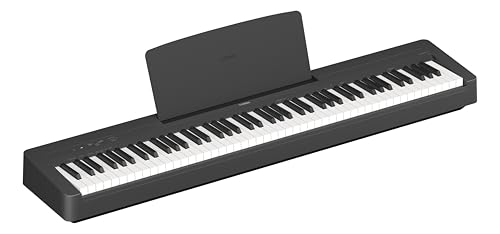
The P71 is Yamaha’s Amazon-exclusive version of its long-running entry piano, and it stays the safest first choice for a learner who wants to stop researching and start playing. Its fully weighted Graded Hammer Standard action is heavier in the bass and lighter in the treble, the way an acoustic piano behaves, and the single-button layout keeps the panel out of a beginner’s way. Ten voices cover the essentials, Duo mode splits the board for a teacher and student, and both a sustain pedal and the power supply are in the box.
Watch out for: there is no Bluetooth and only ten voices, so app-based learners need a USB cable connection.
Yamaha P-145BT 88-Key Digital Piano
- Best for: learners who play along with a phone or tablet and want a compact, current Yamaha.
- Keys: 88 full-size keys
- Action: Graded Hammer Compact (GHC), weighted and touch sensitive
- Connectivity: Bluetooth audio, USB
- Speakers: built-in speakers
learners who play along with a phone or tablet and want a compact, current Yamaha.
the included foot switch is a basic on-off pedal, so pianists who want half-pedalling control should plan on a pedal upgrade.
The P-145BT is the newer, slimmer Yamaha for learners who practice along with songs and videos on a phone. Its Graded Hammer Compact action keeps the graded, fully weighted feel of the bigger P Series boards in a shorter, lighter cabinet, and Bluetooth audio streams sound from a phone or tablet through the piano’s own speakers, which makes playing along with a lesson video feel natural. The design is deliberately plain: a sustain foot switch and music rest are included, the panel stays minimal, and the whole instrument is easy to move between rooms.
Watch out for: the included foot switch is a basic on-off pedal, so pianists who want half-pedalling control should plan on a pedal upgrade.
Alesis Recital Pro 88-Key Digital Piano
- Best for: students who will use lesson and record modes and want louder built-in speakers.
- Keys: 88 full-size keys
- Action: hammer action, weighted, adjustable touch response
- Voices: 12
- Polyphony: 128 notes maximum
students who will use lesson and record modes and want louder built-in speakers.
it is the bulkiest board here, and running it on D-cell batteries is a backup option rather than a daily habit.
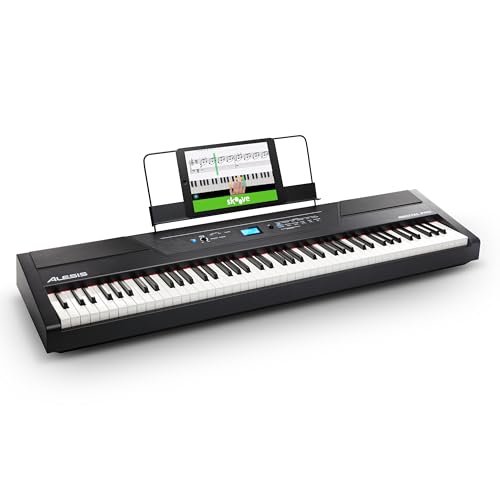
The Recital Pro is the pick for a student who wants the piano itself to help with practice. Alongside its 88 hammer-action keys with adjustable touch response, it adds a lesson mode that splits the keyboard into two identical ranges for side-by-side teaching, a record mode for hearing yourself back, and split and layer modes for two sounds at once. Twelve voices, effects such as reverb and chorus, and a 128-note polyphony ceiling give it more headroom than most entry boards, and the twin 20-watt speakers are the strongest in this group.
Watch out for: it is the bulkiest board here, and running it on D-cell batteries is a backup option rather than a daily habit.
Donner DEP-20 88-Key Weighted Digital Piano
- Best for: beginners who want the pedal, stand for sheet music and adapter included from day one.
- Keys: 88 full-size keys
- Action: weighted hammer action, adjustable touch response
- Polyphony: 128 notes
- Tones: 238, with dual-tone layering
beginners who want the pedal, stand for sheet music and adapter included from day one.
the tone library is broad but the core piano voice is what matters for lessons, and a separate keyboard stand is still needed.
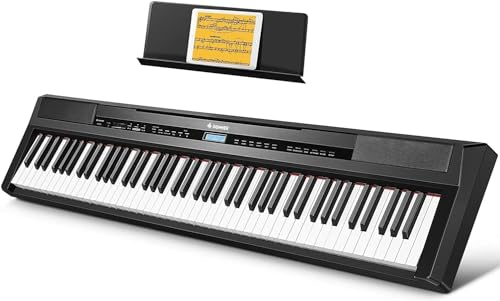
The DEP-20 suits a learner who wants one box to contain the whole starting setup. The 88 full-size keys are weighted with a hammer action and adjustable touch response, the listing states 128-note polyphony and a wide library of 238 tones with a dual-tone layer function, and the sustain pedal, sheet music stand and power adapter are all included. At 11.6 kilograms it is light enough for one person to move between rooms, and the 6.35 mm headphone output keeps practice quiet in the evenings without extra adapters for standard piano headphones.
Watch out for: the tone library is broad but the core piano voice is what matters for lessons, and a separate keyboard stand is still needed.
Which One Fits Your Situation
You Are Starting Formal Piano Lessons
Choose the Yamaha P71. Its graded hammer action is the reference feel teachers expect, the sustain pedal is already in the box, and Duo mode lets a teacher sit beside you on the same board during home practice between lessons. It asks nothing of you beyond a stand and a chair at the right height, and its plain panel means practice time goes on playing rather than on menus.
Your Room Is Small and the Piano Must Tuck Away
The Yamaha P-145BT fits this life best. Its compact cabinet is shorter and lighter than the older Yamaha design, so it sits happily on a sturdy table or a simple stand and moves to a wall or cupboard when the room has to be a room again. Bluetooth audio also removes one cable from a tight setup, since your phone can send accompaniment and lesson audio straight to the piano speakers.
You Learn Best With Apps, Videos and Play-Alongs
Pick the P-145BT if your phone is your main practice partner, because Bluetooth audio through the piano speakers makes every video lesson sound like part of the instrument. If you prefer a computer-based course, any of the four works over USB, and the Alesis Recital Pro adds its own built-in lesson and record modes, so you can drill with a split keyboard and hear your playing back without opening an app at all.
You Practice at Night in a Shared Home
All four boards here have a headphone jack, so quiet practice is covered either way. The Donner DEP-20 and the Yamaha P71 are the simplest late-night setups: both include the pedal, both stay quiet and compact on a stand, and neither needs an amplifier. Choose the Donner if you also want the sheet music stand in the box, and the Yamaha if the graded action matters more than the extras.
Common Mistakes
- Buying an unweighted 61-key board for piano lessons, then having to replace it once the teacher asks for weighted keys and full range.
- Confusing a MIDI controller with a piano keyboard: a controller makes no sound on its own and always needs a computer or app running.
- Skipping the sustain pedal to save money, even though pedalling is part of basic technique from the first months of lessons.
- Ignoring polyphony, so held chords and pedalled passages lose notes on boards with a low note ceiling.
- Setting the keyboard on a dining table at the wrong height instead of using a stand that puts the keys at piano height.
Frequently Asked Questions
Does a beginner really need all 88 keys?
For piano lessons, yes, most of the time. Method books and exam pieces assume the full range, and a shorter board forces awkward octave shifts once pieces spread out. A 61-key keyboard is fine for playing songs and chords, but a student aiming at real piano technique should start on 88 full-size keys.
What is the difference between weighted and semi-weighted keys?
Weighted keys use a hammer mechanism that resists your finger and mimics an acoustic piano, and graded versions are heavier in the bass than in the treble. Semi-weighted keys use springs and lighter weights, so they feel easier and faster but build less finger strength. For piano study, fully weighted is the safer match; semi-weighted suits synth and organ styles.
Can these keyboards work with lesson apps?
Yes. The Yamaha P71, Alesis Recital Pro and Donner DEP-20 connect to a computer or tablet over USB, so lesson and notation apps can hear the notes you play. The Yamaha P-145BT adds Bluetooth audio, which streams app sound through the piano speakers; note that playing along is different from note-by-note tracking, which still uses the USB connection.
Do I need a stand and a bench right away?
You need the keys at the right height from the first week, because a board that sits too high or too low bends your wrists and builds poor posture into every practice session. A basic X-style or furniture stand solves it, and any firm, height-appropriate chair works at first. A proper bench is a comfort upgrade you can add once the habit sticks.
FAQ
Does a beginner really need all 88 keys?
What is the difference between weighted and semi-weighted keys?
Can these keyboards work with lesson apps?
Do I need a stand and a bench right away?
More from Amazon
Programs that pair well with the guide above. Offers and eligibility are set by Amazon and may change.
Free shipping on eligible items, Prime Video and more. Eligible new members can start with a free trial.
Start a Prime free trialAd-free music streaming. Eligible new subscribers can start with a free trial.
Try Music Unlimited freeA Prime membership for ages 18-24 with a trial period. Eligibility is set by Amazon.
See Prime for Young AdultsAudiobooks and podcasts to listen to on the go. Eligible new members can start with a free trial.
Try Audible freeAs an Amazon Associate we earn from qualifying purchases.