Key takeaways
- These are the best graphics cards for photo editing, with large memory for big raw files, quiet cooling, and outputs to suit your monitor setup. See all four.
Photo editing asks a graphics card for different things than gaming does. You need enough video memory to hold large raw files and layered documents, steady acceleration for brushes, filters, and exports, and a cooler that stays quiet while you work through a long edit. A card that screams through a game but rattles its fans at every brush stroke will wear you down, and a card with too little memory will stutter exactly when a panorama or a high-resolution file gets heavy. The right choice balances memory, quiet cooling, and the connections your monitors need.
This guide is for photographers working with large raw files, for hobbyists building a first editing PC, and for anyone upgrading an older machine that has started to lag on exports. Every card below was chosen from the name and specifications shown on its Amazon page, with memory size, cooling design, and display outputs weighed for editing work rather than for frame rates alone.
Quick Picks
As an Amazon Associate we earn from qualifying purchases
| Product | Best for | Key spec from title |
|---|---|---|
| ASUS Dual RTX 5060 Ti OC 16GB | Large raw files and AI tools | 16GB GDDR7 memory |
| Sapphire Pulse RX 9060 XT 16GB | Big edits on a smaller budget | 16GB GDDR6 memory |
| ASRock Arc B580 Steel Legend 12GB OC | Quiet triple-fan cooling | 12GB GDDR6 memory |
| ASUS Dual RTX 4070 EVO OC 12GB | Demanding layered documents | 12GB GDDR6X memory |
How to Choose
Start with video memory
Video memory is the first number to check, because it decides how large a file you can work on without slowdowns. Sixteen gigabytes gives you comfortable room for high-resolution raw files, panoramas, and layered documents with many adjustment layers, and it leaves headroom for the AI-assisted tools that modern editors now include. Twelve gigabytes still handles most editing well, including large single images and batch exports, but it can feel tight with very large panoramas or heavy compositing. Eight gigabytes is workable for smaller files yet risky if your camera shoots high-resolution raw. Buy as much memory as your budget allows, since it cannot be upgraded later.
Look for quiet cooling
Editing is slow, focused work, and a loud card breaks concentration in a way that matters. Dual-fan and triple-fan designs with a zero-decibel mode stop the fans entirely under light loads, so the card stays silent while you cull, sort, and make basic adjustments. Axial-style fans move more air at lower speeds, which keeps noise down during longer exports too. Read the cooling description on the listing and favour cards that mention a quiet or idle fan mode. A card that is silent in the editor and only spins up during exports is worth more to a photographer than a slightly faster card that hums all day.
Check the display outputs
Your monitors connect through the card, so the outputs decide what your desk can look like. Most editing cards carry one HDMI port and several DisplayPort connections, which suits a two-monitor setup with a main editing display and a second screen for tools and folders. DisplayPort 2.1 supports higher resolutions and refresh rates than older versions, which matters if your monitor is a 4K panel. Count your monitors before you buy and match the ports on the card to the cables you already own. An adapter can fix a mismatch, but a card with the right ports from the start is simpler.
Mind the size and the power supply
A graphics card has to fit your case and your power supply, and both are easy to overlook. Two-and-a-half-slot cards fit most mid-tower cases, while longer triple-fan cards need a case with room to spare, so measure the space from the slot to the front of the case before ordering. Check the recommended power supply wattage on the listing as well, since a card that asks for 650 watts will not be happy on an old 450-watt unit. Also confirm the card uses a standard power connector your supply already has. A quick check now saves a return later.
The 4 Best Options
ASUS Dual RTX 5060 Ti OC 16GB

This card leads the guide because its sixteen gigabytes of memory is exactly what heavy photo work wants. Large raw files, layered documents, and AI-assisted editing tools all get room to breathe, and the modern architecture accelerates exports and filter previews smoothly. The dual-fan design with a zero-decibel mode keeps the card silent during light editing, and the 2.5-slot size fits most mid-tower cases without fuss. With HDMI 2.1b and DisplayPort 2.1b outputs, it drives a 4K editing monitor and a second screen without adapters. It is the most future-proof pick here for photographers whose files keep growing.
Specs
- 16GB GDDR7 memory
- PCIe 5.0 interface
- DLSS 4 support
- HDMI 2.1b output
- DisplayPort 2.1b outputs
- 2.5-slot design with Axial-tech fan
- 0dB technology for silent operation under light loads
Best for: Photographers working with large raw files and AI-assisted editing tools.
Watch out for: The card is new enough that driver updates matter, so keep the driver current after installing it.
ASIN: B0F7WB6LSH
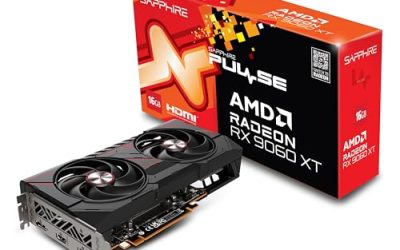
Sapphire Pulse RX 9060 XT 16GB
The Pulse RX 9060 XT brings sixteen gigabytes of memory to editors who want the headroom without the top-tier spend. Its boost clock reaches high speeds for quick previews and exports, and the dual-fan cooler keeps the card steady during long batch jobs. Two HDMI ports plus a DisplayPort connection give you flexible monitor options, and the 182-watt power draw is modest enough for many existing power supplies. For photographers moving up from an older card with eight gigabytes, the jump in memory alone makes large files feel noticeably smoother. It is a sensible, well-rounded pick for everyday editing.
Specs
- 16GB GDDR6 memory
- Boost clock up to 3290 MHz in OC mode
- Dual-fan cooling design
- 2 HDMI outputs and 1 DisplayPort output
- 182W board power
- AMD RDNA 4 architecture
Best for: Editors who want sixteen gigabytes of memory at a gentler level of spend.
Watch out for: The single DisplayPort output limits multi-monitor setups that rely on DisplayPort alone.
ASIN: B0F8C6MWSY
ASRock Arc B580 Steel Legend 12GB OC
The Arc B580 Steel Legend is the quiet achiever of this guide, a triple-fan card that stays cool and calm through long editing sessions. Twelve gigabytes of memory handles most photo work well, including large single images and batch exports, while the wide 192-bit memory interface keeps data moving. Three DisplayPort 2.1 outputs and one HDMI 2.1 connection suit a multi-monitor desk, and the card measures under 300 millimetres long, so it fits many cases. The 650-watt recommended power supply is worth checking before you buy, but the card itself is a strong, composed performer for editors who value silence.
Specs
- 12GB GDDR6 memory
- 192-bit memory interface
- Boost clock up to 2800 MHz
- Triple-fan cooling design
- 3 DisplayPort 2.1 outputs and 1 HDMI 2.1 output
- 298 x 131 x 51 millimetres in size
- 650W power supply recommended
Best for: Editors who want quiet triple-fan cooling and three DisplayPort outputs.
Watch out for: The recommended 650-watt power supply may mean an upgrade for older machines.
ASIN: B0DNV4NRK5
ASUS Dual RTX 4070 EVO OC 12GB
The RTX 4070 EVO OC is the heavyweight option here, a card that pairs twelve gigabytes of fast memory with the kind of acceleration that makes demanding layered documents feel light. Its 2520 MHz memory speed and mature architecture handle big composites, panorama merges, and AI tools without hesitation, and the dual-fan design with zero-decibel technology stays silent during ordinary editing. The 2.5-slot size fits most cases, and Auto-Extreme manufacturing is listed as part of the build. For photographers who edit large files daily and want the most capable card in this guide, it is the pick.
Specs
- 12GB GDDR6X memory
- Memory speed of 2520 MHz
- Maximum screen resolution of 7680 x 4320 pixels
- 2.5-slot design with Axial-tech fan
- 0dB technology for silent operation under light loads
- Auto-Extreme Technology manufacturing
- HDMI 2.1a and DisplayPort 1.4a outputs
Best for: Photographers editing demanding layered documents every day.
Watch out for: It draws more power than the lighter cards here, so confirm your power supply first.
ASIN: B0CQRX9HPK
Which One Fits Your Situation
You edit large raw files from a modern camera
Pick the ASUS Dual RTX 5060 Ti OC 16GB. Sixteen gigabytes of memory gives your largest files room to breathe, and the quiet dual-fan design keeps long editing sessions calm. The DisplayPort 2.1b outputs suit a 4K monitor, and the card has headroom for the AI tools your editor keeps adding.
You want sixteen gigabytes without the top spend
Pick the Sapphire Pulse RX 9060 XT 16GB. You still get the memory that matters most for big files, with a dual-fan cooler and a modest power draw that suits many existing machines. Check your monitor cables first, since it carries two HDMI ports and only one DisplayPort.
You work in a quiet room and use two monitors
Pick the ASRock Arc B580 Steel Legend 12GB OC. The triple-fan design runs quietly, and three DisplayPort 2.1 outputs make a multi-monitor desk easy. Twelve gigabytes covers most photo work well, though very large panoramas may feel tighter than on the sixteen-gigabyte cards.
You edit heavy composites every day
Pick the ASUS Dual RTX 4070 EVO OC 12GB. Its fast memory and mature architecture handle layered documents, panorama merges, and AI tools with ease. Confirm your power supply can feed it, then enjoy a card that rarely feels like the bottleneck in your workflow.
Common Mistakes
- Buying a card with eight gigabytes of memory and then struggling with high-resolution raw files.
- Ignoring fan noise and ending up with a card that hums through every editing session.
- Forgetting to count monitor ports and discovering the card lacks the connection your second screen needs.
- Skipping the power supply check and finding the card needs more wattage than the old unit provides.
- Choosing a card that is too long for the case and having to return it.
Frequently Asked Questions
How much video memory do I need for photo editing?
Twelve gigabytes covers most photo editing well, including large images and batch exports. Sixteen gigabytes is better if you work with high-resolution raw files, panoramas, or layered documents, since it leaves headroom for AI-assisted tools too. Eight gigabytes can work for smaller files, but it fills up quickly. Buy as much as your budget allows.
Does a graphics card speed up photo editing?
Yes, a modern graphics card accelerates many editing tasks, including brush previews, filter rendering, exports, and AI-assisted tools. The difference is most obvious on large files, where a capable card keeps previews smooth and exports short. The processor and memory still matter, so a graphics card upgrade works best alongside enough system memory and a fast drive.
Is a gaming graphics card good for photo editing?
Yes, gaming cards work well for photo editing because the same acceleration that drives games also powers editing software. The key differences are memory size and noise: editors should favour cards with more memory and quiet cooling over the fastest gaming clock speeds. A gaming card with sixteen gigabytes and a zero-decibel fan mode is an excellent editing card.
What should I check before installing a new graphics card?
Measure the space inside your case, since longer triple-fan cards need room to spare. Check the recommended power supply wattage on the listing and confirm your unit has the right power connectors. Update your graphics driver after installing the card, and check that your monitors connect to the ports the card provides.
FAQ
How much video memory do I need for photo editing?
Does a graphics card speed up photo editing?
Is a gaming graphics card good for photo editing?
What should I check before installing a new graphics card?
More from Amazon
Programs that pair well with the guide above. Offers and eligibility are set by Amazon and may change.
Free shipping on eligible items, Prime Video and more. Eligible new members can start with a free trial.
Start a Prime free trialAd-free music streaming. Eligible new subscribers can start with a free trial.
Try Music Unlimited freeA Prime membership for ages 18-24 with a trial period. Eligibility is set by Amazon.
See Prime for Young AdultsAudiobooks and podcasts to listen to on the go. Eligible new members can start with a free trial.
Try Audible freeAs an Amazon Associate we earn from qualifying purchases.