Our Short List of 3

- Best for: 1440p high-refresh players who want DLSS features and efficient power use.
- 12GB GDDR6X memory, 192-bit interface
- Core clock up to 2505 MHz
- PCI Express 4.0 interface
- WINDFORCE triple-fan cooling

- Best for: Competitive players who want maximum rendered frame rates at 1440p.
- 16GB GDDR6 memory, 256-bit interface
- 640 GB/s memory bandwidth, 20 Gbps memory speed
- 64 MB Infinity Cache
- AMD RDNA 4 architecture

- Best for: 240 Hz and high-refresh 4K players building around a flagship monitor.
- 16GB GDDR7 memory, 256-bit interface, 28 Gbps
- Boost frequency up to 2580 MHz
- PCI Express Gen 5 interface
- TRI FROZR 4 triple-fan cooler
All 3 Picks at a Glance
| Product | Specs | Action |
|---|---|---|
| Gigabyte GeForce RTX 4070 Super Windforce OC |
| Check price on Amazon |
| Sapphire Pulse AMD Radeon RX 9070 XT |
| Check price on Amazon |
| MSI GeForce RTX 5070 Ti Gaming Trio OC Plus |
| Check price on Amazon |
Our Top Picks
A high-FPS graphics card is bought for a monitor, not for a spec sheet. The real decision is matching the card to the refresh rate you actually own: a card that holds very high frame rates at 1440p transforms a 240 Hz display, while the same money spent beyond your monitor’s ceiling buys frames you will never see. The second decision is how you get those frames, whether through raw raster power, upscaling and frame generation, or a mix of both across the games you play most.
This guide is for players running high-refresh monitors in competitive and fast-paced games who want to hold frame rates near their panel’s limit. The three picks span two GPU generations and both major brands, and every spec quoted comes from the card’s Amazon listing.
Quick Picks
As an Amazon Associate we earn from qualifying purchases.
| Product | Best for | Key spec from title |
|---|---|---|
| Gigabyte GeForce RTX 4070 Super Windforce OC | High-refresh 1440p with DLSS support | 12GB GDDR6X memory |
| Sapphire Pulse AMD Radeon RX 9070 XT | Maximum raster frame rates at 1440p | 16GB GDDR6 memory, RDNA 4 |
| MSI GeForce RTX 5070 Ti Gaming Trio OC Plus | Pushing 240 Hz and high-refresh 4K | 16GB GDDR7 memory |
How to Choose
Match the card to your monitor’s refresh rate
Start from the panel. A 144 Hz 1440p monitor needs a card that can hold that rate in your games at the settings you prefer, and all three picks clear that bar with room to spare. A 240 Hz panel is a different commitment: it rewards the strongest raster performance and the newest frame-generation features, because holding near 240 frames per second in modern titles takes both. Buying for a monitor you plan to own within the year is reasonable; buying for a hypothetical future panel usually wastes money, since card generations move quickly and today’s flagship features become tomorrow’s midrange standard.
Raw raster power versus frame generation
There are two roads to high frame rates. Raw raster performance is the honest one: the GPU renders every frame, input response stays tied to the render rate, and competitive players tend to prefer it. Upscaling and frame generation raise the displayed rate further by rendering at a lower internal resolution and inserting generated frames, which looks smooth and helps in demanding single-player titles. The listings here cover both approaches: the AMD card leans on strong raster output with 16GB of memory, while the NVIDIA cards add mature upscaling and frame-generation support. Know which road your favorite games reward before choosing.
Memory capacity for high settings
High frame rates do not excuse small memory. At 1440p with high texture settings, 12GB is a workable floor today and 16GB is the comfortable figure that keeps ultra textures and future titles from forcing compromises. The three picks here carry 12GB of GDDR6X, 16GB of GDDR6 and 16GB of GDDR7 respectively, and the memory speed matters too: faster memory feeds the GPU more effectively at the very high frame rates this guide is about, where the processor has less time to wait for data between frames.
Cooling, size and power headroom
A card chasing high frame rates runs hard and hot, so its cooler decides whether the performance you bought survives a long session. Triple-fan designs like two of the picks here move more air at lower noise, but they are long cards that demand case clearance. Check the stated dimensions, the power connector type and your power supply’s capacity before ordering, especially when stepping up a tier. A card that throttles or a system that shuts down under load delivers the opposite of the smooth experience this category promises.
The 3 Best Options
Gigabyte GeForce RTX 4070 Super Windforce OC
- Best for: 1440p high-refresh players who want DLSS features and efficient power use.
- 12GB GDDR6X memory, 192-bit interface
- Core clock up to 2505 MHz
- PCI Express 4.0 interface
- WINDFORCE triple-fan cooling
1440p high-refresh players who want DLSS features and efficient power use.
The 12GB capacity is the floor for this class, so ultra texture packs in future titles may need watching.
The RTX 4070 Super is the balanced high-FPS choice for 1440p. Its 12GB of GDDR6X memory runs on a 192-bit interface, the Windforce OC edition carries a factory overclock with a stated 2505 MHz core figure, and NVIDIA’s DLSS feature set gives you upscaling and frame generation for the titles where raw output alone will not reach your refresh ceiling. The triple-fan Windforce cooler suits sustained high-load gaming, and the card’s efficiency means most existing gaming power supplies handle it without an upgrade. For a 1440p 144 Hz or 165 Hz setup, this is the tier where high-FPS gaming stops feeling like a compromise.
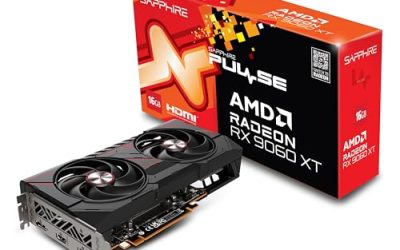
Sapphire Pulse AMD Radeon RX 9070 XT
- Best for: Competitive players who want maximum rendered frame rates at 1440p.
- 16GB GDDR6 memory, 256-bit interface
- 640 GB/s memory bandwidth, 20 Gbps memory speed
- 64 MB Infinity Cache
- AMD RDNA 4 architecture
Competitive players who want maximum rendered frame rates at 1440p.
AMD’s upscaling path differs from NVIDIA’s, so check support in the specific games you play most.
The Pulse RX 9070 XT is the raster-performance pick. Built on AMD’s RDNA 4 architecture, it pairs 16GB of GDDR6 memory on a 256-bit bus with 640 GB/s of bandwidth and 64 MB of Infinity Cache, a combination aimed squarely at feeding very high frame rates at 1440p without leaning on upscaling. The Pulse cooler keeps the card compact by flagship standards, and the dual HDMI and dual DisplayPort outputs suit multi-monitor high-refresh setups. If your games are competitive titles where rendered frames matter more than generated ones, this is the card in the guide built around your priorities.
MSI GeForce RTX 5070 Ti Gaming Trio OC Plus
- Best for: 240 Hz and high-refresh 4K players building around a flagship monitor.
- 16GB GDDR7 memory, 256-bit interface, 28 Gbps
- Boost frequency up to 2580 MHz
- PCI Express Gen 5 interface
- TRI FROZR 4 triple-fan cooler
240 Hz and high-refresh 4K players building around a flagship monitor.
It is a long, heavy card with a 16-pin power connector, so confirm case space and power supply support.
The RTX 5070 Ti Gaming Trio OC Plus is the pick for players chasing the highest rates this guide covers, including 240 Hz play and high-refresh 4K. Its 16GB of GDDR7 memory runs at 28 Gbps on a 256-bit bus, the Blackwell architecture brings the newest DLSS generation with multi frame generation, and MSI’s Gaming Trio OC Plus trim adds a boost figure up to 2580 MHz under the TRI FROZR 4 triple-fan cooler. This is a large, premium card in every sense, and it is aimed at systems built around it: high-refresh flagship monitors, strong CPUs that will not bottleneck it, and cases with room to spare.
Which One Fits Your Situation
You play competitive titles at 1440p 165 Hz
Choose the Gigabyte RTX 4070 Super Windforce OC or the Sapphire Pulse RX 9070 XT. Both hold high rates at this resolution; the difference is philosophy. Pick the Gigabyte card if your games support DLSS and you like having upscaling in reserve for heavier titles. Pick the Sapphire card if you prefer rendered frames and want the larger 16GB memory pool for the years ahead.
You own or are buying a 240 Hz monitor
Choose the MSI RTX 5070 Ti Gaming Trio OC Plus. Feeding a 240 Hz panel means taking every advantage available: the fastest memory in this guide, the newest frame-generation features and a cooler built to sustain top clocks. Pair it with a strong CPU, because at these frame rates the processor becomes the bottleneck in many games long before this card does.
You play a mix of esports and demanding single-player games
Choose the Sapphire Pulse RX 9070 XT for its balance. The 16GB memory pool and wide bus serve heavy single-player titles at high settings, while the raw raster output keeps competitive games fast without depending on feature support in each title. It is the most self-sufficient card here: no ecosystem decisions, just a wide memory system and a current-generation architecture.
Your case or power supply is modest
Choose the Gigabyte RTX 4070 Super Windforce OC. It delivers genuine high-FPS 1440p performance with the most forgiving power and size requirements of the three, and its efficiency keeps heat manageable in smaller cases. You give up the top tier of frame generation and some memory headroom, but for a 144 Hz or 165 Hz target it reaches the ceiling that matters.
Common Mistakes
- Buying a flagship card for a 60 Hz or 75 Hz monitor, where most of its frame output can never be displayed.
- Chasing frame generation figures while ignoring the base render rate, which is what input response actually follows.
- Pairing a high-FPS card with an older CPU that cannot feed it, then blaming the card for low rates.
- Overlooking card length and power connectors until the box is open and the card does not fit.
- Assuming 12GB and 16GB cards age the same at high settings, when texture demands keep climbing.
Frequently Asked Questions
What frame rate should I target for high-FPS gaming?
Target your monitor’s refresh rate. A 144 Hz panel shows up to 144 frames per second, a 240 Hz panel up to 240, and frames beyond that ceiling add little beyond slightly reduced input latency. The practical goal is a card that holds your refresh rate in your main games at your preferred settings, which is why this guide is organized around 1440p high-refresh play rather than abstract performance tiers.
Is 12GB of VRAM enough for high-FPS gaming?
At 1440p today, 12GB handles high settings in most titles, and the RTX 4070 Super here pairs it with fast GDDR6X memory. The margin is thinner than it used to be, though, and ultra texture settings in newer releases are the first place pressure shows. If you keep cards for many years or play the heaviest releases at maximum settings, the 16GB picks in this guide are the safer long-term choice.
Does frame generation really increase FPS?
It increases the number of frames displayed, which is what your monitor shows and what motion smoothness follows. The base frames are still rendered by the GPU, and input response tracks that rendered rate more than the displayed one. For single-player games the trade is usually welcome; for competitive play, many players prefer raw rendered frames, which is why this guide includes a strong raster-focused card alongside the frame-generation options.
Can my CPU hold back a high-FPS graphics card?
Yes, and at high frame rates it often does. The faster the GPU renders, the more draw calls and game logic the CPU must supply per second, so an older processor can cap frame rates well below what the card could deliver. If you step up to the RTX 5070 Ti tier, budget for a current CPU platform as part of the same upgrade, or the card will spend its life waiting.
FAQ
What frame rate should I target for high-FPS gaming?
Is 12GB of VRAM enough for high-FPS gaming?
Does frame generation really increase FPS?
Can my CPU hold back a high-FPS graphics card?
More from Amazon
Programs that pair well with the guide above. Offers and eligibility are set by Amazon and may change.
Free shipping on eligible items, Prime Video and more. Eligible new members can start with a free trial.
Start a Prime free trialAd-free music streaming. Eligible new subscribers can start with a free trial.
Try Music Unlimited freeA Prime membership for ages 18-24 with a trial period. Eligibility is set by Amazon.
See Prime for Young AdultsAudiobooks and podcasts to listen to on the go. Eligible new members can start with a free trial.
Try Audible freeAs an Amazon Associate we earn from qualifying purchases.