Key takeaways
- USB vs XLR: USB microphones offer plug-and-play simplicity ideal for beginners, while XLR connections deliver professional audio quality through an audio interface but require additional hardware and investment.
- Dynamic vs Condenser: Dynamic mics reject background noise naturally and suit untreated rooms, whereas condenser mics capture more detail and warmth but pick up keyboard sounds and ambient noise more easily.
- Polar Pattern: Cardioid and supercardioid patterns focus on your voice while rejecting sound from the sides and rear, making them the best choices for solo streamers in less-than-ideal acoustic spaces.
- Latency Monitoring: A built-in headphone jack with zero-latency monitoring lets you hear exactly what your audience hears in real time, which is essential for catching audio issues mid-stream.
- On-Body Controls: Tap-to-mute sensors, gain dials, and RGB status indicators on the mic itself save you from alt-tabbing to software during gameplay and prevent embarrassing moments from reaching your stream.
What's inside
Finding the right gaming microphone in 2026 is harder than it sounds. The market is saturated with options ranging from budget USB plug-and-play models to professional-grade XLR setups, and most buyers waste money on features they don’t need or end up with a mic that picks up every keystroke and fan spin in the background. Whether you’re streaming on Twitch, recording YouTube content, or just want crystal-clear voice chat in Discord, the wrong choice means your audience hears more of your room than your voice.
As an Amazon Associate we earn from qualifying purchases.


This guide cuts through the noise. We’ve evaluated the top gaming microphones available this year based on audio quality, ease of setup, software features, build quality, and value for money. From entry-level RGB condensers to dynamic XLR kits with AI noise cancellation, these are the standout picks worth your attention in 2026.
🛒 Best Price Today on Amazon
Prime members get fast, free shipping on everything above, plus member-only deals. New members get a 30-day free trial — cancel anytime.
Watch: Best Gaming Mic 2026 — Video Review
How to Choose a Gaming Mic 2026
- USB vs XLR: USB microphones offer plug-and-play simplicity ideal for beginners, while XLR connections deliver professional audio quality through an audio interface but require additional hardware and investment.
- Dynamic vs Condenser: Dynamic mics reject background noise naturally and suit untreated rooms, whereas condenser mics capture more detail and warmth but pick up keyboard sounds and ambient noise more easily.
- Polar Pattern: Cardioid and supercardioid patterns focus on your voice while rejecting sound from the sides and rear, making them the best choices for solo streamers in less-than-ideal acoustic spaces.
- Latency Monitoring: A built-in headphone jack with zero-latency monitoring lets you hear exactly what your audience hears in real time, which is essential for catching audio issues mid-stream.
- On-Body Controls: Tap-to-mute sensors, gain dials, and RGB status indicators on the mic itself save you from alt-tabbing to software during gameplay and prevent embarrassing moments from reaching your stream.
The Best Gaming Mic 2026s Reviewed
Razer Seiren V3 Chroma
The Seiren V3 Chroma pairs 32-bit DSP processing with a supercardioid capsule and AI-powered noise isolation, making it one of the most refined USB options for streamers who want polished audio without touching an interface. Tap-to-mute, Chroma RGB, and broad OBS and Streamlabs compatibility round out a premium package for serious content creators.
FIFINE AmpliGame AM8T
This XLR/USB hybrid dynamic mic hits a sweet spot between convenience and upgradeability, giving you plug-and-play USB today and a clean XLR path when you invest in an interface later. The included boom arm, headphones jack, and streaming RGB kit make it a remarkable all-in-one value.
TONOR TD510 AIR S H+
TONOR’s flagship dynamic gaming mic brings AI noise cancellation, dual XLR/USB connectivity, and a full boom arm set to a price that undercuts most competitors. Gain control, a 3.5mm monitoring jack, and tap-to-mute functionality make it a well-equipped choice for content creators who need background rejection on a budget.
FIFINE AmpliGame AM8
The AM8 delivers the same dynamic capsule and dual connectivity as its sibling but comes with a desktop stand instead of a boom arm, making it ideal for creators who want a clean, no-fuss setup. RGB lighting, a mute button, and a headphones jack ensure it holds its own at this price tier.
TONOR TC310+ Boom Arm Set
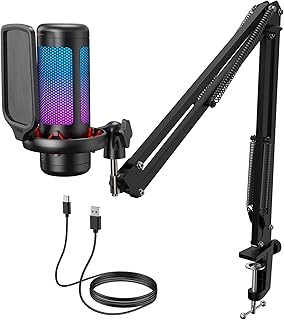
As an entry-level condenser USB mic with a boom arm, controllable RGB, one-tap mute, and volume control, the TC310+ covers all the basics a new streamer needs. It won’t match dynamic mics for background rejection, but it’s hard to beat for value and ease of use.
Frequently Asked Questions
Do I need an XLR microphone for streaming?
No. Modern USB microphones, especially 32-bit DSP models, deliver excellent streaming audio quality without the extra cost and complexity of an audio interface. XLR makes sense when you plan to expand to multiple mics or want broadcast-grade processing later.
What is the difference between a dynamic and condenser microphone?
Dynamic microphones are less sensitive and naturally reject background noise, making them great for untreated gaming rooms. Condenser microphones are more sensitive and capture a wider frequency range, but they pick up keyboard clicks and ambient sounds more easily.
Is tap-to-mute necessary for a gaming microphone?
It isn’t strictly necessary, but tap-to-mute is one of the most useful features for streamers. It lets you silence your mic instantly during coughs, private conversations, or background distractions without searching for a hotkey or software toggle.
Will a better microphone fix my audio quality issues?
Only partially. Room treatment, proper mic placement, and software tools like noise gates and compressors often matter more than the microphone itself. Start with positioning the mic close to your mouth and away from your keyboard before upgrading hardware.
Final Thoughts
For most streamers and content creators in 2026, the Razer Seiren V3 Chroma offers the best balance of audio quality, smart features, and ease of use in a USB package. If you want room to grow, the FIFINE AmpliGame AM8T and TONOR TD510 AIR S H+ stand out as excellent dynamic XLR/USB hybrids that reject background noise and won’t bottleneck you when you upgrade your signal chain.