Our Top Picks
 Shure MV7X XLR Dynamic Podcast & Recording MicrophoneCompact4.9 x 4.3 x 10.8 inches1.1 poundsCheck on Amazon

The best podcast microphones under $200 are the Samson Q9U for USB-C plus XLR in one dynamic mic, the Audio-Technica AT2020USB-X for a plug-in condenser, and the Rode PodMic for an XLR broadcast sound. The Samson Q2U is the entry route if you want to spend less.
Podcasting mics split into two camps: dynamic microphones that reject room noise and need to be close to your mouth, and condenser microphones that capture more detail but also more of the room. At this ceiling you can choose USB for plug-and-play recording, XLR for growth with an interface, or hybrid models that offer both.
Every model below is compared from listing specifications. Home office, small-room and gaming-stream use are covered in the buying section and the FAQ, so you can match the mic to your space and your setup.
Quick Comparison
| Model | Key specs per listing | Best for |
|---|---|---|
| Samson Q9U XLR/USB Dynamic Broadcast Mic | Dynamic, cardioid, XLR and USB-C outputs, 24-bit | Podcasters who want USB now and XLR later |
| Audio-Technica AT2020USB-X Condenser | Cardioid condenser, USB-C, 24-bit/96 kHz, mute button, headphone jack | Quiet rooms and detailed vocals |
| Rode PodMic Dynamic Broadcast Microphone | Cardioid dynamic, XLR, internal pop filter, shock mounting, all-metal | Studio-style spoken word with an interface |
| Shure MV7X XLR Dynamic Podcast Mic | XLR dynamic, voice-isolating technology, all-metal build | XLR users who want a name brand |
| MAONO PD200W Hybrid Wireless Podcast Mic | Dynamic, XLR and USB, desk stand, software, noise cancellation | Creators who want a stand and software |
| Samson Q2U USB/XLR Dynamic Microphone Pack | Dynamic, USB and XLR, recording and podcasting pack | Entry route to podcasting |
The table uses listing wording only: connection type, capsule type, sampling rate where stated and bundled features. Only the Audio-Technica and Samson Q9U listings give a bit depth or sample rate, and the Rode and Shure listings note XLR-only output, which means an audio interface or mixer is required. Anything the listing leaves out is marked as not listed in the picks below.
Samson Q9U XLR/USB Dynamic Broadcast Mic
As an Amazon Associate we earn from qualifying purchases at no extra cost to you.

Spec line: Dynamic broadcast microphone with XLR and USB-C outputs, 24-bit audio and cardioid pattern, for broadcasting, podcasting and streaming.
The Samson Q9U is the most flexible pick at this ceiling because one microphone gives you both connections. You can plug the USB-C output into a laptop to start recording today, then move to the XLR output when you buy an interface or a mixer. The listing names a cardioid pattern and a dynamic capsule, which means it picks up what is in front of it and rejects most room noise. It is the second most expensive pick here, so you pay for flexibility rather than for a larger feature list. Headphone monitoring and gain details are not in the listing text, so check the maker page.
- Pro: USB-C and XLR outputs together
- Pro: Dynamic cardioid for noisy rooms
- Pro: 24-bit audio listed
- Con: Near the top of the price ceiling
- Con: Monitoring features not listed
Audio-Technica AT2020USB-X Condenser

Spec line: Cardioid condenser USB microphone, 24-bit/96 kHz sampling rate, USB-C output, mute button and headphone jack.
This is the plug-in condenser of the group. A condenser captures more detail in a voice than a dynamic mic, which suits podcasters recording in a quiet, treated room. The listing names a 24-bit and 96 kHz sampling rate, a USB-C output, a mute button and a headphone jack, so you can monitor yourself without latency from the computer. The trade-off is that a condenser also picks up keyboard clatter, fans and room echo, so it is a poor fit for a noisy home office. It does not offer XLR, so you cannot upgrade to an interface later with the same mic. A stand is not mentioned in the listing.
- Pro: High 96 kHz sampling listed
- Pro: Headphone jack for monitoring
- Pro: Mute button on the mic
- Con: Picks up room noise
- Con: USB only, no XLR
Rode PodMic Dynamic Broadcast Microphone

Spec line: Cardioid dynamic broadcast microphone, XLR, internal pop filter and shock mounting, broadcast dynamic capsule, all-metal build; requires an XLR interface or mixer.
The PodMic is built for spoken word. The listing names a broadcast dynamic capsule, an internal pop filter and internal shock mounting, all in a metal body, which together reduce plosives and desk bumps without extra accessories. The big catch is in the listing text itself: it requires an XLR interface or mixer, so the true cost is the mic plus the interface. For a podcaster who already owns an interface, it is a strong match for a broadcast-style voice. For someone starting from zero, a USB model is simpler. A mount or boom arm is not listed.
- Pro: Internal pop filter and shock mount
- Pro: All-metal build
- Pro: Broadcast dynamic capsule
- Con: Needs an XLR interface or mixer
- Con: Stand or arm not listed
Shure MV7X XLR Dynamic Podcast Mic

Spec line: XLR dynamic podcast and recording microphone, voice-isolating technology, all-metal build, black.
Shure’s MV7X is the premium-priced XLR option here, at the top of this price range. The listing says it uses voice-isolating technology and an all-metal build, which points to a dynamic mic that favours close speech and reduces background sound. It is XLR only, so like the Rode it needs an interface or mixer. The brand name carries weight for anyone who wants an established podcasting microphone. The disadvantage is that it costs more than hybrid options like the Samson Q9U, which add USB. The listing does not mention a stand, shock mount or accessories.
- Pro: Voice-isolating technology named
- Pro: All-metal build
- Pro: Established podcasting brand
- Con: XLR only
- Con: Priced at the top of the range
MAONO PD200W Hybrid Wireless Podcast Mic

Spec line: Hybrid wireless podcast microphone, dynamic XLR and USB mic, desktop stand with software, noise cancellation, for vocal recording, streaming and voiceover.
MAONO’s PD200W is positioned as an all-in-one creator mic. The listing names a dynamic capsule, XLR and USB connections, a desk stand, companion software and noise cancellation, and it lists vocal recording, streaming, content creation, home studio and voiceover as uses. The wireless wording suggests a hybrid design, but the listing text does not explain how the wireless link works, so check the maker page before counting on it. It is less established than Shure or Rode, which means fewer long-term reports on durability. The included software is a plus for beginners.
- Pro: XLR and USB connections
- Pro: Stand and software included
- Pro: Dynamic capsule
- Con: Wireless details unclear
- Con: Less proven brand
Samson Q2U USB/XLR Dynamic Microphone Pack
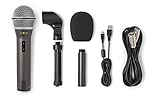
Spec line: USB and XLR dynamic microphone recording and podcasting pack.
The Samson Q2U is a long-running entry route into podcasting. The listing names USB and XLR connections, a dynamic capsule and a podcasting pack, so you get a mic that can plug straight into a computer and still grow with a mixer later. It sits at the bottom of this price tier, so it is the pick if you want to spend well below the ceiling and keep room for an arm or a pop filter. The listing text we saw gives few details beyond the pack name, so contents, cable length and software are not listed. Check what is in the box before ordering.
- Pro: USB and XLR together
- Pro: Dynamic mic suits untreated rooms
- Pro: Lowest cost in the group
- Con: Pack contents not listed
- Con: Few details in the listing
Dynamic or Condenser for a Podcast
Dynamic microphones are the safe choice for a home setup because they reject most background noise, so a fan, a keyboard or a street sound is far less noticeable. They want to be placed a few centimetres from your mouth, which gives a close, radio-style voice. Condensers capture more detail and a wider range, but they need a quiet room.
Connection also shapes the choice. USB mics plug straight into a computer and need no extra gear, XLR mics need an audio interface or mixer, and hybrid mics give you both. If you might add a co-host later, XLR gives you more room to grow because you can add channels, while a single USB mic is limited to one computer input.
Budget the rest of the setup too. A boom arm, a pop filter and closed-back headphones can improve a recording as much as a more expensive mic. Several listings above do not mention accessories, so plan for them separately.
Placement matters more than most buyers expect. Keep a dynamic mic about a fist-width from your mouth, angle it slightly off-axis to soften plosive sounds, and record a short sample before every session. If levels are inconsistent between hosts, matching the same model of mic for each person makes editing much faster.
How to Choose Podcast Microphones Under $200
Connection and growth path
Choose USB for the simplest setup, XLR if you already own an interface, and a hybrid such as the Samson Q9U or Q2U if you want both. An interface is an extra purchase, so account for it when you compare an XLR mic to a USB one under $200.
Capsule type and room
For an untreated room, pick a dynamic mic: the Rode PodMic, Shure MV7X, Samson models and MAONO PD200W all list a dynamic design. For a quiet, padded room, the Audio-Technica condenser can capture more detail.
Home office and small-room use
For a home office, a podcast mic for home office use should be dynamic and close-miked, since desks have fans and keyboards. In a small room, add a foam panel or a blanket behind you, because reflections from nearby walls are the main source of echo.
Gaming and streaming use
If you also stream games, a podcast mic for gaming works best when it has a mute button and a headphone jack, such as the Audio-Technica. A dynamic mic with a boom arm keeps keyboard noise lower, which helps in a shared gaming room.
FAQ
Is USB or XLR better for podcasting?
USB is easier and cheaper to start, while XLR scales better with an interface and multiple guests. A hybrid mic gives you both options.
Do I need an audio interface?
Only for XLR-only mics such as the Rode PodMic and Shure MV7X. USB and hybrid mics can plug straight into a computer.
Is a dynamic mic better for a noisy room?
Generally yes, because dynamic capsules reject distant sound. Place the mic close to your mouth for best results.
Can I use a podcast mic for streaming?
Yes. Most listed models are marketed for streaming too, and USB or hybrid models are simplest on a gaming PC.
Are podcast microphones for small spaces different?
The mic itself is the same, but room treatment matters more. Close miking with a dynamic mic helps a small, echoey room.
Last updated: November 2026
FAQ
Is USB or XLR better for podcasting?
Do I need an audio interface?
Is a dynamic mic better for a noisy room?
Can I use a podcast mic for streaming?
Are podcast microphones for small spaces different?
More from Amazon
Programs that pair well with the guide above. Offers and eligibility are set by Amazon and may change.
Free shipping on eligible items, Prime Video and more. Eligible new members can start with a free trial.
Start a Prime free trialAd-free music streaming. Eligible new subscribers can start with a free trial.
Try Music Unlimited freeA Prime membership for ages 18-24 with a trial period. Eligibility is set by Amazon.
See Prime for Young AdultsAudiobooks and podcasts to listen to on the go. Eligible new members can start with a free trial.
Try Audible freeAs an Amazon Associate we earn from qualifying purchases.