Key takeaways
- Compare the best balance boards for standing desks, from gentle rockers to 360-degree wobble boards that keep gamers moving through long sessions.
A height-adjustable desk solves the sitting problem, but standing locked in one spot for a six-hour session brings its own aches: stiff calves, sore heels, and a lower back that tightens up between matches. A balance board fixes that by turning a static stance into constant, gentle motion. Your ankles, calves, and core stay quietly engaged while your hands stay on the keyboard and mouse, and the small shifts in weight keep blood moving through your legs far better than a flat floor or a plain mat ever will.
The catch is that boards built for desk work are very different from boards built for gym training. A desk board needs a mild tilt you can hold while aiming, typing, and reading chat, plus a footprint that slides under the desk when you sit back down. This guide covers five boards that fit that brief, from a wide cushioned rocker made for all-day standing to a full 360-degree wobble board for players who want a real challenge between queues.
Disclosure: As an Amazon Associate, we earn from qualifying purchases made through links in this article, at no extra cost to you.
Quick Picks
| Product | Best for | ASIN |
|---|---|---|
| FEZIBO Standing Desk Balance Board (Large) | All-day comfort at the desk | B088R4DBSW |
| StrongTek Professional Wooden Balance Board | Beginners who want a gentle rocker | B079J6SQ6G |
| Gaiam Evolve Balance Board | A wide, ergonomic rocking deck | B01MYLYSK4 |
| Yes4All Versatile Wooden Wobble Balance Board | Full 360-degree wobble training | B00WJJJX2Q |
| Amazon Basics Wood Wobble Balance Board | A simple first board | B07DWKNXNY |
How to Choose a Balance Board for a Standing Desk
Pick the motion type first. Rocker boards tilt on one axis, front to back, and are the easiest to live with at a desk: the movement stays predictable, your screen stays readable, and your aim barely notices. Wobble boards sit on a rounded base and tilt in every direction, which works more muscle but demands more attention. If you plan to stand on the board during ranked matches, a mild rocker is the safer pick; save the full wobble board for casual sessions, breaks, and training away from the keyboard.
Check the tilt angle. Desk-friendly boards usually tilt somewhere between about 8 and 15 degrees. A shallow tilt around 8.5 degrees feels like a nudge to keep shifting your weight, while 15 degrees and beyond turns standing into an active exercise. Deeper is not automatically better at a desk, because every extra degree shows up as sway in your upper body and, eventually, in your crosshair.
Match the footprint to your stance and your desk. Round wobble boards around 15.75 inches across suit a feet-together stance. Rectangular desk boards in the 17 to 27 inch range let you stand wider, which most taller players prefer. Measure the space between your desk legs as well, and look for a board slim enough to slide underneath or stand on edge in a corner when you switch back to a chair.
Look at the deck surface. A high-density latex or foam top cushions your heels during long sessions and works well barefoot or in socks. A hard wooden deck with a grip texture feels firmer and more precise, and some boards add raised massage points that give your feet something to press against when they get restless. Underneath, a rubber base protects hard floors and keeps the board quiet on wood or tile.
Confirm the listed capacity and build. Every board here lists its maximum supported weight in the product details, and they range from 250 to 350 pounds. Solid wood and hardwood plywood decks handle daily use well; if you are near the top of a board’s listed capacity, step up to the next sturdier model rather than pushing the limit.
The 5 Best Balance Boards for Standing Desks
FEZIBO Standing Desk Balance Board (Large)

Specs
- Board style: rectangular rocker board with cushioned deck
- Dimensions: 26 x 14.7 x 3.1 inches
- Listed capacity: 320 pounds
- Tilt: 8.5 degrees
- Materials: natural hardwood core, high-density latex top, natural rubber base
- Extras: raised foot massage points, carry hole, no assembly needed
The FEZIBO is the board on this list most clearly designed around a desk rather than a gym. The 8.5-degree tilt is gentle enough to hold through a full evening of gaming, and the elastic latex top cushions your feet in a way hard wooden decks never do, so it doubles as an anti-fatigue surface on the days you only want a slight rock. Raised massage points across the deck give your arches something to work against during loading screens.
The wide 26-inch deck leaves room for a natural stance, the rubber base keeps it silent and planted on hard floors, and the whole board weighs about 8.2 pounds, so sliding it aside when you sit down takes one hand. If your main complaint about standing is sore feet rather than a lack of challenge, this is the board to get.
Best for: Long standing sessions where comfort matters more than difficulty.
StrongTek Professional Wooden Balance Board
Specs
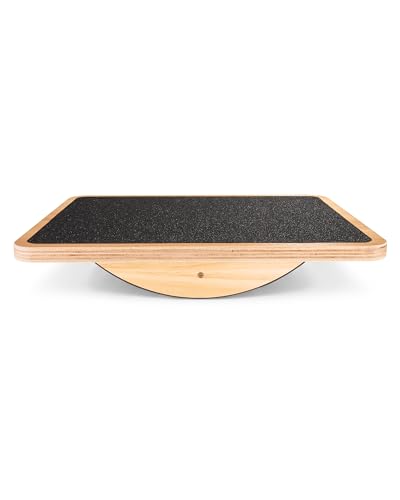
- Board style: single-axis wooden rocker board
- Dimensions: 17.5 x 13.5 inches
- Listed capacity: 350 pounds
- Materials: Lauan hardwood plywood deck
- Surface: textured non-slip grip top
- Underside: anti-slip pads that protect floors
StrongTek’s rocker is the classic entry point into desk boards: a flat hardwood deck on two curved rails that tips front to back and nothing else. That single-axis motion is exactly what a first-time user wants, because it keeps your weight shifting without ever surprising you mid-game. The deck is compact enough to stand on edge in a corner or lean against a desk leg when it is not in use.
The build is the highlight. Lauan hardwood plywood gives the board the highest listed capacity in this roundup at 350 pounds, and the textured top grips shoes securely. StrongTek suggests wearing shoes on the grip surface, since it is firmer than the cushioned decks, and the pads underneath keep the rails from marking wood floors. It arrives ready to use, with nothing to assemble.
Best for: First-time users who want a sturdy, predictable rocker.
Gaiam Evolve Balance Board
Specs
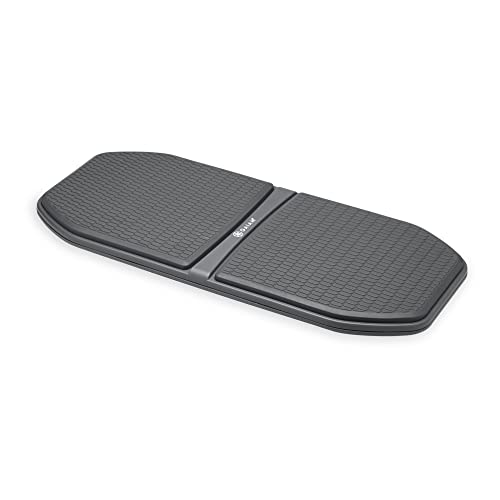
- Board style: ergonomic rocker board
- Deck length: 27 inches
- Listed capacity: 250 pounds
- Materials: PU, PVC, and TPR construction
- Surface: honeycomb non-slip texture
- Weight: 6.5 pounds
The Gaiam Evolve takes a different approach from the wooden boards: its deck is molded to encourage a neutral ankle position, so your feet settle into a natural alignment instead of rolling inward or outward as you rock. The 27-inch deck is the widest stance platform here, which taller players and anyone who stands with feet well apart will appreciate during long sessions.
The honeycomb texture on top grips socks, bare feet, and shoes alike, and the rubber base is designed to sit quietly on hardwood without scratching it. At 6.5 pounds it is easy to move between a home office and a living-room setup. The trade-off is the lowest listed capacity in this group at 250 pounds, so heavier players should look at the StrongTek or FEZIBO instead.
Best for: Taller players who want a wide deck and posture-friendly shaping.
Yes4All Versatile Wooden Wobble Balance Board

Specs
- Board style: round wobble board, tilts in every direction
- Diameter: 15.75 inches
- Listed capacity: 300 pounds
- Tilt: 15 degrees with 360-degree rotation
- Materials: solid wood deck with anti-skid pad surface
- Weight: 3.1 pounds
This is the one true wobble board in the roundup, and it plays by different rules. The rounded base lets the deck tilt a full 15 degrees in any direction, so your ankles and core work constantly to keep you level. That makes it a genuine training tool for balance, coordination, and ankle strength, and a fun way to stay active during casual games, streams, or breaks between matches.
At the desk, treat it as the advanced option: most players will find the motion too lively for precise mouse work, so it shines brightest away from competitive play. The solid wood deck supports a listed 300 pounds, the anti-skid surface keeps your feet planted, and at just over 3 pounds it is the easiest board here to carry from room to room or tuck into a closet.
Best for: Players who want real balance training alongside desk use.
Amazon Basics Wood Wobble Balance Board
Specs
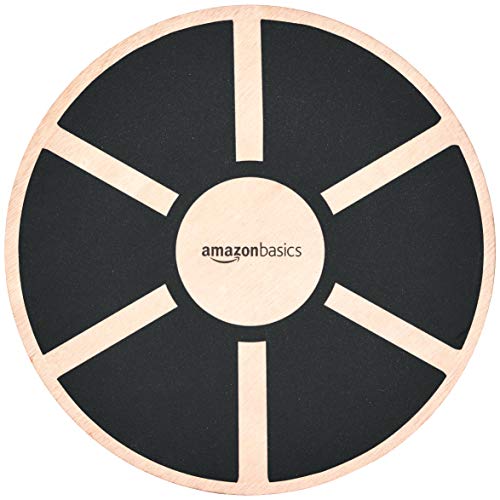
- Board style: round wobble board
- Dimensions: 15.75 x 15.75 x 3.15 inches
- Listed capacity: 265 pounds
- Materials: solid wood top
- Surface: non-slip finish for a secure grip
- Coverage: backed by an Amazon Basics 1-year limited warranty
The Amazon Basics board covers the fundamentals and nothing more: a solid wood round deck on a wobble base that tilts in every direction. It asks your core, legs, and ankles to keep you steady, and owners commonly use it under standing desks as well as for push-ups, planks, and balance drills away from the desk.
You give up the cushioned tops, shaped decks, and desk-specific tuning of the boards above it, and the listed capacity of 265 pounds is on the lower side. In return you get a simple, compact board that is easy to store and easy to replace. If you are curious whether standing on a moving surface suits your setup at all, this is the low-commitment way to find out before moving to a purpose-built desk board.
Best for: Trying out a wobble board before committing to a desk-specific model.
FAQ
Can I actually game while standing on a balance board?
Yes, with the right board. A gentle rocker with a tilt around 8.5 degrees keeps the movement below your hips, so your shoulders, arms, and aim stay steady. Full wobble boards demand more attention and are better kept for casual play and breaks. Most people build up from short sessions of 20 to 30 minutes.
Will a balance board scratch my floor?
Boards with rubber bases or anti-slip pads underneath, like the FEZIBO and StrongTek in this guide, are made to sit on wood and tile without marking them. Bare wooden rails and rounded wobble bases can scuff softer floors over time, so place a thin mat underneath if your flooring is delicate.
How long should I stand on a balance board each day?
Begin with short blocks of 15 to 30 minutes mixed into your standing time, then extend them as your calves and ankles adapt. Alternate between the board, flat standing, and sitting across a long session. If your feet or lower back complain, step off and take that as your limit for the day.
What is the difference between a rocker board and a wobble board?
A rocker board tilts on one axis, front to back, which makes it predictable and easy to use while you work or play. A wobble board sits on a rounded base and tilts in every direction, giving a harder, more athletic workout. Rockers suit desk use; wobble boards suit training.
Conclusion
For most standing desk gamers, the FEZIBO Large is the easiest recommendation: its mild 8.5-degree tilt and cushioned, massage-textured deck are built for hours of standing rather than minutes of exercise. Beginners who prefer solid wood should look at the StrongTek rocker, taller players get the widest stance from the Gaiam Evolve, and anyone who wants a genuine balance challenge can graduate to the Yes4All wobble board or test the waters with the Amazon Basics. Whichever you pick, the goal is the same: keep your legs moving so a long session at a standing desk leaves you loose instead of locked up.
More from Amazon
Programs that pair well with the guide above. Offers and eligibility are set by Amazon and may change.
Free shipping on eligible items, Prime Video and more. Eligible new members can start with a free trial.
Start a Prime free trialAd-free music streaming. Eligible new subscribers can start with a free trial.
Try Music Unlimited freeA Prime membership for ages 18-24 with a trial period. Eligibility is set by Amazon.
See Prime for Young AdultsAudiobooks and podcasts to listen to on the go. Eligible new members can start with a free trial.
Try Audible freeAs an Amazon Associate we earn from qualifying purchases.