Key takeaways
- The best bookshelf speakers audiophile listeners choose for two-channel music, compared: five passive pairs judged on drivers, sensitivity and placement.
A serious two-channel system does not need floor-standing cabinets. A well-engineered bookshelf pair on proper stands can image with precision, resolve fine detail in a recording, and fill a small to medium room with balanced sound, all while taking up a fraction of the floor space. That is why the bookshelf format is where most audiophile speaker design effort now concentrates, from affordable two-ways to flagship coaxial designs.
This guide compares five passive bookshelf pairs built for critical listening: the KEF LS50 Meta, KEF Q150, Klipsch Reference Premiere RP-600M II, ELAC Debut 2.0 B6.2, and Polk Signature Elite ES20. Every pick is a genuine hi-fi loudspeaker sold as a stereo pair, chosen on driver design, published frequency response, sensitivity, and cabinet engineering rather than on marketing claims. All five need an amplifier or receiver, and each section below explains what kind of listener and room the pair suits.
As an Amazon Associate, we earn from qualifying purchases.
Quick answer
The KEF LS50 Meta is the top pick for critical listening: its coaxial Uni-Q driver and Metamaterial Absorption Technology deliver the most precise imaging and cleanest treble of the five. The KEF Q150 brings similar coaxial focus for less money, the Klipsch RP-600M II plays loudest on modest power, the ELAC Debut 2.0 B6.2 is the budget benchmark, and the Polk ES20 gives the fullest bass.
Best overall: KEF LS50 Meta
The LS50 Meta is the reference point for modern bookshelf design. Its 12th-generation Uni-Q array places a 1-inch aluminium dome tweeter at the acoustic centre of a 5.25-inch aluminium midrange and woofer cone, so high and low frequencies arrive at the listener from a single point. That point-source behaviour produces unusually stable imaging: instruments hold their positions in the soundstage even when the listener moves off the centre seat.
Behind the tweeter sits KEF’s Metamaterial Absorption Technology, a maze-like structure that absorbs the unwanted sound radiating from the back of the dome. KEF publishes a frequency response of 79 Hz to 28 kHz and a sensitivity figure of 85 dB, which means the LS50 Meta rewards a capable amplifier rather than a budget receiver. Feed it clean power in the 40 to 100 watt range and it returns exceptional midrange clarity, grain-free treble, and bass that is tight rather than abundant. Listeners who value vocal realism and imaging accuracy over low-end weight will find this pair the most complete loudspeaker in the guide.
Key specs:
- Design: 2-way bass reflex, coaxial Uni-Q driver array
- Drivers: 5.25-inch aluminium Uni-Q with 1-inch vented aluminium dome tweeter
- Frequency response: 79 Hz to 28 kHz
- Sensitivity: 85 dB
- Impedance: 8 ohms
- Recommended amplifier power: 40 to 100 watts
- Crossover frequency: 2,100 Hz
- Dimensions: 302 x 200 x 281 mm per speaker
- Weight: 7.8 kg per speaker
- Finish listed: Carbon Black
Best for smaller rooms: KEF Q150
The Q150 applies the same Uni-Q thinking as the flagship at a far lower cost, and its compact cabinet makes it the easiest pair here to place in a small listening room or on a wide desk. The 5.25-inch Uni-Q driver pairs an aluminium cone with a damped tweeter loading tube, and the rear port includes flexible port plugs so the bass can be trimmed when the speakers must sit close to a wall.
Published response runs from 51 Hz to 28 kHz, so the Q150 reaches noticeably deeper than its cabinet size suggests, and its 86 dB sensitivity with an 8 ohm load makes it an undemanding partner for integrated amplifiers in the 10 to 100 watt range. It cannot match the LS50 Meta for treble refinement or cabinet inertness, but the family resemblance in imaging and tonal balance is unmistakable. For a first serious pair, or a second system in a study or bedroom, the Q150 is the sensible way into coaxial listening.
Key specs:
- Design: 2-way bass reflex, coaxial Uni-Q driver array, rear port with plugs
- Drivers: 5.25-inch aluminium Uni-Q with 1-inch vented aluminium dome tweeter
- Frequency response: 51 Hz to 28 kHz
- Sensitivity: 86 dB
- Impedance: 8 ohms
- Recommended amplifier power: 10 to 100 watts
- Crossover frequency: 2,500 Hz
- Dimensions: 303 x 180 x 278 mm per speaker
- Weight: 5.6 kg per speaker
- Finish listed: Black
Best for dynamics and modest amplifiers: Klipsch Reference Premiere RP-600M II
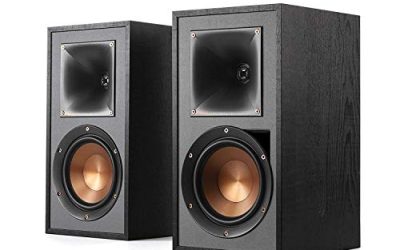
The RP-600M II takes the opposite route to realism: efficiency. Its horn-loaded 1-inch titanium tweeter and 6.5-inch Cerametallic woofer produce a sensitivity figure of 94.5 dB, far higher than any other pair in this guide. A modest integrated amplifier or even a compact Class D unit will drive it to room-filling levels, and the horn’s controlled directivity keeps detail crisp in rooms with reflective surfaces.
Klipsch publishes a response of 44 Hz to 25 kHz, and the larger woofer gives this pair genuine low-end authority for rock, electronic music, and film soundtracks in a dual-purpose room. The trade-off is tonal: the presentation is lively and forward rather than neutral, which many listeners love and measurement purists question. Dual binding posts allow bi-wiring or bi-amping, and the rear Tractrix port needs some clearance from the wall to breathe. Choose this pair when dynamics, scale, and easy driving matter more than strict neutrality.
Key specs:
- Design: 2-way bass reflex, horn-loaded tweeter, rear Tractrix port
- Drivers: 1-inch titanium LTS dome in Tractrix horn, 6.5-inch Cerametallic woofer
- Frequency response: 44 Hz to 25 kHz
- Sensitivity: 94.5 dB
- Impedance: 8 ohms
- Power handling: 100 watts continuous, 400 watts peak
- Crossover frequency: 1,500 Hz
- Terminals: dual binding posts, bi-wire and bi-amp capable
- Dimensions: 432 x 202 x 330 mm per speaker
- Weight: 8.2 kg per speaker
- Finish listed: Ebony
Best budget pair: ELAC Debut 2.0 B6.2
Designed by Andrew Jones, the Debut 2.0 B6.2 remains the benchmark for affordable audiophile sound. A 6.5-inch woven aramid-fibre woofer handles bass and midrange while a 1-inch cloth dome tweeter, loaded by a wide-dispersion waveguide, extends response to a published 35 kHz. The front-firing port is a practical advantage at this level: the pair can sit on a shelf or credenza close to a wall without the bass boom that plagues rear-ported budget designs.
The specification sheet lists response from 44 Hz, sensitivity of 87 dB into a 6 ohm load, and a maximum power input of 120 watts, so almost any stereo amplifier will drive the B6.2 comfortably. The cabinet is thick MDF with internal bracing, unusual attention at this tier, and it shows in the clean, uncoloured midrange. Finish and driver materials are plainer than the pairs above it in this guide, but for listeners assembling a first vinyl or streaming system, the money saved here is better spent on the amplifier and source.
Key specs:
- Design: 2-way bass reflex, front-firing port
- Drivers: 1-inch cloth dome tweeter with waveguide, 6.5-inch woven aramid-fibre woofer
- Frequency response: 44 Hz to 35,000 Hz
- Sensitivity: 87 dB
- Impedance: 6 ohms
- Maximum power input: 120 watts
- Crossover frequency: 2,200 Hz
- Cabinet: CARB2-rated MDF with internal bracing, black ash vinyl finish
- Dimensions: 195 x 375 x 268 mm per speaker
- Weight: 7.4 kg per speaker
Best for fuller bass without a subwoofer: Polk Signature Elite ES20
The ES20 is the largest bookshelf model in Polk’s Signature Elite line, and it is voiced for listeners who want a full-range sound from a single pair of cabinets. A 6.5-inch mica-fortified polypropylene woofer works with Polk’s Power Port, a flared rear vent designed to smooth airflow and reduce port noise, giving the ES20 a published response reaching down to 41 Hz. That extension lets string bass, kick drums, and piano left-hand lines carry real weight without a separate subwoofer in small and medium rooms.
Up top, a 1-inch Terylene dome tweeter carries Hi-Res Audio certification and extends the published response to 40 kHz. Sensitivity is a friendly 88 dB, the impedance is compatible with 4 and 8 ohm amplifier outputs, and Polk recommends 20 to 150 watts of amplification. The cabinet is deep, so measure shelf depth before ordering, and the rear Power Port wants a little space behind it. For a one-pair system that must cover the whole frequency range gracefully, the ES20 is the most complete value here.
Key specs:
- Design: 2-way bass reflex with Power Port rear venting
- Drivers: 1-inch Terylene dome tweeter, 6.5-inch mica-fortified polypropylene woofer
- Frequency response: 41 Hz to 40 kHz
- Sensitivity: 88 dB
- Impedance: compatible with 4 and 8 ohm outputs
- Recommended amplifier power: 20 to 150 watts
- Certification: Hi-Res Audio certified
- Dimensions: 376 x 216 x 350 mm per speaker
- Finish listed: Black
How to choose
Match the speaker to the amplifier first. Sensitivity decides how much power a pair needs: the Klipsch RP-600M II, at 94.5 dB, will play loudly on a small amplifier, while the KEF LS50 Meta, at 85 dB, needs a stronger unit delivering clean current into its load. Check the amplifier’s power into the speaker’s impedance, and favour honest wattage figures over headline numbers.
Consider the room and placement next. Rear-ported designs such as the LS50 Meta, RP-600M II, and ES20 sound best with space between the cabinet and the wall behind it; the front-ported ELAC B6.2 and the plug-equipped Q150 tolerate shelves and near-wall positions far better. Stands that place the tweeter near ear height improve every pair in this guide, and coaxial designs such as the two KEFs are the most forgiving when listening distance is short, as at a desk.
Finally, weigh bass extension against accuracy. Published low-frequency limits range from 41 Hz for the Polk ES20 to 79 Hz for the LS50 Meta, yet the KEF counters with superior midrange resolution. Decide whether the deepest notes or the clearest midband matter more for the music in regular rotation, and remember that a subwoofer can be added to any of these pairs later, while driver quality cannot be upgraded after purchase.
Who should skip
Listeners who want sound without buying an amplifier should skip all five pairs: every model here is passive and silent without a receiver or integrated amp, so a powered speaker or a soundbar system would serve better. Anyone furnishing a very large room should also look elsewhere, because bookshelf cabinets of this size run out of headroom at high volumes in big spaces, where floor-standing speakers or a subwoofer pairing make more sense. And if the goal is background music rather than attentive listening, the engineering in these pairs, particularly the LS50 Meta, is wasted; simpler and cheaper speakers will do that job well.
Frequently Asked Questions
Do all five pairs need a separate amplifier?
Yes. Every speaker in this guide is passive, so each needs an integrated amplifier, a stereo receiver, or an AV receiver to work. Check the recommended power ranges in the spec lists: the Klipsch RP-600M II is content with modest wattage thanks to its high sensitivity, while the KEF LS50 Meta performs best with a stronger amplifier in the 40 to 100 watt range.
How far from the wall should bookshelf speakers sit?
Rear-ported models such as the KEF LS50 Meta, Klipsch RP-600M II, and Polk ES20 generally sound cleanest with clear space behind the cabinet, since the port needs room to work. The ELAC Debut 2.0 B6.2 fires its port forward and can sit close to a wall, and the KEF Q150 includes port plugs that tame bass when placement is tight.
Is a subwoofer necessary with these speakers?
Not for most music in small and medium rooms. The Polk ES20 reaches a published 41 Hz and the ELAC B6.2 and Klipsch RP-600M II reach 44 Hz, which covers the fundamentals of most instruments. A subwoofer still helps with the lowest octave in electronic music and film scores, and it relieves the main speakers of deep-bass duty, but it is an addition rather than a requirement.
Which pair works best for nearfield listening at a desk?
The two KEF pairs are the natural nearfield choices because their Uni-Q drivers radiate from a single point, keeping the sound coherent at short distances where separate woofers and tweeters can blur together. The compact Q150 suits a wide desk in a small room, while the LS50 Meta is the step up for listeners who want maximum resolution from the same configuration.
Final verdict
For the listener who wants one pair that does the most things at the highest level, the KEF LS50 Meta is the recommendation: no other speaker here images as precisely or resolves treble as cleanly. The KEF Q150 is the value route to the same coaxial character, the Klipsch RP-600M II is the dynamic crowd-pleaser that any amplifier can drive, the ELAC Debut 2.0 B6.2 remains the budget benchmark for a first serious system, and the Polk Signature Elite ES20 is the fullest-sounding pair for listeners skipping a subwoofer. Any of the five will anchor a credible two-channel system; the right choice is the one whose strengths match the room, the amplifier, and the music.
Product and ASIN Reference
| Product | ASIN |
|---|---|
| KEF LS50 Meta (Pair, Carbon Black) | B08G1T1CYZ |
| KEF Q150 Bookshelf Speakers (Pair, Black) | B071P6KQZX |
| Klipsch Reference Premiere RP-600M II (Ebony) | B09V5NRNDJ |
| ELAC Debut 2.0 B6.2 Bookshelf Speakers (Pair, Black) | B07B4Q5587 |
| Polk Signature Elite ES20 Bookshelf Speakers (Pair, Black) | B09B7XF3Z9 |
FAQ
Do all five pairs need a separate amplifier?
How far from the wall should bookshelf speakers sit?
Is a subwoofer necessary with these speakers?
Which pair works best for nearfield listening at a desk?
More from Amazon
Programs that pair well with the guide above. Offers and eligibility are set by Amazon and may change.
Free shipping on eligible items, Prime Video and more. Eligible new members can start with a free trial.
Start a Prime free trialAd-free music streaming. Eligible new subscribers can start with a free trial.
Try Music Unlimited freeA Prime membership for ages 18-24 with a trial period. Eligibility is set by Amazon.
See Prime for Young AdultsAudiobooks and podcasts to listen to on the go. Eligible new members can start with a free trial.
Try Audible freeAs an Amazon Associate we earn from qualifying purchases.