Our Short List of 3
All 5 Picks at a Glance
| Product | Specs | Action |
|---|---|---|
 1. JBL GTO629 |
| Check price on Amazon |
 2. Rockford Fosgate Prime R165X3 |
| Check price on Amazon |
 3. Kicker 46CSC654 |
| Check price on Amazon |
 4. Pioneer TS-A1670F |
| Check price on Amazon |
 5. Infinity Reference REF-6522EX |
| Check price on Amazon |
Key takeaways
- Compare the best car speakers for bass and sound quality, from punchy 6.5-inch coaxials to shallow-mount upgrades, with specs and a buying guide.
Factory car speakers are built to a budget, and it shows the moment you turn the volume up. Bass turns muddy, vocals lose their edge, and the high end goes thin or harsh. A good set of aftermarket car speakers fixes all three problems at once, and because most cars use standard 6.5-inch door openings, the upgrade is one of the simplest improvements you can make to a vehicle.
Disclosure: As an Amazon Associate, we earn from qualifying purchases.
This guide focuses on coaxial car speakers, the format that makes the most sense for most drivers. A coaxial speaker mounts the tweeter on the same axis as the woofer, so the whole unit drops into a factory door location with no custom fabrication. Every pick below is a 6.5-inch coaxial model, which is the most common door size in sedans, hatchbacks, SUVs, and trucks. If your car takes a different size, measure the factory opening and check the mounting depth before ordering.
How to Choose Car Speakers for Bass and Sound Quality
Bass and clarity pull in opposite directions, and the speakers that do both well share a few traits. Here is what to weigh before you buy.
Size and fit
A 6.5-inch woofer moves more air than a smaller driver, which is exactly what bass needs. It also fits the factory door openings of a huge range of vehicles. Check two measurements: the cutout diameter and the mounting depth. Shallow-mount models exist for doors with tight clearance, and they are worth seeking out if your car has shallow doors or windows that travel close to the speaker.
Power handling and sensitivity
Power handling is listed as RMS and peak. RMS is the continuous power the speaker is designed to handle, and it is the number that matters. Peak is a short-burst figure. A speaker rated around 45 to 100 watts RMS pairs well with an aftermarket head unit, and it leaves headroom if you add an amplifier later.
Sensitivity, measured in decibels, tells you how loud a speaker plays from a given amount of power. A higher sensitivity figure means more volume from a factory head unit, which is useful if you are not planning to add an amplifier. Speakers in the 90 dB range and above are efficient enough to sound lively on modest power.
Impedance
Most car speakers are rated at 4 ohms, which matches the output stage of factory and aftermarket head units. A small number of models use a lower impedance, such as 3 ohms, to draw a little more power from the same head unit. That can add volume, but it also asks more of the amplifier, so it is worth knowing before you install.
Cone and tweeter materials
The woofer cone shapes the bass. Polypropylene is the workhorse material: light, stiff, and resistant to moisture, which matters inside a door that sees rain and condensation. Carbon and mica reinforced cones add rigidity, which keeps the bass tight instead of boomy. The tweeter handles the detail. Soft dome and silk tweeters sound smooth and forgiving, while harder dome materials sound brighter and more forward. Neither is better in every car; it comes down to whether you prefer a warm sound or a crisp one.
Two-way versus three-way
A two-way coaxial pairs a woofer with one tweeter. A three-way adds a midrange driver or a second tweeter, spreading the work across more drivers. Three-way designs can sound fuller at high volume, but a well-built two-way often sounds cleaner, because fewer crossover points mean fewer chances for the frequency response to get uneven. Either layout can sound excellent, so treat the driver count as one factor among many rather than a ranking.
Bass expectations
A 6.5-inch door speaker can deliver satisfying mid-bass, the punch you feel in kick drums and bass guitar, but it cannot move as much air as a dedicated subwoofer. If you want deep sub-bass that shakes the cabin, plan for a subwoofer as a separate step. What a good coaxial can do is keep the bass clean, punchy, and balanced with the rest of the music, without the distortion that makes factory speakers fall apart.
Best Car Speakers for Bass and Sound Quality
1. JBL GTO629
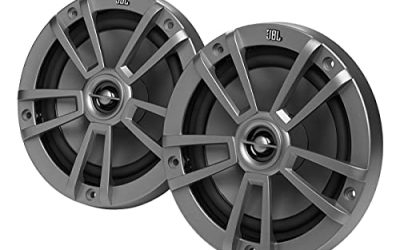
The JBL GTO629 is a 6.5-inch two-way coaxial built around a carbon-injected Plus One woofer cone. The Plus One design gives the cone more surface area than a standard cone of the same size, and more surface area means more air moved on every bass note. That is the main reason this speaker earns its place at the top of a bass-focused list.
Power handling is 60 watts RMS with 180 watts peak, and impedance is 4 ohms, so it works with a factory head unit and has room to grow with an amplifier. The tweeter is an edge-driven soft dome unit mounted on a UniPivot housing, which lets you angle the tweeter toward the listening position after installation.
The low end reaches down to around 40 Hz, which is deep for a 6.5-inch coaxial and gives kick drums and bass lines genuine weight. Vocals stay clear because the soft dome tweeter keeps the top end smooth rather than sharp. This is the pick for drivers who want strong bass and a balanced sound from a single pair of door speakers, with no extra hardware required.
Key specs:
Check the JBL GTO629 on Amazon
– Power handling: 60 watts RMS, 180 watts peak
– Impedance: 4 ohms
– Woofer: carbon-injected Plus One cone
– Tweeter: edge-driven soft dome, UniPivot adjustable
– Low-end response: around 40 Hz
2. Rockford Fosgate Prime R165X3
The Rockford Fosgate Prime R165X3 is a 6.5-inch three-way coaxial, and it is one of the longest-running models in car audio. Its staying power comes from a simple formula: a polypropylene woofer cone, a separate midrange driver, and a silk dome tweeter, all tuned to sound full without needing a lot of power.
Power handling is 45 watts RMS with 90 watts peak at 4 ohms, which makes it an easy match for a factory head unit. The frequency response reaches down to 52 Hz, so the low end is solid for a speaker of this size, and the three-way layout spreads vocals and instruments across dedicated drivers for a warm, full sound at higher volume.
The pair includes grilles and mounting hardware, so installation is a matter of swapping the factory speakers and connecting the wires. Its shallow mounting depth suits a wide range of doors, which is one reason installers keep recommending it for straightforward factory replacements. This is the pick for drivers who want a proven, easy upgrade that adds warmth and body to the sound without touching the rest of the system.
Key specs:
Check the Rockford Fosgate R165X3 on Amazon
– Power handling: 45 watts RMS, 90 watts peak
– Impedance: 4 ohms
– Woofer: polypropylene cone
– Tweeter: 0.5-inch silk dome, plus midrange driver
– Low-end response: 52 Hz
– In the box: pair of speakers with grilles and mounting hardware
3. Kicker 46CSC654
The Kicker 46CSC654, part of the CS Series, is a 6.5-inch two-way coaxial built for drivers who play their music loud. Its headline figures are 100 watts RMS and 300 watts peak, the highest continuous power handling in this roundup, which means it stays composed at volumes where lesser speakers start to distort.
The polypropylene woofer cone uses EVC technology, and the tweeter is a PEI dome with a zero-protrusion design, so the tweeter sits flush and the speaker fits behind factory grilles without clearance problems. Sensitivity is 90 dB, so it still plays loud from a head unit, and the frequency response runs from 40 Hz to 20,000 Hz, giving it the low-end reach to make bass lines feel present rather than implied.
Impedance is 4 ohms, and the speaker works with factory or aftermarket head units, with plenty of headroom for an amplifier later. This is the pick for drivers who want headroom: clean bass and clear highs at higher volume, with a speaker that will not be the limiting factor if the rest of the system grows.
Key specs:
Check the Kicker 46CSC654 on Amazon
– Power handling: 100 watts RMS, 300 watts peak
– Impedance: 4 ohms
– Frequency response: 40 Hz to 20,000 Hz
– Sensitivity: 90 dB
– Woofer: polypropylene cone with EVC technology
– Tweeter: PEI dome, zero-protrusion design
4. Pioneer TS-A1670F
The Pioneer TS-A1670F is a 6.5-inch three-way coaxial from the Pioneer A-Series, and it is built for bass. Its woofer cone is made from carbon and mica reinforced injection-molded polypropylene, a rigid material that resists flexing under heavy bass notes. A cone that stays rigid produces tighter, more controlled low end instead of the loose, boomy sound that comes from a cone bending under pressure.
Power handling is 70 watts RMS with 320 watts peak at 4 ohms, placing it between the Rockford Fosgate and the Kicker in this lineup. The three-way layout adds a midrange driver and a tweeter to the woofer, so vocals and instruments get their own dedicated driver while the woofer concentrates on the low end. That division of labor is part of why the bass stays clean even when the music gets busy.
This is a straightforward drop-in upgrade for most 6.5-inch door locations, and it pairs well with both factory head units and aftermarket stereos. It is the pick for drivers who want a bass-forward sound with a rigid cone and a three-way layout, at a sensible step up from the most basic replacement speakers.
Key specs:
Check the Pioneer TS-A1670F on Amazon
– Power handling: 70 watts RMS, 320 watts peak
– Impedance: 4 ohms
– Woofer: carbon and mica reinforced injection-molded polypropylene cone
– Drivers: woofer, midrange, and tweeter
5. Infinity Reference REF-6522EX
The Infinity Reference REF-6522EX is a 6.5-inch two-way coaxial with a trick that the others in this list do not have: a shallow mounting depth. Some cars, especially older models and vehicles with tight door panels, simply do not have room for a deep speaker. This model is built for those doors, and its shallow basket means it fits where a standard-depth speaker would hit the window track.
It uses a Plus One woofer cone, the same surface-area idea as the JBL, paired with an edge-driven textile tweeter that keeps the high end smooth. Power handling is 60 watts RMS with 180 watts peak, and sensitivity is 93 dB, the highest in this roundup, so it plays loud from modest power. The notable spec is its 3-ohm impedance, a Harman design choice that lets the speaker draw a little more power from a factory head unit than a 4-ohm speaker would.
That combination of shallow fit, high sensitivity, and 3-ohm impedance makes it the pick for drivers with tight doors or a factory head unit they plan to keep. It delivers strong bass and clear highs without demanding an amplifier or a deep door cavity.
Key specs:
Check the Infinity REF-6522EX on Amazon
– Power handling: 60 watts RMS, 180 watts peak
– Impedance: 3 ohms
– Sensitivity: 93 dB
– Woofer: Plus One cone
– Tweeter: edge-driven textile dome
Comparison
The five speakers here cover different priorities, and the right choice depends on your car and your listening habits.
For the deepest bass from a single pair, the JBL GTO629 and the Kicker 46CSC654 lead the way, both reaching down to around 40 Hz. The JBL pairs that low end with an adjustable tweeter and a smooth soft dome, while the Kicker adds the highest power handling in the group, which suits louder listening.
For a warm, full sound on a factory head unit, the Rockford Fosgate Prime R165X3 is the straightforward choice. Its 45 watts RMS rating and three-way layout are tuned for easy driving, and it has been a staple replacement speaker for years.
For bass with a rigid cone and a three-way design, the Pioneer TS-A1670F sits in the middle of the power range with a carbon and mica reinforced cone that keeps the low end controlled.
For tight doors and factory stereos, the Infinity Reference REF-6522EX stands alone. Its shallow mounting depth solves fit problems the others cannot, and its 93 dB sensitivity and 3-ohm impedance squeeze the most volume from a stock head unit.
If you are replacing all four door speakers, buying two pairs of the same model keeps the sound consistent from front to rear. Mixing brands between the front and rear doors can work, but the tonal balance will shift as sound moves around the cabin, so a matched set is the simpler path.
Installation Notes
Most 6.5-inch coaxial speakers install with basic hand tools: a panel removal tool, a screwdriver, and a socket set. Remove the door panel, unplug the factory speaker, and connect the new speaker using the included harness or a vehicle-specific adapter. Adapters are worth buying, because cutting the factory wiring makes it harder to return the car to stock later.
Check the mounting depth before you order. If the new speaker is deeper than the factory one, it can interfere with the window when the glass rolls down. Shallow-mount models exist for exactly this reason. Also check that the speaker grille clears the door panel; most coaxial tweeters sit flush, but some protrude, and a quick test fit saves a second round of panel removal.
Sound deadening is an optional step that pays off. A layer of deadening material on the inner door skin reduces rattles and gives the woofer a more solid enclosure to work against, which tightens the bass. It is the single most effective companion upgrade to new speakers.
Finally, break the speakers in gently. Playing new speakers at moderate volume for the first several hours lets the suspension loosen up, and the sound typically opens up a little once that happens. Avoid running them at maximum volume straight out of the box.
FAQ
Will new car speakers improve bass without a subwoofer?
Yes, to a point. A good 6.5-inch coaxial produces far tighter and deeper mid-bass than a factory speaker, and the improvement is obvious on kick drums, bass guitar, and electronic music. Deep sub-bass below the range a door speaker can reach still needs a dedicated subwoofer, but for most music, a quality coaxial upgrade is a large step up.
Do I need an amplifier for aftermarket car speakers?
No. Every speaker in this guide is efficient enough to run from a factory or aftermarket head unit, and all five will sound better than factory speakers on head-unit power alone. An amplifier adds volume and control, and it is worth considering later, but it is not a requirement for the upgrade to be worthwhile.
What size speakers fit my car?
Most cars use 6.5-inch speakers in the doors, but sizes vary by make, model, and year. Check your vehicle manual, measure the factory speaker, or use a fitment guide from the speaker maker before ordering. Mounting depth matters as much as diameter.
Are two-way or three-way speakers better for bass?
The woofer does the bass work in either layout, so the driver count alone does not decide bass quality. Cone material, cone area, and power handling matter more. Three-way designs can sound fuller because the midrange has its own driver, while two-way designs can sound cleaner because the crossover is simpler. Listen to the whole package rather than the driver count.
Can I mix speaker brands between the front and rear doors?
You can, but a matched set sounds more consistent. If the front and rear speakers have different tonal characters, the sound changes as it moves around the cabin. Matching pairs front and rear keeps the balance even.
How long do car speakers last?
A well-built car speaker lasts for many years. The main threats are moisture inside the door and prolonged exposure to high volume that pushes the speaker past its limits. Keeping the power within the rated RMS range and making sure the door drains are clear will keep a set sounding good for a long time.
Final Thoughts
The best car speakers for bass and sound quality are the ones that fit your car, match your head unit, and balance low-end punch with clear highs. The JBL GTO629 leads for deep bass and an adjustable tweeter, the Kicker 46CSC654 leads for power handling and loud listening, the Rockford Fosgate Prime R165X3 is the proven easy upgrade, the Pioneer TS-A1670F brings a rigid cone and a three-way layout, and the Infinity Reference REF-6522EX solves tight doors and stock stereos in one move.
Start with the front doors, where you sit and listen. If the improvement convinces you, match the rear doors with the same model, and consider sound deadening while the panels are off. A subwoofer can come later if you want deeper bass, but for most drivers, a good set of coaxial speakers is the upgrade that changes the daily drive.
FAQ
Will new car speakers improve bass without a subwoofer?
Do I need an amplifier for aftermarket car speakers?
What size speakers fit my car?
Are two-way or three-way speakers better for bass?
Can I mix speaker brands between the front and rear doors?
How long do car speakers last?
More from Amazon
Programs that pair well with the guide above. Offers and eligibility are set by Amazon and may change.
Free shipping on eligible items, Prime Video and more. Eligible new members can start with a free trial.
Start a Prime free trialAd-free music streaming. Eligible new subscribers can start with a free trial.
Try Music Unlimited freeA Prime membership for ages 18-24 with a trial period. Eligibility is set by Amazon.
See Prime for Young AdultsAudiobooks and podcasts to listen to on the go. Eligible new members can start with a free trial.
Try Audible freeAs an Amazon Associate we earn from qualifying purchases.