Key takeaways
- RX 6950 XT: 335 + 150 + 150 = 635 W, so a quality 750 W PSU is the safe target.
- RX 7900 XTX: 355 + 150 + 150 = 655 W, so a quality 750-850 W PSU is the safe target.
The RX 7900 XTX is the better gaming card: it is roughly 25-40% faster at 4K, carries 24 GB of VRAM instead of 16 GB, handles ray tracing better and actually launched at a lower MSRP than the RX 6950 XT. The RX 6950 XT only makes sense as a discounted used card for 1440p, where it still delivers excellent raster performance for considerably less money.
Our top picks
 ASRock Radeon RX 7900 XTX Phantom Gaming
- Flagship Gaming Performance, AMD Radeon RX 7900 XTX…
- Advanced RDNA 3 Architecture, 96 compute units with…
- Premium Cooling Solution, Phantom Gaming 3X Cooling System…
| Product | Key specs | |
|---|---|---|
 AMD Radeon™ RX 6950 XT gddr6 Graphics AMD Radeon™ RX 6950 XT gddr6 Graphics | Check price | |
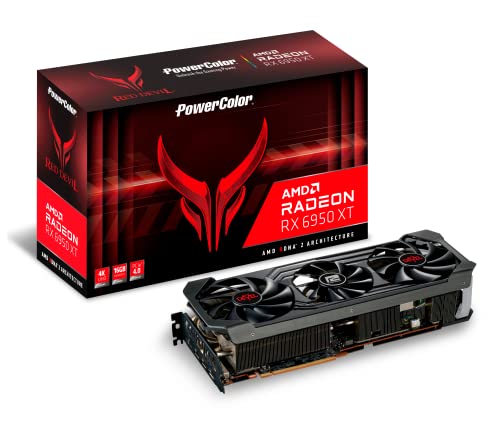 PowerColor Red Devil AMD Radeon RX 6950 PowerColor Red Devil AMD Radeon RX 6950 | Check price | |
| ASRock Radeon RX 7900 XTX Phantom Gaming | Flagship Gaming Performance, AMD Radeon RX 7900 XTX… Advanced RDNA 3 Architecture, 96 compute units with… Premium Cooling Solution, Phantom Gaming 3X Cooling System… | Check price |
 PowerColor Hellhound AMD Radeon RX 7900 XTX PowerColor Hellhound AMD Radeon RX 7900 XTX | Card Dimensions: 320 x 118.5 x 62 mm Minimum System Power Requirement: 800W Video Memory: 24GB GDDR6 | Check price |
As an Amazon Associate we earn from qualifying purchases at no extra cost to you.
The Old Flagship vs the New One
AMD released the RX 6950 XT in May 2022 at $1,099 as a refreshed, higher-clocked version of the RDNA 2 flagship. Just six months later, in November 2022, the RDNA 3-based RX 7900 XTX replaced it at $999. That makes this an unusual comparison: the newer card was both faster and cheaper at launch. Both are now previous-generation, sitting behind AMD’s current RX 9000 lineup, and are mostly bought used.
Specs at a Glance
| Spec | RX 6950 XT | RX 7900 XTX |
|---|---|---|
| Architecture | RDNA 2.0 | RDNA 3.0 |
| Release date | 10 May 2022 | 3 November 2022 |
| Launch MSRP | $1,099 | $999 |
| Stream processors | 5120 | 6144 |
| Boost clock | 2324 MHz | 2498 MHz |
| Process | 7 nm | 5 nm |
| TDP | 335 W | 355 W |
| Memory | 16 GB GDDR6 | 24 GB GDDR6 |
| Bus width | 256-bit | 384-bit |
| Bandwidth | 576.0 GB/s | 960.0 GB/s |
| Cache | 4 MB L2 + 128 MB L3 | 6 MB L2 + 96 MB L3 |
| Interface | PCIe 4.0 x16 | PCIe 4.0 x16 |
| Power connectors | 2x 8-pin | 2x 8-pin |
| Length / width | 267 mm, 3-slot | 287 mm, 2-slot |
| Outputs | 1x HDMI 2.1, 2x DP 1.4a | 1x HDMI 2.1a, 2x DP 2.1, 1x USB-C |
The RX 7900 XTX brings 20% more stream processors, a 50% wider memory bus and about two-thirds more bandwidth. RDNA 3 also introduced dual-issue shader execution and second-generation ray accelerators, which help in some workloads more than others.
Gaming Performance
4K: Where the XTX Pulls Away
Reviews from TechSpot/Hardware Unboxed and KitGuru show the RX 7900 XTX ahead of the RX 6950 XT by margins ranging from the mid-teens in some games to over 50% in others at 4K. Averaged across titles, the lead falls roughly in the 25-40% range. AMD’s pre-launch claim of 50-70% proved optimistic; TechSpot noted that typical margins were far smaller than that, though still substantial.
1440p and 1080p
At 1440p the gap narrows to roughly 20-30%, since the 6950 XT’s 128 MB Infinity Cache works most effectively at lower resolutions and some games start leaning on the CPU. At 1080p the difference shrinks further and many titles become CPU-limited with either card, so a 1080p player gains little from the XTX.
As approximate ranges that vary with settings, CPU and patch, the RX 6950 XT typically runs demanding 4K games at 50-75 fps on high settings, while the RX 7900 XTX tends to reach 70-105 fps. At 1440p both cards exceed 100 fps in most titles.
Ray Tracing
RDNA 3’s ray accelerators are meaningfully faster than RDNA 2’s, so the XTX’s lead tends to grow with RT enabled, often into the 40-50% range in RT-heavy titles. Neither card matches NVIDIA’s best in path tracing, but the XTX is far more usable with moderate RT settings at 1440p.
Upscaling and Frame Generation
Both cards support FSR 3.1 upscaling and frame generation in supported games and AMD Fluid Motion Frames 2 at the driver level. Neither officially supports FSR 4, which AMD built for the AI hardware in RX 9000 cards. So in features, the two are on equal footing; the XTX simply has more performance to start with.
VRAM: 16 GB vs 24 GB
At 1440p, 16 GB is plenty for every current game. At 4K with maximum textures, ray tracing and frame generation, a small number of titles approach or exceed 16 GB, which is where the XTX’s 24 GB becomes a genuine advantage. For content creation and local AI workloads, 24 GB opens up larger projects and models. For a 1440p gamer, the 6950 XT’s capacity is not a limitation.
Power, PSU and Physical Size
The power ratings are close: 335 W for the RX 6950 XT and 355 W for the RX 7900 XTX, and both use two 8-pin connectors. Using GPU TDP + CPU + about 150 W headroom with a 150 W gaming CPU:
- RX 6950 XT: 335 + 150 + 150 = 635 W, so a quality 750 W PSU is the safe target.
- RX 7900 XTX: 355 + 150 + 150 = 655 W, so a quality 750-850 W PSU is the safe target.
In practice, a system that runs one runs the other. Physically, the RX 6950 XT reference card is shorter at 267 mm but takes three slots; the RX 7900 XTX reference is 287 mm and two slots. Partner cards for both are often longer and thicker, so measure your case clearance.
Cost Per Performance
Set the RX 6950 XT at 100 and the RX 7900 XTX at around 132 (4K midpoint).
- At MSRP: 6950 XT $1,099 / 100 = $10.99 per point; XTX $999 / 132 = about $7.57 per point. The newer card was clearly better value at launch.
- Used, with an RX 6950 XT usually $350-$450 and an RX 7900 XTX usually $650-$800: 6950 XT midpoint $400 = $4.00 per point; XTX midpoint $725 = about $5.49 per point.
On the used market the value advantage flips to the RX 6950 XT for raster performance per dollar, especially at 1440p, where the performance gap is smaller. The XTX costs more per frame but adds VRAM and RT headroom.
Decision Table
| Buyer profile | Better choice |
|---|---|
| 1440p, mostly raster, budget near $400 | RX 6950 XT |
| 4K high settings | RX 7900 XTX |
| Wants ray tracing on moderate settings | RX 7900 XTX |
| Uses large creative or AI workloads | RX 7900 XTX |
| Wants DisplayPort 2.1 or AV1 encoding | RX 7900 XTX |
| Has around $650+ and wants a new card with warranty | Consider RX 9070 XT alongside a used XTX |
What to Check When Buying Used
Some early reference RX 7900 XTX cards suffered from a vapor chamber issue that caused very high hotspot temperatures; check hotspot readings under load and prefer partner models or confirmed replacement units. RX 6950 XT cards are generally robust but run hot and can be loud, so confirm fan health and look for coil whine. Ask for receipts, since warranties on later units may still be valid.
Display Outputs, Encoding and Other Extras
Beyond frame rates, the RX 7900 XTX brings several platform upgrades. Its DisplayPort 2.1 outputs support higher refresh rates at 4K and above without compression, which matters for the newest 4K 240 Hz monitors. The RX 6950 XT is limited to DisplayPort 1.4a, which relies on Display Stream Compression for the highest refresh modes. The XTX also adds AV1 hardware encoding, a clear benefit for streamers and anyone recording gameplay, since AV1 delivers better quality at the same bitrate than older codecs. The reference XTX also includes a USB-C display output.
Idle and multi-monitor power behavior is worth checking too. Early RDNA 3 drivers showed high idle power with certain multi-monitor and high-refresh setups, and AMD improved this over time. Keeping drivers current matters for either card, and AMD’s new-game optimization focus has shifted toward RDNA 3 and RDNA 4, which gives the XTX a modest longevity advantage over the RDNA 2-based 6950 XT.
Verdict
The RX 7900 XTX is the faster, more modern and better-equipped card, and it was the better buy at launch prices. Today, the RX 6950 XT is a strong used value for 1440p players who do not need ray tracing or more than 16 GB of VRAM. If you game at 4K or want the card to last, the XTX is worth the extra money.
Frequently Asked Questions
How much faster is the RX 7900 XTX than the RX 6950 XT?
Reviews put it roughly 25-40% faster at 4K and about 20-30% faster at 1440p. The gap is smaller at 1080p, where CPU limits often apply.
Is the RX 6950 XT still good in 2026?
Yes, for 1440p raster gaming it remains a strong card with 16 GB of VRAM. Its weaknesses are ray tracing and power draw, and it lacks FSR 4 support.
Do both cards support FSR 4?
No. FSR 4 is officially limited to RX 9000 series GPUs. Both cards support FSR 3.1 upscaling and frame generation and AMD Fluid Motion Frames 2.
Can I swap a 6950 XT for a 7900 XTX without changing my PSU?
Usually yes. The power ratings differ by only 20 W and both cards use two 8-pin connectors, so a quality 750 W or larger PSU handles either one.
Is upgrading from a 6950 XT to a 7900 XTX worth it?
For 4K players it can be, given a 25-40% performance gain and extra VRAM. For 1440p players the gain is smaller, and a jump to a newer RX 9070 XT or RTX 50 card may offer better features for similar money.