
Key takeaways
- 1440p ultra: both cards typically run current AAA games around 70 to 120 fps, with differences that are hard to notice without a frame counter.
- 4K high: both deliver roughly 45 to 75 fps natively in many games; the 6950 XT’s larger cache gives it a small edge in some titles.
Moving from an RX 6950 XT to an RX 7900 GRE is not a performance upgrade: the newer GRE is roughly equal to slightly slower in rasterized games, so RX 6950 XT owners should skip it and look higher, such as the RX 9070 XT, if they want a real step up. The GRE only beats the 6950 XT on power draw, ray tracing and card size, which makes it the better buy for someone choosing between the two from scratch, but not a worthwhile swap for an existing 6950 XT owner.
The two cards share several headline numbers: 5120 stream processors, 16 GB of GDDR6 on a 256-bit bus and 576 GB/s of bandwidth. The RX 6950 XT is AMD’s top RDNA 2 card, launched in May 2022 at $1,099, while the RX 7900 GRE is a cut-down RDNA 3 card with a global launch price of $549. Architecture changes, clocks and cache account for the differences that remain.
Our top picks

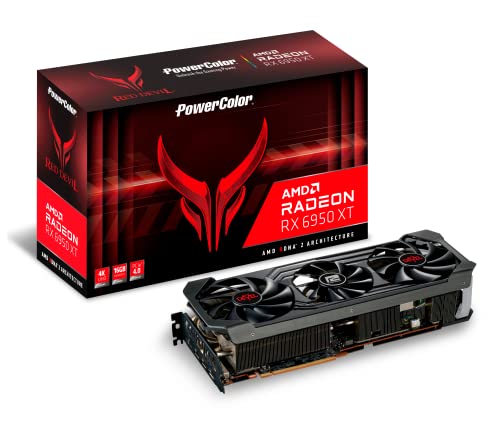


As an Amazon Associate we earn from qualifying purchases at no extra cost to you.
What Changes on Paper
| Specification | RX 6950 XT | RX 7900 GRE |
|---|---|---|
| Architecture | RDNA 2.0 | RDNA 3.0 |
| Release date | 10 May 2022 | 27 July 2023 |
| Launch MSRP | $1,099 | $549 |
| Stream processors | 5120 | 5120 |
| Boost clock | 2324 MHz | 2245 MHz |
| Process | 7 nm | 5 nm |
| TDP | 335 W | 260 W |
| Memory | 16 GB GDDR6 | 16 GB GDDR6 |
| Memory bus | 256-bit | 256-bit |
| Bandwidth | 576.0 GB/s | 576.0 GB/s |
| L2 / L3 cache | 4 MB / 128 MB | 6 MB / 64 MB |
| Interface | PCIe 4.0 x16 | PCIe 4.0 x16 |
| Power connectors | 2x 8-pin | 2x 8-pin |
| Length / width | 267 mm / 3-slot | 276 mm / 2-slot |
| Outputs | 1x HDMI 2.1, 2x DP 1.4a | 1x HDMI 2.1a, 2x DP 2.1, 1x USB-C |
The 6950 XT has twice the Infinity Cache and slightly higher clocks; the GRE has the newer architecture with dual-issue shaders and improved ray accelerators, a smaller process and 75 W less rated power. The two largely cancel out in rasterized performance.
Performance Class: Sideways, Not Up
Review data and benchmark aggregates consistently show these cards in the same tier. Test results compiled across outlets place the RX 6950 XT roughly 2 to 8 percent ahead of the RX 7900 GRE in average rasterized performance at 1440p and 4K, with some newer games showing the GRE level or slightly ahead. TechPowerUp’s GRE review data also positioned the two cards close together in its relative-performance charts, and the GRE’s launch was widely framed by reviewers as delivering last-generation flagship performance at a midrange price.
In practice, with frame rates varying by settings, CPU and patch:
- 1440p ultra: both cards typically run current AAA games around 70 to 120 fps, with differences that are hard to notice without a frame counter.
- 4K high: both deliver roughly 45 to 75 fps natively in many games; the 6950 XT’s larger cache gives it a small edge in some titles.
Ray tracing: the one real gain
RDNA 3’s improved ray accelerators give the GRE a measurable advantage when ray tracing is enabled. Benchmark data shows the GRE ahead in many RT titles, sometimes by 15 to 30 percent in heavier implementations. That said, neither card handles demanding RT or path tracing well, so this gain matters mainly for players who use light-to-moderate RT effects with upscaling at 1440p.
Features: What You Get and What You Do Not
- Upscaling: both cards support FSR 3.1 upscaling and frame generation, plus driver-level AMD Fluid Motion Frames. FSR 4 launched exclusively for RDNA 4, so moving to the GRE does not unlock it.
- Video encoding: the GRE adds AV1 hardware encoding, useful for streaming and recording. The 6950 XT lacks AV1 encode.
- Display output: the GRE supports DisplayPort 2.1, which helps with very high-refresh 4K monitors; the 6950 XT uses DisplayPort 1.4a.
- VRAM: 16 GB on both, so there is no memory gain from upgrading.
Power, Heat and PSU Needs
The GRE’s biggest practical advantage is efficiency. Rated at 260 W against 335 W, it runs cooler and quieter for similar performance. PSU sizing with GPU TDP plus CPU plus about 150 W headroom:
- RX 6950 XT + 125 W CPU: 335 + 125 + 150 = 610 W, so a quality 750 W unit is the sensible choice given the 6950 XT’s transient spikes.
- RX 7900 GRE + 125 W CPU: 260 + 125 + 150 = 535 W, so a good 650 W unit is sufficient.
Over a year of gaming, the 75 W difference adds up modestly. At about 20 hours of gaming per week and an electricity price of $0.15 per kWh, saving roughly 75 W works out to about 78 kWh, or around $12 per year. That is real but far too small to justify replacing a working card.
Both use two 8-pin connectors. The 6950 XT reference card is a 3-slot design, while the GRE is listed as 2-slot, which helps in tighter cases. Partner cards for both are frequently larger.
When the Switch Actually Pays Off
For an existing 6950 XT owner, swapping to a GRE pays off only in narrow cases:
- The 6950 XT is failing, out of warranty, or running hot and loud, and a GRE is available cheaply.
- A small-form-factor build needs a 2-slot, lower-power card at the same performance.
- AV1 encoding for streaming is essential, and selling the 6950 XT covers most of the GRE’s price.
- Ray-traced games are the main focus and a 15 to 30 percent RT gain in some titles justifies the cost.
For everyone else, a real upgrade needs a bigger jump. The RX 9070 and RX 9070 XT, or Nvidia’s RTX 5070 Ti, offer meaningfully higher raster performance, much stronger ray tracing and newer upscalers such as FSR 4 or DLSS 4.
Getting more from an existing 6950 XT
Owners who want a little more performance without spending on a sideways swap have a few low-cost options. Enabling FSR 3.1 upscaling in quality mode at 1440p or 4K recovers a meaningful amount of frame rate in demanding games. AMD Fluid Motion Frames can smooth motion in titles without native frame generation, though it adds some latency. Undervolting through AMD’s Adrenalin software often lowers power draw and temperatures noticeably while keeping performance close to stock, which narrows the GRE’s efficiency advantage. Replacing dried thermal paste on an older card can also restore quieter fan behavior.
Buying One or the Other Fresh
For someone without either card, the choice is different. Both are previous-generation now and mostly sold used. The 6950 XT usually sells used around $350 to $450 and the GRE in a similar range. With rasterized performance close, the GRE’s lower power draw, better RT, AV1 encoding and smaller size make it the more sensible pick at equal prices, while a noticeably cheaper 6950 XT is a fine raster-focused buy for owners of a 750 W or larger PSU.
| Scenario | Recommendation |
|---|---|
| Own a 6950 XT, want more FPS | Skip the GRE; look at RX 9070 XT or RTX 5070 Ti class |
| Own a 6950 XT, want less heat in SFF | GRE is a reasonable sideways move |
| Buying new-to-you at the same price | RX 7900 GRE |
| 6950 XT noticeably cheaper, 750 W PSU | RX 6950 XT |
| Streaming with AV1 | RX 7900 GRE |
Frequently Asked Questions
Is the RX 7900 GRE faster than the RX 6950 XT?
Not in rasterized games, where review data and benchmark aggregates put the RX 6950 XT roughly 2 to 8 percent ahead on average. The GRE is faster in many ray-traced titles. Overall they sit in the same performance tier.
Should I upgrade from an RX 6950 XT to an RX 7900 GRE?
For most owners, no, because rasterized performance and VRAM are essentially unchanged. The gains are limited to lower power draw, better ray tracing, AV1 encoding and DisplayPort 2.1. A meaningful upgrade requires a higher-tier card such as the RX 9070 XT.
Does the RX 7900 GRE support FSR 4?
FSR 4 launched exclusively for RDNA 4 cards, and the RX 7900 GRE is an RDNA 3 card. It uses FSR 3.1 upscaling and frame generation, the same as the RX 6950 XT. Both also support AMD Fluid Motion Frames at the driver level.
What PSU do I need for the RX 6950 XT?
A quality 750 W power supply is recommended for the RX 6950 XT with a typical gaming CPU. The card is rated at 335 W and can produce short power spikes above that. It uses two 8-pin PCIe connectors.
How much power does the RX 7900 GRE save?
The RX 7900 GRE is rated at 260 W versus 335 W for the RX 6950 XT, a 75 W difference. At around 20 hours of gaming per week, that saves roughly 78 kWh per year. The savings are modest in money terms but noticeable in heat and fan noise.









