
Key takeaways
- 1080p: 11 GB is ample.
- 1440p: most games stay under 11 GB, though a few new titles at ultra textures with RT approach or exceed it.
- 4K: 12-16 GB usage is common in recent AAA games, which favors the RX 6950 XT.
The RX 6950 XT is the clearly faster card, roughly 45-60% ahead of the RTX 2080 Ti in rasterized games at 1440p and 4K with 16 GB of VRAM versus 11 GB, so it is the better buy for high-refresh 1440p and 4K gaming. The RTX 2080 Ti remains worth considering only if it is much cheaper, if DLSS image quality matters more than raw frames, or if the PSU cannot handle a 335 W card.
These cards were both flagships, four years apart. The RTX 2080 Ti was Nvidia’s 2018 Turing halo card and the first consumer GPU with dedicated RT and Tensor cores. The RX 6950 XT was AMD’s 2022 RDNA 2 refresh at the top of the stack. In 2026 both are well behind the RTX 50 and Radeon RX 9000 series and are bought almost entirely used, which shifts the comparison toward used pricing, power, and longevity.
Our top picks


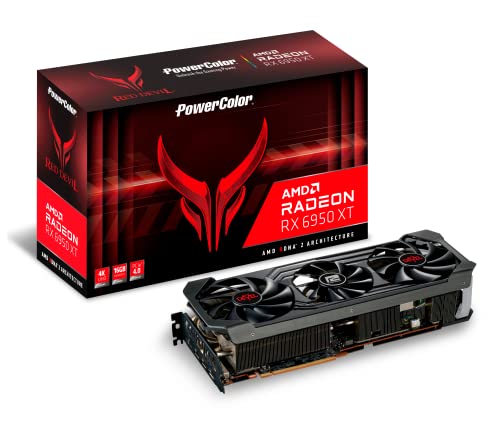
As an Amazon Associate we earn from qualifying purchases at no extra cost to you.
Head-to-Head Specs
| Specification | RTX 2080 Ti | RX 6950 XT |
|---|---|---|
| Architecture | Turing | RDNA 2.0 |
| Release date | 20 September 2018 | 10 May 2022 |
| Launch MSRP | $999 | $1,099 |
| Shaders | 4352 CUDA cores | 5120 stream processors |
| Boost clock | 1545 MHz | 2324 MHz |
| Process | 12 nm | 7 nm |
| TDP | 250 W | 335 W |
| VRAM | 11 GB GDDR6 | 16 GB GDDR6 |
| Memory bus | 352-bit | 256-bit |
| Bandwidth | 616.0 GB/s | 576.0 GB/s |
| Cache | 5.5 MB L2 | 4 MB L2 + 128 MB L3 |
| Interface | PCIe 3.0 x16 | PCIe 4.0 x16 |
| Power connectors | 2x 8-pin | 2x 8-pin |
| Length / width | 267 mm, 2-slot | 267 mm, 3-slot |
| Outputs | 1x HDMI 2.0, 3x DP 1.4a, 1x USB-C | 1x HDMI 2.1, 2x DP 1.4a |
The RTX 2080 Ti actually has slightly more raw memory bandwidth, but the RX 6950 XT’s 128 MB Infinity Cache makes its effective bandwidth far higher. Combined with a much higher clock speed, that explains the large raster gap.
Rasterized Gaming Performance
According to TechPowerUp’s relative performance data, the RTX 2080 Ti lands near RTX 3070 level, while the RX 6950 XT sits close to the RTX 3090 and RTX 3090 Ti in raster. That places the RX 6950 XT roughly 45-60% ahead of the RTX 2080 Ti at 1440p and 4K. Benchmark aggregates that rely on synthetic and older DirectX 11 tests show a smaller 30-40% gap, so the advantage is largest in modern games at higher resolutions.
For a sense of scale: a demanding AAA game that runs around 60-70 fps at 1440p high on an RTX 2080 Ti typically lands in the 90-110 fps range on an RX 6950 XT. At 4K, a 2080 Ti result around 40 fps often becomes 60-plus on the AMD card. All figures vary with game, settings, CPU, and driver version.
Ray Tracing: Closer Than the Raster Gap
Ray tracing narrows the distance. RDNA 2’s first-generation ray accelerators are less efficient per unit than Turing’s RT cores, but the RX 6950 XT has more of them (80 vs 68) running at much higher clocks. Synthetic RT tests show the RX 6950 XT roughly 15-30% ahead, and in real games with moderate RT the AMD card usually leads by a smaller margin than in raster. In heavy RT or path-traced modes, both cards struggle and neither is a good choice.
Upscaling: DLSS vs FSR
This is the RTX 2080 Ti’s strongest argument. As an RTX card it supports DLSS 4 Super Resolution with the transformer model and Ray Reconstruction, which deliver noticeably better image quality than FSR 3.1 at the same internal resolution. It does not support DLSS Frame Generation (RTX 40 and newer) but can use FSR 3 frame generation in games that include it.
The RX 6950 XT supports FSR 3.1 upscaling and frame generation plus AMD Fluid Motion Frames at the driver level. FSR 4 is officially limited to RDNA 4. In practice, an RTX 2080 Ti running DLSS Balanced can look comparable to an RX 6950 XT at FSR Quality while closing some of the performance gap, though the RX 6950 XT still usually stays ahead.
Driver status also matters. Turing remains on Nvidia’s mainstream driver branch, while AMD announced in late 2025 that RDNA 1 and RDNA 2 were moving to a maintenance-focused driver track with new game optimizations prioritized for newer architectures.
VRAM: 11 GB vs 16 GB
- 1080p: 11 GB is ample.
- 1440p: most games stay under 11 GB, though a few new titles at ultra textures with RT approach or exceed it.
- 4K: 12-16 GB usage is common in recent AAA games, which favors the RX 6950 XT.
The RX 6950 XT’s 16 GB gives it more runway for future games, which matters for a card bought used in 2026 with the intention of keeping it a few years.
Power, PSU and Case Fit
The RX 6950 XT is rated at 335 W versus 250 W. Both use two 8-pin connectors on reference designs, though partner RX 6950 XT models often use three. PSU sizing with GPU TDP + CPU + about 150 W headroom:
- RX 6950 XT + 125 W CPU: 335 + 125 + 150 = 610 W, so a quality 750 W unit; 850 W with a high-power CPU because RDNA 2 flagships can spike briefly above rated power.
- RTX 2080 Ti + 125 W CPU: 250 + 125 + 150 = 525 W, so 650 W is comfortable.
Both are listed at 267 mm, but the RX 6950 XT is a 3-slot design and many partner cards stretch past 300 mm. The RTX 2080 Ti’s 2-slot reference design is easier to fit. Note the 2080 Ti’s HDMI 2.0 port limits 4K output over HDMI to 60 Hz; use DisplayPort for high-refresh 4K. The RX 6950 XT’s HDMI 2.1 handles 4K at 120 Hz on TVs.
Used Market Value
In 2026 a used RTX 2080 Ti often sells for about $200-$270, while a used RX 6950 XT commonly sells around $350-$450. With the 2080 Ti as index 100 and the RX 6950 XT around 150:
- RTX 2080 Ti at $235: $2.35 per performance point
- RX 6950 XT at $400: $2.67 per performance point
The RTX 2080 Ti is slightly cheaper per frame, while the RX 6950 XT offers far more absolute performance and VRAM. Used RTX 2080 Ti cards are now seven to eight years old, so check for memory artifacts, fan noise, and high temperatures before buying.
Creator and Non-Gaming Workloads
Outside of games, the comparison shifts. The RTX 2080 Ti’s CUDA support and Tensor cores make it the more broadly compatible card for GPU rendering in Blender (via OptiX), many video editing plugins, and local AI tools, most of which are built around Nvidia hardware first. Its NVENC encoder is also well supported for streaming in H.264 and HEVC, though it lacks AV1 encoding.
The RX 6950 XT works in Blender via HIP and handles video editing well, but software support for AMD in AI and some professional plugins is narrower. It also has no AV1 encoder. For a mixed gaming and creator machine, the RTX 2080 Ti’s software ecosystem can outweigh its lower gaming performance; for a pure gaming PC, the RX 6950 XT’s speed advantage wins.
Decision Table by Resolution and Budget
| Situation | Better pick |
|---|---|
| 1080p, tight budget, 650 W PSU | RTX 2080 Ti |
| 1440p high-refresh | RX 6950 XT |
| 4K gaming | RX 6950 XT |
| Image quality with upscaling | RTX 2080 Ti (DLSS 4 transformer) |
| Long-term VRAM headroom | RX 6950 XT |
| Compact case, 2-slot limit | RTX 2080 Ti |
Before choosing either, compare with an RX 9070 or RTX 5070. These current cards match or beat the RX 6950 XT in most games, add better ray tracing and modern upscaling, draw less power, and come with a warranty.
Frequently Asked Questions
How much faster is the RX 6950 XT than the RTX 2080 Ti?
In modern rasterized games at 1440p and 4K, the RX 6950 XT is roughly 45-60% faster based on TechPowerUp’s relative performance positioning. Synthetic and older-game aggregates show a smaller 30-40% lead. The gap narrows with ray tracing enabled.
Is the RTX 2080 Ti still good in 2026?
It is still capable at 1080p and 1440p with DLSS, and its 11 GB of VRAM handles most games. It lacks DLSS Frame Generation and is now quite old, so reliability of used units is a concern. It makes sense mainly at a low used price.
Which card is better at ray tracing?
The RX 6950 XT is usually ahead in ray tracing by a modest margin, roughly 15-30% in synthetic tests. With DLSS enabled, the RTX 2080 Ti can close much of that gap. Neither card handles path tracing well.
What PSU do I need for the RX 6950 XT?
A quality 750 W power supply is the safe minimum for the RX 6950 XT with a mainstream CPU, and 850 W with a high-power processor. Use separate PCIe cables for each 8-pin connector. The RTX 2080 Ti runs on 650 W.
Does the RTX 2080 Ti work on PCIe 4.0 boards?
Yes. The RTX 2080 Ti is a PCIe 3.0 x16 card and works in any PCIe 4.0 or 5.0 slot at 3.0 speeds. With a full x16 link, the bandwidth loss is negligible in games.









