Key takeaways
- GPU Headroom: If your graphics card cannot sustain frame rates above 144 fps at your target resolution, a 240Hz panel offers minimal tangible benefit. Check benchmarks for your specific games before paying the premium.
- Competitive vs. Immersive: Esports titles like Valorant, CS2, and Overwatch 2 benefit noticeably from 240Hz, while story-driven AAA games are largely indistinguishable beyond 144Hz. Match the refresh rate to the games you play most.
- Resolution Trade-off: Higher refresh rates demand lower resolutions to maintain high frame rates. 1080p at 240Hz is common and affordable; 1440p at 240Hz requires a seriously powerful GPU. Decide which resolution tier your system targets.
- Panel Technology: Fast IPS and OLED panels deliver the best motion clarity and viewing angles. VA panels offer superior contrast but slower pixel response, which can introduce smearing at high refresh rates. TN is fast but dated.
- Adaptive Sync: Ensure the monitor supports either AMD FreeSync Premium or NVIDIA G-SYNC Compatible certification. Tearing and stutter are far more noticeable at high refresh rates, making variable refresh rate support essential rather than optional.
Choosing between a 144Hz and a 240Hz monitor is one of the most consequential decisions a PC gamer can make. Refresh rate directly impacts motion clarity, input latency, and competitive performance, yet many buyers overspend on high refresh rates their hardware cannot properly drive, or settle for 144Hz when their GPU and CPU could push well beyond it. The right choice depends on your game library, your system’s capabilities, your resolution target, and your budget.
Our top picks

 AOC 27" Gaming Monitor QHD 260Hz Overclocked
- Product Group: Personal Computer
- Binding: Personal Computers



As an Amazon Associate we earn from qualifying purchases at no extra cost to you. Ratings are shown as listed on Amazon.
This guide compares the two refresh rate tiers head-to-head and rounds up the best 240Hz gaming monitors available today. Whether you are upgrading from 60Hz, sidegrading from a tired 144Hz panel, or building a new competitive rig from scratch, the picks below cover a range of resolutions, panel types, and price points to help you make the right call.
🛒 Best Price Today on Amazon
Prime members get fast, free shipping on everything above, plus member-only deals. New members get a 30-day free trial — cancel anytime.
Watch: 144Hz vs 240Hz Monitor: Worth It in 2026? — Video Review
How to Choose a/an 144Hz vs 240Hz Monitor
- GPU Headroom: If your graphics card cannot sustain frame rates above 144 fps at your target resolution, a 240Hz panel offers minimal tangible benefit. Check benchmarks for your specific games before paying the premium.
- Competitive vs. Immersive: Esports titles like Valorant, CS2, and Overwatch 2 benefit noticeably from 240Hz, while story-driven AAA games are largely indistinguishable beyond 144Hz. Match the refresh rate to the games you play most.
- Resolution Trade-off: Higher refresh rates demand lower resolutions to maintain high frame rates. 1080p at 240Hz is common and affordable; 1440p at 240Hz requires a seriously powerful GPU. Decide which resolution tier your system targets.
- Panel Technology: Fast IPS and OLED panels deliver the best motion clarity and viewing angles. VA panels offer superior contrast but slower pixel response, which can introduce smearing at high refresh rates. TN is fast but dated.
- Adaptive Sync: Ensure the monitor supports either AMD FreeSync Premium or NVIDIA G-SYNC Compatible certification. Tearing and stutter are far more noticeable at high refresh rates, making variable refresh rate support essential rather than optional.
The Best 144Hz vs 240Hz Monitors Reviewed
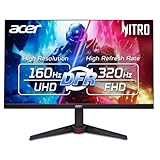
Acer Nitro 27″ QHD 240Hz IPS
The Acer Nitro XV272U pairs a 1440p IPS panel with a 240Hz refresh rate and a 0.5ms response time, making it a top-tier all-rounder for gamers who want both resolution and speed. With HDR400, an ergonomic stand, and 99% sRGB coverage, it delivers excellent value for mid-to-high-end systems.
AOC 27″ QHD 260Hz IPS
The AOC Q27G41ZE pushes 240Hz natively with a 260Hz overclock and 0.3ms response, backed by NVIDIA G-SYNC compatibility. Its combination of 1440p resolution and aggressive pricing makes it one of the strongest value plays in the high refresh market.
INNOCN 24.5″ 1440P 240Hz IPS
The INNOCN 25G2S offers a compelling middle ground with a 1440p resolution on a 24.5-inch Fast IPS panel at 240Hz. HDMI 2.1 support and compatibility with both FreeSync and G-SYNC make it versatile for PC and PS5 gaming alike.
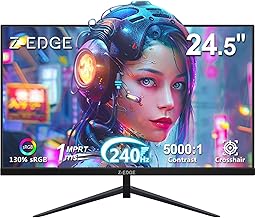
Z-Edge 24.5″ 240Hz FHD VA
The Z-Edge UG25I delivers 240Hz gaming at a budget-friendly price point with a 5000:1 contrast VA panel and 1ms MPRT. While color performance trails IPS alternatives, the sharp contrast and aggressive price make it a solid entry-level pick for competitive gamers.
Dell 24 SE2426HG 240Hz IPS
The Dell SE2426HG provides a clean 23.8-inch 1080p IPS panel at 240Hz with AMD FreeSync Premium and a TÜV-certified low-blue-light filter. It is a dependable, no-nonsense option for budget-conscious players who prioritize Dell reliability and eye comfort.
Frequently Asked Questions
Is 240Hz noticeably better than 144Hz?
The difference is most perceptible in fast-paced competitive games where you are already maintaining frame rates above 200 fps. In slower or more visually demanding titles, the jump is far less obvious and may not justify the price premium.
Can a mid-range GPU handle a 240Hz monitor?
It depends on the resolution and game. A mid-range GPU can easily exceed 200 fps in esports titles at 1080p but will struggle to reach even 144 fps in modern AAA games at 1440p. Match the refresh rate to your hardware’s realistic output.
Does 240Hz reduce input lag?
Yes, marginally. A 240Hz panel refreshes every 4.17ms compared to 6.94ms at 144Hz, which reduces the maximum time between a frame being rendered and displayed. The improvement is measurable but small relative to other latency factors.
Should I choose 1440p 144Hz or 1080p 240Hz?
Competitive gamers who play CS2, Valorant, or Rainbow Six Siege will benefit more from 1080p 240Hz. Players who prioritize visual fidelity across a broader game library will generally be happier with 1440p 144Hz, which balances clarity and smoothness.
Final Thoughts
For most gamers, the Acer Nitro 27″ QHD 240Hz strikes the best balance of resolution, speed, and price, while the AOC 27″ QHD 260Hz offers outstanding value if you want maximum refresh headroom. Budget-focused players should look closely at the Z-Edge 24.5″ 240Hz, which delivers competitive performance without straining the wallet.