Key takeaways
- The best long throw projectors for rear-shelf and ceiling installs, compared by throw ratio, zoom, lens shift, brightness and gaming lag from listing specs.
A long throw projector only makes sense if the lens can fill your screen from the spot where the mount has to live, usually the ceiling or a rear shelf behind the seating. That single measurement decides everything. Pick a model whose throw ratio is too short and the image overflows the screen; pick one that is too long and you are stuck with a picture smaller than the wall you bought it for, no matter how good the panel behind the lens is.
This guide is for three kinds of buyers: people building a dedicated theater room, living-room installers who want the projector out of the way at the back, and gamers who want a cinema-size image without a coffee-table box sitting in front of them. Every pick below is a standard or long throw model sold on Amazon, chosen from the throw ratio, zoom range and lens shift figures published on its product page, so you can match the lens to your room before anything else.
Quick Picks
As an Amazon Associate we earn from qualifying purchases.
| Product | Best for | Key spec from title |
|---|---|---|
| Epson Home Cinema 3800 | Ceiling mounts that cannot sit dead-center | 4K PRO-UHD 3-Chip Projector with HDR |
| Optoma UHZ66 | Bright rooms with a long lens-to-screen run | Compact Long Throw True 4K UHD Laser, 4,000 Lumens |
| Optoma UHD38x | Big-screen gaming from behind the couch | True 4K UHD Gaming Projector, 240Hz |
| Sony VPL-XW5000ES | Dedicated dark theaters | 4K HDR Laser with Native 4K SXRD Panel |
| BenQ HT2060 | A first fixed install that does not need 4K | 1080p HDR LED Home Theater Projector |
How to Choose
Measure lens-to-screen distance, then divide by screen width
Throw ratio is the distance from the lens to the screen divided by the width of the image, and it is the first number to check. Measure where the mount can actually go, not the full depth of the room, because seating, shelves and ceiling joists all eat into the run. A 120-inch 16:9 screen is about 105 inches wide, so a lens 14 feet away needs a ratio near 1.6. Every model in this guide publishes its ratio range, and the zoom range inside that figure is your margin for error if the tape measure was optimistic.
Match brightness to the light you cannot switch off
A projector rated at 2,000 lumens looks rich in a blacked-out theater and washed out in a living room with lamps on, so brightness has to follow the room, not the spec sheet race. Dedicated rooms with controlled light can take the dimmer, contrast-focused models here. Rooms that host sports with the lights up need the 3,000 to 4,000 lumen class, and the bigger the screen, the more brightness you need because the same light is spread over more area. Laser models also hold their output steadier over the years than lamps, which slowly dim.
Decide how much input lag your gaming can tolerate
Throw distance itself adds no meaningful delay, but the processing inside the projector does, so gamers should read the gaming mode figures on the listing rather than the headline refresh rate. The fastest pick here quotes 4.2ms at 1080p and 240Hz, with a still-respectable figure at 4K 60Hz, which suits fast console and PC play on a huge screen. Movie-only buyers can ignore this section entirely. One catch: on many models, enabling the low-lag mode disables keystone and some geometry correction, so the mount has to be square before you ever press the button.
Treat lens shift and zoom as installation insurance
Zoom decides how much placement slack you get, and lens shift decides whether the image can move without moving the projector. A wide 1.6x zoom forgives a mount that lands a foot or two off your plan, while optical lens shift lets you slide the picture up, down or sideways with no quality loss. Digital keystone is the fallback, and it costs you resolution and sharpness because it rescales the image. If your ceiling mount cannot sit exactly on the screen’s center line, optical shift stops being a luxury and becomes the feature that saves the install.
The 5 Best Options
Epson Home Cinema 3800
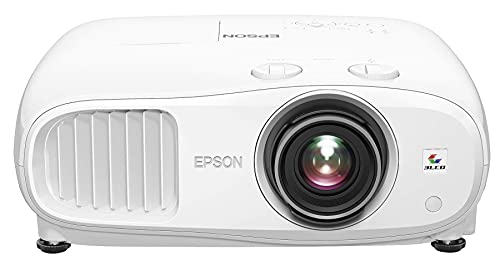
The Home Cinema 3800 is the placement problem-solver of this group. Its throw ratio runs from 1.32 to 2.15, the widest span here alongside the Sony, and the lens shift is generous in both directions, so a ceiling mount that lands off-center still produces a square, full-resolution image. The 3LCD design shows the full color signal in every frame, which is why this model keeps appearing in theater builds where the mount position was fixed long before the projector was chosen. It suits buyers who need forgiveness more than they need the newest light source.
Specs
- Resolution: 4K PRO-UHD (3,840 x 2,160, pixel-shifted), 3-chip 3LCD
- Brightness: 3,000 lumens color and white brightness
- Throw ratio: 1.32 to 2.15:1
- Zoom: 1.62x optical, manual
- Lens shift: Vertical +60% to -60%, horizontal +24% to -24%
- Contrast ratio: Up to 100,000:1 with auto iris
- Light source: 250W UHE lamp
Best for: Ceiling installs where the mount cannot sit on the screen’s center line.
Watch out for: It is lamp-based, so heavy use means replacement lamps over the years, and this is an older model line, so confirm the seller and that the unit is new rather than renewed before ordering.
ASIN: B07XF2G9WT
Optoma UHZ66

Optoma puts the words long throw in this model’s name, and the lens backs it up: a 1.4 to 2.24 throw ratio with 1.6x zoom throws a 120-inch image from about 12 feet and still has range left for deeper rooms. The DuraCore laser is rated for up to 30,000 hours, so there is no lamp schedule hanging over a permanent install, and 4,000 lumens is enough output to keep sports and daytime viewing watchable in rooms that never get fully dark. It is the set-and-forget option for a big living room.
Specs
- Resolution: True 4K UHD 3,840 x 2,160, DLP
- Brightness: 4,000 lumens
- Throw ratio: 1.4 to 2.24:1
- Zoom: 1.6x manual
- Light source: DuraCore laser, up to 30,000 hours
- Contrast ratio: 500,000:1
- Gaming: Enhanced Game Mode for 1080p 240Hz and 4K 60Hz signals
Best for: Long rooms where the projector also has to fight ambient light.
Watch out for: There is no lens shift and the fixed image offset means the mount height has to be measured carefully before drilling.
ASIN: B0CKXWQQNP
Optoma UHD38x

The UHD38x is the gamer’s route to a rear-of-room setup. Its 1.5 to 1.66 throw ratio is the narrowest window in this guide, but from a back wall or rear ceiling mount it fills a large screen while the Enhanced Gaming Mode drops input lag to 4.2ms at 1080p 240Hz, or 16ms at 4K 60Hz for consoles. Four thousand lumens means gaming does not have to wait for sunset, and HDR10 and HLG support covers film nights on the same install. It asks for a precise mount and rewards you with speed.
Specs
- Resolution: True 4K UHD 3,840 x 2,160, DLP
- Brightness: 4,000 lumens
- Throw ratio: 1.5 to 1.66:1
- Input lag: 4.2ms at 1080p 240Hz, 16ms at 4K UHD in Enhanced Gaming Mode
- Contrast ratio: 1,000,000:1
- Light source: 240W lamp, up to 4,000 hours in Bright mode and 15,000 hours in Dynamic mode
- HDR: HDR10 and HLG compatible
Best for: Gamers who want the projector behind the seating, not beside it.
Watch out for: The 1.1x zoom leaves very little placement slack, and as a single-chip DLP it can show rainbow artifacts to sensitive viewers.
ASIN: B0BGVGDB72
Sony VPL-XW5000ES

The XW5000ES is the purist’s pick: a native 4K SXRD panel with no pixel shifting, lit by a laser and driven by Sony’s X1 Ultimate processor. Its 1.38 to 2.21 throw ratio and manual lens shift in both directions make it a genuine long throw install projector, happy on a rear shelf or ceiling mount at the back of a dedicated room. Brightness is a modest 2,000 lumens, which tells you exactly what it is for: a dark room, a fixed screen, and films shown the way a cinema shows them.
Specs
- Resolution: Native 4K SXRD panel, 3,840 x 2,160
- Brightness: 2,000 lumens
- Throw ratio: 1.38 to 2.21:1
- Zoom: 1.6x manual
- Lens shift: Vertical +71% to -71%, horizontal +25% to -25%, manual
- Light source: Laser diode
- Processor: X1 Ultimate for projector
Best for: Dedicated, light-controlled theaters that want true native 4K.
Watch out for: The 2,000-lumen output is tuned for dark rooms, so it is the wrong pick for a bright family room, and the manual lens controls make setup a deliberate, one-time job.
ASIN: B09XC1K3NH
BenQ HT2060

The HT2060 is the honest entry point for a first permanent install. It is a 1080p LED home theater projector with vertical lens shift and a 1.3x zoom, built for a ceiling mount or rear shelf rather than a coffee table, and its LED light source removes lamp changes from the picture. Be clear-eyed about the lens, though: its 1.15 to 1.50 throw range is the shortest in this guide, so it fits mid-room mounts and moderate rooms better than very deep ones. For film-focused buyers who sit far enough back, 1080p still holds up well.
Specs
- Resolution: 1080p Full HD 1,920 x 1,080, 4K input compatible
- Light source: LED
- Throw ratio: 1.15 to 1.50:1
- Zoom: 1.3x
- Lens shift: Vertical
- Contrast ratio: 500,000:1
- Input lag: 8.3ms at 1080p 120Hz
- Audio: Built-in 5W x 2 speakers, S/PDIF output
Best for: First fixed installs and film nights that do not need 4K.
Watch out for: Check the throw range against your mount distance before buying, because deep rooms can outrun its lens, and the native 1080p image softens on very large screens.
ASIN: B0BWGXHVRV
Which One Fits Your Situation
Your mount point is fixed and the room is deep
Start with the Optoma UHZ66 or the Sony VPL-XW5000ES. Both zoom out past a 2.2 throw ratio, which is what a lens at the back of a long room needs to avoid an undersized picture. The Optoma adds brightness and a lamp-free laser for mixed-use rooms, while the Sony trades output for native 4K panels and contrast in the dark. Either way, the wide zoom range means a small measuring error does not ruin the install.
You game as much as you watch films
The Optoma UHD38x is built for you. Its gaming mode figures are the fastest in this guide, the brightness keeps daytime sessions playable, and the long throw lens keeps the projector and its fan behind your seating instead of next to your head. Just respect the narrow zoom window when you place the mount, because there is little room to correct a bad measurement afterward.
The projector cannot sit dead-center of the screen
Choose the Epson Home Cinema 3800. Its two-way lens shift is the most forgiving here, letting the image slide into place optically while the projector stays where the joists, shelf or room layout demand. The Sony is the step-up alternative with manual shift in both directions. Avoid solving this problem with digital keystone on any model, because the rescaled image gives up the sharpness you paid for.
You are building a film-first room without chasing 4K
The BenQ HT2060 covers this brief well. The LED light source suits a permanent install, lens shift helps the mount land where it must, and at normal seating distances a good 1080p image still looks clean on screens up to about 120 inches. Put the money you do not spend on resolution toward the screen and the room’s light control instead, and measure the throw distance twice before ordering.
Common Mistakes
- Measuring the full depth of the room instead of the actual lens-to-screen distance, then discovering the mount lands outside the projector’s throw range.
- Buying a short throw or ultra-short throw model for a rear mount, or a long throw model for a small room, because the listing headline never mentioned throw at all.
- Leaning on digital keystone to fix a crooked or off-center mount, which rescales the image and throws away resolution and edge sharpness.
- Ignoring the zoom range and assuming any long throw projector fits any long room, when a narrow 1.1x zoom can miss your screen size by inches.
- Forgetting the practical run to the back of the room: long HDMI cables that actually carry 4K signals, a power outlet near the mount, and fan noise sitting directly above the seats.
Frequently Asked Questions
What counts as a long throw projector?
A long throw projector is one designed to sit across the room from the screen, typically with a throw ratio around 1.3:1 or higher, so the lens needs real distance to build a big image. Short throw models work from a few feet away, and ultra-short throw models sit inches from the wall. The category matters because the room fixes the mount position, and the ratio has to match it.
How far back does a long throw projector sit for a 120-inch screen?
Work from the screen’s width, which is about 105 inches for a 120-inch 16:9 screen. Multiply that width by the throw ratio: at 1.5:1 the lens sits roughly 13 feet away, and a model with zoom up to 2.24:1 can sit close to 20 feet back. That is why the zoom range in each listing matters as much as the headline ratio when your mount point is already decided.
Can a long throw projector work in a bright living room?
Yes, if the brightness is there. The two 4,000-lumen Optoma models in this guide are built for rooms that keep some ambient light, while the 2,000-lumen Sony expects darkness. Screen choice helps too, and a fixed frame screen will always beat a bare wall. What does not work is pairing a dim, contrast-focused theater projector with uncovered windows and expecting the image to survive the afternoon.
Does a long throw distance add input lag for gaming?
No. The light crossing the room adds nothing you could ever measure, and lag comes from the projector’s image processing instead. That is why the gaming figures quoted on listings, such as the UHD38x’s Enhanced Gaming Mode numbers, matter more than where the projector sits. If you play fast games, pick the model with the strongest low-lag mode and mount it wherever its throw ratio fits.
FAQ
What counts as a long throw projector?
How far back does a long throw projector sit for a 120-inch screen?
Can a long throw projector work in a bright living room?
Does a long throw distance add input lag for gaming?
More from Amazon
Programs that pair well with the guide above. Offers and eligibility are set by Amazon and may change.
Free shipping on eligible items, Prime Video and more. Eligible new members can start with a free trial.
Start a Prime free trialAd-free music streaming. Eligible new subscribers can start with a free trial.
Try Music Unlimited freeA Prime membership for ages 18-24 with a trial period. Eligibility is set by Amazon.
See Prime for Young AdultsAudiobooks and podcasts to listen to on the go. Eligible new members can start with a free trial.
Try Audible freeAs an Amazon Associate we earn from qualifying purchases.