Key takeaways
- Compare five Epson projectors for home use by brightness, resolution and light source, from the 4K PRO-UHD Home Cinema 2350 to the portable EF22 laser.
Picking a home projector from one brand still leaves a real decision, because Epson sells lamp models built for bright living rooms, pixel-shifting 4K PRO-UHD models for dark theater spaces, and small laser units that trade raw brightness for instant-on convenience. The deciding factors are how much light your room lets in, how far the projector will sit from the wall or screen, and whether streaming apps need to live inside the projector itself or in a separate device you already own.
The five models below cover those camps: movie households building a fixed setup, sports fans watching with the lights up, families splitting time between films and games, renters who need something portable, and small-room viewers who want a compact laser unit. Each pick was chosen from the name and specifications on its Amazon listing, so the brightness and resolution figures quoted here are the ones Epson publishes for that exact model.
Quick Picks
As an Amazon Associate we earn from qualifying purchases.
| Product | Best for | Key spec from title |
|---|---|---|
| Epson Home Cinema 2350 | Streaming and gaming in living rooms | 2,800 lumens, 4K PRO-UHD |
| Epson Home Cinema 3800 | Dedicated dark theater rooms | 3,000 lumens with lens shift |
| Epson Home Cinema 1080 | Bright rooms and daytime sports | 3,400 lumens, Full HD 1080p |
| Epson EpiqVision Flex CO-W01 | Portable home and work use | 3,000 lumens, WXGA |
| Epson EpiqVision Mini EF22 | Small spaces and backyard nights | 1,000-lumen laser, Google TV |
How to Choose
Match brightness to your room light
Every projector here publishes both color and white brightness, and the two figures are equal on these Epson models, which makes comparisons honest. A darkened theater room can work with the EF22’s 1,000 lumens because no ambient light competes with the image. A living room with windows and lamps needs the 2,800 to 3,400 lumens of the lamp models to keep colors from washing out during daytime viewing. Judge brightness against your worst lighting condition, not your best, because a projector that only works after sunset limits how often the household actually uses it.
Decide between native 1080p and 4K PRO-UHD
Three of these models render a native 1080p picture, while the Home Cinema 2350 and 3800 use 4K PRO-UHD pixel shifting to put a sharper image on screen from 1080p panels. The difference shows most on large screens viewed from close seating, where fine detail in film grain, game textures and on-screen text stays cleaner. At smaller image sizes or longer viewing distances, a native 1080p model like the Home Cinema 1080 looks very close in practice. The CO-W01 sits a step below at WXGA resolution, which suits casual viewing and presentations more than close-up movie watching.
Lamp or laser light source
The EF22 is the only laser model in this group, and that changes ownership more than picture quality. A laser unit turns on at full brightness almost immediately, needs no lamp replacements during its rated life, and tolerates being moved between rooms without a fragile bulb cooling down. Lamp models counter with higher brightness for the size and a replaceable light source when output eventually fades. If the projector will live on one ceiling mount for years, a lamp is no burden; if it travels between a bedroom, living room and backyard, laser convenience compounds quickly.
Placement, throw and built-in sound
Check where the projector can physically sit before falling for a specification sheet. The Home Cinema 3800’s zoom range and lens shift let it land off-center and still square the image optically, while the EF22’s swivel stand simply aims the picture where the unit points. Fixed positions with no shift mean careful measuring and keystone correction, which shrinks the usable image. Built-in speakers follow the same logic: the 2350’s 10 W speaker and the EF22’s stereo pair handle casual viewing, but a fixed theater setup deserves a separate sound path from the start.
The 5 Best Options
Epson Home Cinema 2350

The Epson Home Cinema 2350 is the most complete living-room package in this group, combining a 4K PRO-UHD picture with Android TV built in, so streaming apps run on the projector without an extra stick. Its 2,800 lumens of color and white brightness hold up with lamps on, HDR10 and HLG support covers the main high-dynamic-range formats, and the listing’s low-latency billing makes it the natural pick here for console gaming on a big screen. A 10 W built-in speaker and Bluetooth output round out a setup that needs little extra hardware.
Specs
- Resolution: 4K PRO-UHD with HDR10 and HLG
- Technology: 3-Chip 3LCD
- Brightness: 2,800 lumens color and white
- Streaming: Android TV built in
- Speaker: 10 W built-in
- Connectivity: Bluetooth
- Gaming: Low latency as listed
Best for: Households wanting streaming, films and console gaming from one living-room unit.
Watch out for: No lens shift is listed, so placement needs more care than the Home Cinema 3800.
Epson Home Cinema 3800
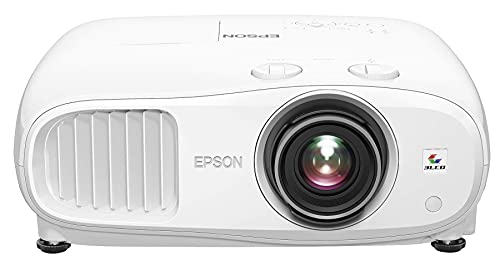
The Epson Home Cinema 3800 is the placement specialist of the group, built for a fixed theater room where the projector cannot always sit dead center. Its 1.62x zoom and optical lens shift, up to 60 percent vertical and 24 percent horizontal as listed, square the picture without digital correction. The 4K PRO-UHD image runs at 3,000 lumens of color and white brightness with HDR support and a listed contrast ratio up to 100,000:1, giving dark scenes more depth than the brighter-but-simpler models here. It assumes external sources and sound, like a traditional theater build.
Specs
- Resolution: 4K PRO-UHD with HDR
- Technology: 3-Chip 3LCD
- Brightness: 3,000 lumens color and white
- Contrast: Up to 100,000:1 as listed
- Zoom: 1.62x manual
- Lens shift: Up to 60 percent vertical, 24 percent horizontal
- Model: V11H959020
Best for: Dedicated dark rooms where the mount position is fixed and off-center.
Watch out for: No built-in streaming platform is listed, so a separate source device is required.
Epson Home Cinema 1080

The Epson Home Cinema 1080 leads this group on raw brightness, publishing 3,400 lumens of both color and white output, which is why it suits rooms that never fully darken. The native 1080p 3LCD image keeps films, sports and games sharp at typical living-room screen sizes, and the listed 16,000:1 contrast is respectable for a lamp model aimed at mixed lighting. Dual HDMI ports let a console and a streaming box stay connected at once, the built-in speaker covers casual use, and automatic picture skew correction speeds up setting the unit on a coffee table.
Specs
- Resolution: Native 1080p (1920 x 1080)
- Technology: 3-Chip 3LCD
- Brightness: 3,400 lumens color and white
- Contrast: 16,000:1 as listed
- Inputs: Dual HDMI
- Speaker: Built-in
- Correction: Auto picture skew
- Model: V11H980020
Best for: Bright living rooms, daytime sports and households that never fully darken the space.
Watch out for: No smart streaming system is built in, so movies come from whatever you plug into HDMI.
Epson EpiqVision Flex CO-W01

The Epson EpiqVision Flex CO-W01 is the portable member of this lineup, a compact 3LCD unit publishing 3,000 lumens of color and white brightness and an image up to 300 inches as listed. Its native WXGA resolution sits below the 1080p models, so text and fine detail are softer, but brightness stays high enough for rooms with the lights on, which matches its double life between home entertainment and work presentations. A 5 W built-in speaker and a single HDMI input keep the kit minimal: carry it in, plug in a laptop or streaming stick, and project.
Specs
- Resolution: WXGA (1280 x 800)
- Technology: 3-Chip 3LCD
- Brightness: 3,000 lumens color and white
- Image size: Up to 300 inches as listed
- Speaker: 5 W built-in
- Input: HDMI
- Model: V11HA86020
Best for: Renters and presenters who move the projector between rooms and roles.
Watch out for: WXGA resolution is the lowest here, so close-up movie detail trails the 1080p models.
Epson EpiqVision Mini EF22

The Epson EpiqVision Mini EF22 takes the opposite approach to the lamp models: a compact laser unit rated at 1,000 lumens that switches on quickly and never asks for a lamp change. The Full HD 1080p picture carries HDR support, Google TV is built in with Netflix ready to sign into, and the swivel stand tilts and rotates the unit so the image lands where you point it, including a wall in the backyard after dark. Built-in stereo speakers complete a genuinely self-contained package for bedrooms, dorms and small apartments where a big fixed installation makes no sense.
Specs
- Resolution: Full HD 1080p with HDR
- Technology: 3-Chip 3LCD laser
- Brightness: 1,000 lumens as listed
- Streaming: Google TV with Netflix
- Stand: Swivel stand built in
- Speakers: Built-in stereo
- Finish: Stone Blue
- Model: V11HB38420
Best for: Small rooms, renters and backyard movie nights in controlled light.
Watch out for: At 1,000 lumens it needs a dark space; daylight viewing belongs to the lamp models.
Which One Fits Your Situation
A living room that doubles as a cinema
If one room hosts afternoon sports and evening films, brightness and built-in streaming matter more than absolute sharpness. The Home Cinema 2350 covers both roles with 2,800 lumens and Android TV inside, while the Home Cinema 1080 pushes brightness further for rooms with big windows. Either way, plan the seating distance first and let that decide how much the 4K PRO-UHD step-up matters to your eyes.
A dedicated dark theater room
A room built for movies rewards placement flexibility and contrast over convenience features. The Home Cinema 3800’s lens shift lets the mount go where the ceiling allows rather than where geometry demands, and its listed contrast serves dark scenes well. Pair it with a fixed screen, a separate streaming source and real speakers, because this model deliberately leaves those jobs to dedicated hardware.
A renter who cannot mount anything
When the projector must live on a shelf and disappear into a closet, portability rules the choice. The EF22’s swivel stand and laser light source make setup a one-minute task with no lamp worries, and the CO-W01 adds brightness for rooms that stay lit. Both work on a plain wall, so no screen purchase or wall fixings stand between you and the first movie night.
Family gaming on a big screen
Console play on a projected image lives or dies on responsiveness and brightness during shared daytime sessions. The Home Cinema 2350 is the one model here whose listing calls out low latency, and its speaker plus Bluetooth keep the setup simple for younger players. Keep the image size moderate, since very large pictures spread the same brightness thinner and make fast scenes harder to read.
Common Mistakes
- Choosing by headline lumens alone, without checking whether the figure covers both color and white brightness.
- Placing a projector with no lens shift off-center, then relying on heavy keystone correction that shrinks and softens the image.
- Expecting a 1,000-lumen portable to work in a sunlit room because it looked fine in a dark showroom clip.
- Forgetting sound until setup day, when the built-in speaker turns out to be the weakest part of a fixed theater build.
- Projecting onto a textured or colored wall and blaming the projector for the uneven, tinted picture.
Frequently Asked Questions
Is 4K PRO-UHD the same as native 4K?
No. Epson’s 4K PRO-UHD models shift a 1080p image rapidly to put more pixels on screen, and the listings describe them exactly that way. The result looks sharper than plain 1080p, especially on large screens, but it is a different process from a native 4K panel, and the Home Cinema 2350 and 3800 should be judged as enhanced 1080p designs.
How many lumens does a living room projector need?
It depends on light control more than room size. The models here span 1,000 to 3,400 lumens of color and white brightness: the EF22’s figure works once the room is dark, while daytime viewing with curtains open calls for the 2,800 to 3,400 lumens of the lamp models. Match the number to the brightest conditions you realistically watch in.
Does the EF22 need lamp replacements like the other models?
No. The EF22 uses a laser light source, so there is no lamp to swap during its rated life, and it reaches full brightness quickly after switching on. The lamp-based models here will eventually need a replacement lamp as output fades with age, which is a normal ownership step rather than a fault, but it is one the laser model skips entirely.
Can these projectors play games without much delay?
Only the Home Cinema 2350’s listing explicitly calls out low latency, so it is the safest pick here for console play. The other models publish no input-lag figure in their listings, which means competitive players should treat them as movie-first machines. Casual and family gaming still works on any of them, but reaction-critical titles belong on the 2350 or a television.
FAQ
Is 4K PRO-UHD the same as native 4K?
How many lumens does a living room projector need?
Does the EF22 need lamp replacements like the other models?
Can these projectors play games without much delay?
More from Amazon
Programs that pair well with the guide above. Offers and eligibility are set by Amazon and may change.
Free shipping on eligible items, Prime Video and more. Eligible new members can start with a free trial.
Start a Prime free trialAd-free music streaming. Eligible new subscribers can start with a free trial.
Try Music Unlimited freeA Prime membership for ages 18-24 with a trial period. Eligibility is set by Amazon.
See Prime for Young AdultsAudiobooks and podcasts to listen to on the go. Eligible new members can start with a free trial.
Try Audible freeAs an Amazon Associate we earn from qualifying purchases.