Key takeaways
- Compare the best portable outdoor projectors with built-in batteries: 1080p Nebula and XGIMI picks for backyard movies, camping trips and travel nights.
As an Amazon Associate, we earn from qualifying purchases made through links on this page.
A portable outdoor projector solves a different problem from a living-room projector. There is usually no spare outlet on a patio, no shelf at a campsite and no patience for a ten-minute setup routine when the audience is sitting on blankets with drinks going warm. The models that work outdoors share a short list of traits: a built-in battery that lasts at least one full film, a carry-friendly body, speakers loud enough to work in open air, and automatic focus and keystone tools that square the picture up without a laptop, a tape measure or a stack of books under one corner.
Every projector in this roundup is a battery-powered 1080p model sold on Amazon US, chosen because its published specifications suit outdoor use after dark: brightness figures from the manufacturer, a stated video playtime on battery, and a smart platform with licensed streaming apps so a phone hotspot is all the infrastructure you need. They range from a soda-can-sized mini that disappears into a jacket pocket to a handle-topped outdoor model with splash resistance and enough light output for a genuinely large backyard screen.
What to Look for in a Portable Outdoor Projector
Brightness, in the right units. Outdoor projection is a fight against ambient light, and the numbers only help if you compare like with like. Anker quotes ANSI lumens for its Nebula models, while XGIMI quotes ISO lumens; the two standards are close but not identical, so treat cross-brand figures as approximate. As a working rule from manufacturer guidance, 200 ANSI lumens needs near-total darkness and a modest image, 400 ANSI lumens handles a dark backyard comfortably at family-movie sizes, and 1,000 ANSI lumens keeps a big screen watchable while some dusk light remains. No battery projector on this list — or anywhere — produces a good picture in direct daylight.
Battery capacity and honest runtimes. Manufacturers quote video playtime in Eco mode, at reduced brightness and moderate volume. A rating of 2.5 hours generally means one standard film with a little margin, not a double feature at full brightness. Bigger batteries buy both runtime and light output, which is why the brightest model here is also the heaviest. USB-C Power Delivery support matters too: several of these projectors can top up from a large power bank, which is the practical way to extend a camping weekend beyond one charge.
A licensed smart platform. A projector with Google TV or Android TV and officially licensed Netflix behaves like a smart TV: sign in, open the app, press play. Models without licensed apps force workarounds through casting or an HDMI streaming stick, which adds a device, a cable and a second battery to manage. Check the platform on the exact listing before buying, because some brands sell near-identical hardware with different software.
Speakers that work in open air. Indoors, walls hand the sound back to you. Outdoors, it simply leaves. A single small speaker that sounds fine in a bedroom can vanish on a patio, so driver count and wattage deserve as much attention as the picture specs. Dual-speaker models with a stated Dolby Audio tuning are the safer choice for dialogue-heavy films, and Bluetooth output to a separate speaker is a useful fallback on every model listed here.
Automatic setup. Autofocus, auto keystone correction, screen fit and obstacle avoidance sound like marketing extras until you are aligning a picture on a fence in the dark. The good systems settle in a few seconds and re-settle when someone bumps the table. If you plan to project onto a wall, a sheet or the side of a tent rather than a framed screen, these features stop being optional.
Size, weight and weather. Portability is a spectrum. A sub-kilogram projector travels in a daypack and asks for darkness in return; a four-and-a-half-kilogram model with a handle stays in the car or the garden but lights a far bigger picture. True weather sealing is rare in this category — only the Nebula Mars 3 here carries an ingress rating (IPX3, splash resistant) — so for every other model, dew and drizzle mean the session ends and the projector goes back inside.
The Best Portable Outdoor Projectors
1. Anker Nebula Mars 3 — The Bright Outdoor Flagship

See the Nebula Mars 3 on Amazon
The Mars 3 is the one model in this roundup designed outdoors-first rather than adapted to it. Its 1,000 ANSI lumens is the highest figure here by a wide margin, and it shows in the use cases that figure unlocks: a screen in the 100 to 200 inch range stays watchable after sunset even when the evening is not fully dark, and group viewing at campsite or garden-party scale stops being a compromise. The built-in battery is rated for up to 5 hours of video playback in Eco mode, the longest claim in this group, and the 40W built-in speaker is sized for open-air listening rather than a quiet bedroom.
The body explains the trade-offs. At roughly 4.5 kg with a fixed carry handle, this is a grab-and-go-to-the-garden projector, not a pack-and-hike one. It is also the only pick with an IPX3 splash-resistance rating, which covers light spray and damp grass anxiety, though not rain. Android TV provides the streaming layer with the usual app catalogue, and AI-assisted image adaptation handles focus and alignment automatically when you set it down.
Who it is for: households that host regular backyard movie nights or group camping trips and want the biggest, brightest battery-powered picture available without running a cable. Limitations: the size and weight rule it out for backpacking, the 5-hour battery figure is an Eco-mode number that drops at full brightness, and Android TV’s interface is a step behind the Google TV models below for app polish.
2. Anker Nebula Mars 3 Air — The Balanced Backyard Pick

See the Nebula Mars 3 Air on Amazon
The Mars 3 Air takes the same design brief and halves everything: 400 ANSI lumens instead of 1,000, a 1.69 kg box with a fold-over handle instead of the big chassis, and a battery rated at 2.5 hours of video or 8 hours of music playback. In a properly dark backyard that brightness is enough for a satisfying image up to its 150 inch maximum, and the dual 8W Dolby Audio speakers are the strongest sound package in this size class — enough that the projector doubles as a Bluetooth speaker after the film.
It runs Google TV with officially licensed Netflix, which removes the app workaround problem entirely, and Anker’s Intelligent Environment Adaptation handles autofocus, keystone correction, screen fit and obstacle avoidance in a few seconds. HDMI input covers a console or laptop when the campsite Wi-Fi is a phone hotspot that would rather not stream a whole film.
Who it is for: most buyers, most of the time — it is the middle point of this list for brightness, sound, size and runtime, and the natural default for family backyard use. Limitations: the 2.5-hour battery rating is again an Eco-mode figure, so a long film at full brightness may need the mains adapter or a power bank for the final act; it has no ingress rating, so it comes inside when the dew gets heavy.
3. XGIMI Halo+ — The Brightest of the Small Models

The Halo+ (the current Google TV version) is the brightness outlier among the compact models: 700 ISO lumens from a body in the same travel class as the Mars 3 Air. ISO and ANSI figures are not perfectly interchangeable, but on paper this is the strongest light output you can get in a battery projector this size, and it translates to a picture that holds together at larger sizes and in less-than-perfect darkness. The 59.454Wh built-in battery is rated for up to 2.5 hours of playtime, and the dual 5W Harman Kardon speakers give it a sound signature tuned by a name-brand audio partner.
Google TV with licensed Netflix covers streaming, and XGIMI’s Intelligent Screen Adaption performs autofocus, keystone correction, screen fit and obstacle avoidance automatically. The tower-style body stands stably on a table or flat rock, and the maximum image size runs to 200 inches on paper, though the battery brightness makes the middle of that range the realistic outdoor zone.
Who it is for: buyers who want the most brightness they can carry in one hand, and viewers who split time between a living room and the garden. Limitations: as with its rivals, the rated runtime assumes Eco settings, and real-world playback at full brightness is shorter — plan on one film per charge. There is no weather sealing, and the quoted lumens use the ISO standard, so direct numerical comparison with the ANSI-rated Nebula models should be treated as approximate.
4. Anker Nebula Capsule 3 — The Pocket-Sized Option

See the Nebula Capsule 3 on Amazon
The Capsule 3 is the projector that actually earns the word portable: a cylinder about the size of a soda can, 0.85 kg, that stands on a table, a car bonnet or a flat stone and throws a 1080p picture of up to 120 inches. It runs Google TV with officially licensed Netflix, focuses and squares itself automatically, and its battery is rated at 2.5 hours of video playback in Eco mode or 8 hours as a music speaker. The single 8W Dolby Audio speaker is honest about its size — clear at conversational distances, not a garden-party sound system.
That convenience is bought with light. At 200 ANSI lumens this is a darkness projector: a moonless campsite, a blacked-out tent wall, a backyard after full nightfall. Used inside those limits, at sensible image sizes of 60 to 100 inches, the picture is exactly what the form factor promises. USB-C charging means a power bank you already own for your phone can extend or repeat the show.
Who it is for: campers, travellers and anyone whose projector lives in a bag rather than a garden shed. Limitations: the dimmest output here, the smallest speaker, and a maximum image size that shrinks in practice — treat 120 inches as a spec-sheet ceiling, not a target.
5. Anker Nebula Capsule 3 Laser — The Laser Step-Up
See the Nebula Capsule 3 Laser on Amazon
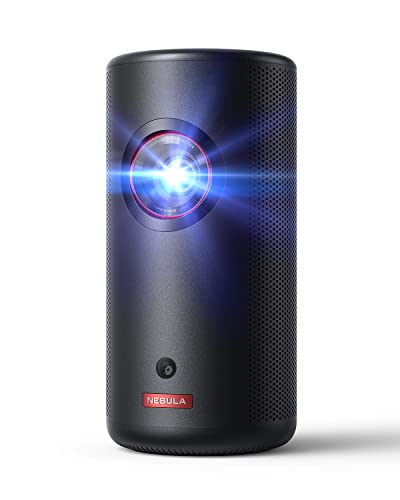
The Capsule 3 Laser keeps the same soda-can idea — about 0.9 kg, built-in battery, 1080p, images up to 120 inches — and swaps the LED light source for a laser engine rated at 300 ANSI lumens. That is half as much light again as the standard Capsule 3, with the wider colour gamut laser projection is known for, and it makes the Laser the better of the two minis for viewers who found the LED version slightly washed out at larger sizes. The 52Wh battery is rated for up to 2.5 hours of viewing, and the 8W Dolby Digital speaker matches its sibling.
The difference that decides between them is software. The Laser model runs Android TV 11 rather than Google TV, and Netflix is not available as an officially licensed built-in app on this version — the practical routes are Chromecast casting from a phone or a streaming stick in the HDMI port. Buyers who live in Netflix should weigh that against the brightness gain; buyers who mostly cast, game over HDMI or play local files will not miss it.
Who it is for: travellers who want the pocketable shape with a brighter, richer picture and who mainly cast or use HDMI sources. Limitations: the Netflix app situation above, a speaker that shares the mini-projector ceiling on volume, and the same darkness-first brightness class as every sub-kilogram model.
Comparison Table
| Projector | Brightness | Battery (video, maker rating) | Speakers | Smart platform | Max image | Weight |
|---|---|---|---|---|---|---|
| Nebula Mars 3 | 1,000 ANSI lumens | Up to 5 hours (Eco) | 40W built-in | Android TV | 200 in | Approx. 4.5 kg |
| Nebula Mars 3 Air | 400 ANSI lumens | Up to 2.5 hours (Eco) | 2 x 8W Dolby Audio | Google TV, licensed Netflix | 150 in | 1.69 kg |
| XGIMI Halo+ | 700 ISO lumens | Up to 2.5 hours | 2 x 5W Harman Kardon | Google TV, licensed Netflix | 200 in | Compact tower body |
| Nebula Capsule 3 | 200 ANSI lumens | Up to 2.5 hours (Eco) | 8W Dolby Audio | Google TV, licensed Netflix | 120 in | 0.85 kg |
| Nebula Capsule 3 Laser | 300 ANSI lumens | Up to 2.5 hours | 8W Dolby Digital | Android TV 11 | 120 in | Approx. 0.9 kg |
FAQ
Can a portable projector work outdoors during the day?
Not in any way you would enjoy. Even the 1,000 ANSI lumen Mars 3 is an after-sunset device; direct daylight washes out every battery projector. Plan outdoor sessions for dusk onwards, and treat a shaded wall at twilight as the earliest realistic start.
What can I project onto without a screen?
A smooth, light-coloured wall is the easiest surface. A white sheet works if it is pulled taut and the night is calm — wrinkles and billowing both show. Purpose-made portable screens fold into a bag and give the flattest result, but every projector here will produce a watchable picture on a garage door, a fence panel or the side of a tent in full darkness.
Do these projectors need Wi-Fi to play a film?
No. Streaming apps need a connection — a phone hotspot is enough — but downloaded content, files on a USB drive and anything connected over HDMI play with no network at all. Downloading the film before a camping trip is the reliable option.
Can I run a portable projector from a power bank?
Models with USB-C Power Delivery input, including the Capsule 3 line, can charge or top up from a suitably powerful power bank, which extends runtime beyond the internal battery. Check the wattage the projector asks for and match the bank to it; a small phone bank will slow the drain rather than reverse it.
How long will the battery really last?
Maker ratings are measured in Eco mode. At full brightness with the volume up, expect noticeably less — the honest planning figure is one feature film per charge for the 2.5-hour models, with the Mars 3’s much larger battery giving it genuine two-film headroom in Eco.
Conclusion
Portable outdoor projectors are a trade between light, sound and size, and the right pick depends on where the projector will live. The Nebula Mars 3 is the answer for a fixed backyard habit and the biggest screen, with brightness, battery and splash resistance nothing else here matches. The Mars 3 Air is the balanced default for family movie nights, and the XGIMI Halo+ is the brightest of the genuinely small models. For a bag or a campsite, the Capsule 3 and its Laser sibling trade light for a shape you will actually carry — and a projector you carry is the one that gets used.
More from Amazon
Programs that pair well with the guide above. Offers and eligibility are set by Amazon and may change.
Free shipping on eligible items, Prime Video and more. Eligible new members can start with a free trial.
Start a Prime free trialAd-free music streaming. Eligible new subscribers can start with a free trial.
Try Music Unlimited freeA Prime membership for ages 18-24 with a trial period. Eligibility is set by Amazon.
See Prime for Young AdultsAudiobooks and podcasts to listen to on the go. Eligible new members can start with a free trial.
Try Audible freeAs an Amazon Associate we earn from qualifying purchases.