Key takeaways
- Compare the best electric keyboards for beginners: four musical keyboards with touch-sensitive keys, built-in lessons and headphone practice, checked on Amazon.
Learning piano starts with a keyboard that responds to how you play, and that is where cheap keyboards fail. Keys that feel the same no matter how hard you press teach bad habits from the first lesson. The four keyboards in this guide all have touch-sensitive keys, so a gentle touch sounds soft and a firm touch sounds loud, just like a real piano.
This guide is for adults and older children starting to learn music at home, whether for lessons, self-study, or a first instrument for a child. Every keyboard below was chosen from the names and specifications on its Amazon page, with the key count, touch response, voices, and lesson features that decide whether a beginner keeps playing or gives up.
Quick Picks
As an Amazon Associate we earn from qualifying purchases
| Product | Best for | Key spec from title |
|---|---|---|
| Yamaha PSR-E373 | Best all-round starter | 61 touch-sensitive keys, 622 voices |
| Casio CT-S300 PPK | Best budget starter pack | 61 keys, stand and headphones included |
| Alesis Recital | Best full-size 88 keys | 88 semi-weighted keys, 2x20W speakers |
| Casio Casiotone CT-S1 | Most portable | 61 keys, 4.5 kg, carry handle |
How to Choose
Count the Keys and Check Touch Response
Key count decides how much music you can play before running out of notes. A 61-key board covers most beginner pieces and popular songs, while an 88-key board matches a real piano and suits players who plan to keep going. Touch response matters more than the count: touch-sensitive keys change volume with how hard you press, which is how piano technique works. Avoid keyboards with fixed-velocity keys, since they teach you to press every note the same way. A longer key bed also helps when two hands play together in the middle range.
Listen to the Sound Quality
Sound quality decides whether practice feels rewarding or dull. A keyboard with more voices gives you more instrument sounds to explore, from piano and strings to drums and synths. Polyphony is the number of notes the keyboard can sound at once; 48 notes or more covers beginner pieces with the sustain pedal held down. Built-in speakers matter too, since a beginner usually practices through speakers rather than an amplifier, and weak speakers make even good voices sound thin. Test the main piano voice first, since it is the sound you will hear most often.
Look for Built-In Lessons
Built-in lessons help a beginner who practices alone between lessons with a teacher. Yamaha Education Suite and similar lesson modes break songs into steps and wait for the right note, which keeps practice structured. A song bank with preset pieces gives you something to learn right away, and a metronome keeps your timing honest. These features do not replace a teacher, but they make daily practice easier to stick with. A display that shows the next note helps younger players follow along without reading sheet music.
Plan Where and How You Will Practice
Where you practice decides the size, weight, and power options you need. A keyboard that runs on batteries works anywhere in the house, while a mains-powered board stays in one spot. Headphone practice matters when others are home, so check for a headphone jack before buying. A light keyboard with a carry handle moves between rooms easily, while an 88-key board is heavier and usually stays on a stand in one place. A keyboard that folds away or stands on a shelf fits better in a small room.
The 4 Best Options
Yamaha PSR-E373
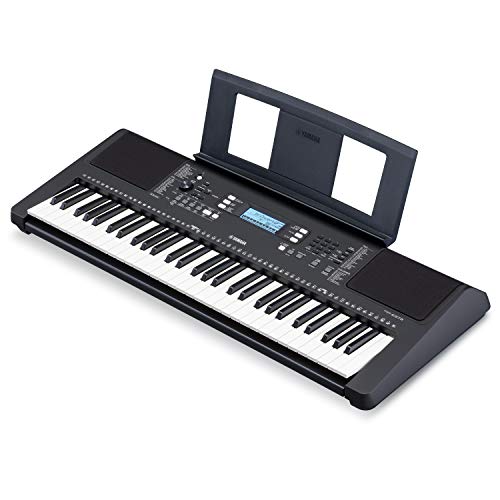
The Yamaha PSR-E373 is the strongest all-round starter keyboard in this guide, with 61 touch-sensitive keys and 622 voices to explore. Super Articulation Lite voices add realistic expression to instruments like strings and guitar, and 205 auto-accompaniment styles let you play along with a band. Yamaha Education Suite breaks 154 preset songs into lessons, and the USB audio interface records your playing to a computer. It is the most complete learning package here for a beginner who wants room to grow.
Specs
- 61 touch-sensitive keys
- 622 voices, including Super Articulation Lite voices
- 48-note polyphony
- 205 auto-accompaniment styles
- 154 preset songs with Yamaha Education Suite
- 2.5W + 2.5W built-in speakers
- USB audio interface
- Smart Chord function for easy accompaniment
- Dimensions 945 x 369 x 118 mm
- Weight 4.6 kg
- Runs on PA-130 adapter (sold separately) or 6 AA batteries
Best for: Best all-round starter keyboard for a beginner who wants the most voices and lessons.
Watch out for: The power adapter is sold separately, so budget for one or use batteries.
Casio CT-S300 PPK

The Casio CT-S300 PPK is the best budget starter pack, because it includes the keyboard, a stand, headphones, and a power supply in one box. The 61 touch-responsive keys play 400 tones and 77 rhythms, and a pitch bend wheel adds expression to lead sounds. Dance Music mode and the My Setup button give a beginner fun ways to experiment, while the LCD display shows settings clearly. It is the easiest way to start playing without buying extras separately.
Specs
- 61 touch-responsive keys
- 400 tones and 77 rhythms
- 48-note polyphony
- Pitch bend wheel
- LCD display
- My Setup button and Dance Music mode
- 10 reverb types and 60 built-in songs
- USB connection
- Dimensions 930 x 256 x 73 mm
- Weight 3.3 kg
- Up to 19 hours on 6 AA batteries
- Pack includes stand, headphones, and power supply
Best for: Best budget starter pack with everything a beginner needs in one box.
Watch out for: The speakers are modest, so use the included headphones for the best sound.
Alesis Recital

The Alesis Recital is the only full-size 88-key board in this guide, and the best choice for a beginner who wants a piano-like layout. Semi-weighted keys with adjustable touch response feel closer to a real piano than the unweighted keys on most starter boards. Five voices cover the essentials, and 128-note polyphony handles sustained chords with the pedal down. Two 20W speakers fill a room without an amplifier, and Skoove lessons come included for three months.
Specs
- 88 full-size semi-weighted keys
- Adjustable touch response
- 5 voices
- 128-note polyphony
- 2x20W built-in speakers
- Standard, Split, Layer, and Lesson modes
- Chorus and reverb effects
- 1/4 inch sustain pedal input, headphone output, RCA outputs, USB-MIDI
- Dimensions 1283 x 291 x 87 mm
- Weight 7.1 kg
- Runs on adapter or 6 D batteries
- Includes 3 months of Skoove premium lessons
Best for: Best full-size 88-key board for a beginner who wants a real piano layout.
Watch out for: It is heavier and wider than 61-key boards, so it needs a sturdy stand and a fixed spot.
Casio Casiotone CT-S1

The Casio Casiotone CT-S1 is the most portable keyboard here, at 4.5 kg with a built-in carry handle and a strap option. Its 61 touch-sensitive keys use the AiX sound source, with 61 tones that sound warm and clear through the built-in speakers. A headphone jack and audio input let you practice quietly or play along with songs from a phone. It runs on batteries or mains power, so it works on a table, a bed, or a park bench.
Specs
- 61 full-size touch-sensitive keys
- Semi-weighted key action
- 61 tones from the AiX sound source
- 64-note polyphony
- 2.5W built-in speakers
- USB-MIDI connection
- Headphone jack and audio input
- Built-in metronome
- Built-in carry handle, strap-ready
- Weight 4.5 kg
- Runs on 6 AA batteries or AC adapter
Best for: Most portable beginner keyboard for practice anywhere in the house.
Watch out for: It has fewer voices and no built-in lesson mode, so it suits players who already have a teacher.
Which One Fits Your Situation
A Child Starting Piano Lessons
A child starting lessons needs touch-sensitive keys and a lesson mode that keeps practice fun between lessons. The Yamaha PSR-E373 is the best fit, with Yamaha Education Suite breaking songs into steps and 622 voices to explore. The Casio CT-S300 PPK is the cheaper alternative, with a stand and headphones included so the child can practice quietly. Either one gives a teacher a proper instrument to work with.
An Adult Learning Alone at Home
An adult learning alone needs built-in guidance and a keyboard that sounds good enough to enjoy. The Yamaha PSR-E373 leads here, with its lesson mode, song bank, and USB recording for tracking progress. The Alesis Recital suits adults who want a full 88-key layout from the start, with Skoove lessons included for the first three months. Pick the Yamaha for features, or the Alesis for the full-size keyboard.
Practice in a Shared Home
Practice in a shared home means headphones, so the keyboard needs a headphone jack and decent sound through it. The Casio CT-S300 PPK includes headphones in the pack, which makes it the simplest choice. The Casio CT-S1 is the most portable option for moving between rooms, with a carry handle and battery power. Both let you practice late at night without disturbing anyone else.
A Small Flat With Little Space
A small flat leaves little room for a full-size board, so a compact 61-key keyboard is the right call. The Casio CT-S1 is the lightest at 4.5 kg and stores in a cupboard or under a bed. The Yamaha PSR-E373 is only slightly larger and adds the best lesson features in this guide. Skip the Alesis Recital here, since its 88 keys and 7.1 kg weight need a fixed stand and a dedicated spot.
Common Mistakes
- Buying a keyboard with fixed-velocity keys that cannot play loud and soft, which teaches bad technique from day one.
- Picking a 61-key board when you plan to play classical pieces that need the full 88-key range.
- Forgetting to check whether the power adapter is included, and finding it sold separately.
- Practising through weak built-in speakers and blaming the keyboard for a thin sound.
- Skipping the headphone jack check and discovering you cannot practise quietly in a shared home.
Frequently Asked Questions
How many keys does a beginner keyboard need?
A 61-key keyboard covers most beginner pieces, popular songs, and early grades, so it is enough for the first year or two of learning. An 88-key board matches a real piano and suits players who plan to play classical music or keep learning for years. Start with 61 keys unless you already know you need the full range.
What are touch-sensitive keys and why do they matter?
Touch-sensitive keys change volume with how hard you press them, so a gentle touch sounds soft and a firm touch sounds loud. This is how a real piano works, and it is how piano technique is taught. Keyboards without touch response play every note at the same volume, which teaches bad habits that are hard to unlearn later.
Do I need a stand and a sustain pedal?
A stand holds the keyboard at a good height for playing, and most beginners need one unless they play at a table. The Casio CT-S300 PPK includes a stand in the pack, while the others need one separately. A sustain pedal lets notes ring after you lift your fingers, and it matters once you start playing pieces with held chords.
Can I learn piano on a 61-key keyboard?
Yes, a 61-key keyboard is enough for early piano learning, since most beginner pieces stay within five octaves. The Yamaha PSR-E373 and both Casio models in this guide have 61 touch-sensitive keys and built-in lessons. You may outgrow 61 keys if you move to advanced classical pieces, but by then you will know what you need.
FAQ
How many keys does a beginner keyboard need?
What are touch-sensitive keys and why do they matter?
Do I need a stand and a sustain pedal?
Can I learn piano on a 61-key keyboard?
More from Amazon
Programs that pair well with the guide above. Offers and eligibility are set by Amazon and may change.
Free shipping on eligible items, Prime Video and more. Eligible new members can start with a free trial.
Start a Prime free trialAd-free music streaming. Eligible new subscribers can start with a free trial.
Try Music Unlimited freeA Prime membership for ages 18-24 with a trial period. Eligibility is set by Amazon.
See Prime for Young AdultsAudiobooks and podcasts to listen to on the go. Eligible new members can start with a free trial.
Try Audible freeAs an Amazon Associate we earn from qualifying purchases.