Our Short List of 3
All 5 Picks at a Glance
| Product | Specs | Action |
|---|---|---|
 Akai Professional MPK Mini MK3 | Check price on Amazon | |
 Arturia MiniLab 3 | Check price on Amazon | |
 Novation Launchkey Mini 25 MK4 | Check price on Amazon | |
 M-Audio Oxygen Pro Mini | Check price on Amazon | |
 Native Instruments Komplete Kontrol M32 | Check price on Amazon |
Key takeaways
- Compare the best mini keyboards for music making: five compact MIDI controllers with velocity-sensitive keys, pads and knobs for small desks and laptops.
As an Amazon Associate, we earn from qualifying purchases made through links on this page.
A mini music keyboard is not a smaller typing board. It is a MIDI controller: a compact set of piano-style keys, drum pads and knobs that sends note and control data to music software on your computer, while making no sound of its own. That distinction matters on a crowded desk. The same workspace that holds a gaming monitor, a mouse and a full-size typing keyboard rarely has room for a 49-key or 61-key instrument, yet a 25-key controller slides in front of a laptop, sits beside a stream deck, or travels in a backpack between rooms. For beat making, sketching bass lines, triggering samples during a stream, or learning piano basics inside a digital audio workstation, the mini format is often the practical format.
Every pick below is a genuine mini MIDI keyboard controller from a known music hardware maker, with velocity-sensitive keys, a USB connection documented by the manufacturer, and a control layout suited to music production rather than typing. Four of the five use the standard 25-key layout; one stretches to 32 mini keys for players who want a little more melodic range without giving up the compact footprint. Each section lists the manufacturer-documented specs, explains who the board suits, and names the limits that follow from those specs, so the trade-offs are visible before you commit desk space to one.
What to look for in a mini music keyboard
Key count and key action. Twenty-five velocity-sensitive mini keys is the standard mini layout: two octaves plus one note, enough for bass lines, leads and chord shapes played one hand at a time or in simple two-hand patterns. Velocity sensitivity means the software responds to how firmly a key is pressed, which is what makes a software piano or drum kit feel expressive instead of flat. Mini keys are narrower than full-size piano keys, so players with large hands or piano training should expect an adjustment period. A 32-key model adds half an octave, which helps melodies sit in a comfortable hand position with fewer octave shifts.
Pads. Backlit performance pads are for finger drumming, launching clips and triggering one-shot samples. Look at pad count, whether the pads respond to velocity, and extras such as note repeat, which retriggers a pad in time with the project tempo, and aftertouch, which lets a held pad keep shaping the sound after the initial hit. Eight pads is the common mini layout; sixteen pads gives two full banks without switching pages.
Knobs, faders and screens. Rotary knobs map to filter cutoffs, effect sends and plug-in parameters inside the software. Faders suit mixer levels and drawbar-style control. A small built-in display helps because it confirms which parameter, preset or octave the hardware is currently sending, instead of leaving you to guess from the software window alone.
Connection and MIDI out. All five controllers here connect and draw power over USB, so a single cable handles both data and power from a laptop. A dedicated MIDI output port, either a full-size five-pin socket or a 3.5 mm TRS jack, matters only if you also plan to control hardware synthesizers or older sound modules without a computer in between. If your work stays inside one laptop, plain USB is enough.
Software bundle. Mini controllers ship with entry-level production software, loop content and instrument plug-ins from the maker. The bundle decides how quickly a first-time buyer can make a complete track, and deep integration between the hardware and the maker’s own software library is a real workflow difference, not a box-ticking extra. Check that the included software runs on your machine, whether Windows or macOS, before choosing.
Size and power. These boards are bus-powered and light enough for a backpack, but depth varies: models with faders and wheels need more front-to-back room than pad-and-knob layouts. Measure the space between your monitor stand and the edge of the desk, because that strip is where a mini controller usually lives.
Akai Professional MPK Mini MK3
Akai Professional MPK Mini MK3 on Amazon
The MPK Mini MK3 is the beat-making benchmark in this size class. Akai fits 25 velocity-sensitive mini keys from its second-generation keybed, eight backlit MPC pads, eight assignable Q-Link knobs and a four-way joystick that handles pitch bend and modulation. The pads carry two features borrowed from Akai’s larger MPC hardware: Note Repeat, which retriggers a held pad in rhythmic divisions, and Full Level, which fixes pad output at maximum velocity for consistent drum hits. A built-in arpeggiator and a small OLED display round out the panel, and the unit runs entirely from USB power drawn from the host computer.
The bundled software leans toward production from day one: MPC Beats gives a complete beat-making environment, and the package adds software instruments from AIR Music Tech. A sustain pedal input on the rear panel lets piano-style players hold notes with a foot pedal, which many rival mini boards omit.
Who it suits: beat makers and hip-hop or electronic producers who think in drum patterns first and melodies second, and who want the MPC pad feel in a board that fits beside a laptop.
Limits from the specs: there is no MIDI output socket, so the MPK Mini MK3 talks to a computer and nothing else; hardware synth rigs need a different pick. The joystick is compact and precise enough for bends and vibrato, but players who rely on long, slow modulation sweeps may prefer physical wheels. Two octaves also means frequent use of the octave shift buttons during melodic playing.
Arturia MiniLab 3
The MiniLab 3 takes a more complete-control approach. Arturia pairs 25 velocity-sensitive slim keys with eight RGB backlit pads across two banks, eight rotary knobs and four faders, a layout that maps naturally onto mixer channels and plug-in controls at the same time. Pitch and modulation are handled by touch strips, and a small display with a clickable encoder handles browsing and menu work on the hardware itself. The rear panel is unusually generous for this class: USB-C for the computer link, a full-size five-pin MIDI output for hardware instruments, and a control input that accepts a sustain pedal or an external switch.
Onboard tools include an arpeggiator and a Chord mode that plays full chords from single keys, aimed at producers who write harmony by ear. The software bundle is one of the strongest in the mini class: Analog Lab Intro brings thousands of preset sounds from Arturia’s instrument collection, alongside Ableton Live Lite, a piano instrument from UVI and a guitar effects suite from Native Instruments.
Who it suits: producers who want one compact board to play keys, ride faders and control plug-ins, and anyone building a small hybrid setup where a hardware synth sits next to the laptop.
Limits from the specs: the slim keys are velocity-sensitive but light in feel, which suits synth and organ parts better than expressive piano practice. Touch strips respond well to quick gestures, though they give less positional feedback than wheels during slow filter work. The faders are short-throw, so fine level adjustments take a gentle hand.
Novation Launchkey Mini 25 MK4
Novation Launchkey Mini 25 MK4 on Amazon
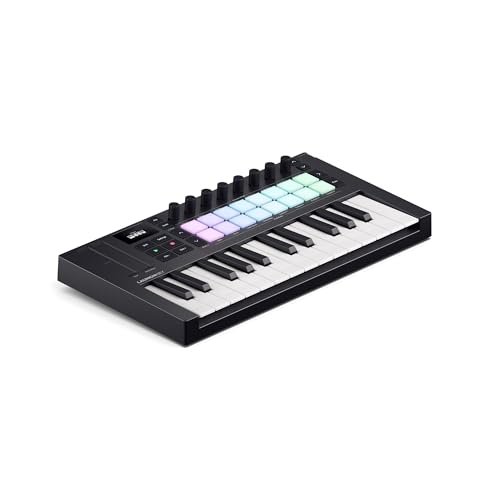
The fourth-generation Launchkey Mini is built around deep control of music software. Its 25 synth-action mini keys sit below sixteen RGB pads that use force-sensing resistors and support polyphonic aftertouch, meaning each pad keeps responding to pressure after the hit, a feature none of the other boards here match on the pad side. Eight endless encoders, an OLED display and dedicated transport and capture controls tie the hardware tightly to major recording programs, with Ableton Live at the front of the queue and documented integration for Logic Pro, Cubase, FL Studio and others.
The onboard creative tools are the headline. Scale mode locks the keys to a chosen musical scale so wrong notes become hard to play, Chord modes build one-finger harmonies and user chords, and a generative arpeggiator with pattern editing turns held notes into moving sequences. A 3.5 mm TRS MIDI output covers hardware instruments, USB-C handles the computer link and power, and the bundle includes Ableton Live Lite plus a rotating collection of software through Novation’s Sound Collective.
Who it suits: Ableton Live users first, and any producer who wants the mini board to act as the control center of the software session, launching clips, recording parts and shaping sounds without reaching for the mouse.
Limits from the specs: the deepest integration targets specific programs, so users of less common software get generic MIDI mapping instead of the scripted workflow. Sixteen expressive pads and the encoder workflow also carry a learning curve; the board rewards time spent learning its modes. There are no faders, so mixer-style level riding goes to the encoders.
M-Audio Oxygen Pro Mini
M-Audio Oxygen Pro Mini on Amazon
The Oxygen Pro Mini is the range extender of the group: 32 semi-weighted mini keys instead of 25, which gives melodies and two-handed parts more room before an octave shift is needed. M-Audio adds eight RGB backlit pads, four knobs and four faders, plus physical pitch and modulation wheels, a combination few mini boards manage. An OLED display confirms settings, and the rear panel carries USB, a sustain input and a 3.5 mm MIDI output for hardware gear.
Its software-assisted playing tools mirror the bigger Oxygen Pro line. Smart Chord builds harmonies from single keys, Smart Scale keeps played notes inside a chosen scale, and the arpeggiator includes Note Repeat behavior for the pads. Automatic mapping for major recording programs assigns the faders, knobs and transport keys without manual setup, and the bundle includes MPC Beats, Ableton Live Lite and software instruments from AIR Music Tech.
Who it suits: keyboard-leaning players who found 25 keys cramped, streamers who want wheels and faders in a board that still fits a compact desk, and producers moving between a laptop and a hardware synth.
Limits from the specs: 32 keys make this the longest board in the roundup, so the tightest desks should measure first. The semi-weighted mini keys feel firmer than synth-action keys, which finger drummers may not care about but fast synth runs feel different than on the lighter boards. The pad count stays at eight while one rival here doubles it.
Native Instruments Komplete Kontrol M32
Native Instruments Komplete Kontrol M32 on Amazon
The Komplete Kontrol M32 takes the opposite route from the pad-heavy boards: no pads at all, and instead a clean control surface built for browsing and playing software instruments. It carries 32 velocity-sensitive micro keys, eight touch-sensitive knobs that display their assigned parameter on the OLED screen when touched, two touch strips for pitch and modulation, and transport controls that work with major recording programs. The rear panel keeps things simple with USB and a TRS input for a sustain or expression pedal.
The reason to pick it is the software handshake. The Komplete Kontrol software maps the knobs automatically to Native Instruments instruments and to third-party plug-ins that support the NKS format, so the same eight knobs control a synth, a sampled piano or an effect with labels that follow the loaded sound. Smart Play tools add scale locking, one-finger chords and an arpeggiator. The bundle includes a selection of Komplete instruments and effects, Maschine Essentials and Ableton Live Lite.
Who it suits: producers who already work with Native Instruments sounds, composers who sketch with sampled instruments, and players who value an uncluttered key-focused layout over drum pads.
Limits from the specs: the absence of pads rules it out for finger drumming and clip launching; beat-first producers should look at the Akai or Novation boards. There is no MIDI output, so like the MPK Mini it serves computer-based setups only. The micro keys are the narrowest here, which fast players may find tight for wide chord voicings.
Comparison table
| Model | Keys | Pads | Knobs and faders | MIDI out | Computer link |
|---|---|---|---|---|---|
| Akai Professional MPK Mini MK3 | 25 mini, velocity-sensitive | 8 MPC pads, Note Repeat | 8 knobs, joystick | None | USB |
| Arturia MiniLab 3 | 25 slim, velocity-sensitive | 8 RGB pads, two banks | 8 knobs, 4 faders, touch strips | Five-pin DIN | USB-C |
| Novation Launchkey Mini 25 MK4 | 25 mini, synth action | 16 FSR pads, polyphonic aftertouch | 8 endless encoders | 3.5 mm TRS | USB-C |
| M-Audio Oxygen Pro Mini | 32 mini, semi-weighted | 8 RGB pads | 4 knobs, 4 faders, wheels | 3.5 mm TRS | USB |
| Native Instruments Komplete Kontrol M32 | 32 micro, velocity-sensitive | None | 8 touch-sensitive knobs, touch strips | None | USB |
Frequently asked questions
Does a mini MIDI keyboard make sound on its own?
No. A MIDI controller sends note and control data to software on a connected computer or tablet, and the software produces the sound. Every board here needs a host device and a music program, which is why the included software bundle matters so much in this category.
Is 25 keys enough to learn and write music?
For bass lines, melodies, chord shapes and beat making, yes, especially with octave shift buttons extending the effective range. Players working through piano lessons with two hands reading sheet music will outgrow two octaves quickly, and the 32-key models here only soften that limit rather than removing it.
Can these keyboards connect to a gaming PC and a laptop at the same time?
Each board links to one host over its USB cable. Moving between machines means moving the cable, and the maker’s configuration software is tied to whichever computer it is installed on. A USB switch is a workable workaround for shared desks, though it is an extra purchase outside this roundup.
Which of these works with hardware synthesizers and no computer?
The MiniLab 3 with its five-pin MIDI output, and the Launchkey Mini 25 MK4 and Oxygen Pro Mini with their 3.5 mm TRS MIDI outputs, can send notes to hardware instruments directly, though they still need USB power from a computer or a powered hub. The MPK Mini MK3 and the Komplete Kontrol M32 are computer-only designs.
Do the pads and knobs work with any music software?
Pads and keys send standard MIDI data, so they function in any program that accepts MIDI input. The deep, pre-mapped control and the on-screen parameter labels depend on the maker’s integration for specific programs, which each section above names where the manufacturer documents it.
Conclusion
Mini music keyboards succeed or fail on fit: fit for the desk, fit for the software, and fit for the way you write. The Akai MPK Mini MK3 remains the natural first board for beat-first producers who want MPC pads and a proven layout. The Arturia MiniLab 3 is the most complete all-rounder here, pairing keys with faders, a strong sound library and a proper MIDI output. The Novation Launchkey Mini 25 MK4 is the software control specialist, with the most expressive pads and the deepest Ableton Live workflow. The M-Audio Oxygen Pro Mini answers the range complaint with 32 semi-weighted keys, wheels and faders in one compact frame. The Native Instruments Komplete Kontrol M32 strips the formula back to keys and smart knobs, and earns its place through the tightest link to a major instrument library. Measure your desk strip, name your main music program, and the right board from this list should be an easy call.
More from Amazon
Programs that pair well with the guide above. Offers and eligibility are set by Amazon and may change.
Free shipping on eligible items, Prime Video and more. Eligible new members can start with a free trial.
Start a Prime free trialAd-free music streaming. Eligible new subscribers can start with a free trial.
Try Music Unlimited freeA Prime membership for ages 18-24 with a trial period. Eligibility is set by Amazon.
See Prime for Young AdultsAudiobooks and podcasts to listen to on the go. Eligible new members can start with a free trial.
Try Audible freeAs an Amazon Associate we earn from qualifying purchases.