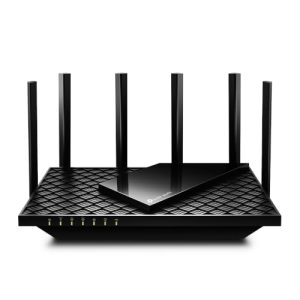
Our Short List of 3

- Fast 1.8 GHz dual-core CPU and 512 MB RAM handle OpenVPN encryption well
- Mature, well-documented DD-WRT support with official builds
- AC3200 Wi-Fi with Tri-Stream 160 and MU-MIMO
- Four Gigabit LAN ports plus USB 3.0 and eSATA storage options

- Long-established, stable DD-WRT support with a large user community
- Strong coverage from three high-powered external antennas with beamforming
- Four Gigabit LAN ports plus USB 3.0 and USB 2.0
- Capable stock firmware with dynamic QoS for gaming traffic

- 1.8 GHz dual-core CPU and 512 MB RAM deliver strong OpenVPN throughput
- Stock firmware already includes an OpenVPN client and server
- AiProtection security, adaptive QoS, and a gamers private network mode
- AiMesh support for extending coverage with a second ASUS router
All 5 Picks at a Glance
| Product | Specs | Action |
|---|---|---|
| 1. Linksys WRT3200ACM — Best Overall DD-WRT Router for OpenVPN |
| Check price on Amazon |
| 2. NETGEAR Nighthawk R7000 — Best All-Round DD-WRT Router |
| Check price on Amazon |
| 3. ASUS RT-AC86U — Best DD-WRT Router for Gaming and VPN Speed |
| Check price on Amazon |
 4. ASUS RT-AC68U — Best Value DD-WRT Router for OpenVPN |
| Check price on Amazon |
 5. Linksys WRT1900ACS — Best DD-WRT Router for Storage and Media Sharing |
| Check price on Amazon |
Key takeaways
- Discover the best DD-WRT routers OpenVPN users rely on for whole-home VPN coverage, faster encrypted traffic, and full control over every connected device.
Running a VPN on every device in your home, one by one, is a chore — and some devices, like most game consoles and smart TVs, cannot run a VPN app at all. That is the problem the best DD-WRT routers OpenVPN users depend on are built to solve. Flash DD-WRT firmware onto a compatible router, configure a single OpenVPN client connection, and every device on your network is protected automatically.
DD-WRT is free, open-source router firmware that replaces the stock software on supported hardware. It unlocks a full OpenVPN client and server, policy-based routing that sends only selected devices through the VPN, advanced quality of service controls, and detailed network monitoring.
There is a catch. Not every router can run DD-WRT, and not every router that can run it will run OpenVPN well. OpenVPN encryption is CPU-intensive, so a weak processor becomes a bottleneck that caps VPN speed far below your internet plan. The routers in this guide combine proven DD-WRT support, a processor strong enough to handle OpenVPN encryption at useful speeds, and listings that remain available on Amazon US.
One honest note: several of the strongest DD-WRT routers are older models, so some are now sold mainly as renewed units or through third-party sellers. Their DD-WRT support is mature, but check the listing condition and the seller before ordering.
Disclosure: As an Amazon Associate, we earn from qualifying purchases.
How to Choose a DD-WRT Router for OpenVPN
Choosing a router for DD-WRT and OpenVPN is different from choosing an ordinary router. The headline Wi-Fi speed on the box is almost irrelevant to VPN performance. What matters is the processor, the memory, the exact hardware revision, and community support for that specific model.
Processor power decides your VPN speed
OpenVPN encrypts and decrypts every packet in the tunnel, and that work lands on the router CPU. A dual-core processor running at 1.6 GHz or faster is the practical minimum for a household VPN router. Single-core routers and budget chips can cap OpenVPN throughput at speeds that feel sluggish even on a modest broadband plan. Every router in this guide carries a dual-core processor. Keep expectations realistic, though: even a strong consumer router will not push full gigabit speeds through OpenVPN.
Memory, flash, and the exact hardware revision
Look for at least 256 MB of RAM and 128 MB of flash storage. More RAM helps when many devices are connected and when you run extra services alongside the VPN client, while flash determines which DD-WRT build you can install — the full-featured builds with OpenVPN need more space than the minimal ones. Just as important is the exact model and hardware revision. DD-WRT support is tied to the specific model and revision, not just the brand or product family, and two routers with nearly identical names can have different chipsets. Before buying, check the official DD-WRT router database for your exact model and revision and confirm a current stable build exists for it.
OpenVPN client support, ports, and coverage
Most people want the router to act as an OpenVPN client, connecting outward to a commercial VPN provider so all household traffic is encrypted. That requires a provider that supplies OpenVPN configuration files, which most major providers do. Note that some routers ship with stock firmware that includes an OpenVPN server but no outbound client — on those models, DD-WRT unlocks whole-home outbound VPN protection. Look for four Gigabit LAN ports for wired devices, at least one USB port for shared storage, and external antennas for flexible coverage.
Buy with the flashing process in mind
Installing DD-WRT replaces the manufacturer’s firmware, which carries real risk: a wrong build or an interrupted flash can leave a router unresponsive, and flashing may affect warranty coverage. Choose a model with a well-documented flashing path, a recovery mode, and an active community forum where others have already solved the problems you are likely to meet. All five routers below have years of community history behind them, which is a large part of why they are on this list.
Top Picks
1. Linksys WRT3200ACM — Best Overall DD-WRT Router for OpenVPN
- Fast 1.8 GHz dual-core CPU and 512 MB RAM handle OpenVPN encryption well
- Mature, well-documented DD-WRT support with official builds
- AC3200 Wi-Fi with Tri-Stream 160 and MU-MIMO
- Four Gigabit LAN ports plus USB 3.0 and eSATA storage options
The Linksys WRT3200ACM is the router most DD-WRT enthusiasts reach for first, and it has held that position for years. It was designed with open-source firmware in mind, and it has official DD-WRT builds, an active community, and hardware chosen to handle exactly this workload. Its 1.8 GHz dual-core processor and 512 MB of RAM give it the headroom to run OpenVPN at speeds weaker routers cannot match, and its 256 MB of flash leaves room for full-featured DD-WRT builds.
It is an AC3200-class dual-band router with combined speeds of up to 3200 Mbps, using Tri-Stream 160 technology. The wired side is equally solid: four Gigabit LAN ports, a Gigabit WAN port, one USB 3.0 port, and a combination eSATA and USB 2.0 port for attached storage.
Note that the stock Linksys firmware provides OpenVPN server features but no outbound OpenVPN client, so flashing DD-WRT is the step that unlocks whole-home outbound VPN protection. The community has produced detailed flashing guides for this model.
Pros:
Cons:
Who it fits: Power users who want the most proven DD-WRT OpenVPN platform available and are comfortable flashing firmware to get it.
2. NETGEAR Nighthawk R7000 — Best All-Round DD-WRT Router
- Long-established, stable DD-WRT support with a large user community
- Strong coverage from three high-powered external antennas with beamforming
- Four Gigabit LAN ports plus USB 3.0 and USB 2.0
- Capable stock firmware with dynamic QoS for gaming traffic
The NETGEAR Nighthawk R7000 is one of the most widely owned routers in DD-WRT history. It pairs a 1 GHz dual-core processor with 256 MB of RAM and 128 MB of flash, enough to run a full DD-WRT build with OpenVPN and still have room for extra services. It has been supported by DD-WRT for so long that its builds are stable, its quirks are documented, and its recovery procedures are well understood.
As an AC1900 dual-band router, it delivers combined wireless speeds of up to 1900 Mbps. Three high-powered external antennas with beamforming help coverage in larger homes. It has four Gigabit LAN ports, a Gigabit WAN port, one USB 3.0 port on the front, and one USB 2.0 port on the back.
The R7000 is a sensible middle ground. It does not have the raw CPU power of the WRT3200ACM, so its OpenVPN ceiling is lower, but it is still fast enough for most households. Its stock firmware includes dynamic QoS for prioritizing gaming traffic, so you can run it on stock firmware while you learn DD-WRT, then flash it when you are ready.
Pros:
Cons:
Who it fits: Households that want a dependable, well-supported DD-WRT router with strong coverage, without paying for the most powerful hardware on this list.
3. ASUS RT-AC86U — Best DD-WRT Router for Gaming and VPN Speed
- 1.8 GHz dual-core CPU and 512 MB RAM deliver strong OpenVPN throughput
- Stock firmware already includes an OpenVPN client and server
- AiProtection security, adaptive QoS, and a gamers private network mode
- AiMesh support for extending coverage with a second ASUS router
The ASUS RT-AC86U, sold as the AC2900, is the fastest VPN performer among the ASUS picks in this guide. Its 1.8 GHz dual-core processor and 512 MB of RAM give it the encryption headroom OpenVPN demands, and its combined wireless speed of up to 2900 Mbps keeps wireless traffic moving even when the tunnel is busy. For a household that games online and routes traffic through a VPN at the same time, that combination is exactly what you want.
The RT-AC86U supports DD-WRT, and its stock ASUSWRT firmware already includes a built-in OpenVPN client and server, along with AiProtection network security, adaptive QoS, and a dedicated gamers private network feature. That means you can run OpenVPN on stock firmware immediately, then move to DD-WRT later if you want its deeper controls.
It has four Gigabit LAN ports, one USB 3.0 port, and one USB 2.0 port, plus a mobile app for setup and management. One thing to watch: some owners report that the router occasionally drops saved settings, so export a backup of your configuration once OpenVPN is set up.
Pros:
Cons:
Who it fits: Gamers and heavy users who want fast OpenVPN performance and the option of running a VPN on stock firmware or DD-WRT.
4. ASUS RT-AC68U — Best Value DD-WRT Router for OpenVPN
- Extremely mature DD-WRT support with a huge community knowledge base
- Low cost of entry for a reliable whole-home VPN setup
- AC1900 Wi-Fi with beamforming and 3 by 3 MIMO
- Four Gigabit LAN ports plus USB 3.0 and USB 2.0
The ASUS RT-AC68U is the longest-serving router on this list, and its staying power is a genuine strength. It has been supported by DD-WRT for many years, its builds are mature, and there is an enormous body of community knowledge covering flashing, OpenVPN configuration, and troubleshooting. Its dual-core Broadcom processor, 256 MB of RAM, and 128 MB of flash meet the requirements for a full DD-WRT build with OpenVPN.
As an AC1900 dual-band router, it offers combined wireless speeds of up to 1900 Mbps using 3 by 3 MIMO and AiRadar beamforming. It has four Gigabit LAN ports, a USB 3.0 port, and a USB 2.0 port, and the stock ASUSWRT firmware includes AiProtection security, adaptive QoS, and VPN server support.
The RT-AC68U is not the fastest router here, but it is the cheapest way into a reliable, well-supported DD-WRT OpenVPN setup. If your internet plan is modest, or your main goal is whole-home VPN coverage rather than maximum encrypted throughput, its performance is more than adequate. It also makes a good second router for a home office or a dedicated VPN gateway.
Pros:
Cons:
Who it fits: Budget-conscious buyers setting up a first DD-WRT OpenVPN router, or anyone adding a second router as a dedicated VPN gateway.
5. Linksys WRT1900ACS — Best DD-WRT Router for Storage and Media Sharing
- 1.6 GHz dual-core CPU and 512 MB RAM handle OpenVPN well
- Long-standing DD-WRT support with official builds and deep community history
- USB 3.0 and eSATA ports make it strong for network storage and media sharing
- Four external antennas and four Gigabit LAN ports
The Linksys WRT1900ACS is the predecessor to the WRT3200ACM, and it remains a capable DD-WRT OpenVPN router in its own right. Its 1.6 GHz dual-core ARM processor and 512 MB of RAM handle OpenVPN encryption at useful speeds, and like its successor it was built with open-source firmware in mind — Linksys sells the WRT line as open-source ready, and the WRT1900ACS has long-standing DD-WRT support with official builds.
Wireless performance is AC1900 class, with combined speeds of up to 1900 Mbps, and the four external antennas give solid coverage for a medium to large home. Where this router stands out is storage: it has a USB 3.0 port and a dual eSATA and USB 2.0 port, which makes it well suited to sharing an external hard drive across the network for media streaming or backups.
As with the WRT3200ACM, the stock firmware does not include an outbound OpenVPN client, so flashing DD-WRT unlocks whole-home outbound VPN protection. New units are scarce, so most listings are renewed or third-party — confirm the condition and the exact model number before ordering.
Pros:
Cons:
Who it fits: Households that want a proven WRT-platform DD-WRT router with strong storage sharing, at a lower cost than the WRT3200ACM.
Comparison Table
| Router | ASIN | Wi-Fi Class | Processor | RAM | LAN Ports | USB Ports | Best For |
|---|---|---|---|---|---|---|---|
| Linksys WRT3200ACM | B01JOXW3YE | AC3200 | 1.8 GHz dual-core | 512 MB | 4 x Gigabit | USB 3.0, USB 2.0 / eSATA | Best overall DD-WRT OpenVPN platform |
| NETGEAR Nighthawk R7000 | B00F0DD0I6 | AC1900 | 1 GHz dual-core | 256 MB | 4 x Gigabit | USB 3.0, USB 2.0 | Best all-round coverage and reliability |
| ASUS RT-AC86U | B0752FD3XJ | AC2900 | 1.8 GHz dual-core | 512 MB | 4 x Gigabit | USB 3.0, USB 2.0 | Best for gaming and VPN speed |
| ASUS RT-AC68U | B00FB45SI4 | AC1900 | Dual-core | 256 MB | 4 x Gigabit | USB 3.0, USB 2.0 | Best value first DD-WRT router |
| Linksys WRT1900ACS | B014MIBLSA | AC1900 | 1.6 GHz dual-core | 512 MB | 4 x Gigabit | USB 3.0, eSATA / USB 2.0 | Best for storage and media sharing |
Frequently Asked Questions
Do I need DD-WRT to run OpenVPN on my router?
It depends on the router. Some routers, including the ASUS models in this guide, include an OpenVPN client in their stock firmware. Others, including the Linksys WRT models here, only offer OpenVPN server features on stock firmware and need DD-WRT to act as an outbound OpenVPN client. DD-WRT also adds policy-based routing, which lets you choose which devices use the VPN and which connect directly.
Will a DD-WRT router slow down my internet connection?
Running traffic through an OpenVPN tunnel adds encryption overhead, so some speed loss is normal. How much you lose depends on the processor: a 1.8 GHz dual-core router will sustain far higher VPN speeds than a 1 GHz or single-core model. Policy-based routing can help by sending only the devices that need VPN protection through the tunnel and letting the rest connect directly.
Can any router be flashed with DD-WRT?
No. DD-WRT only supports specific models and hardware revisions, and support depends on the chipset inside the router. Two routers with similar names can have different chipsets, and a build made for one may not work on the other. Always check the official DD-WRT router database for your exact model number and hardware revision before buying or flashing.
Is flashing DD-WRT risky?
It carries real risk. Installing the wrong build, using the wrong procedure for your model, or losing power during the flash can leave a router unresponsive, and flashing may affect warranty coverage. The risk is manageable: use only the build listed for your exact model and revision, follow a guide written for that model, and use a wired connection for the flash. Choosing a model with a well-documented flashing path and a recovery mode, like the five routers in this guide, makes the process far safer.
What do I need from my VPN provider to set up OpenVPN on DD-WRT?
You need a VPN provider that supports OpenVPN and supplies configuration files for its servers — most major providers do, and they normally publish setup guides for DD-WRT. The configuration file contains the server address, port, encryption settings, and certificates that DD-WRT needs. In the DD-WRT interface, you enter those details under the VPN settings, add your VPN username and password, and enable the OpenVPN client.
Conclusion
The best DD-WRT routers OpenVPN users rely on are not the newest routers on the market — they are the ones with proven firmware support, processors strong enough to handle encryption, and communities that have spent years refining the setup. The Linksys WRT3200ACM leads this guide with the fastest hardware here and the most mature DD-WRT support. The ASUS RT-AC86U is the best choice for gamers, the NETGEAR Nighthawk R7000 is the dependable all-rounder, the ASUS RT-AC68U is the lowest-cost way into a reliable whole-home VPN, and the Linksys WRT1900ACS adds strong storage sharing to the proven WRT platform.
Whichever model you choose, confirm the exact model and hardware revision in the DD-WRT router database before you buy, check the listing condition carefully, and follow a flashing guide written for your specific router. Do that, and a single OpenVPN connection will protect every device in your home — including the ones that could never run a VPN app on their own.
FAQ
Do I need DD-WRT to run OpenVPN on my router?
Will a DD-WRT router slow down my internet connection?
Can any router be flashed with DD-WRT?
Is flashing DD-WRT risky?
What do I need from my VPN provider to set up OpenVPN on DD-WRT?
More from Amazon
Programs that pair well with the guide above. Offers and eligibility are set by Amazon and may change.
Free shipping on eligible items, Prime Video and more. Eligible new members can start with a free trial.
Start a Prime free trialAd-free music streaming. Eligible new subscribers can start with a free trial.
Try Music Unlimited freeA Prime membership for ages 18-24 with a trial period. Eligibility is set by Amazon.
See Prime for Young AdultsAudiobooks and podcasts to listen to on the go. Eligible new members can start with a free trial.
Try Audible freeAs an Amazon Associate we earn from qualifying purchases.