
Key takeaways
- RTX 3070 Ti: DLSS 4 Super Resolution with the transformer model works on all RTX cards, so the 3070 Ti benefits from NVIDIA’s best upscaler and the widest game support. It does not support DLSS Frame Generation (RTX 40 and newer) or Multi Frame Generation (RTX 50 only), but it can use FSR 3.1 frame generation where offered.
- RX 9070 GRE: FSR 4, AMD’s machine-learning upscaler, is exclusive to RDNA 4. It is a major quality jump over FSR 3 and close to DLSS in many scenes. Game support is smaller than DLSS, though AMD’s driver can upgrade many FSR 3.1 titles to FSR 4. It also supports FSR frame generation and AMD Fluid Motion Frames.
The RX 9070 GRE is the better graphics card for nearly everyone choosing between these two: it is substantially faster at 1440p, carries 12 GB of VRAM instead of 8 GB, uses about 70 W less power and supports FSR 4. The RTX 3070 Ti only makes sense as a cheap used buy for 1080p gamers who value DLSS support in their specific games or need NVIDIA’s CUDA ecosystem.
On paper, these cards come from neighboring price brackets: the RTX 3070 Ti launched at $599 in 2021, the RX 9070 GRE at $549 in 2025. In practice, one is a four-generation-old Ampere card mostly sold secondhand, and the other is a current RDNA 4 model. The key differences come down to performance class, memory, power and features.
Our top picks
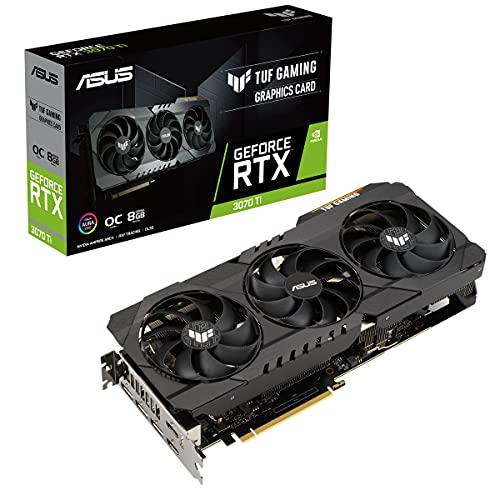
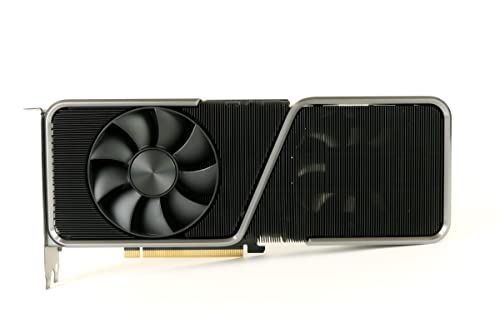 NVIDIA
- Item Package Quantity - 1
- Product Type - VIDEO CARD
- This pre-owned product has been professionally inspected, tested…


As an Amazon Associate we earn from qualifying purchases at no extra cost to you.
Key Specifications
| Specification | RTX 3070 Ti | RX 9070 GRE |
|---|---|---|
| Architecture | Ampere | RDNA 4 |
| Release date | 31 May 2021 | 8 May 2025 |
| Launch MSRP | $599 | $549 |
| Shader units | 6,144 CUDA cores | 3,072 stream processors |
| Boost clock | 1,770 MHz | 2,790 MHz |
| Process node | 8 nm | 4 nm |
| VRAM | 8 GB GDDR6X | 12 GB GDDR6 |
| Memory bus | 256-bit | 192-bit |
| Memory bandwidth | 608.3 GB/s | 432.0 GB/s |
| Cache | 4 MB L2 | 8 MB L2 + 48 MB Infinity Cache |
| TDP | 290 W | 220 W |
| PCIe interface | PCIe 4.0 x16 | PCIe 5.0 x16 |
| Power connectors | 1x 12-pin (reference) | 2x 8-pin |
| Reference length | 267 mm | Varies by partner model |
| Slot width | 2-slot | 2-slot |
| Display outputs | 1x HDMI, 3x DisplayPort | 1x HDMI 2.1b, 3x DP 2.1a |
Don’t read too much into the shader counts. NVIDIA counts Ampere’s dual-issue FP32 units as separate CUDA cores, and AMD’s RDNA 4 design achieves much higher clocks. The 3070 Ti does have more raw memory bandwidth, but the GRE’s 48 MB Infinity Cache reduces how often it needs to go to VRAM.
Head-to-Head Gaming Results
Where the RX 9070 GRE sits
Hardware Unboxed’s RX 9070 GRE review (published on TechSpot) found the card effectively tied with both the RX 7900 GRE and the RTX 5070 at 1440p, slipping about 5% behind them at 4K, and holding a 30%-plus lead over the RTX 5060 Ti 16GB. Notebookcheck’s roundup of early reviews reached a similar conclusion about its parity with the 7900 GRE at 1440p.
How far behind is the 3070 Ti?
No major outlet has published a recent direct comparison of these two specific cards, so the gap has to be estimated from cards they were both tested alongside. The RTX 3070 Ti trails the RX 7900 GRE and the RTX 5070 by a sizable margin in published review data, and on that basis the RX 9070 GRE should be roughly 20–35% faster at 1440p on average. In newer games where 8 GB is not enough at high textures, the gap can be much larger, because the 3070 Ti’s frame times degrade sharply once VRAM overflows.
In approximate terms, a modern AAA game running at 55–65 FPS on the 3070 Ti at 1440p high could reach roughly 70–85 FPS on the 9070 GRE in the same scene. Treat those ranges as indicative; they vary with game, settings, CPU and patch.
Ray tracing
This used to be NVIDIA’s clear win, but RDNA 4 changed that. AMD’s redesigned ray accelerators bring the RX 9000 series much closer to NVIDIA in RT, and the 9070 GRE’s higher overall performance and larger VRAM pool mean it often matches or beats the 3070 Ti with RT enabled. The 3070 Ti’s 8 GB is a particular problem with RT, which adds memory pressure. Heavy path tracing still favors NVIDIA hardware in general, but neither card is a path-tracing card.
DLSS 4 vs FSR 4
- RTX 3070 Ti: DLSS 4 Super Resolution with the transformer model works on all RTX cards, so the 3070 Ti benefits from NVIDIA’s best upscaler and the widest game support. It does not support DLSS Frame Generation (RTX 40 and newer) or Multi Frame Generation (RTX 50 only), but it can use FSR 3.1 frame generation where offered.
- RX 9070 GRE: FSR 4, AMD’s machine-learning upscaler, is exclusive to RDNA 4. It is a major quality jump over FSR 3 and close to DLSS in many scenes. Game support is smaller than DLSS, though AMD’s driver can upgrade many FSR 3.1 titles to FSR 4. It also supports FSR frame generation and AMD Fluid Motion Frames.
For image quality, DLSS 4 remains the benchmark. But the GRE’s raw speed advantage often means it can use a higher-quality upscaling preset than the 3070 Ti at the same frame rate, which narrows that difference in practice.
VRAM: The 3070 Ti’s Weak Spot
The RTX 3070 Ti was criticized for its 8 GB even at launch, and the issue has become more visible since. A practical guide:
| Use case | Approximate VRAM need | 3070 Ti (8 GB) | 9070 GRE (12 GB) |
|---|---|---|---|
| 1080p high | 6–9 GB | Mostly fine | Fine |
| 1440p high | 9–12 GB | Needs texture cuts in new games | Fine |
| 1440p high + RT | 10–13 GB | Frequently over budget | Usually fine |
| 4K high | 12–16 GB | Not recommended | Workable with upscaling |
Power, PSU and Connectors
The RTX 3070 Ti is one of the least efficient cards of its era, rated at 290 W. The RX 9070 GRE is rated at 220 W while delivering more performance. PSU sizing with GPU TDP + CPU + about 150 W headroom, using a 120 W-class gaming CPU:
- RTX 3070 Ti: 290 + 120 + 150 = about 560 W, so a quality 650–750 W PSU
- RX 9070 GRE: 220 + 120 + 150 = about 490 W, so a quality 600–650 W PSU
The Founders Edition 3070 Ti uses NVIDIA’s 12-pin connector with an included adapter, while most partner models use two 8-pin plugs. The RX 9070 GRE uses two 8-pin connectors. Factory-overclocked versions of either card can draw more than the reference figures.
Performance per Dollar at Launch
Using launch MSRPs and the 20–35% performance estimate at 1440p:
- RTX 3070 Ti: $599 for an index of 100 = $5.99 per point
- RX 9070 GRE: $549 for an index of 120–135 = roughly $4.07–$4.58 per point
At launch prices the GRE offers about 25–30% better value per frame, plus more VRAM and lower power draw. Today the 3070 Ti is mainly a used card, typically selling for roughly $230–$300 depending on condition and model. At those prices it can match or beat the GRE on pure cost per frame at 1080p, but you give up VRAM, warranty and efficiency.
Size and Case Compatibility
The reference 3070 Ti is a 267 mm dual-slot card, and many partner versions are longer triple-fan designs. RX 9070 GRE cards come only as partner designs, with lengths varying by model, so check each card’s listed dimensions against your case’s GPU clearance.
Which Should You Choose?
| Situation | Better choice |
|---|---|
| 1440p gaming, new AAA titles | RX 9070 GRE |
| Want 12 GB VRAM and longevity | RX 9070 GRE |
| Lower power and heat | RX 9070 GRE |
| 1080p esports, very cheap used deal | RTX 3070 Ti |
| Need CUDA for creative or AI software | RTX 3070 Ti |
| Games where DLSS is the only upscaler offered | RTX 3070 Ti, if the price is right |
Frequently Asked Questions
Is the RX 9070 GRE faster than the RTX 3070 Ti?
Yes. Published reviews place the 9070 GRE level with the RX 7900 GRE and RTX 5070 at 1440p, which puts it roughly 20–35% ahead of the 3070 Ti on average. The gap grows in games that need more than 8 GB of VRAM.
Does the RTX 3070 Ti support DLSS 4?
It supports DLSS 4 Super Resolution with the transformer model, which improves upscaling quality. It does not support DLSS Frame Generation or Multi Frame Generation. FSR 3.1 frame generation can be used in games that include it.
Is 8 GB of VRAM still enough on the RTX 3070 Ti?
At 1080p with high settings, it is usually enough. At 1440p, many new games need reduced textures to avoid stutter, especially with ray tracing. That limitation is the main reason the 3070 Ti has aged worse than its raw power suggests.
What PSU do I need for the RX 9070 GRE?
A quality 600–650 W power supply with two PCIe 8-pin connectors covers most builds. The card is rated at 220 W. Leave extra headroom if you run a high-end CPU or an overclocked partner card.
Is the RX 9070 GRE good for 4K?
It can handle 4K in many games with FSR 4 upscaling and medium-high settings. Reviews showed it slipping slightly behind the RX 7900 GRE at 4K due to its narrower memory bus. For native 4K, the RX 9070 XT is the stronger option.









