
Key takeaways
- 1080p high: the RX 6600 typically runs current AAA games in roughly the 50 to 80 fps range; the RTX 4060 usually lands about 10 to 15 fps higher in the same scenes.
- 1080p esports titles: both easily push well past 144 fps in games such as Valorant, CS2 and Fortnite on competitive settings.
- 1440p: both cards can run it at medium settings or with upscaling, but 8 GB and the 128-bit bus become limiting in newer games.
The RTX 4060 is the better card overall, roughly 15 to 25 percent faster at 1080p with a large lead in ray tracing and access to DLSS, but the RX 6600 remains the smarter buy when it costs noticeably less, especially used, for players who stick to 1080p rasterized gaming. Both are 8 GB cards built for 1080p, so neither is the right pick for 1440p ultra or long-term texture headroom.
The RX 6600 arrived in October 2021 at a $329 MSRP during the GPU shortage and later became one of the most popular budget cards after heavy price cuts. The RTX 4060 launched in 2023 at $299 as Nvidia’s entry Ada Lovelace card. Both have since been succeeded by current-generation entry cards such as the RTX 5050, RTX 5060, RX 9060 XT and Arc B580, which matters if you are buying new.
Our top picks
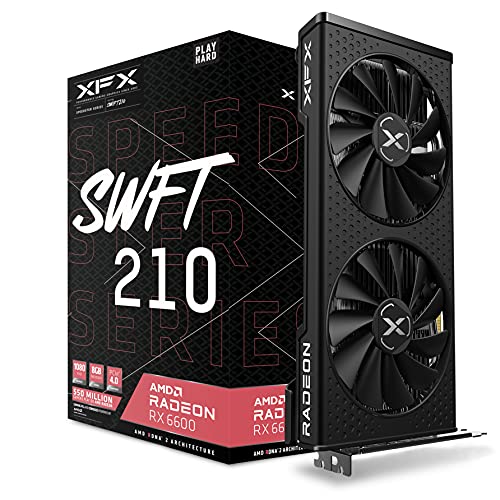
 ASRock AMD Radeon RX 6600 Challenger D
- ***Not compatible with all built-in computers or systems
- AMD Radeon RX 6600 GPU: Built on RDNA…
- 8GB GDDR6 Memory: Provides smooth gameplay and multitasking…
 Gigabyte GeForce RTX 4060 WINDFORCE OC 8G
- Powered by NVIDIA DLSS 3, ultra-efficient Ada Lovelace…
- 4th Generation Tensor Cores: Up to 4x performance…
- 3rd Generation RT Cores: Up to 2x ray…
As an Amazon Associate we earn from qualifying purchases at no extra cost to you.
Key Specifications
| Specification | RX 6600 | RTX 4060 |
|---|---|---|
| Architecture | RDNA 2.0 | Ada Lovelace |
| Release date | 13 October 2021 | 18 May 2023 |
| Launch MSRP | $329 | $299 |
| Shaders / CUDA cores | 1792 | 3072 |
| Boost clock | 2491 MHz | 2460 MHz |
| Process | 7 nm | 5 nm |
| TDP | 132 W | 115 W |
| Memory | 8 GB GDDR6 | 8 GB GDDR6 |
| Memory bus | 128-bit | 128-bit |
| Bandwidth | 224.0 GB/s | 272.0 GB/s |
| Cache | 2 MB L2 + 32 MB L3 | 24 MB L2 |
| Interface | PCIe 4.0 x8 | PCIe 4.0 x8 |
| Power connector | 1x 8-pin | 1x 12-pin (reference spec) |
| Length / width | 190 mm / 2-slot | 240 mm / 2-slot |
| Outputs | 1x HDMI, 3x DisplayPort | 1x HDMI 2.1, 3x DP 1.4a |
On paper they look close: same VRAM, same bus width, same PCIe x8 link. The differences are architecture, cache design and Nvidia’s feature stack.
Gaming Performance at 1080p and 1440p
Launch reviews from outlets such as TechPowerUp and Hardware Unboxed placed the RTX 4060 a little ahead of the RX 6650 XT, a card that is itself meaningfully faster than the RX 6600. Combining that review data with benchmark aggregates puts the RTX 4060 roughly 15 to 25 percent ahead of the RX 6600 in average 1080p rasterized performance. Some individual games show bigger swings, while a few AMD-friendly titles leave the cards nearly even.
Approximate expectations, which vary with settings, CPU and game patch:
- 1080p high: the RX 6600 typically runs current AAA games in roughly the 50 to 80 fps range; the RTX 4060 usually lands about 10 to 15 fps higher in the same scenes.
- 1080p esports titles: both easily push well past 144 fps in games such as Valorant, CS2 and Fortnite on competitive settings.
- 1440p: both cards can run it at medium settings or with upscaling, but 8 GB and the 128-bit bus become limiting in newer games.
Ray tracing
Ray tracing is where the gap becomes large. RDNA 2’s first-generation ray accelerators fall well behind Ada Lovelace’s third-generation RT cores, and review data commonly shows the RTX 4060 tens of percent ahead with RT enabled. Realistically, neither card is a strong ray tracing performer at 1080p native, but the 4060 makes light RT effects plus DLSS a usable option, whereas the RX 6600 is best run with RT off.
Upscaling and frame generation
The RTX 4060 supports DLSS 4 super resolution with the transformer model and DLSS 3 frame generation. At 1080p, where upscalers have fewer pixels to work with, DLSS holds image quality noticeably better than FSR 2 or FSR 3.1 in quality mode. The RX 6600 can use FSR 3.1 upscaling and frame generation, plus driver-level AMD Fluid Motion Frames, but it does not support FSR 4, which is limited to RDNA 4. For 1080p gamers who rely on upscaling to keep frame rates up, this is a real advantage for the 4060.
VRAM: Same 8 GB, Same Limits
With identical 8 GB buffers, VRAM is not a differentiator between these two cards, but it is a shared limitation worth understanding:
- 1080p medium to high: 8 GB is sufficient for most games.
- 1080p ultra textures in recent AAA releases: some titles exceed 8 GB, leading to stutter or reduced texture quality.
- 1440p high: 8 GB is tight; 12 GB or more is the comfortable target.
Nvidia’s frame generation adds some memory overhead, so the 4060 can occasionally hit its 8 GB ceiling sooner when frame generation is on.
The PCIe x8 caveat
Both cards use a PCIe 4.0 x8 link. On a PCIe 3.0 motherboard that halves the available bus bandwidth, which matters most when a game overflows the 8 GB of VRAM. Owners of older PCIe 3.0 systems should keep texture settings conservative on either card.
Efficiency, PSU and Physical Size
The RTX 4060 is rated at 115 W against 132 W for the RX 6600, and its higher performance makes it the more efficient card per frame. Both are easy to power. Using GPU TDP plus CPU plus about 150 W headroom:
- RX 6600 + 105 W CPU: 132 + 105 + 150 = 387 W, so a quality 450 to 500 W supply is enough.
- RTX 4060 + 105 W CPU: 115 + 105 + 150 = 370 W, so the same 450 to 500 W class works.
The reference spec lists a 12-pin connector for the RTX 4060, but most partner cards use a single standard 8-pin, the same as the RX 6600. The RX 6600’s 190 mm reference length makes it one of the easiest cards to fit in compact cases, and many RTX 4060 partner models are also short dual-fan or single-fan designs.
Value: New and Used
At launch MSRP, with the RX 6600 as 100 points and the RTX 4060 at about 120:
- RX 6600: $329 / 100 = about $3.29 per point.
- RTX 4060: $299 / 120 = about $2.49 per point.
At original MSRPs the 4060 was clearly better value. In practice the RX 6600 spent much of its life selling far below MSRP, and it is now mostly a used-market card, usually around $130 to $170 used. A used RTX 4060 generally commands more, often $200 to $250. At those prices the RX 6600 can deliver better raw frames per dollar, while the 4060 justifies its premium through ray tracing, DLSS and efficiency.
Pick X If, Pick Y If
| Your priority | Pick |
|---|---|
| Lowest cost for 1080p raster gaming | RX 6600 |
| 1080p with upscaling in new AAA games | RTX 4060 (DLSS) |
| Any ray tracing | RTX 4060 |
| Esports at high refresh | Either; the cheaper one |
| Very compact case | RX 6600 (190 mm reference) |
| Streaming with NVENC or AI tools | RTX 4060 |
| Linux gaming with open-source drivers | RX 6600 |
If the price gap is small, the RTX 4060 is the safer all-round choice. If the RX 6600 saves a meaningful amount, it remains a capable 1080p card. Buyers spending closer to $300 on a new card should also compare current options with more VRAM, such as the Arc B580 with 12 GB or the RX 9060 XT 16GB.
Frequently Asked Questions
How much faster is the RTX 4060 than the RX 6600?
Review data and benchmark aggregates place the RTX 4060 roughly 15 to 25 percent ahead in average 1080p rasterized gaming. With ray tracing enabled, the gap grows much larger. Results vary by game, with a few titles showing the two nearly even.
Can the RX 6600 run games at 1440p?
Yes, at medium settings or with FSR upscaling, the RX 6600 can run many games at 1440p. Demanding recent releases will push it below 60 fps at high settings. It is best treated as a 1080p card.
Does the RTX 4060 need a 12-pin power connector?
The reference specification lists a 12-pin connector, but most partner RTX 4060 cards use a single 8-pin PCIe connector. Check the specific model’s power input before buying. Either way, the card’s 115 W rating is easy for any quality 450 W or larger supply.
Is 8 GB of VRAM still enough for 1080p gaming?
For most games at medium to high settings, 8 GB still works at 1080p. Some recent AAA titles exceed it at maximum texture quality, causing stutter. Lowering texture settings one notch usually solves the problem on either card.
Is the RX 6600 worth buying used in 2026?
A used RX 6600 can be a strong budget pick for 1080p raster gaming if the price is low, typically well under what a new current-generation card costs. It lacks FSR 4 and strong ray tracing. Buyers who want newer features and more VRAM should compare it with current entry-level cards.









