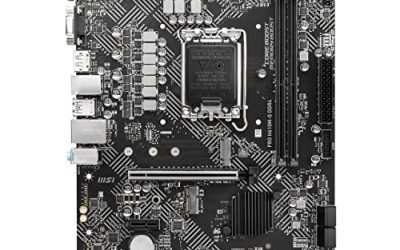
Our Short List of 3

- Socket: LGA1151 for 6th and 7th generation Intel Core, Pentium and Celeron processors
- Chipset: Intel H110
- Form factor: micro-ATX, 22.6 cm by 18.3 cm
- Memory: 2 DDR4 DIMM slots, up to 32GB, DDR4 2400/2133

- Socket: LGA1151 for 6th and 7th generation Intel Core, Pentium and Celeron processors
- Chipset: Intel H110
- Form factor: micro-ATX
- Memory: 2 DDR4 DIMM slots, up to 32GB, DDR4 2133

- Socket: LGA1151
- Chipset: Intel H110
- Form factor: micro-ATX
- Memory: 2 DDR4 DIMM slots, up to 32GB, DDR4 2133
All 4 Picks at a Glance
| Product | Specs | Action |
|---|---|---|
| ASUS H110M-K |
| Check price on Amazon |
| ASRock H110M-DGS |
| Check price on Amazon |
| Diyeeni H110 Motherboard |
| Check price on Amazon |
 ASRock H110 Pro BTC+ |
| Check price on Amazon |
Key takeaways
- Keep a Skylake PC running with the best 6th generation motherboards still sold new: verified H110 LGA1151 picks, chipset differences and buying checks.
Nobody buys a 6th generation motherboard to start a new build in 2026. You buy one because a Skylake PC you already own has a dead or failing board, and the CPU, memory and storage in that machine still have years of useful life in them. Swapping the motherboard keeps the whole system alive for far less effort than replacing the platform, and it is usually the only repair that makes sense once a ten-year-old board gives up.
That is the honest context for this guide. Intel’s 100-series chipsets launched alongside the 6th generation Core processors in 2015, and every board here uses the original LGA1151 socket with an H110, B150, H170 or Z170 chipset. These are legacy products. The big brands stopped manufacturing them years ago, Amazon US stock is thin, and most listings that remain are third-party sellers moving leftover inventory or current-production generic boards. Every pick below was checked against live Amazon US listings before inclusion, and several well-known boards were left out because their listings have gone dark or only used copies remain.
One compatibility warning matters more than anything else in this guide. The later 300-series motherboards also use a socket called LGA1151, but they are wired differently and do not accept 6th generation processors. A board for a Skylake chip must be a 100-series or 200-series board, and the safest drop-in replacement is a 100-series model like the ones gathered here.
As an Amazon Associate, we earn from qualifying purchases.
ASUS H110M-K
- Socket: LGA1151 for 6th and 7th generation Intel Core, Pentium and Celeron processors
- Chipset: Intel H110
- Form factor: micro-ATX, 22.6 cm by 18.3 cm
- Memory: 2 DDR4 DIMM slots, up to 32GB, DDR4 2400/2133
The ASUS H110M-K is the closest thing this platform has to a default recommendation, and it earns that spot by being the board most likely to simply work. It is a micro-ATX H110 board from a major manufacturer, with the standard layout that filled countless office and home PCs during the Skylake era, and it is the one legacy board in this guide whose Amazon US listing still shows fresh third-party new stock moving through it.
What sets the H110M-K apart from the no-name boards below is the support trail behind it. ASUS still hosts the full BIOS history, driver set and CPU support list for this model, so confirming that your exact processor is supported, and updating the BIOS if you later drop in a 7th generation chip, is a five-minute job rather than a research project. The board also covers the three display outputs a Skylake integrated GPU can drive, which matters for the many surviving Skylake machines that run without a graphics card.
The limits are the limits of H110 itself. Two memory slots cap you at 32GB, there is no M.2 slot for a modern NVMe drive, and the chipset offers no overclocking of any kind. For a like-for-like repair of a home or office Skylake PC, none of that is a real obstacle, and this is the board to buy first if the listing is live when you shop. It sits in the budget tier of this small market, where it belongs.
ASRock H110M-DGS
- Socket: LGA1151 for 6th and 7th generation Intel Core, Pentium and Celeron processors
- Chipset: Intel H110
- Form factor: micro-ATX
- Memory: 2 DDR4 DIMM slots, up to 32GB, DDR4 2133
The ASRock H110M-DGS covers the same repair job as the ASUS board with a slightly different set of trade-offs, and for some buyers it will be the better fit. ASRock built its H110 line on its Super Alloy branding, with solid capacitors and a high-density glass fabric PCB that resists humidity-related damage, a thoughtful touch for a board that may spend its second life in a garage PC, a workshop machine or a PC in a humid climate.
The trade-off against the ASUS board is on the rear panel. The H110M-DGS has no HDMI output, only DVI-D and VGA, so if your Skylake machine drives a TV or a monitor that only accepts HDMI, this is the wrong board unless you are using a discrete graphics card. It also gives you one fewer PCIe x1 slot. In exchange, the DGS has historically been one of the easiest H110 boards to find in stock, and ASRock keeps its BIOS and driver pages for the model online and complete.
Memory support is the plain DDR4 2133 that Skylake’s memory controller was designed for, which is all a 6th generation chip can use at stock settings anyway. Like every H110 board, it accepts 7th generation processors after a BIOS update, which gives an old i5-6400 machine a modest second upgrade path to something like a Core i7-7700 later on. Treat this as the budget-tier alternative: buy it when the ASUS listing is out of stock or when its DVI-only display setup matches the monitor you already own.
Diyeeni H110 Motherboard
- Socket: LGA1151
- Chipset: Intel H110
- Form factor: micro-ATX
- Memory: 2 DDR4 DIMM slots, up to 32GB, DDR4 2133
Most surviving Skylake owners who go shopping today discover the same thing: the branded boards are nearly gone, and the listings that remain in steady supply are generic H110 boards made by small manufacturers and sold under storefront brand names. The Diyeeni H110 board is a representative of that category, and it is included here because its Amazon US listing is live, sold by a third-party seller and shipped from Amazon, which makes returns straightforward if the board arrives faulty.
On paper this generic board actually offers two things the branded H110 boards above do not: an M.2 slot that accepts an NVMe SSD, and a DisplayPort output alongside HDMI and VGA. For a Skylake repair where you also want to retire a spinning hard drive, that M.2 slot is a genuine quality-of-life upgrade, and it is the main reason to consider this board over the ASUS and ASRock picks.
The cautions are equally real. Documentation is thin, BIOS updates are unlikely to ever appear, and long-term support rests entirely with the seller rather than a global manufacturer. The listing copy for boards in this category sometimes makes broad processor-support claims, so judge it strictly as an H110 board for 6th and 7th generation chips and ignore anything beyond that. Buy it from a listing with Amazon handling fulfilment, keep the packaging until the system has run for a few weeks, and it is a reasonable budget-tier route to a working machine.
ASRock H110 Pro BTC+
- Socket: LGA1151 for 6th and 7th generation Intel Core, Pentium and Celeron processors
- Chipset: Intel H110
- Form factor: ATX
- Memory: 2 DDR4 DIMM slots, up to 32GB, DDR4 2400/2133
The ASRock H110 Pro BTC+ is the odd one out in this guide, and it is included for a specific kind of reader. It was designed for cryptocurrency mining, with one full-length PCIe slot and twelve PCIe x1 slots arranged so a single Skylake or Kaby Lake processor can drive thirteen graphics cards at once. Mining demand is what kept this board in production and in stock long after the rest of the H110 range disappeared, which is why it remains one of the easiest 100-series boards to buy new.
For a conventional one-GPU gaming or office PC, this board makes little sense: it is full ATX, it has a single display output, and its layout is optimised for riser cables rather than a tidy case build. But for anyone assembling a multi-GPU compute rig, a folding workstation or a home AI experiment box around a cheap second-hand Skylake chip, nothing else in the 100-series range does what it does. The Intel network controller is also a step above the Realtek parts on the other boards here.
It sits in the mid-range tier of this guide, priced by its specialist hardware rather than by its chipset. Everyone else should buy one of the micro-ATX boards above and leave this one to the multi-GPU crowd it was built for.
How to Choose
Start with the chipset, because it decides what the board can do. H110 is the entry tier: two memory slots, no overclocking, limited USB and SATA counts. B150 and H170 added more ports, more memory slots and, on H170, more PCIe lanes, while Z170 was the only chipset that could overclock an unlocked processor such as the Core i5-6600K or Core i7-6700K. In a healthier market this guide would include B150, H170 and Z170 boards, but new stock of those models has effectively vanished from Amazon US, so the realistic choice today is between the H110 boards that remain and a used purchase elsewhere.
Confirm the socket generation, not just the socket name. Your 6th generation processor needs a 100-series or 200-series board. A 300-series board shares the LGA1151 name but will not even POST with a Skylake chip. Every board in this guide is 100-series, so any of them is electrically and mechanically correct for a 6th generation CPU out of the box.
Check whether the board uses DDR4 or DDR3. A handful of 100-series models were built with DDR3 or DDR3L slots to reuse older memory, and they look nearly identical to the DDR4 versions in listings. All four boards here are DDR4 models, which matches the memory in the overwhelming majority of Skylake systems. If you are replacing a board in an existing PC, match the new board to the memory you already own.
Think about the BIOS if a 7th generation upgrade is in your future. Every 100-series board supports Kaby Lake chips only after a BIOS update, and that update must be installed while a 6th generation processor is still fitted. Since your Skylake chip is the reason you are buying the board, update the BIOS first and the upgrade path stays open.
Buy the listing, not just the board. On a platform this old, the seller matters almost as much as the model. Prefer listings shipped by Amazon or with a clear returns window, confirm the I/O shield is included, and photograph the socket pins on arrival before you build. A board that arrives with bent pins is a return, not a repair project.
Match the board to the case and the monitor. Three of these boards are micro-ATX and drop into almost any case; the Pro BTC+ is full ATX. Display outputs differ more than buyers expect: the ASRock H110M-DGS has no HDMI, while the generic board is the only pick with DisplayPort. Check both ends of the swap before ordering.
Frequently Asked Questions
Will a 6th generation motherboard also work with a 7th generation processor?
Yes, with a condition. The 100-series chipsets were designed for 6th generation Skylake processors, and every board in this guide also accepts 7th generation Kaby Lake processors such as the Core i7-7700 once its BIOS has been updated to a version that recognises them. The update has to be applied while a supported 6th generation chip is installed, because the board will not boot with the newer processor until the firmware knows what it is. Update first, swap second.
Can an H110 motherboard overclock a Core i5-6600K or Core i7-6700K?
No. Overclocking an unlocked K-series processor on this platform requires a Z170 motherboard. H110, B150 and H170 boards will run a 6600K or 6700K perfectly well at its stock speeds and boost clocks, and the chip will work exactly as Intel specified, but the multiplier stays locked and the extra money the K chip cost buys you nothing on these boards. If overclocking is the whole point of the build, you are shopping for a Z170 board on the used market instead.
How much memory can a 100-series motherboard use, and does DDR3 work?
It depends on the board. H110 boards carry two DDR4 slots and top out at 32GB, while B150, H170 and Z170 boards usually carry four slots and accept up to 64GB. A Skylake processor’s memory controller is happiest at DDR4 2133 in an H110 board. DDR3 is a separate trap: a small number of 100-series boards were built with DDR3 slots, and DDR3 and DDR4 modules are physically keyed differently, so they cannot be interchanged. Every board in this guide uses DDR4.
What should I check when a legacy motherboard arrives from a third-party seller?
Check the socket first, under good light, before anything is installed: the LGA1151 socket has over a thousand fragile pins, and a single bent row means the board goes back. Confirm the I/O shield and any promised cables are in the box, look the board over for swollen capacitors or corrosion around the battery, and then build the system on a test bench or cardboard outside the case so a faulty board can be returned without a full teardown. Keep all packaging until the machine has run under load for a few days.
Final Verdict
Keeping a Skylake PC alive is a small, well-defined job, and the right board depends on which version of that job you have. For a straightforward like-for-like repair, the ASUS H110M-K is the first choice: branded support, every common display output and the freshest stock situation of any board here. The ASRock H110M-DGS is the natural substitute when the ASUS listing is out of stock or its DVI-and-VGA panel suits your monitor. The generic Diyeeni board earns its place if you want an M.2 slot and DisplayPort in the same repair and you buy it through an Amazon-fulfilled listing. The ASRock H110 Pro BTC+ serves a different master entirely and is the pick only for multi-GPU builds. Whichever you choose, verify the listing is live before ordering, because on a platform this old, stock disappears without warning.
Product and ASIN Reference
| Product | ASIN |
|---|---|
| ASUS H110M-K | B017UL7NKQ |
| ASRock H110M-DGS | B0196KJDVG |
| Diyeeni H110 LGA1151 Motherboard | B0F8R1NJ56 |
| ASRock H110 Pro BTC+ | B073BX57M1 |
FAQ
Will a 6th generation motherboard also work with a 7th generation processor?
Can an H110 motherboard overclock a Core i5-6600K or Core i7-6700K?
How much memory can a 100-series motherboard use, and does DDR3 work?
What should I check when a legacy motherboard arrives from a third-party seller?
More from Amazon
Programs that pair well with the guide above. Offers and eligibility are set by Amazon and may change.
Free shipping on eligible items, Prime Video and more. Eligible new members can start with a free trial.
Start a Prime free trialAd-free music streaming. Eligible new subscribers can start with a free trial.
Try Music Unlimited freeA Prime membership for ages 18-24 with a trial period. Eligibility is set by Amazon.
See Prime for Young AdultsAudiobooks and podcasts to listen to on the go. Eligible new members can start with a free trial.
Try Audible freeAs an Amazon Associate we earn from qualifying purchases.