Our Short List of 3
All 4 Picks at a Glance
| Product | Specs | Action |
|---|---|---|
 ASUS ROG Strix X870-A Gaming WiFi | Check price on Amazon | |
 Gigabyte X870 AORUS Elite WIFI7 ICE | Check price on Amazon | |
 Gigabyte B850 AORUS Elite WIFI7 ICE | Check price on Amazon | |
 MSI MPG B650 Edge WiFi | Check price on Amazon |
Our Top Picks
As an Amazon Associate we earn from qualifying purchases.
A white motherboard is the part that decides whether a white PC build actually looks white. You can fit a white case, white memory, a white graphics card and white fans, and the build will still read as half-finished if a black board sits underneath all of it, showing through every gap. The board covers the largest single area inside the case, so its colour sets the background that everything else is judged against.
The honest complication is that “white motherboard” covers three very different levels of commitment, and listings rarely tell you which one you are getting. At the top are boards with a genuinely white printed circuit board, where the surface itself is white and stays white even in the corners no heatsink covers. Next are boards with a dark circuit board hidden under full white heatsinks, shrouds and covers, which look white from a normal viewing angle but show dark edges up close. At the bottom are silver-white boards, where polished silver heatsinks do the visual work over a dark board. All three can look good. They are not the same product, and this guide labels each pick with the level it actually reaches, based on the manufacturer description and the listing details, so you can choose the level you care about before you order.
Every pick in this guide is an AMD AM5 board in the standard ATX size. That is not an oversight. The current white-board market is heavily concentrated on AM5, where ASUS and Gigabyte both maintain dedicated white lines, while recent Intel white boards with clean, verifiable availability were far thinner on the ground at the time of writing. If you are building on Intel, treat this guide as a guide to what the white levels mean and what to check, and apply the same checks to the Intel listings you find. If you are building a Ryzen 7000, 8000 or 9000 system, the four boards below are the shortlist worth comparing.
How to Choose a White Motherboard
Start with the colour itself, because it is the reason this category exists. Look past the hero photo, which is usually shot at the angle that hides the most board. Check the manufacturer description for the exact wording. A board described as having a white PCB is making the strongest claim. A board sold under a name like ICE, with white heatsinks and shrouds listed as the colour feature, is usually the second level: white-dominant, with the finish carried by the metalwork. A board described as silver-white is telling you, fairly, that the heatsinks are silver and the board underneath may be dark. None of these is a trick, but they age differently in a build. A white-PCB board still looks white if you change coolers or leave an M.2 slot uncovered. A heatsink-driven board depends on its covers staying in place, so check how much of the surface the covers actually occupy.
Socket and chipset come next, and here the choice is simpler than it looks. All four picks use the AM5 socket and DDR5 memory, so your processor shortlist is the Ryzen 7000, 8000 and 9000 families. The chipset decides the extras. X870 boards bring mandatory USB4 and the fullest PCIe 5.0 provision. B850 boards keep PCIe 5.0 storage and graphics support in most implementations, drop the USB4 requirement, and usually cost less for very similar day-to-day gaming behaviour. B650 boards are the previous generation of the same idea: still PCIe 5.0-capable in the right design, still entirely adequate for a single graphics card and fast storage, and now the value end of the AM5 range. For gaming alone, no chipset here will hold back a current graphics card. Buy the chipset for its ports and slots, not for frame rates it will not change.
Power delivery matters in proportion to the processor you plan to fit. A six- or eight-core Ryzen chip is an easy load for any board in this guide. If you intend to fit a twelve- or sixteen-core part, or to keep the board through a later processor upgrade, the stronger power designs on the X870 picks give you more headroom and usually larger heatsinks, which on a white board has a side benefit: more white metalwork on show. Check the stated power-stage count in the listing, and treat it as a comparison point between these boards rather than an absolute score.
Storage and slots deserve a quick count before you fall for a finish. Decide how many M.2 drives you will realistically fit over the life of the build, and confirm the board has at least that many slots, with at least one PCIe 5.0 slot if you plan to buy a Gen5 drive. Also read the manual notes on lane sharing where they are published: on some boards, filling a particular M.2 slot reduces the graphics slot’s lane count. That behaviour varies by model and is exactly the kind of detail the live listing and manual settle, so confirm it for the board you choose rather than assuming either way.
Networking is now a genuine separator. The two X870 picks and the B850 pick include Wi-Fi 7, while the B650 pick carries Wi-Fi 6E. If your router is Wi-Fi 7, matching it removes one bottleneck; if it is not, Wi-Fi 6E remains entirely serviceable for gaming, and every pick here also includes 2.5 gigabit wired Ethernet for a stable competitive connection. Finally, look at the building-quality-of-life features, because white builds are usually showcase builds that get opened and adjusted more often. Tool-free M.2 and PCIe latches, a BIOS update method that works without a processor installed, and a pre-mounted rear I/O shield all save real time, and they appear in the pick notes below where the manufacturer lists them.
Picks at a Glance
| Pick | Chipset | Form factor | Whiteness level | Networking | Best for |
|---|---|---|---|---|---|
| ASUS ROG Strix X870-A Gaming WiFi | X870 | ATX | White PCB with white and silver heatsinks | Wi-Fi 7, 2.5GbE | The fullest white finish with flagship ports |
| Gigabyte X870 AORUS Elite WIFI7 ICE | X870 | ATX | All-white ICE finish, white-dominant | Wi-Fi 7, 2.5GbE | A showcase build that wants USB4 and four M.2 slots |
| Gigabyte B850 AORUS Elite WIFI7 ICE | B850 | ATX | White ICE heatsinks and shrouds, white-dominant | Wi-Fi 7, 2.5GbE | The same ICE look on the newer mid-range chipset |
| MSI MPG B650 Edge WiFi | B650 | ATX | Silver-white heatsinks over a dark PCB | Wi-Fi 6E, 2.5GbE | A lighter, brighter build where pure white is not mandatory |
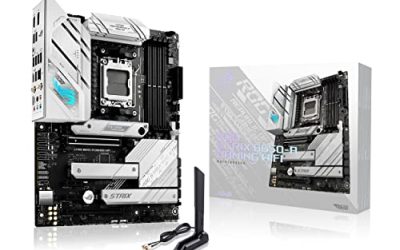
ASUS ROG Strix X870-A Gaming WiFi
This is the board to start with if the colour is the whole point. ASUS describes the Strix X870-A as having a white PCB, and the listing colour is given as Silver White, which together put it at the top whiteness level in this guide: the board surface itself is white, and the heatsinks and shrouds continue the white and silver theme instead of contrasting with it. In a white case with a glass panel, this is the pick that leaves the fewest dark patches for your other components to work around.
The platform underneath the finish is the full X870 specification. The listing describes a 16+2+2 power-stage design, four M.2 slots, PCIe 5.0 support, Wi-Fi 7 and USB4 ports, along with ASUS features including its quick-release graphics slot mechanism and its memory and cooling tuning tools. Four M.2 slots is the joint-highest count in this guide, and USB4 is the port standard that separates X870 from the cheaper chipsets, giving high-speed Type-C connectivity for fast external drives and docks. The power design is comfortably more than a gaming processor requires, which makes this a sensible board to keep through a processor upgrade rather than a board bought for one chip only.
The trade-offs are the usual flagship ones. You are paying for finish and ports together, so if your build will sit in a closed case, or you have no USB4 devices and no plan to fill more than two M.2 slots, the B850 pick below delivers the same white effect for less commitment. Also confirm the exact rear-panel layout on the live listing before ordering, because high-end boards vary their port mix between regions and revisions. For a glass-panel build where the board is on permanent display, though, the X870-A is the most complete answer in this guide: the whitest surface, the fullest port set, and no obvious specification gap to explain away later.
Gigabyte X870 AORUS Elite WIFI7 ICE
Gigabyte’s ICE line is its dedicated white range, and the X870 AORUS Elite WIFI7 ICE is the current flagship expression of it. The listing colour is Snow White, and the finish is described across manufacturer and retailer material as an all-white design carried by white heatsinks, shrouds and detailing across the board. It sits at the white-dominant level rather than making the same explicit white-PCB claim as the ASUS above, but the coverage is extensive, and in practice this is a board chosen specifically because it turns the inside of the case white, including in darker cases where owners use it as deliberate contrast.
On specification it matches the ASUS stride for stride in the areas most builders use. The listing describes four M.2 slots, PCIe 5.0, USB4, Wi-Fi 7 and 2.5 gigabit Ethernet, with Gigabyte’s EZ-Latch tool-free fittings for the graphics slot and M.2 drives, and a stated five-year warranty. The wireless package includes a high-gain directional antenna according to the product material, which is a small but real quality-of-life detail if your desk sits far from the router and you game over Wi-Fi rather than a cable. Storage expansion is the headline strength: four M.2 slots, with Gen5 support among them per the listing, gives a showcase build room to grow without adapters or compromises.
Choosing between this board and the Strix X870-A comes down to two questions. First, which finish do you prefer in photographs of real builds: the ASUS board’s white PCB look, or the Gigabyte board’s all-white metalwork look. Second, which maker’s BIOS layout and software you would rather live with, because you will see far more of that screen than of any port specification. On paper specifications alone there is no bad answer here. As with the ASUS, confirm the board revision on the live listing, since Gigabyte sells this model in more than one revision and the manual that applies to yours is revision-specific.
Gigabyte B850 AORUS Elite WIFI7 ICE
The B850 AORUS Elite WIFI7 ICE exists for buyers who want the ICE finish without paying the X870 premium, and it gives up less than you might expect. The white treatment follows the same approach as its X870 sibling: white ICE heatsinks and shrouds making the board white-dominant in the case. If the two Gigabyte boards were photographed side by side in finished builds, most viewers would not separate them on looks. The differences are in the chipset specification, not the mirror.
The listing describes a 14+2+2 power-phase design, three M.2 slots, PCIe 5.0 support, Wi-Fi 7, 2.5 gigabit Ethernet and EZ-Latch fittings, again with a stated five-year warranty. Losing one M.2 slot against the X870 model is the clearest specification step down, and USB4 is no longer a chipset guarantee, so check the port list on the live listing if fast Type-C peripherals matter to you. For the typical gaming build — one fast system drive, perhaps one larger game drive, a wired or Wi-Fi 7 connection and no USB4 dock — this board covers every requirement while keeping the newest chipset generation’s memory and processor support.
This is the pick we would steer most white-build buyers toward first. It keeps Wi-Fi 7, keeps PCIe 5.0, keeps the finish that motivated the search, and trims exactly the features — the fourth M.2 slot and guaranteed USB4 — that the fewest gaming builds use. The remaining decision is processor ambition: the 14+2+2 power design is well matched to the Ryzen range’s gaming chips, and builders planning a sixteen-core workstation hybrid should compare the X870 models above before committing. Confirm the exact model name at checkout, because Gigabyte sells a non-ICE version of this board in black with a very similar name, and the ICE suffix is the entire point of this pick.
MSI MPG B650 Edge WiFi
This pick comes with the clearest honesty note in the guide, so it gets one in its heading summary too: the MPG B650 Edge WiFi is a silver-white board, not a white-PCB board. MSI describes a silver-white colour scheme, and that scheme is carried by polished silver heatsinks and shrouds over a dark circuit board. In a finished build the effect is bright, clean and unmistakably lighter than a black board, and it pairs naturally with silver and white components. But if your standard is that no dark board surface should show anywhere, the three picks above are the ones that meet it, and this board should be skipped without regret.
Judged on its own terms, as the value route into a light-themed AM5 build, it is a well-rounded board. The listing describes DDR5 support, PCIe 5.0-capable M.2 storage in its specification set, Wi-Fi 6E with Bluetooth, 2.5 gigabit-class networking features in its family specification and MSI’s Mystic Light lighting control for matching case lighting to the build theme. The B650 chipset is the oldest in this guide, which shows up in the wireless generation and in a generally leaner port list than the X870 boards, but not in gaming performance: a current graphics card and a fast NVMe drive run at full speed here, and the money saved against the flagship picks is real money that a white build can spend on matching memory, fans or cables, where it will be just as visible.
Choose this board if you like the silver aesthetic in its own right, if your build mixes silver and white deliberately, or if the budget freed up here completes the rest of the theme. Skip it if the build is an all-white showcase with a glass panel and your eye will go straight to the dark board edges — because once you have seen that contrast in your own case, it is the only thing you will look at. As always, verify the slot and port details on the live listing, since B650 boards were sold in several closely named variants.
Which White Motherboard Should You Buy?
If the finish matters most and the budget allows it, the decision is between the two X870 boards. Pick the ASUS ROG Strix X870-A Gaming WiFi for the genuine white PCB and the most complete port set, or the Gigabyte X870 AORUS Elite WIFI7 ICE for the all-white ICE metalwork, four M.2 slots and USB4 in a slightly different visual style. Both are keep-it-for-years boards, and the better choice is the one whose BIOS and looks you prefer, because their headline specifications are closely matched.
If value matters alongside the finish, the Gigabyte B850 AORUS Elite WIFI7 ICE is the centre of this guide. It preserves the white-dominant ICE look, Wi-Fi 7 and PCIe 5.0 while trimming the extras few gaming builds use. Most white AM5 builds specced from this page should start here and move up only for a named reason: a fourth M.2 slot, guaranteed USB4, or a top-end processor that justifies the larger power design.
The MSI MPG B650 Edge WiFi is the conditional pick. It is the right board for a silver-white build or a budget that needs room for the rest of the theme, and the wrong board for a strict all-white showcase. That distinction — white PCB, white-dominant, or silver-white — is the single most useful thing to take from this guide, whichever board you buy and wherever you buy it. Check the manufacturer wording, look at photographs of the bare board rather than only finished builds, and the board that arrives will match the build in your head.
Disclosure
Disclosure: This article contains affiliate links. If you buy through those links, a commission may be earned at no additional cost to you. Product information was taken from the listings and manufacturer details available at the time of writing, and specifications should be confirmed on the live listing before purchase.
FAQ
Which White Motherboard Should You Buy?
More from Amazon
Programs that pair well with the guide above. Offers and eligibility are set by Amazon and may change.
Free shipping on eligible items, Prime Video and more. Eligible new members can start with a free trial.
Start a Prime free trialAd-free music streaming. Eligible new subscribers can start with a free trial.
Try Music Unlimited freeA Prime membership for ages 18-24 with a trial period. Eligibility is set by Amazon.
See Prime for Young AdultsAudiobooks and podcasts to listen to on the go. Eligible new members can start with a free trial.
Try Audible freeAs an Amazon Associate we earn from qualifying purchases.