Our Short List of 3
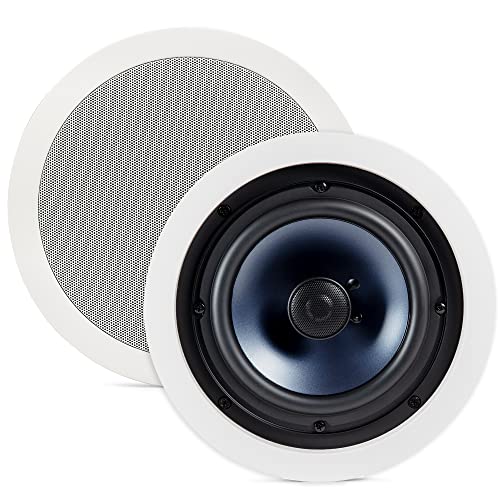
- Best for: Homes that need one pair to serve a bathroom, kitchen or covered porch as well as a living room.
- 8-inch Dynamic Balance woofer with mineral-filled polymer cone
- 1-inch aimable tweeter
- Rubber seal for damp and humid indoor placement
- Paintable aluminum grilles
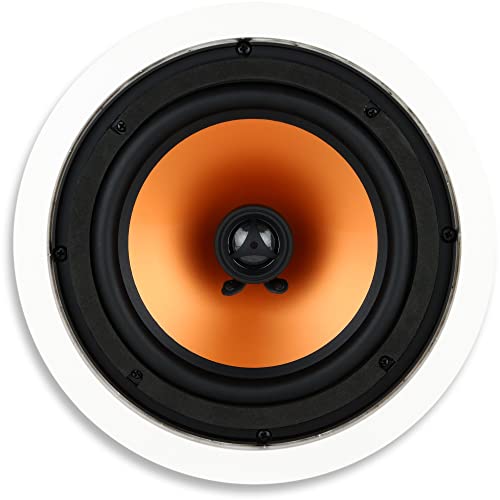
- Best for: Adding one speaker at a time to a bedroom, office or hallway, or building a system room by room.
- 8-inch high-excursion poly woofer
- 1-inch pivoting silk dome tweeter
- Frequency response of 40Hz to 20kHz
- Impedance of 8 ohms

- Best for: A home theater or music room where a pair of ceiling speakers must match the output of the rest of the system.
- 8-inch blue polypropylene mica cone woofer
- 1-inch fluid-cooled soft-dome swivel tweeter
- Maximum output power of 140 watts
- Impedance of 8 ohms
All 5 Picks at a Glance
| Product | Specs | Action |
|---|---|---|
| Polk Audio RC80i |
| Check price on Amazon |
| Micca M-8C |
| Check price on Amazon |
| Yamaha NS-IC800 |
| Check price on Amazon |
 Klipsch CDT-5650-C II |
| Check price on Amazon |
 Acoustic Audio CS-IC83 |
| Check price on Amazon |
Key takeaways
- Compare the best ceiling speakers for home theater and home audio, from damp-room pairs to a five-speaker set, with cutout sizes and wiring needs explained.
A ceiling speaker disappears into the room, and that is exactly the point — and the risk. Once the hole is cut, the speaker lives there, wired to a receiver in another room, so the choice you make before the drywall saw comes out matters more than with any box speaker you can move later. The real decision is not which speaker sounds best in isolation. It is which combination of woofer size, cutout diameter, mounting depth and amplifier requirement fits the ceiling you actually have, the joists above it and the way the room gets used.
This guide is for homeowners adding background music, movie watchers building overhead channels, and anyone replacing visible boxes with sound that comes from above. Every speaker below is an in-ceiling model chosen from its Amazon listing name and specifications, with the cutout and wiring details that decide whether it fits your ceiling.
Quick Picks
As an Amazon Associate we earn from qualifying purchases.
| Product | Best for | Key spec from title |
|---|---|---|
| Polk Audio RC80i | Damp rooms and whole-home music | 8-inch woofer, aimable tweeter |
| Micca M-8C | Single-room installs, one speaker at a time | 8-inch woofer, 100 watts |
| Yamaha NS-IC800 | Home theater pairs with strong output | 140-watt, 8-inch 2-way |
| Klipsch CDT-5650-C II | Dedicated theater rooms | 6.5-inch woofer, titanium tweeter |
| Acoustic Audio CS-IC83 | Five-speaker surround or multi-room setups | 5-speaker set, 3-way, 95dB |
How to Choose
Match the woofer to the room
An 8-inch woofer moves more air than a 6.5-inch one, which shows up as fuller midbass in a living room or open kitchen where the speaker has no cabinet behind it. In a small bedroom, hallway or office, a 6.5-inch driver is often enough, and its smaller cutout is easier to place between joists. Think about the largest room the speaker must fill, not the smallest, because a speaker that strains at normal listening volume will sound thin no matter how good its tweeter is. Every speaker in this guide is an in-ceiling model, so the woofer size also decides the hole you cut.
Aim the tweeter at the listener
A ceiling speaker fires straight down by default, which puts the listener off axis in most seating positions. A pivoting or aimable tweeter lets you angle the high frequencies toward the sofa or dining table instead of the floor, and that single adjustment does more for clear dialogue than any other feature on the box. Fixed tweeters suit hallways and kitchens where people move around and no single seat matters. If the room has one main seating area, treat an aimable tweeter as a requirement rather than a bonus, and check that it swivels enough to reach the seat.
Check the amplifier, wire and depth before you cut
Every passive in-ceiling speaker in this guide needs a receiver or amplifier plus speaker wire, and none of them plays on its own. Confirm that your receiver has a free pair of channels for each pair of speakers, and run in-wall rated speaker cable before the drywall goes back. Mounting depth matters just as much: a speaker that needs 3.78 inches of clear space will not fit a shallow ceiling with ductwork in the way. Measure the cavity, find the joists, and compare both numbers with the listing before ordering.
Plan for damp rooms and the finished look
Bathrooms, kitchens and covered porches expose a speaker to steam and humidity that a living room never will, so a rubber seal and a moisture-resistant cone are worth having where the listing offers them. The grille is the only part you see afterward, so a paintable grille that sits flush is what makes the speaker vanish into the ceiling. Check whether the grille attaches with magnets or friction, because a magnetic grille comes off cleanly for painting and for reaching the tweeter adjustment later without marking the ceiling.
The 5 Best Options
Polk Audio RC80i
- Best for: Homes that need one pair to serve a bathroom, kitchen or covered porch as well as a living room.
- 8-inch Dynamic Balance woofer with mineral-filled polymer cone
- 1-inch aimable tweeter
- Rubber seal for damp and humid indoor placement
- Paintable aluminum grilles
Homes that need one pair to serve a bathroom, kitchen or covered porch as well as a living room.
It is sold only as a pair, and it needs a receiver or amplifier and speaker wire, since no amplifier is built in.
The RC80i is the pair to start with when one set of speakers has to cover more than one kind of room. Its rubber seal suits bathrooms, kitchens and covered porches, while the 8-inch woofer gives a living room enough body for movies and music without a separate subwoofer in the ceiling. The tweeter aims toward the listener, so dialogue stays clear even when the speakers sit wide of the seating. Installation follows the familiar cut, connect and clamp pattern, and the paintable aluminum grilles blend into a white ceiling once fitted.
Watch out for: It is sold only as a pair, and it needs a receiver or amplifier and speaker wire, since no amplifier is built in.
Micca M-8C
- Best for: Adding one speaker at a time to a bedroom, office or hallway, or building a system room by room.
- 8-inch high-excursion poly woofer
- 1-inch pivoting silk dome tweeter
- Frequency response of 40Hz to 20kHz
- Impedance of 8 ohms
Adding one speaker at a time to a bedroom, office or hallway, or building a system room by room.
Buying an odd number leaves one channel unpaired for stereo, so count the speakers per room before ordering.
The M-8C suits buyers who want to add speakers one room at a time, because it is sold as a single speaker rather than a pair. Its 8-inch poly woofer and pivoting silk dome tweeter cover the same ground as the larger pairs in this guide, and the published cutout and depth figures make the install predictable before any drywall is cut. Built-in mounting tabs grip drywall directly, so no extra bracket is needed. The paintable grille sits close to flush, which keeps the ceiling looking plain once the speaker is in.
Watch out for: Buying an odd number leaves one channel unpaired for stereo, so count the speakers per room before ordering.
Yamaha NS-IC800
- Best for: A home theater or music room where a pair of ceiling speakers must match the output of the rest of the system.
- 8-inch blue polypropylene mica cone woofer
- 1-inch fluid-cooled soft-dome swivel tweeter
- Maximum output power of 140 watts
- Impedance of 8 ohms
A home theater or music room where a pair of ceiling speakers must match the output of the rest of the system.
It needs a 10-inch class cutout despite the 8-inch woofer, so confirm the joist spacing before cutting.
The NS-IC800 is a strong fit for a home theater pair that must keep up with a subwoofer and a center channel. Its 8-inch blue polypropylene mica cone woofer and swiveling soft-dome tweeter give dialogue and music a balanced presentation, and the sealed back cover protects the driver and crossover from dust and moisture inside the ceiling. The magnetic paintable grille snaps on flush and comes off easily for adjustment. Note that the Amazon listing gives frequency response as 20 kHz while other sources quote 28 kHz, so this guide uses the lower figure from the listing.
Watch out for: It needs a 10-inch class cutout despite the 8-inch woofer, so confirm the joist spacing before cutting.
Klipsch CDT-5650-C II
- Best for: Dedicated theater rooms and Atmos height channels where an aimable horn tweeter earns its place.
- 6.5-inch Cerametallic woofer
- 1-inch titanium tweeter
- Tractrix horn for wide dispersion
- Pivoting tweeter design
Dedicated theater rooms and Atmos height channels where an aimable horn tweeter earns its place.
Some roundups list this model with an 8-inch woofer; the listing used here gives a 6.5-inch driver, so measure the cutout against the 6.5-inch figure.
The CDT-5650-C II is the pick for a dedicated theater room where detail matters more than filling several rooms at once. Its titanium tweeter sits in a Tractrix horn that spreads the highs evenly, and the pivoting design lets you aim that horn at the seating rather than the floor. The Cerametallic woofer stays rigid under load, which keeps dialogue clean when a film soundtrack gets busy. It is sold as a single speaker, so a full Atmos or surround layout means ordering the exact number of channels the receiver supports.
Watch out for: Some roundups list this model with an 8-inch woofer; the listing used here gives a 6.5-inch driver, so measure the cutout against the 6.5-inch figure.
Acoustic Audio CS-IC83
- Best for: A full five-speaker surround layout or whole-home audio where one bundle covers every room.
- 8-inch high-rigidity poly cone woofer
- Poly mica midrange
- 13mm soft dome tweeter
- 3-way passive crossovers
A full five-speaker surround layout or whole-home audio where one bundle covers every room.
Five speakers need five amplified channels and five cable runs, so plan the receiver and wiring before the bundle arrives.
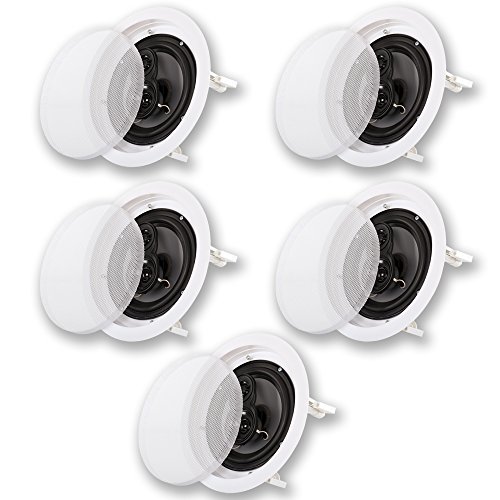
The CS-IC83 is the only bundle in this guide, and that is its whole argument: five 3-way speakers in one box cover a full surround layout or several rooms without ordering speakers one by one. Each unit pairs an 8-inch poly cone woofer with a poly mica midrange and a soft dome tweeter, and the 95dB sensitivity means a modest receiver drives them to satisfying volume. The pressure-lock mounting system clamps tight to drywall, and the paintable grilles keep five visible circles from dominating the ceiling.
Watch out for: Five speakers need five amplified channels and five cable runs, so plan the receiver and wiring before the bundle arrives.
Which One Fits Your Situation
A bathroom, kitchen or covered porch
Choose the Polk Audio RC80i. Its rubber seal and moisture-resistant build are made for damp and humid placement, and the aimable tweeter keeps dialogue clear when the speakers sit over a bath or a worktop rather than a sofa. Buy it as a pair for stereo, and keep the grilles paintable so they match the ceiling.
A home theater with overhead channels
Choose the Klipsch CDT-5650-C II for the height channels and the Yamaha NS-IC800 for the main ceiling pair. The Klipsch horn tweeter aims the highs at the seats, while the Yamaha pair brings the output and sealed back that a busy soundtrack needs. Order one Klipsch per channel and count the Yamaha pairs separately.
Music in several rooms from one system
Choose the Acoustic Audio CS-IC83 five-speaker set. One bundle fills several rooms or a whole surround layout, and the 95dB sensitivity keeps the load on the receiver modest. Add the Micca M-8C for any extra room, since it is sold singly and its cutout matches the same 8-inch class.
One room, one pair, straightforward install
Choose the Yamaha NS-IC800 or the Micca M-8C, depending on how the room is wired. The Yamaha pair suits a room with a receiver nearby and a subwoofer in the system, while the Micca singles suit a room where you want to start with two speakers and add more later without reordering a pair.
Safety Notes
Cut power to the receiver or amplifier before connecting any speaker wire, and never run speaker cable through the same holes as mains wiring. Before cutting, check above the ceiling for joists, pipes, ductwork and existing electrical cables, and use a stud finder rather than guessing. Use in-wall rated speaker cable for any run inside a wall or ceiling cavity. If the ceiling contains old insulation, vermiculite or wiring you cannot identify, stop and bring in a qualified electrician before cutting further.
Common Mistakes
- Cutting the hole before checking joist spacing, mounting depth and ductwork above the ceiling.
- Buying an odd number of single speakers for a stereo pair, or a pair when the room needs three channels.
- Choosing a speaker with no amplifier plan, since every passive in-ceiling speaker needs a receiver or amplifier and speaker wire.
- Installing a standard speaker in a bathroom or covered porch instead of one listed for damp and humid placement.
- Forgetting the grille: an unpainted grille draws the eye, and a friction-fit grille fitted carelessly can work loose over time.
Frequently Asked Questions
Do ceiling speakers need an amplifier?
Yes. Every speaker in this guide is a passive in-ceiling model, so each one needs a receiver or amplifier and speaker wire to produce sound. The amplifier also sets the volume and, in a theater, the channel layout. Check that your receiver has a free pair of channels for each pair of speakers, and that its power output suits the power handling given in the listing before you buy.
Can I install ceiling speakers in a bathroom?
You can, provided the speaker is listed for damp and humid indoor placement. The Polk Audio RC80i in this guide carries a rubber seal for that use, while the other speakers here are aimed at dry living spaces. Keep the speaker away from direct water spray, use in-wall rated cable, and check the ceiling cavity for steam paths before cutting.
What size hole do I need to cut?
It depends on the model. The Micca M-8C needs a 9.4-inch cutout, the Acoustic Audio CS-IC83 needs a 9.45-inch cutout, and the Yamaha NS-IC800 needs a cutout in the 10-inch class. Always measure the joist spacing first, mark the cutout with the template that comes with the speaker, and confirm the mounting depth fits the cavity above.
Do ceiling speakers work for Dolby Atmos height channels?
Yes, and that is one of their most common uses. An in-ceiling speaker with an aimable tweeter, such as the Klipsch CDT-5650-C II, points the height effects at the seating instead of the floor. Place the height speakers according to your receiver manual, wire each one to its own Atmos channel, and add a subwoofer separately, since no ceiling speaker here replaces one.
FAQ
Do ceiling speakers need an amplifier?
Can I install ceiling speakers in a bathroom?
What size hole do I need to cut?
Do ceiling speakers work for Dolby Atmos height channels?
More from Amazon
Programs that pair well with the guide above. Offers and eligibility are set by Amazon and may change.
Free shipping on eligible items, Prime Video and more. Eligible new members can start with a free trial.
Start a Prime free trialAd-free music streaming. Eligible new subscribers can start with a free trial.
Try Music Unlimited freeA Prime membership for ages 18-24 with a trial period. Eligibility is set by Amazon.
See Prime for Young AdultsAudiobooks and podcasts to listen to on the go. Eligible new members can start with a free trial.
Try Audible freeAs an Amazon Associate we earn from qualifying purchases.