Our Short List of 3
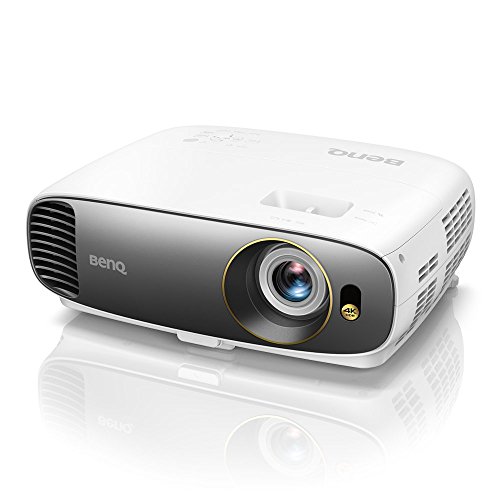
- Display: DLP with XPR pixel shifting, 3840×2160 (4K UHD)
- Brightness: 2,200 ANSI lumens
- Contrast: 10,000:1 (FOFO)
- Color: Rec.709 coverage >96%, Delta E

- Display: DLP, native 1080p
- Brightness: 2,200 ANSI lumens
- Contrast: 15,000:1 (FOFO)
- Color: Rec.709 coverage 96%, 1.07 billion colors

- Display: 3-chip 3LCD, 1080p
- Brightness: 3,400 lumens color brightness and 3,400 lumens white brightness
- Color: displays 100% of the RGB color signal for every frame (manufacturer statement)
- Contrast: dynamic, up to 16,000:1
All 3 Picks at a Glance
| Product | Specs | Action |
|---|---|---|
| BenQ HT2550 4K UHD HDR Home Theater Projector |
| Check price on Amazon |
| BenQ HT2150ST 1080P Short Throw Projector |
| Check price on Amazon |
| Epson Home Cinema 1080 3-chip 3LCD Projector |
| Check price on Amazon |
Key takeaways
- Three color-accurate projectors for showing photographs, compared on published Rec.709 coverage, Delta E, 3LCD color brightness and ISF picture modes.
A projector is an unforgiving way to look at a photograph. A screen that shifts skin tones toward magenta, crushes shadow detail, or renders a saturated red as dull orange will undo careful editing work in front of exactly the people you want to impress — clients at a proofing session, a class you are teaching, or family gathered around a wedding slideshow. Photographers shopping for a projector therefore need a different checklist than home-theater buyers. Raw brightness and gaming features matter less than published color figures: how much of the Rec.709 color space the projector covers, whether the manufacturer publishes a Delta E accuracy figure, whether color brightness matches white brightness, and whether the picture modes include calibration-friendly options such as ISF Day and ISF Night.
This guide compares three digital projectors whose product pages publish exactly those kinds of figures. Two are BenQ DLP models built around the company’s CinematicColor approach, with Rec.709 coverage stated at 96% or above. The third is an Epson 3LCD model that publishes equal color and white brightness and states that it displays 100% of the RGB color signal for every frame. Every figure below comes from the manufacturer’s own published specifications on each product page — coverage percentages, contrast ratios, lamp-life tables and all — so you can judge the color claims on paper rather than on marketing adjectives.
As an Amazon Associate, we earn from qualifying purchases.
Quick answer
For most photographers, the BenQ HT2550 is the strongest paper specification here: 4K UHD resolution via pixel shifting, Rec.709 coverage published at over 96%, and a Delta E figure of less than 3 from the factory, plus ISF Day and Night modes for different room lighting. If your room is small and you need a big image from a short distance, the BenQ HT2150ST pairs the same 96% Rec.709 coverage with a short-throw lens. If you present in brighter rooms and want a 3LCD design whose color brightness equals its white brightness, the Epson Home Cinema 1080 publishes 3,400 lumens of each and full RGB signal display on every frame.
Key takeaways
- The BenQ HT2550 publishes the most complete color-accuracy spec set: Rec.709 coverage over 96% and Delta E <3.
- The BenQ HT2150ST covers 96% of Rec.709 and adds a 0.69–0.83 short-throw ratio for small rooms.
- The Epson Home Cinema 1080 publishes 3,400 lumens of color brightness and 3,400 lumens of white brightness — equal figures, which is the 3LCD design’s published advantage for color-rich images.
- Both BenQ models use a 6-segment RGBRGB color wheel and include ISF Night and ISF Day picture modes.
- Contrast figures differ by measurement style: BenQ publishes full-on/full-off (FOFO) ratios, while Epson publishes a dynamic contrast figure, so the numbers are not directly interchangeable.
The picks
BenQ HT2550 4K UHD HDR Home Theater Projector
- Display: DLP with XPR pixel shifting, 3840×2160 (4K UHD)
- Brightness: 2,200 ANSI lumens
- Contrast: 10,000:1 (FOFO)
- Color: Rec.709 coverage >96%, Delta E
The HT2550 is the pick for photographers who want the closest thing to a reference image in this group. BenQ’s CinematicColor material for this model publishes Rec.709 coverage of more than 96% and a Delta E of less than 3 — a Delta E under 3 is the threshold at which color error becomes difficult for most viewers to spot, and it is rare for a projector in this class to publish the figure at all. For photo work, that combination means the reds in a sunset portrait and the greens in a landscape should land close to what your editing monitor showed you, at least within the Rec.709 space that most web and print-proof images live in.
Resolution is the other half of its appeal. The HT2550 uses DLP with XPR pixel shifting to put a 3840×2160 image on screen, so fine detail in a projected photograph — hair, fabric texture, distant foliage — holds up better at large sizes than a native 1080p image. It publishes 2,200 ANSI lumens and a 10,000:1 full-on/full-off contrast ratio, and it supports HDR10 input. The RGBRGB color wheel is the configuration BenQ uses on its color-focused models, dedicating segments to primary colors rather than adding a white segment that would trade saturation for brightness. ISF Night and ISF Day modes give you separate, calibrator-friendly presets for a darkened room and a lit one, which suits photographers who proof in the evening but present in a classroom by day.
View the BenQ HT2550 on Amazon
BenQ HT2150ST 1080P Short Throw Projector
- Display: DLP, native 1080p
- Brightness: 2,200 ANSI lumens
- Contrast: 15,000:1 (FOFO)
- Color: Rec.709 coverage 96%, 1.07 billion colors
The HT2150ST solves a logistics problem that photographers run into constantly: the rooms where you show work — a studio corner, a camera-club hall, a client’s living room — are rarely deep enough for a standard-throw projector. Its published throw ratio of 0.69–0.83 is a genuine short-throw figure, so the projector sits close to the screen or wall and still fills it, keeping the unit out of the audience’s sightline and reducing the chance of shadows when someone stands up mid-slideshow.
Crucially, going short-throw does not mean giving up the color specification. The HT2150ST publishes the same 96% Rec.709 coverage as its sibling, driven by a 6-segment RGBRGB color wheel, and it renders 1.07 billion colors. Native resolution is 1080p rather than pixel-shifted 4K, which is a reasonable trade at typical slideshow viewing distances, and the published contrast ratio is 15,000:1 full-on/full-off — higher on paper than the HT2550’s figure. Brightness is 2,200 ANSI lumens. Like the HT2550, it includes ISF Night and ISF Day picture modes, so a photographer who calibrates a dark-room preset for proofing and a brighter preset for talks can switch between them rather than re-adjusting settings at every venue.
View the BenQ HT2150ST on Amazon
Epson Home Cinema 1080 3-chip 3LCD Projector
- Display: 3-chip 3LCD, 1080p
- Brightness: 3,400 lumens color brightness and 3,400 lumens white brightness
- Color: displays 100% of the RGB color signal for every frame (manufacturer statement)
- Contrast: dynamic, up to 16,000:1
The Epson Home Cinema 1080 takes the opposite technological route from the two DLP models, and its published figures address the weakness photographers most often notice in bright-room projection: washed-out color. Epson publishes 3,400 lumens of color brightness and 3,400 lumens of white brightness — identical numbers. On single-chip designs, white brightness can be achieved in ways that leave color brightness lower, which is why saturated photographs can look pale even when a projector seems bright. Epson states that this 3-chip 3LCD design displays 100% of the RGB color signal for every frame, so the color information in each image is fully presented rather than time-shared.
That makes the Home Cinema 1080 the natural choice for photographers who present where lights stay on: workshops, schoolrooms, gallery talks, and wedding-venue walkthroughs. Its dynamic contrast is published at up to 16,000:1, it can project an image up to 320 inches, and it offers two HDMI 2.0 inputs, so a laptop and a backup device can both stay connected. The published color modes — Dynamic, Bright Cinema, Cinema, and Game — include two cinema presets suited to photo and video content. Resolution is 1080p, and Epson does not publish a Rec.709 coverage percentage or Delta E figure for this model, so its case rests on the color-brightness specification rather than a gamut claim; photographers who need a stated gamut number should weigh the BenQ models above.
View the Epson Home Cinema 1080 on Amazon
How to choose
Start with the published gamut figure. Rec.709 is the color space of the web, of HDTV, and of the sRGB files most photographers deliver. A projector that publishes 96% or greater Rec.709 coverage is telling you it can reproduce nearly all of that space; one that publishes no coverage figure is asking you to trust it. In this group, both BenQ models publish coverage (96% and over 96%), and the HT2550 adds a Delta E <3 claim, which speaks to accuracy — how close the reproduced colors are to the targets — rather than just the size of the gamut.
Separate color brightness from white brightness. A lumens figure by itself describes white output. For photographs, what matters is whether color output keeps pace, because a projector can hit its brightness number with white light while saturated colors lag behind. The Epson’s published pairing of 3,400 color lumens with 3,400 white lumens is the specification to look for if you present in lit rooms. The BenQ models publish 2,200 ANSI lumens and lean on their gamut coverage instead; they are better matched to rooms you can darken.
Match the throw ratio to your room. Throw ratio tells you how far the projector sits from the screen for a given image size. The HT2150ST’s 0.69–0.83 ratio is short throw: a large image from a few feet away, ideal for studios and small meeting rooms. Standard-throw models like the other two picks need more depth but are easier to ceiling-mount in a dedicated space. Measure your room before you fall for a specification sheet.
Read contrast figures by their method, not just their size. BenQ’s ratios here are full-on/full-off measurements; Epson’s is a dynamic figure, which involves an adjustable iris or lamp modulation and is not measured the same way. A dynamic 16,000:1 and an FOFO 15,000:1 are not a like-for-like comparison, so do not rank these projectors on that number alone. For photo proofing, published color figures and a dark room will do more for perceived contrast than the ratio on the box.
Consider resolution against viewing distance. The HT2550’s pixel-shifted 4K will show finer detail when viewers sit close to a large image — portfolio reviews, for example. At the back of a hall, the 1080p models’ resolution is rarely the limiting factor; brightness and color are. Also weigh lamp life from the published mode tables if the projector will run long presentation days: the HT2550’s LampSave mode is published at 15,000 hours, while brighter modes trade life for output.
Check the picture modes for your workflow. ISF Day and Night modes on the BenQ models exist precisely for spaces that alternate between dark and lit use, and they give a calibrator dedicated slots to work in. The Epson’s Cinema and Bright Cinema modes play a similar role for its brighter-room brief. Whichever you choose, budget time to set white balance and gamma for your room rather than trusting any factory preset for critical proofing.
Who should skip these
Skip all three if your work lives outside Rec.709. Photographers editing in Adobe RGB or Display P3 for wide-gamut print workflows will find that every projector here is specified against Rec.709; none publishes Adobe RGB coverage, so none can proof a wide-gamut file faithfully. Skip the BenQ models if your venue cannot be darkened at all and your images are heavily saturated — their published strength is gamut coverage at 2,200 lumens, not bright-room punch. Skip the Epson if a published Delta E or gamut-coverage figure is a requirement for your buying decision, because its page does not state one. And skip lamp-based projection entirely if you need instant on/off and zero lamp replacement over the product’s life; all three of these are lamp projectors with finite, mode-dependent lamp hours.
FAQ
What does Rec.709 coverage mean for showing photographs?
It describes how much of the Rec.709 color space — effectively the sRGB world your exported files live in — the projector can reproduce. Coverage of 96% or more, as published for both BenQ models here, means nearly the entire space is within reach; colors outside the covered portion get remapped to the nearest reproducible shade, which is where subtle shifts in saturated subjects can appear.
Is Delta E <3 good enough for proofing?
Delta E measures the distance between a target color and the reproduced color. A published figure under 3, as BenQ states for the HT2550, indicates errors small enough that most viewers cannot reliably see them. It is a strong factory specification, though serious proofing still calls for calibrating the projector in the room where you will use it, since walls, screens, and ambient light all shift the result.
Why does the Epson publish two brightness numbers?
Because color brightness and white brightness can differ. Epson publishes 3,400 lumens for both on the Home Cinema 1080, and states the projector displays 100% of the RGB color signal for every frame. For photographers, equal figures suggest that a bright image will not come at the cost of pale, washed-out color — the trade-off that matters most when the lights stay on.
Should photographers choose DLP or 3LCD?
Choose by specification and room, not by technology label. The DLP models here publish the gamut and Delta E figures and suit darker rooms; the 3LCD model publishes equal color and white brightness and suits lit rooms. Single-chip DLP designs use a color wheel — both BenQ picks use an RGBRGB wheel, the configuration aimed at color performance — while 3LCD dedicates a panel to each primary color. Your venue’s lighting is the most practical deciding factor.
Final verdict
For a photographer buying on published color accuracy, the BenQ HT2550 is the headline pick: Rec.709 coverage over 96%, a Delta E <3 factory figure, ISF Day and Night modes, and pixel-shifted 4K detail for close-up portfolio work. The BenQ HT2150ST keeps the essential color specification — 96% Rec.709, RGBRGB wheel, ISF modes — and adds a short-throw lens that makes small rooms workable. The Epson Home Cinema 1080 is the bright-room alternative, trading gamut claims for a published 3,400 lumens of color brightness matched to its white brightness and full RGB signal display on every frame. Decide by your room first and your proofing standards second, and any of the three will show your photographs more honestly than a projector bought on lumens alone.
Product and ASIN Reference
| Product | ASIN | Key published color figures |
|---|---|---|
| BenQ HT2550 4K UHD HDR Home Theater Projector | B077PP4S93 | Rec.709 >96%, Delta E <3, RGBRGB wheel, HDR10 |
| BenQ HT2150ST 1080P Short Throw Projector | B01K2V0WP4 | Rec.709 96%, 1.07 billion colors, RGBRGB wheel |
| Epson Home Cinema 1080 3-chip 3LCD Projector | B08GL2DSKZ | 3,400 lm color / 3,400 lm white brightness, 100% RGB signal per frame |
More from Amazon
Programs that pair well with the guide above. Offers and eligibility are set by Amazon and may change.
Free shipping on eligible items, Prime Video and more. Eligible new members can start with a free trial.
Start a Prime free trialAd-free music streaming. Eligible new subscribers can start with a free trial.
Try Music Unlimited freeA Prime membership for ages 18-24 with a trial period. Eligibility is set by Amazon.
See Prime for Young AdultsAudiobooks and podcasts to listen to on the go. Eligible new members can start with a free trial.
Try Audible freeAs an Amazon Associate we earn from qualifying purchases.