Key takeaways
- Compare the best graphics cards for after effects: RTX 4060 and RTX 4070 cards plus an RX 7700 XT with the VRAM, cooling and outputs for smooth video work.
After Effects leans on the graphics card differently from games, and the wrong pick can leave previews stuttering while a gaming benchmark looks fine. The real decision is how much video memory you need for your compositions, because high-resolution footage, layered effects and 3D renders all compete for the same memory. A card with too little VRAM forces the software to fall back to slower paths, while a card with enough memory keeps previews fluid and exports moving.


This guide is for video editors, motion designers and creators who render in After Effects and want a card that handles previews, effects and exports without constant slowdowns. Every card below was chosen from the name and specifications shown on its Amazon page, so the memory, clocks and outputs match what the listings state.
Quick Picks
As an Amazon Associate we earn from qualifying purchases
| Product | Best for | Key spec from title |
|---|---|---|
| ASUS Dual RTX 4060 EVO White OC | White builds | 8GB GDDR6, 2535 MHz boost |
| ASUS Dual RTX 4060 V2 OC | Compact 1080p edits | 8GB GDDR6, dual-fan design |
| GIGABYTE RTX 4070 Gaming OC | 1440p timelines | 12GB GDDR6X, triple-fan cooling |
| XFX RX 7700 XT Core | 12GB on a budget | 12GB GDDR6, 2544 MHz boost |
How to Choose
Video Memory First
Video memory is the first number to check for After Effects, because it sets the ceiling on how much footage, cache and effect data the card can hold at once. Eight gigabytes handles 1080p timelines and moderate effects work comfortably, while 12GB gives headroom for 4K footage, heavy layering and 3D compositions. Once memory fills up, the software spills work to slower paths and previews stutter. If you work in 4K regularly, step up to a 12GB card even if the rest of your system is modest, because no amount of processor speed makes up for a memory shortfall.
CUDA Cores and Acceleration
After Effects uses the graphics card to accelerate effects, and NVIDIA cards have the broadest support through CUDA, which many third-party effects and plugins rely on. More CUDA cores generally mean faster rendering of accelerated effects, though the gains level off once the card is strong enough for your timeline. AMD cards work well for playback and basic effects, but some plugins and renderers only accelerate on NVIDIA hardware, so check the tools you actually use before choosing a brand. If your workflow includes a CUDA-only plugin, the choice is already made for you.
Cooling and Noise
A graphics card that runs hot will slow itself down, and After Effects keeps cards under load for long stretches during previews and exports. Dual-fan and triple-fan coolers keep temperatures lower than single-fan designs, and a 0dB mode stops the fans entirely during light work. Check the card length and slot width against your case, because a 2.5-slot card needs more room than a slim dual-slot model. Noise matters if you edit in a shared room, so a card with a larger cooler and slower fans is worth the extra space it takes.
Outputs and Power
Check the outputs before you buy, because After Effects work often runs on two screens, with the timeline on one and the preview on the other. All four cards here offer a mix of HDMI and DisplayPort, which covers most dual-monitor setups. Power is the other practical check: confirm your power supply meets the card’s requirement and has the right connectors, and measure the case clearance for the card length. A card that does not fit or cannot be powered is a return, not an upgrade.
The 4 Best Options
ASUS Dual RTX 4060 EVO White OC
The ASUS Dual RTX 4060 EVO White OC is the white-build pick of this group, with a white shroud and backplate that suits light-colored cases. Under the styling, it is a capable After Effects card: 8GB of GDDR6 memory, a boost clock of 2535 MHz in OC mode, and a dual-fan Axial-tech cooler with 0dB technology that stops the fans during light work. The card measures 227.2 mm long and takes 2.5 slots, so it fits most mid-tower cases. A Dual BIOS switch lets you choose between performance and quiet operation, and the outputs cover one HDMI 2.1a port and three DisplayPort 1.4a ports.
Specs
- 8GB GDDR6 memory
- Boost clock 2535 MHz OC mode, 2505 MHz default mode
- 2.5-slot design
- 227.2 mm length
- Dual BIOS
- 0dB technology
- Axial-tech fans
- 1x HDMI 2.1a, 3x DisplayPort 1.4a
Best for: Editors building a white-themed PC.
Watch out for: The 8GB of memory limits 4K timelines, so keep compositions at 1080p or step up to a 12GB card.
ASIN: B0DKS9D5DD
ASUS Dual RTX 4060 V2 OC
The ASUS Dual RTX 4060 V2 OC is the compact pick, a dual-fan card that brings the same RTX 4060 silicon into a smaller frame for tight cases. The 8GB of GDDR6 memory handles 1080p timelines and moderate effects work, and the OC edition runs a factory overclock for a small lift over reference speeds. Two fans keep the card cool under sustained preview loads, and the dual-slot design fits cases where a wider card would not. This is the card for editors who need a capable After Effects GPU in a small case or a machine that also serves as a family PC.
Specs
- NVIDIA GeForce RTX 4060 graphics
- 8GB GDDR6 memory
- Dual-fan cooling
- OC edition factory overclock
- Dual-slot design
Best for: Compact cases and 1080p editing.
Watch out for: The smaller cooler runs louder under long exports than the larger dual-fan cards in this group.
ASIN: B0D6CYLHW1
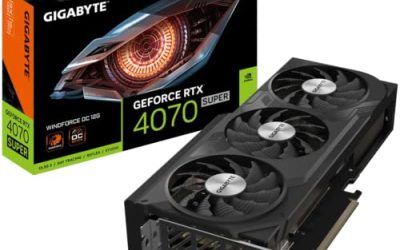
GIGABYTE RTX 4070 Gaming OC 12G
The GIGABYTE RTX 4070 Gaming OC 12G is the strongest card in this group for After Effects, and the reason is the 12GB of GDDR6X memory, which keeps 4K footage and layered compositions in fast memory instead of spilling to slower paths. Triple-fan WINDFORCE cooling keeps the card steady during long renders, and the factory overclock adds a small margin on top of the reference speeds. The model number is GV-N4070GAMING OC-12GD, which is the card to confirm on the listing, since GIGABYTE sells several RTX 4070 variants with similar names. This is the pick for editors who work in 4K or lean on heavy effects.
Specs
- NVIDIA GeForce RTX 4070 graphics
- 12GB GDDR6X memory
- Triple-fan WINDFORCE cooling
- Factory overclock
- Model GV-N4070GAMING OC-12GD
Best for: 4K timelines and heavy effects work.
Watch out for: The triple-fan cooler makes this the longest card in the group, so measure your case before ordering.
ASIN: B0BZHBRQCQ
XFX Speedster SWFT210 RX 7700 XT Core
The XFX Speedster SWFT210 RX 7700 XT Core is the AMD pick, and its 12GB of GDDR6 memory matches the RTX 4070 for timeline headroom at a lower tier of the market. A boost clock of up to 2544 MHz and dual-fan cooling keep previews smooth, and the card carries one HDMI 2.1 port and three DisplayPort 2.1 ports for multi-monitor setups. The part number is RX-77TSWFTFP, the Core Edition of the SWFT210 line. This is the card for editors whose effects work does not depend on CUDA-only plugins, and who want 12GB of memory for 4K timelines.
Specs
- AMD Radeon RX 7700 XT graphics
- 12GB GDDR6 memory
- Boost clock up to 2544 MHz
- Dual-fan cooling
- 1x HDMI 2.1, 3x DisplayPort 2.1
- 283 mm length
- Part number RX-77TSWFTFP
Best for: Editors who want 12GB of memory without CUDA-only plugins.
Watch out for: Some third-party After Effects plugins only accelerate on NVIDIA cards, so check your plugin list first.
ASIN: B0D9QKXJDK
Which One Fits Your Situation
1080p Editors on a Modest Budget
The ASUS Dual RTX 4060 V2 OC is the right card for 1080p work, because its 8GB of memory and dual-fan cooler handle everyday timelines without fuss. If your case has a window and you want the build to look tidy, the EVO White OC adds the white styling and a quieter 0dB mode for the same class of work. Either card keeps previews fluid at 1080p.
4K Timelines and Layered Compositions
The GIGABYTE RTX 4070 Gaming OC is the pick for 4K work, because 12GB of GDDR6X memory keeps large frames and stacked effects in fast memory. The XFX RX 7700 XT is the alternative if your plugins do not need CUDA, since it also carries 12GB and handles 4K timelines well. Choose the RTX 4070 if any plugin in your workflow is NVIDIA-only.
White Builds and Quiet Rooms
The ASUS Dual RTX 4060 EVO White OC fits white builds and quiet editing rooms, with a white shroud and a 0dB fan mode that stops the fans during light work. The Dual BIOS switch lets you favor silence over speed when you are editing late. Pair it with a white case and light-colored cables for a clean look that does not distract from the work.
Small Cases and Shared Machines
The ASUS Dual RTX 4060 V2 OC suits small cases and shared family machines, because its dual-slot design and compact frame fit where wider cards cannot. The 8GB of memory still handles 1080p timelines, and the dual fans keep it cool under sustained loads. Measure the case length first, since even compact cards need clearance for the power connectors.
Common Mistakes
- Buying a card for its gaming benchmark and discovering it has too little memory for your After Effects timelines.
- Choosing an AMD card without checking whether your plugins need CUDA acceleration to run.
- Ordering a triple-fan card that is longer than the case clearance, then having to return it.
- Forgetting to check the power supply, and finding the card needs a connector your unit does not have.
- Running a single monitor and missing how much faster editing feels with the timeline and preview on separate screens.
Frequently Asked Questions
How much VRAM do I need for After Effects?
Eight gigabytes is enough for 1080p timelines and moderate effects, while 12GB is the safer choice for 4K footage, layered compositions and 3D work. Once memory fills, previews stutter and exports slow down. If you work in 4K regularly, choose a 12GB card even if the rest of the system is modest.
Is NVIDIA or AMD better for After Effects?
NVIDIA has the broader advantage, because CUDA acceleration supports more third-party effects and plugins than AMD’s alternatives. AMD cards work well for playback and basic effects, and their 12GB models are strong value. Check the plugins you actually use: if any of them are CUDA-only, the choice is NVIDIA.
Does a faster graphics card speed up exports?
It speeds up the parts of the export that use GPU acceleration, such as effects, scaling and encoding on supported paths. The processor still handles much of the render, so a faster card helps most when your timeline is effect-heavy. For simple cuts and basic grading, the difference is smaller.
Do I need a 0dB fan mode for video editing?
A 0dB mode stops the fans during light work, which keeps the room quiet while you scrub timelines and arrange layers. Under heavy previews and exports the fans will still run. It is a comfort feature rather than a performance one, but editors in shared or quiet rooms notice the difference.
FAQ
How much VRAM do I need for After Effects?
Is NVIDIA or AMD better for After Effects?
Does a faster graphics card speed up exports?
Do I need a 0dB fan mode for video editing?
More from Amazon
Programs that pair well with the guide above. Offers and eligibility are set by Amazon and may change.
Free shipping on eligible items, Prime Video and more. Eligible new members can start with a free trial.
Start a Prime free trialAd-free music streaming. Eligible new subscribers can start with a free trial.
Try Music Unlimited freeA Prime membership for ages 18-24 with a trial period. Eligibility is set by Amazon.
See Prime for Young AdultsAudiobooks and podcasts to listen to on the go. Eligible new members can start with a free trial.
Try Audible freeAs an Amazon Associate we earn from qualifying purchases.