Key takeaways
- Find the best projectors for outside and inside use, from bright portable models with built-in batteries to compact picks for backyard movie nights at home.
The best projectors for outside and inside use move easily between a living room wall and a backyard screen without a rebuild of your setup each time. They are bright enough to hold up after sunset outdoors, sharp enough for everyday viewing indoors, and simple enough that a movie night does not turn into a wiring project. A good dual-use projector carries its own battery or runs happily from a nearby outlet, connects to a phone, laptop, or streaming stick without fuss, and includes autofocus and keystone correction so you can set it down, point it at a surface, and start watching.

That flexibility is the whole point. A dedicated home theater projector can be wonderful in a dark room, but it is often too large, too heavy, and too dependent on a fixed mount to be useful on a patio. A tiny pocket projector, on the other hand, may be easy to carry but too dim for a backyard gathering. The sweet spot sits in the middle: a portable projector with real brightness, native 1080p resolution, a built-in speaker, and a battery that lasts through a full film. Chosen well, one device can cover family movie nights in the backyard, gaming sessions in the bedroom, presentations in a small office, and camping trips where the nearest outlet is a long walk away.
This guide explains what matters when a projector has to work in two very different environments, then recommends three portable projectors that fit that job. Each pick is a real projector sold on Amazon, with its strengths and trade-offs described honestly, so you can match the right model to the way you plan to use it most.
How to Choose a Projector for Outside and Inside Use
Brightness matters more outdoors
Brightness is the biggest difference between indoor and outdoor viewing. In a dark living room, even a modest projector can look great on a white wall. Outside, you are competing with twilight, porch lights, and reflections from nearby surfaces. No portable projector will beat direct sunlight, but a brighter model will give you a watchable image earlier in the evening and a clearer picture at a larger size.
Look for brightness in ANSI lumens rather than inflated marketing lumens, because ANSI lumens follow a standard measurement and are easier to compare across brands. For mixed use, 300 ANSI lumens is a reasonable starting point for a compact battery-powered model, while 500 ANSI lumens gives noticeably more headroom for a backyard screen. If most of your viewing happens after dark, brightness in this range is plenty.
Resolution and image size
Native resolution is what the projector actually produces, and it matters more than the maximum input it accepts. A projector that accepts a 4K signal but has a native 720p panel will still show a 720p image. For a dual-use projector, native 1080p is the right target. It keeps text readable for presentations, faces detailed for films, and games sharp on a big screen, without the cost and power demands of a native 4K portable model.
Screen size is the other half of the equation. Most portable projectors here can fill a screen of 100 to 200 inches, but a bigger image spreads the same light over a larger area, so it looks dimmer. Outdoors, a 100 to 120 inch image usually looks better than a 160 inch image from the same projector.
Battery life and portability
A built-in battery is what makes a projector truly usable outside. Without one, you need an extension cord or a power station, which limits where you can set up. Battery life is usually quoted in hours, and the number depends heavily on brightness settings. Eco mode stretches the battery but dims the image, while bright mode gives a better picture for a shorter time.
For a feature film, look for at least two hours of video playback, and ideally two and a half to three and a half hours, so you are not racing the battery through the final act. Also check weight and shape. A projector under two pounds that fits in a backpack is easy to carry to a campsite. A model closer to six pounds is still portable, but it is more of a carry-by-the-handle device.
Autofocus, keystone correction, and setup speed
Outdoors, you will rarely place the projector perfectly square to the screen. You might set it on a cooler, a small table, or uneven grass, and the image will be tilted or out of focus. Autofocus and automatic keystone correction fix most of that without fiddling with dials in the dark. A 360-degree rotating stand is a bonus, because it lets you aim at a wall, a screen, or even a ceiling indoors.
Sound, connectivity, and smart features
A built-in speaker matters more outdoors than indoors, because you may not want to carry a separate speaker to the yard. An 8-watt speaker can fill a small backyard gathering, while a smaller 4-watt speaker is fine for a couple of viewers sitting close by. Bluetooth is useful in both settings, because it lets you pair a larger speaker or headphones when you want better sound without cables.
For connectivity, HDMI is essential for laptops, consoles, and streaming sticks. Wi-Fi and screen mirroring let you cast from a phone or tablet, which is handy when you do not want to bring a laptop outside. Built-in smart TV software, such as Google TV or Android TV, is even more convenient, because the projector can stream directly from its own apps.
Durability and realistic expectations
Portable projectors are not weatherproof, and none of the models in this guide should be left out in rain or used in direct sunlight for long periods. A sealed optical engine helps keep dust out, which matters at a campsite, but it does not make the device waterproof. The best outdoor viewing happens after sunset, when the sky is dark enough for the image to shine.
Top Picks
1. NEBULA by Anker Capsule 3 Laser
NEBULA by Anker Capsule 3 Laser
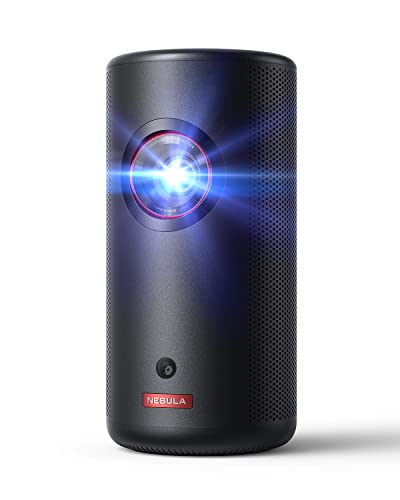
The NEBULA Capsule 3 Laser is the most travel-friendly pick in this guide, and the easiest to recommend if portability is your top priority. It is shaped like a soda can, weighs about two pounds, and slips into a bag without taking up much space.
Its laser light source delivers 300 ANSI lumens in native 1080p, which is bright enough for a dark living room and for backyard viewing after sunset at a screen size of up to 120 inches. Laser projection also means there is no bulb to replace. Autofocus and auto keystone correction are fast, according to customer feedback, and setup is close to point-and-shoot.
The built-in battery offers up to 2.5 hours of playback in standard mode, which covers most feature films, and it supports charging from a power bank over USB-C. An 8-watt Dolby Digital speaker provides sound that reviewers describe as surprisingly loud and clear for the size, and Bluetooth lets you pair external speakers or headphones. Android TV, Google Assistant, and Chromecast support are built in.
The trade-offs come with the size. At 300 ANSI lumens, the image is best in dark conditions, and it can look dim in a semi-lit room or at dusk. Some users also report that the Android TV interface can feel slow at times, and that certain streaming apps need to be installed separately rather than arriving preloaded. If you want the brightest possible outdoor image, a larger model will serve you better. If you want the projector you will actually carry everywhere, this is the one.
Best for: Travel, camping, small rooms, and anyone who values portability above maximum brightness.
Key specifications:
- Native resolution: 1920 x 1080
- Brightness: 300 ANSI lumens
- Light source: Laser
- Battery: Up to 2.5 hours of playback
- Weight: About 2 pounds
- Speaker: 8-watt Dolby Digital
- Smart platform: Android TV with Google Assistant and Chromecast
- Connectivity: HDMI, USB-C, Bluetooth, Wi-Fi
- Maximum image size: Up to 120 inches
2. Wanbo ToGo Pro
The Wanbo ToGo Pro is the brightest battery-powered pick in this guide, and the best choice if your outdoor movie nights are the main event. It delivers 500 ANSI lumens in native 1080p, which gives it a visible advantage over smaller portable models once the sun goes down, and its fully sealed optical engine helps keep dust out of the image path, a useful feature for backyard and campsite use.
Battery life is a strong point, with up to 3.5 hours of video playback on a single charge, enough for two full films or a long evening of sports without recharging. The projector also supports use while charging. A built-in handle and a 360-degree rotating stand make it easy to carry and aim, whether you are pointing it at a backyard screen, a living room wall, or a ceiling for relaxed viewing in bed.
Setup is fast, with real-time autofocus and automatic keystone and screen alignment that adjust the image in seconds, even on uneven outdoor terrain. Google TV is built in, with access to a wide range of streaming apps and free live TV channels, plus voice control and a kids mode with PIN lock. The projector runs quietly, at 27 decibels or less according to the manufacturer. Wi-Fi, Bluetooth, HDMI, USB, and a 3.5mm audio output cover the connections most people need.
The main trade-off is size and weight. At about 5.7 pounds, the ToGo Pro is portable but not pocketable. The manufacturer is also clear that the image works best in dark environments and will look faded under direct sunlight, so plan your outdoor viewing for after sunset.
Best for: Backyard movie nights, camping trips, and families who want the brightest battery-powered option.
Key specifications:
- Native resolution: 1920 x 1080
- Brightness: 500 ANSI lumens
- Light source: LCD with fully sealed optical engine
- Battery: Up to 3.5 hours of video playback
- Weight: About 5.7 pounds
- Smart platform: Google TV with Google Assistant
- Connectivity: HDMI, USB, Bluetooth, Wi-Fi, 3.5mm audio output
- Maximum image size: Up to 200 inches
- Noise level: 27 decibels or less, according to the manufacturer
3. AAXA P6X
The AAXA P6X takes a different approach from the other two picks. It is a pico projector built around a powerful battery and a bright LED light source, aimed at people who want a projector for presentations and movies in equal measure. It is compact, weighing about 1.8 pounds, and it packs a 15,000mAh battery rated for up to four hours of use in eco mode, the longest battery life in this guide.
Brightness is a headline feature. The P6X is rated at 1,000 LED lumens on battery power, with up to 1,100 LED lumens when plugged in, and it can project an image of up to 160 inches in dark conditions. Its native resolution is WXGA, at 1280 by 800 pixels, with support for 1080p input, so it is not a native 1080p projector like the other two picks. For films and casual viewing, the image is still sharp and vivid at typical portable screen sizes, but if native 1080p is a hard requirement, the Capsule 3 Laser or the ToGo Pro will suit you better.
The onboard media player is useful for outdoor use, because it lets you play videos and presentations directly from a USB drive or a microSD card without bringing a laptop. Wi-Fi mirroring for smartphones and Bluetooth for external speakers are included, along with HDMI, USB-C, USB-A, and composite AV inputs. The projector can also charge a smart device from its battery. Its LED light source is rated for 30,000 hours, so there is no bulb to replace.
The trade-offs are the lower native resolution and a smaller 4-watt speaker, which is fine for a small group sitting nearby but may leave you wanting a Bluetooth speaker for a larger backyard gathering. The P6X is also an older design than the other two picks, having first appeared in early 2021, so its smart features are more basic.
Best for: Presentations, camping, and anyone who wants maximum battery life and brightness in a compact body.
Key specifications:
- Native resolution: WXGA, 1280 x 800, with 1080p input support
- Brightness: 1,000 LED lumens on battery, up to 1,100 LED lumens when plugged in
- Light source: LED, rated for 30,000 hours
- Battery: Up to 4 hours in eco mode
- Weight: About 1.8 pounds
- Speaker: 4-watt speaker
- Connectivity: HDMI, USB-C, USB-A, microSD, Bluetooth, Wi-Fi mirroring
- Maximum image size: Up to 160 inches
Comparison Table
| Projector | Native Resolution | Brightness | Battery Life | Weight | Best For |
|---|---|---|---|---|---|
| NEBULA Capsule 3 Laser | 1080p | 300 ANSI lumens | Up to 2.5 hours | About 2 pounds | Travel and everyday portability |
| Wanbo ToGo Pro | 1080p | 500 ANSI lumens | Up to 3.5 hours | About 5.7 pounds | Backyard movie nights |
| AAXA P6X | WXGA 1280 x 800 | 1,000 LED lumens | Up to 4 hours in eco mode | About 1.8 pounds | Presentations and camping |
Brightness figures in this table use the units each manufacturer publishes, and ANSI lumens and LED lumens are not directly comparable. The practical takeaway is that the ToGo Pro is the brightest of the two native 1080p picks, while the P6X is the brightest overall by its own LED lumen rating and offers the longest battery life.
Frequently Asked Questions
Can I use a portable projector in daylight?
You can, but the image will look washed out in direct sunlight, even from a bright portable model. Portable projectors work best after sunset or in shade. If you want daytime viewing, use a covered patio or a shaded area, keep the screen size modest, and choose the brightest model you can carry comfortably.
Do I need a screen for outdoor use?
A dedicated outdoor screen gives the best image, because it is smooth, bright, and evenly reflective. A white sheet pulled taut can work well as a budget option, and a smooth light-colored wall or garage door is also fine. Avoid wrinkled fabric, textured walls, and colored surfaces, which can distort the image and dull the colors.
How long does the battery last on a portable projector?
It depends on the model and the brightness setting. The picks in this guide range from about 2.5 hours to about 4 hours of video playback, with longer life in eco mode and shorter life at full brightness. Most feature films run under two and a half hours, so a battery of that size will usually get you through a movie.
Is native 1080p important for a dual-use projector?
Native 1080p is a good target for mixed use, because it keeps films detailed and text readable for presentations. A native WXGA projector, such as the AAXA P6X, can still look good for movies and presentations at typical portable screen sizes, but it will show less fine detail than a native 1080p model.
Can I connect a portable projector to my phone?
Yes, in most cases. The projectors in this guide support Wi-Fi screen mirroring or Chromecast, and they all have HDMI inputs for a wired connection. Mirroring is convenient for photos and short videos, while a wired HDMI connection or a built-in streaming app is usually more stable for a full film.
Conclusion
The best projectors for outside and inside use are portable, bright enough for the dark, and easy to set up in a new spot without a toolbox. The NEBULA Capsule 3 Laser is the pick for portability, with a soda-can size, a laser light source, and native 1080p in a package you will actually carry. The Wanbo ToGo Pro is the pick for backyard movie nights, with the brightest native 1080p image among the battery-powered picks here and a rotating stand that makes setup simple. The AAXA P6X is the pick for presentations and camping, with the longest battery life in this guide and a bright LED image in a compact body, trading native 1080p resolution for brightness and endurance.
Choose based on where you will use the projector most. If it will travel with you, pick the smallest model that still meets your brightness needs. If it will anchor backyard gatherings, pick the brightest battery-powered model you are happy to carry. Whichever you choose, plan your outdoor viewing for after sunset and keep the screen size reasonable.
Disclosure: As an Amazon Associate, we earn from qualifying purchases.
FAQ
Can I use a portable projector in daylight?
Do I need a screen for outdoor use?
How long does the battery last on a portable projector?
Is native 1080p important for a dual-use projector?
Can I connect a portable projector to my phone?
More from Amazon
Programs that pair well with the guide above. Offers and eligibility are set by Amazon and may change.
Free shipping on eligible items, Prime Video and more. Eligible new members can start with a free trial.
Start a Prime free trialAd-free music streaming. Eligible new subscribers can start with a free trial.
Try Music Unlimited freeA Prime membership for ages 18-24 with a trial period. Eligibility is set by Amazon.
See Prime for Young AdultsAudiobooks and podcasts to listen to on the go. Eligible new members can start with a free trial.
Try Audible freeAs an Amazon Associate we earn from qualifying purchases.