Key takeaways
- Five 12V 4-pin RGB extension cables for PC cases — spools, plug-and-play runs and connector kits — with wire gauge, length and header facts.
Most PC cases leave the motherboard RGB header in one corner and the light strips in another. A short lead on a strip or a fan leaves a gap no controller can bridge, and a header buried behind a radiator is out of reach for a strip mounted along the far edge of a glass panel. A 12-volt 4-pin RGB extension cable closes that gap. It carries the same four wires — 12V, red, green and blue — from the header to the light, so the motherboard software keeps full control of color and effects while the cable itself stays out of sight behind a tray or along a channel.


The catch is that the 4-pin 12V world and the 3-pin 5V addressable world look alike at a glance and do not mix. Plug a 12V cable into a 5V header, or the other way round, and you can damage the strip, the header or both. Every pick below is a 12-volt 4-pin product, and the guide spells out how to tell the two apart before you buy. The five picks cover the whole job: a bulk spool for custom lengths, a long plug-and-play run, a two-pack for linking strips, and two connector kits that bundle cables with splitters and corner pieces.
Disclosure: As an Amazon Associate, we earn from qualifying purchases made through links in this article, at no extra cost to you.
Quick Picks
| Product | Best for | ASIN |
|---|---|---|
| EvZ 22 AWG 4-Pin RGB Extension Wire, 33 ft | Custom-length runs | B00DPQMKBS |
| ESUMIC 4-Pin RGB Extension Cable Wire, 5 m, White | One long run in a white build | B00JPZK934 |
| RGBZONE RGB LED Extension Cables, 2-Pack, 2 m | Linking two strips | B01IX5VDHW |
| FSJEE 4-Pin LED Strip Connector Kit | A first install with corners and splits | B07Y7ZX5T3 |
| Honoson 5050 4-Pin RGB Connector Kit | A large install with two cable lengths | B08YRSFZN4 |
How to Choose
Match the header first. A 4-pin RGB header carries 12V on one pin and red, green and blue on the other three. A 3-pin ARGB header carries 5V, data and ground. The two connectors have different pin counts and different voltages, and they are not interchangeable. Check the manual for the board or controller and look for the +12V mark on the header before you order anything. The arrow on a 4-pin plug lines up with the +12V pin; the connectors are not keyed, so a reversed plug can sit in place while doing nothing, or worse. If a listing never names its voltage or pin count, skip it — a cable that fits the wrong header is worse than no cable at all.
Mind the length. Voltage drop grows with distance, so a very long run can leave the far end of a strip dimmer than the near end. For runs inside a case, a cable under two metres is usually plenty. For runs along a desk or around a room, a thicker wire holds up better — 22 AWG is a solid middle ground for LED strips, while thinner wire suits only short hops. If one header must feed several strips, split close to the header and keep each branch short rather than chaining strip after strip in one long line. A splitter near the header also keeps a fault in one branch from taking the whole chain with it.
Mind the connector gender. Some cables are male-to-female and plug straight between a header and a strip. Others are female-to-female and need a male-to-male adapter at one end. Count the adapters in the box before you buy, or you will be one short on build day. Solderless kits use clamp connectors that bite into the strip pads; spool wire needs solder and a steady hand, plus a connector at each end. Either way, the joint is the weak point, so give every connection a gentle tug once it is seated and route the cable where it will not be knocked loose.
Match the strip width and the coating. Most 5050, 3528 and 2835 RGB strips are 10 mm wide and use the same 4-pin layout, so one cable family covers all three. Waterproof strips carry a silicone coat over the pads, so peel it back at the contact point before you clamp a connector on. Non-waterproof strips need no prep. Finally, count the load on the header. A single motherboard RGB header commonly feeds up to 3 amps; add up the draw of every strip on that header and stay under the figure in the board manual. A header asked to feed too much can dim every strip on it at once.
EvZ 22 AWG 4-Pin RGB LED Extension Wire, 33 ft
Specs
- 22 AWG, 4-conductor parallel ribbon cable
- Tinned stranded copper cores
- 12-volt, 4-wire layout in black, green, red and blue
- Fits 5050, 3528 and 2835 RGB strips
- 33 ft (10 m) spool with PVC insulation
- Cut to length and soldered at each end
The EvZ spool is the bulk lane of this guide. A 33 ft reel gives you enough wire for several custom runs, and you cut exactly what you need for each one. The 22 AWG tinned copper cores hold up well over case-scale distances, and the four color-coded conductors make it easy to keep the 12V line and the three color lines in the right order. This is the pick for a builder who owns a soldering iron and wants every run cut to fit, with no spare cable coiled behind the tray. The trade is time: each end needs a connector soldered on, and a bare spool gives you no plugs in the box. Keep a few spare 4-pin connectors on hand, since a soldered joint is only as good as the plug at its end.
Best for: custom-length runs in a build where you already own soldering tools.
ESUMIC 4-Pin RGB Extension Cable Wire, 5 m, White
Specs
- 5 m (196.85 in) single cable
- 4-pin male-to-female connectors
- White PVC jacket
- 0.2 lb
- Model VFC-LED-RGB-CBLE-5MWHT1
- Listed for indoor and outdoor use
The ESUMIC cable is the long single run. Five metres reaches from a controller at one end of a desk to a strip at the other, or from a header at the bottom of a tall case to a strip along the top edge. The male-to-female ends plug straight in with no adapters, and the white jacket blends into white builds and pale walls where a black cable would stand out. It is one cable, not a kit, so it suits a job with a single gap to close rather than a whole room of strips. The listing also names outdoor use, which matters if the run crosses a window frame or a covered patio edge — just keep the joints themselves out of standing water.
Best for: one long run in a white build.
RGBZONE RGB LED Extension Cables, 2-Pack, 2 m
Specs
- 2 cables, 2 m (6.6 ft) each
- 4-pin female plug ends
- 4 free 4-pin connectors in the box
- Fits 5050, 3528 and 2835 RGB strips
- 2-count pack
- Listed through amazon.ca
The RGBZONE two-pack is the linking pick. Two 2 m cables cover two gaps at once — a controller to a first strip, then a second strip further along the same run. The female plug ends take the male pins of a standard strip, and the four free connectors in the box cover the joints. This is the same product line the roundups list in a 3 m size; the listing used here is the 2 m two-pack sold through amazon.ca. Two metres is a useful middle length for a case or a desk, long enough to reach around a corner and short enough to keep the far end bright. If the run needs more length, a second pack adds little bulk and keeps the same connector family throughout.
Best for: linking two strips with one purchase.
FSJEE 4-Pin LED Strip Connector Kit
Specs
- 6.6 ft RGB extension cable included
- 2-way 4-pin splitter
- T-shape, L-shape and gapless solderless connectors
- 20 male plugs and 20 strip clips
- Fits 10 mm 5050 RGB strips (not RGBIC)
- 12-volt
The FSJEE kit is the all-in-one box. Alongside the 6.6 ft extension cable you get a two-way splitter, T and L connectors for corners and branches, and a pile of male plugs and clips. It is the pick for a first strip install, where the unknowns are the corners and the joints rather than the length. The L connectors turn a strip around a case edge without a kinked cable, and the T connectors let one header feed two directions at once. One note from the listing crawl: it showed no featured offers at the time it was read, so glance at the live listing before ordering.
Best for: a first RGB strip install that needs corners, splits and clips in one box.
Honoson 5050 4-Pin RGB Connector Kit
Specs
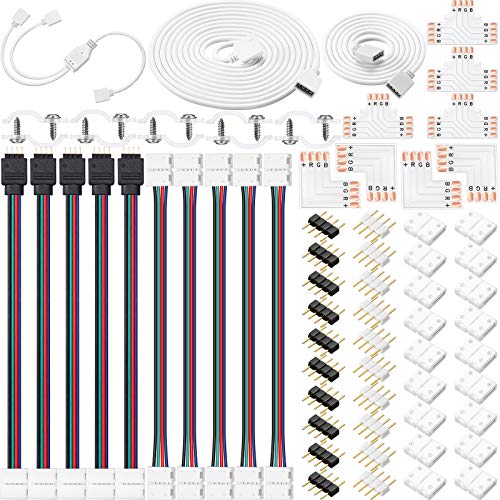
- 3.3 ft and 6.6 ft extension cables
- 2-way splitter
- 5 female connector wire cables and 5 LED connector cables
- L-shape and T-shape connectors, gapless connectors, fixing clips and screws
- Fits 10 mm SMD 5050 RGB strips, waterproof and non-waterproof
- 12-volt
The Honoson kit is the biggest box in this guide. Two extension cables in different lengths cover a short hop and a long run, and the clips and screws let you fix the strips and cables in place instead of relying on adhesive alone. Like the FSJEE kit, its listing crawl showed no featured offers when it was read, so glance at the live listing before ordering. Between the two kits, this one suits a larger install — a full case plus a desk edge, or several strips across a room — where two cable lengths and mounting hardware both earn their keep. The two cable lengths also mean fewer joints in the middle of a run, since you pick the length that fits instead of joining two short cables end to end.
Best for: a large install with two cable lengths and mounting hardware.
FAQ
Can I plug a 4-pin RGB extension cable into a 3-pin ARGB header?
No. The 4-pin header runs at 12 volts and the 3-pin header runs at 5 volts, and the pin counts do not match. Use the header that matches the cable, and check the board manual for the +12V mark before you plug anything in.
Do I need to solder to use an RGB extension cable?
Only for spool wire. Plug-and-play cables and solderless kits need no solder — the connectors clamp onto the strip pads. A spool like the EvZ reel needs a connector soldered at each end.
How long can an RGB extension run be before the far end goes dim?
It depends on wire gauge and total draw. A 22 AWG cable holds up far better over a few metres than a thin one. Keep each branch short, split close to the header, and avoid chaining strip after strip in one long line.
Why must the arrow on a 4-pin plug line up with +12V?
The 4-pin plugs are not keyed, so they can sit in place the wrong way round. The arrow marks the 12V line; line it up with the +12V pin on the header and on the strip, or the strip may stay dark or show the wrong colors.
Conclusion
A 12-volt 4-pin RGB extension cable is a small part that solves a common build problem: a header in one corner and a strip in another. Pick the spool if you solder and want custom lengths, the ESUMIC run if one long white cable closes the gap, the RGBZONE two-pack if two strips need linking, and either kit if corners, splits and mounting hardware are part of the job. Match the header, line up the arrow with +12V, and keep each run short enough to hold its brightness.
More from Amazon
Programs that pair well with the guide above. Offers and eligibility are set by Amazon and may change.
Free shipping on eligible items, Prime Video and more. Eligible new members can start with a free trial.
Start a Prime free trialAd-free music streaming. Eligible new subscribers can start with a free trial.
Try Music Unlimited freeA Prime membership for ages 18-24 with a trial period. Eligibility is set by Amazon.
See Prime for Young AdultsAudiobooks and podcasts to listen to on the go. Eligible new members can start with a free trial.
Try Audible freeAs an Amazon Associate we earn from qualifying purchases.